Supply Chain Optimization: Where Delays Start
Time
Click Count
Supply chain optimization often fails long before a shipment is delayed—at the points where design decisions, supplier coordination, compliance checks, and project timelines first fall out of sync. For project managers and engineering leads, identifying these early friction points is essential to reducing cost overruns, protecting delivery schedules, and building more resilient commercial and consumer supply networks.
Why do delays start before production even begins?

In complex commercial and consumer projects, supply chain optimization is not only about transport speed or warehouse efficiency. Delays usually start upstream, when specification control, supplier capability, certification planning, and site delivery logic are not aligned from day one.
For project managers responsible for store rollouts, fixture programs, smart retail hardware, lighting packages, or sustainable packaging transitions, the challenge is rarely a single weak vendor. The real issue is fragmented decision-making across design, sourcing, engineering, quality, and compliance teams.
This is where Global Business & Consumer Ecosystem, or G-BCE, becomes practical rather than theoretical. By mapping commercial furniture, smart retail technology, consumer goods supply chains, lighting systems, signage, and packaging against international benchmarks, G-BCE helps teams identify where risk begins before it reaches the shipping stage.
- Design teams may release drawings that look complete but omit tolerance requirements, material substitutions, installation constraints, or market-specific certification needs.
- Procurement teams may compare suppliers by unit price only, without evaluating engineering responsiveness, documentation accuracy, or production change management.
- Project schedules may assume that prototyping, testing, approval, mass production, and multi-country delivery can run in parallel when critical dependencies actually force sequential execution.
When these gaps remain hidden, supply chain optimization becomes reactive. Teams rush expediting fees, split shipments, redesign components late, or accept non-ideal substitutions. The budget suffers, and the timeline becomes fragile.
Where supply chain optimization breaks down first
The earliest delay signals are usually visible in planning documents, technical handoffs, and supplier communication patterns. For engineering leads, these are often easier to detect than transport risks, but only if the review process is structured.
The table below highlights common starting points of delay across integrated commercial and consumer supply networks.
For supply chain optimization to work, these friction points must be treated as measurable project risks, not informal communication issues. Once they are tracked, teams can act earlier with less disruption.
Why upstream alignment matters more than emergency logistics
Expedited freight can recover a few days. It cannot recover a missing certification path, an incompatible fixture interface, or a packaging design that fails retailer handling requirements. In integrated retail and commercial delivery, the most expensive delay is usually the one created before the purchase order is placed.
This is especially true when projects combine physical products with digital systems, such as POS terminals, connected fixtures, display lighting, or sustainable packaging formats. Each category carries different engineering and compliance dependencies, yet all must converge on one launch date.
How project managers can diagnose the real source of delay
A practical supply chain optimization process starts with diagnosis. Instead of asking which shipment is late, ask which decision became unstable first. That shift helps managers distinguish root cause from visible consequence.
Five questions that expose hidden supply chain risk
- Are the technical specifications frozen enough for quoting, tooling, and quality planning, or are key details still open to interpretation?
- Has each supplier demonstrated capability in the actual target market, including documentation standards, packaging requirements, and relevant certifications?
- Do lead times include sampling, engineering review, corrective action, and approval cycles, rather than production time alone?
- Are logistics assumptions connected to site realities such as phased installation, storage limits, retailer access windows, or regional import procedures?
- Is there a single source of truth for revisions, compliance records, and delivery milestones across all involved categories?
G-BCE supports this diagnostic approach by providing cross-sector visibility rather than isolated product-level data. That matters when an engineering lead is not buying one SKU, but coordinating a full commercial environment where furniture, hardware, technology, signage, and packaging influence each other.
Which evaluation criteria matter most when selecting suppliers?
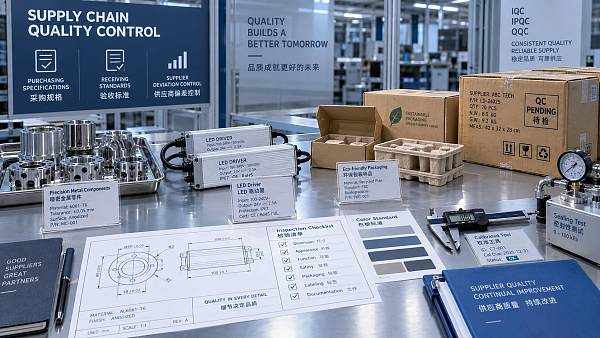
Supplier selection is one of the most important stages in supply chain optimization, yet many teams still rely too heavily on price comparison. For complex project delivery, supplier suitability depends on technical depth, process discipline, and cross-border execution capability.
The following evaluation table can help project managers compare suppliers in a more complete and decision-ready way.
This broader framework strengthens supply chain optimization because it evaluates the supplier as a project execution partner, not simply as a manufacturer. That distinction becomes critical when launch windows are fixed and site conditions are unforgiving.
What experienced teams review before placing orders
- Revision history and document ownership, so there is no confusion over approved versions.
- Critical dimensions, interfaces, and mounting conditions that affect fit on site.
- Testing and compliance responsibilities, including who prepares files and when evidence is needed.
- Packaging configuration for storage, transport, installation sequence, and damage prevention.
How standards and compliance shape supply chain optimization
Compliance is often treated as a final checkpoint. In reality, it is one of the earliest design and sourcing filters. A fixture system, lighting component, office element, or smart retail terminal may need to satisfy different requirements depending on market, use case, and installation environment.
For international projects, supply chain optimization improves when compliance planning is integrated with specification review and supplier screening. If not, teams risk late-stage redesign, approval delay, or non-conforming imports.
Common compliance checkpoints in commercial and consumer programs
- Electrical and electronic products may require region-specific safety and documentation review, especially when installed in public-facing retail environments.
- Furniture and fixture programs may need structural, ergonomic, or material performance references aligned with commercial use expectations.
- Packaging changes may trigger retailer acceptance checks, transport testing needs, or sustainability claim verification depending on the market.
G-BCE adds value here by connecting benchmarking data across these categories. That allows project teams to anticipate where one decision, such as a material change for sustainability, may affect durability, compliance documentation, cost, or lead time elsewhere in the program.
What does a resilient implementation process look like?
Effective supply chain optimization needs a workflow that is realistic for multi-stakeholder delivery. It should connect design release, supplier onboarding, technical validation, production control, and site execution into one review rhythm.
A practical implementation sequence
- Define project-critical specifications early, including material, dimensional, performance, and compliance requirements.
- Screen suppliers using both commercial and technical criteria, not price alone.
- Run prototype or pre-production validation for items with installation, safety, or interface risk.
- Create milestone reviews tied to evidence, such as approved drawings, sample sign-off, test files, and packaging confirmation.
- Plan logistics according to delivery sequence, site readiness, customs timing, and regional distribution realities.
This process is especially useful for engineering leads managing mixed-category programs, where hardware, lighting, digital systems, and packaging all move at different speeds. Without structured checkpoints, one late dependency can disrupt the entire launch.
Common misconceptions that weaken supply chain optimization
“If the supplier is experienced, the process will fix itself.”
Experienced suppliers help, but they cannot compensate for unstable specifications, missing approvals, or unrealistic delivery logic. Strong execution still depends on clear ownership and coordinated decision timing.
“Compliance can wait until production is ready.”
This assumption often creates hidden schedule risk. Compliance questions affect materials, construction, labeling, electrical configuration, and documentation. Waiting too long narrows options and raises cost.
“Lower unit cost means a better sourcing decision.”
Not when the cheaper option creates more engineering ambiguity, less reliable milestone reporting, or higher damage rates in transit. Total delivered cost includes rework, delays, site disruption, and management time.
FAQ: supply chain optimization for project and engineering teams
How do I know whether delays are caused by logistics or upstream planning?
Check whether the shipment delay was preceded by drawing revisions, supplier clarification loops, sample rejection, missing compliance files, or packaging changes. If yes, the logistics issue is usually a downstream symptom of earlier planning instability.
What should project managers prioritize first in supply chain optimization?
Start with specification clarity, supplier capability validation, and milestone discipline. These three areas influence quotation accuracy, approval speed, production readiness, and final delivery reliability more than transport optimization alone.
Which projects benefit most from cross-sector benchmarking?
Programs that combine commercial interiors, store technology, consumer product movement, lighting, signage, and packaging benefit the most. Cross-sector benchmarking helps teams identify interaction risk between categories that are often sourced separately.
How early should compliance be reviewed?
Ideally during concept finalization and before supplier nomination. That timing allows the team to confirm market expectations, applicable documentation, and any design implications before commitments become expensive to change.
Why choose us for supply chain optimization insight and project support
G-BCE is built for decision-makers who manage commercial complexity across regions, categories, and compliance environments. Our value is not limited to one product segment. We connect data across commercial furniture and fixtures, smart retail technology, consumer goods supply chain systems, commercial lighting and signage, and sustainable packaging.
For project managers and engineering leads, that means more useful support at the moments that usually determine success or delay. We help teams evaluate specification risk, compare supplier suitability, review certification implications, and understand how product choices affect delivery sequence and installation reality.
- Need help confirming technical parameters before RFQ release? We can support evaluation frameworks and benchmarking references.
- Need guidance on product selection across fixtures, retail hardware, lighting, or packaging? We can help align options with project constraints and market requirements.
- Need visibility into delivery timelines, supplier readiness, or documentation expectations? We can help structure the review points that prevent late surprises.
- Need to discuss certification requirements, sample support, customized solutions, or quotation planning? These are exactly the conversations that improve supply chain optimization before risk becomes cost.
If your project involves multi-category sourcing, tight rollout schedules, or international commercial standards, contact us to discuss parameter confirmation, product selection, delivery cycle planning, custom solution direction, certification questions, sample coordination, or quotation communication in a more structured way.
News Recommendations
 How to compare commercial linear light wholesale quotes accurately
![51a6ab95581761cc26f4318be6520c15]()
Aris Katos
Future of Carbide Coatings
 How to verify international standards compliance for Middle East exports
![51a6ab95581761cc26f4318be6520c15]()
Aris Katos
Future of Carbide Coatings
 How to select laboratory instruments for reproducible test results
![51a6ab95581761cc26f4318be6520c15]()
Aris Katos
Future of Carbide Coatings
 When does a sheet metal prototype reveal design flaws early?
![51a6ab95581761cc26f4318be6520c15]()
Aris Katos
Future of Carbide Coatings
 When PE air column bags reduce damage in e-commerce fulfillment
![51a6ab95581761cc26f4318be6520c15]()
Aris Katos
Future of Carbide Coatings
 How energy-efficient design reduces operating costs in retail lighting
![51a6ab95581761cc26f4318be6520c15]()
Aris Katos
Future of Carbide Coatings
 When commercial aluminum storefronts make sense for a retail renovation
![51a6ab95581761cc26f4318be6520c15]()
Aris Katos
Future of Carbide Coatings
 What makes LED lights durable in high-use commercial spaces?
![51a6ab95581761cc26f4318be6520c15]()
Aris Katos
Future of Carbide Coatings
 Which industry categories offer the strongest export potential in Latin America?
![51a6ab95581761cc26f4318be6520c15]()
Aris Katos
Future of Carbide Coatings
 How to choose an ultra bright waterproof window display for storefronts
![51a6ab95581761cc26f4318be6520c15]()
Aris Katos
Future of Carbide Coatings
 How to verify suppliers on a trade portal for global sourcing
![51a6ab95581761cc26f4318be6520c15]()
Aris Katos
Future of Carbide Coatings
 How RoHS requirements should be stated in product specifications
![51a6ab95581761cc26f4318be6520c15]()
Aris Katos
Future of Carbide Coatings
 What affects the lead time for custom retail counter displays?
![51a6ab95581761cc26f4318be6520c15]()
Aris Katos
Future of Carbide Coatings
 What consumer packaging USA importers need to verify before ordering
![51a6ab95581761cc26f4318be6520c15]()
Aris Katos
Future of Carbide Coatings
 How commercial spaces interiors shape customer dwell time
![51a6ab95581761cc26f4318be6520c15]()
Aris Katos
Future of Carbide Coatings
 How LED commercial lighting design reduces glare in retail spaces
![51a6ab95581761cc26f4318be6520c15]()
Aris Katos
Future of Carbide Coatings
 How industrial technology information improves RFID inventory accuracy
![51a6ab95581761cc26f4318be6520c15]()
Aris Katos
Future of Carbide Coatings
 When drip garden watering systems make more sense than sprinklers
![51a6ab95581761cc26f4318be6520c15]()
Aris Katos
Future of Carbide Coatings
 When category comparison improves sourcing for industrial applications
![51a6ab95581761cc26f4318be6520c15]()
Aris Katos
Future of Carbide Coatings
 Industrial application guidance for selecting the right LED lighting
![51a6ab95581761cc26f4318be6520c15]()
Aris Katos
Future of Carbide Coatings
 Which commercial architecture standards apply to European retail fit-outs?
![51a6ab95581761cc26f4318be6520c15]()
Aris Katos
Future of Carbide Coatings
 How to verify FDA requirements for maternity care products
![51a6ab95581761cc26f4318be6520c15]()
Aris Katos
Future of Carbide Coatings
 How to verify BPA-free claims for food-contact products
![51a6ab95581761cc26f4318be6520c15]()
Aris Katos
Future of Carbide Coatings
 When does a European wholesale supplier suit modular office projects?
![51a6ab95581761cc26f4318be6520c15]()
Aris Katos
Future of Carbide Coatings
 When consumer ecosystem solutions improve the in-store shopping journey
![51a6ab95581761cc26f4318be6520c15]()
Aris Katos
Future of Carbide Coatings
 How a commercial developers network can reduce site selection risk
![51a6ab95581761cc26f4318be6520c15]()
Aris Katos
Future of Carbide Coatings
 How clear purchasing specifications prevent costly supplier deviations
![51a6ab95581761cc26f4318be6520c15]()
Aris Katos
Future of Carbide Coatings
 What an ISTA drop test lab checks before your packaging ships
![51a6ab95581761cc26f4318be6520c15]()
Aris Katos
Future of Carbide Coatings
 Which commercial furniture standards apply to workplace seating?
![51a6ab95581761cc26f4318be6520c15]()
Aris Katos
Future of Carbide Coatings
 How to evaluate smart lighting module OEM compatibility before sampling
![51a6ab95581761cc26f4318be6520c15]()
Aris Katos
Future of Carbide Coatings
 How to assess whether sustainable technology delivers real impact
![51a6ab95581761cc26f4318be6520c15]()
Aris Katos
Future of Carbide Coatings
 How to assess an OEM supplier’s quality control before ordering
![51a6ab95581761cc26f4318be6520c15]()
Aris Katos
Future of Carbide Coatings
 How consumer ecosystem solutions data can improve retail personalization
![51a6ab95581761cc26f4318be6520c15]()
Aris Katos
Future of Carbide Coatings
 When does consumer packaging design justify a higher product price?
![51a6ab95581761cc26f4318be6520c15]()
Aris Katos
Future of Carbide Coatings
 Supermarket Fixture Installation: Planning Layouts, Wiring, and Handover
![51a6ab95581761cc26f4318be6520c15]()
Aris Katos
Future of Carbide Coatings
 Automated Lighting and Smart Lighting Control in Bergerac: Key Project Considerations
![51a6ab95581761cc26f4318be6520c15]()
Aris Katos
Future of Carbide Coatings
 Segment Streetlight Controllers: Choosing Control Modes for Urban Roads
![51a6ab95581761cc26f4318be6520c15]()
Aris Katos
Future of Carbide Coatings
 IEC 62471-2 Explained: How to Assess Photobiological Risks in LED Lighting
![51a6ab95581761cc26f4318be6520c15]()
Aris Katos
Future of Carbide Coatings
 Food Grade Packaging Requirements by Product Type, Temperature, and Contact Risk
![51a6ab95581761cc26f4318be6520c15]()
Aris Katos
Future of Carbide Coatings