Customs Adds 'Prohibited/Restricted ID Code' for Export Declarations
Time
Click Count
Effective May 1, 2026, China’s General Administration of Customs (GACC) will mandate the填报 of a newly introduced ‘Prohibited/Restricted Identification Code’ on all export customs declarations. The requirement targets high-sensitivity product categories—including biodegradable materials, food-grade compliant packaging, and e-commerce fulfillment packaging—and signals a structural tightening of traceability and end-use oversight for exports subject to international environmental, health, and safety regulations.
Event Overview
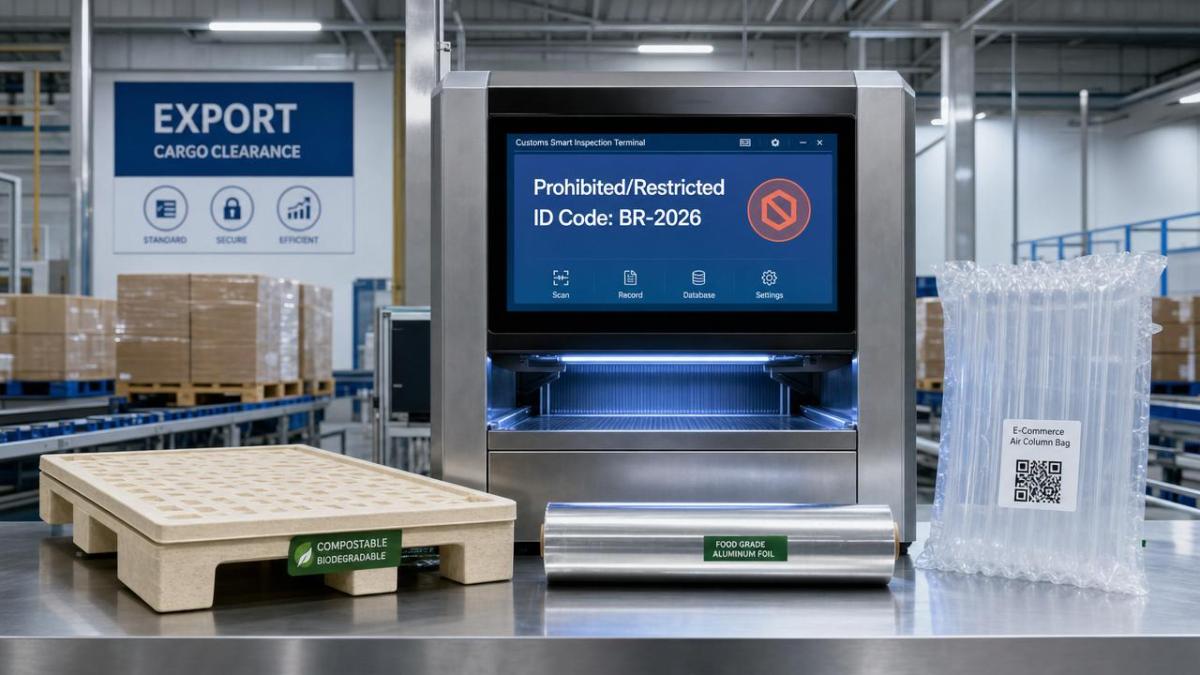
Starting May 2026, GACC will fully implement the ‘Prohibited/Restricted Identification Code’ system on export cargo declarations, alongside new mandatory declaration elements. The measure applies to goods falling under three defined sensitive categories: Biodegradable Materials, Food-Grade Compliance products, and E-commerce Fulfillment Pack items. Inaccurate or incomplete submission triggers automatic rejection of the entire customs declaration or elevated port inspection risk. Overseas importers are explicitly advised to ensure their Chinese suppliers have completed prerequisite documentation—including UN numbers and REACH/SVHC declarations—prior to shipment.
Industries Affected
Direct trading enterprises: Face heightened operational risk at the declaration stage. Errors in code selection or missing upstream compliance documents directly cause shipment delays, demurrage costs, and potential loss of buyer trust. Unlike prior voluntary guidance, this is a hard gate in the customs clearance workflow—not a post-submission verification step.
Raw material procurement enterprises: Must now verify not only supplier certifications (e.g., FDA 21 CFR, EN13432), but also whether those certifications map correctly to GACC’s internal classification logic for the Identification Code. Procurement contracts may require updated clauses assigning responsibility for code validation and REACH/SVHC data sharing.
Contract manufacturing enterprises: Are increasingly treated as ‘declaration originators’ when acting as exporters of record—even if branding and final sales are managed by overseas clients. This shifts liability for code accuracy from the brand owner to the factory, especially where OEM/ODM arrangements lack clear regulatory ownership terms.
Supply chain service enterprises (e.g., freight forwarders, customs brokers, compliance consultants): Will see rising demand for pre-declaration code validation services—but also face stricter accountability. GACC’s enforcement protocol treats misdeclared codes as a systemic compliance failure, not an administrative error; repeated incidents may trigger broker license reviews.
Key Focus Areas and Recommended Actions
Map internal SKUs to GACC’s official code taxonomy
Companies must cross-reference existing product classifications (e.g., HS codes, material composition, intended use statements) against GACC’s published identification code matrix—expected to be released in Q1 2026. Relying solely on past export practices or third-party databases carries significant risk, as code assignment hinges on functional attributes (e.g., ‘intended for direct food contact’) rather than generic category labels.
Verify and formalize upstream compliance documentation
UN numbers, REACH Annex XIV/SVHC declarations, and food-contact compliance letters must be obtained directly from raw material suppliers—and validated for validity, scope, and jurisdictional applicability (e.g., EU REACH vs. UK REACH). Internal records should include date-stamped copies and version control.
Update internal SOPs and train frontline staff
Declaration preparation can no longer be siloed between logistics and quality/compliance teams. Frontline export coordinators need decision trees for code selection, escalation paths for ambiguous cases, and access to real-time updates on GACC’s code revisions—especially given that the taxonomy is expected to expand beyond the initial three categories after 2026.
Editorial Perspective / Industry Observation
Observably, this is not merely a customs procedural update—it reflects a strategic pivot toward ‘upstream regulatory anchoring’. Rather than relying on destination-country enforcement, GACC is embedding compliance obligations earlier in the export value chain, effectively turning Chinese exporters into de facto regulatory intermediaries for global standards. Analysis shows that similar mechanisms (e.g., China’s IEC 62474 declaration for electronics) preceded broader supply chain due diligence mandates in other sectors. Current evidence suggests this code system may serve as the foundation for future integration with China’s emerging ‘Green Export Credit’ incentives and carbon tracking pilots.
Conclusion
This policy shift marks a material step toward harmonizing China’s export control framework with multilateral environmental and consumer safety governance. It does not introduce new substantive restrictions—but significantly raises the cost of non-compliance and reshapes accountability across tiers of the export ecosystem. For industry participants, readiness hinges less on technical capability and more on cross-functional alignment and documentation discipline.
Source Attribution
Official notice issued by the General Administration of Customs of the People’s Republic of China (Announcement No. [TBD], 2026); supplementary guidance expected in March 2026 via GACC’s Integrated Customs Clearance Platform (ICP). The full code taxonomy, implementation checklist, and API interface specifications for ERP integration remain pending release and are under active monitoring.
News Recommendations
 How to select laboratory instruments for reproducible test results
![51a6ab95581761cc26f4318be6520c15]()
Aris Katos
Future of Carbide Coatings
 When does a sheet metal prototype reveal design flaws early?
![51a6ab95581761cc26f4318be6520c15]()
Aris Katos
Future of Carbide Coatings
 When PE air column bags reduce damage in e-commerce fulfillment
![51a6ab95581761cc26f4318be6520c15]()
Aris Katos
Future of Carbide Coatings
 How energy-efficient design reduces operating costs in retail lighting
![51a6ab95581761cc26f4318be6520c15]()
Aris Katos
Future of Carbide Coatings
 When commercial aluminum storefronts make sense for a retail renovation
![51a6ab95581761cc26f4318be6520c15]()
Aris Katos
Future of Carbide Coatings
 What makes LED lights durable in high-use commercial spaces?
![51a6ab95581761cc26f4318be6520c15]()
Aris Katos
Future of Carbide Coatings
 Which industry categories offer the strongest export potential in Latin America?
![51a6ab95581761cc26f4318be6520c15]()
Aris Katos
Future of Carbide Coatings
 How to choose an ultra bright waterproof window display for storefronts
![51a6ab95581761cc26f4318be6520c15]()
Aris Katos
Future of Carbide Coatings
 How to verify suppliers on a trade portal for global sourcing
![51a6ab95581761cc26f4318be6520c15]()
Aris Katos
Future of Carbide Coatings
 How RoHS requirements should be stated in product specifications
![51a6ab95581761cc26f4318be6520c15]()
Aris Katos
Future of Carbide Coatings
 What affects the lead time for custom retail counter displays?
![51a6ab95581761cc26f4318be6520c15]()
Aris Katos
Future of Carbide Coatings
 What consumer packaging USA importers need to verify before ordering
![51a6ab95581761cc26f4318be6520c15]()
Aris Katos
Future of Carbide Coatings
 How commercial spaces interiors shape customer dwell time
![51a6ab95581761cc26f4318be6520c15]()
Aris Katos
Future of Carbide Coatings
 How LED commercial lighting design reduces glare in retail spaces
![51a6ab95581761cc26f4318be6520c15]()
Aris Katos
Future of Carbide Coatings
 How industrial technology information improves RFID inventory accuracy
![51a6ab95581761cc26f4318be6520c15]()
Aris Katos
Future of Carbide Coatings
 When drip garden watering systems make more sense than sprinklers
![51a6ab95581761cc26f4318be6520c15]()
Aris Katos
Future of Carbide Coatings
 When category comparison improves sourcing for industrial applications
![51a6ab95581761cc26f4318be6520c15]()
Aris Katos
Future of Carbide Coatings
 Industrial application guidance for selecting the right LED lighting
![51a6ab95581761cc26f4318be6520c15]()
Aris Katos
Future of Carbide Coatings
 Which commercial architecture standards apply to European retail fit-outs?
![51a6ab95581761cc26f4318be6520c15]()
Aris Katos
Future of Carbide Coatings
 How to verify FDA requirements for maternity care products
![51a6ab95581761cc26f4318be6520c15]()
Aris Katos
Future of Carbide Coatings
 How to verify BPA-free claims for food-contact products
![51a6ab95581761cc26f4318be6520c15]()
Aris Katos
Future of Carbide Coatings
 When does a European wholesale supplier suit modular office projects?
![51a6ab95581761cc26f4318be6520c15]()
Aris Katos
Future of Carbide Coatings
 When consumer ecosystem solutions improve the in-store shopping journey
![51a6ab95581761cc26f4318be6520c15]()
Aris Katos
Future of Carbide Coatings
 How a commercial developers network can reduce site selection risk
![51a6ab95581761cc26f4318be6520c15]()
Aris Katos
Future of Carbide Coatings
 How clear purchasing specifications prevent costly supplier deviations
![51a6ab95581761cc26f4318be6520c15]()
Aris Katos
Future of Carbide Coatings
 What an ISTA drop test lab checks before your packaging ships
![51a6ab95581761cc26f4318be6520c15]()
Aris Katos
Future of Carbide Coatings
 Which commercial furniture standards apply to workplace seating?
![51a6ab95581761cc26f4318be6520c15]()
Aris Katos
Future of Carbide Coatings
 How to evaluate smart lighting module OEM compatibility before sampling
![51a6ab95581761cc26f4318be6520c15]()
Aris Katos
Future of Carbide Coatings
 How to assess whether sustainable technology delivers real impact
![51a6ab95581761cc26f4318be6520c15]()
Aris Katos
Future of Carbide Coatings
 How to assess an OEM supplier’s quality control before ordering
![51a6ab95581761cc26f4318be6520c15]()
Aris Katos
Future of Carbide Coatings
 How consumer ecosystem solutions data can improve retail personalization
![51a6ab95581761cc26f4318be6520c15]()
Aris Katos
Future of Carbide Coatings
 When does consumer packaging design justify a higher product price?
![51a6ab95581761cc26f4318be6520c15]()
Aris Katos
Future of Carbide Coatings
 Supermarket Fixture Installation: Planning Layouts, Wiring, and Handover
![51a6ab95581761cc26f4318be6520c15]()
Aris Katos
Future of Carbide Coatings
 Automated Lighting and Smart Lighting Control in Bergerac: Key Project Considerations
![51a6ab95581761cc26f4318be6520c15]()
Aris Katos
Future of Carbide Coatings
 Segment Streetlight Controllers: Choosing Control Modes for Urban Roads
![51a6ab95581761cc26f4318be6520c15]()
Aris Katos
Future of Carbide Coatings
 IEC 62471-2 Explained: How to Assess Photobiological Risks in LED Lighting
![51a6ab95581761cc26f4318be6520c15]()
Aris Katos
Future of Carbide Coatings
 Food Grade Packaging Requirements by Product Type, Temperature, and Contact Risk
![51a6ab95581761cc26f4318be6520c15]()
Aris Katos
Future of Carbide Coatings
 Food Packaging Compliance Checklist: Tests, Records, and Labeling Before Shipment
![51a6ab95581761cc26f4318be6520c15]()
Aris Katos
Future of Carbide Coatings
 NSF Food Packaging Standards: When Certification Matters for Commercial Food Use
![51a6ab95581761cc26f4318be6520c15]()
Aris Katos
Future of Carbide Coatings