Reusable Grocery Bag Wholesale: MOQ, Margin, and Material Tradeoffs
Time
Click Count
For distributors, agents, and sourcing partners, reusable grocery bag wholesale is no longer just about unit cost—it is a balance of MOQ, profit margin, material durability, and market positioning. Understanding these tradeoffs helps buyers reduce risk, improve inventory planning, and secure products that meet both retail demand and sustainability expectations in competitive global supply chains.
What Buyers Are Really Searching for in Reusable Grocery Bag Wholesale
When buyers search for reusable grocery bag wholesale, the core intent is practical: they want to identify which bag type delivers the safest margin with the lowest sourcing risk.
For distributors and agents, that usually means comparing minimum order quantity, landed cost, print flexibility, material performance, and end-market demand instead of simply chasing the cheapest quote.
The most valuable answer is not a generic product overview. It is a decision framework that helps buyers match bag specifications to channel strategy, customer expectations, and reorder potential.
In most cases, the best wholesale choice is not the lowest-cost bag. It is the SKU that balances acceptable MOQ, reliable quality, stable compliance, and enough perceived value to protect resale pricing.
Before Comparing Prices, Clarify the Commercial Goal
Many sourcing mistakes happen because buyers compare suppliers before defining the selling scenario. A bag for discount retail, supermarket promotions, and premium organic chains should not follow the same buying logic.
If the target channel is mass distribution, the priority is usually cost control, color consistency, and fast replenishment. If the target channel is premium retail, handle comfort, fabric weight, and visual finish matter more.
Some distributors also buy reusable bags as a bundled product for private-label packaging programs. In that case, print quality, branding area, and design flexibility can be more important than absolute unit savings.
Clarifying the commercial goal first helps buyers decide whether to prioritize low MOQs for testing, higher durability for repeat use claims, or stronger aesthetics for better shelf conversion.
How MOQ Affects Cash Flow, Inventory Risk, and Negotiating Power
MOQ is one of the biggest decision factors in reusable grocery bag wholesale because it shapes working capital exposure long before the first resale order is fully validated.
A low MOQ offers flexibility. It allows distributors to test colors, sizes, and printing concepts across different customers without locking too much capital into uncertain inventory.
However, lower MOQs often come with tradeoffs. The unit price is usually higher, customization options may be limited, and some factories may give less favorable production scheduling.
Higher MOQs can improve pricing and strengthen supplier attention, especially when fabrics, handles, and print plates are standardized. But they increase the risk of slow-moving stock if demand assumptions are wrong.
For agents serving multiple smaller accounts, mixed-SKU MOQ solutions are often more valuable than chasing the lowest ex-factory price. Flexibility can create more margin than headline cost reduction.
Buyers should also ask whether MOQ applies per color, per print design, or per total order. Two quotations with the same MOQ may create very different inventory burdens once assortments are added.
From a margin perspective, the right MOQ is the one that preserves acceptable landed cost without forcing inventory turnover beyond what the local market can absorb in one selling cycle.
Margin Is Built on Perceived Value, Not Only Purchase Price
One common mistake in reusable grocery bag wholesale is assuming margin is simply the difference between buy price and sell price. In reality, margin depends on how the market perceives quality and usefulness.
A slightly more expensive bag with better stitching, thicker fabric, and cleaner printing can often command stronger resale pricing and lower complaint rates, improving net margin over time.
Cheap bags may look profitable on paper, but weak handles, poor shape retention, or fading prints can trigger returns, customer dissatisfaction, and damage to distributor credibility.
For many channels, especially supermarkets and chain retailers, perceived durability directly affects reorder behavior. If end users actually reuse the bag, the retailer sees stronger brand visibility and greater satisfaction.
This means distributors should calculate margin in three layers: gross margin per unit, operational margin after defects and freight, and strategic margin based on repeat business potential.
In other words, a bag that sells slightly slower but creates fewer quality claims may be commercially better than a low-cost option that generates friction across the supply chain.
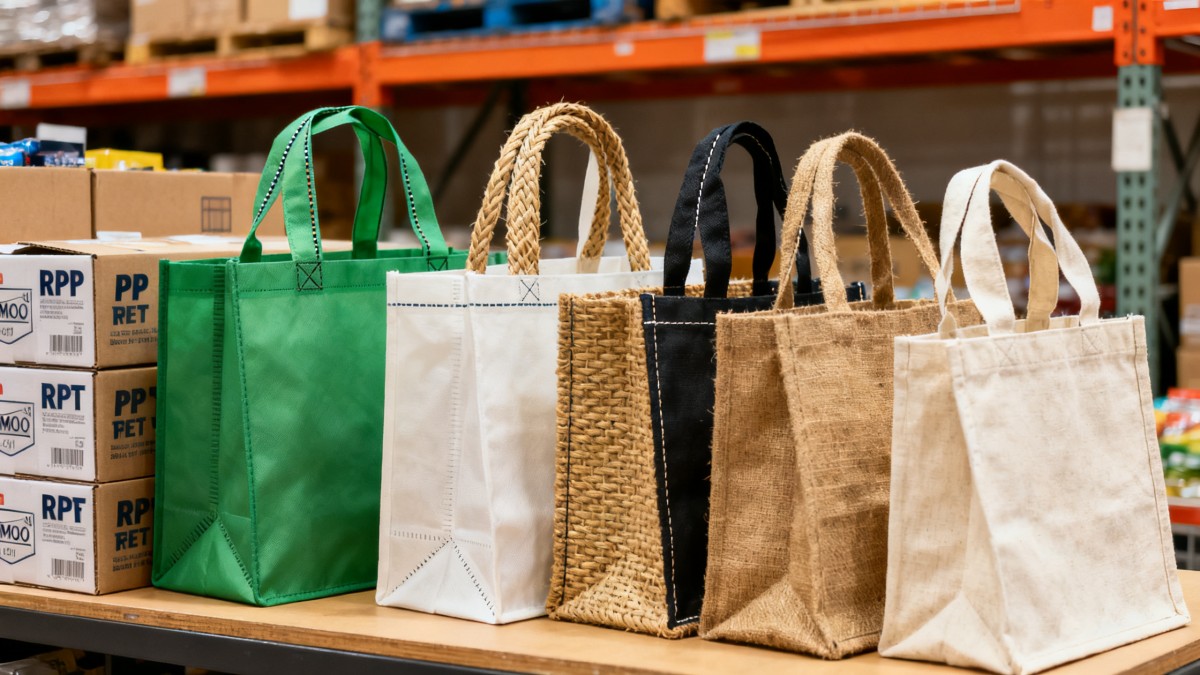
Material Tradeoffs: Non-Woven, Woven PP, RPET, Cotton, and Jute
Material choice is where most wholesale decisions become complex because every fabric affects cost, durability, print result, sustainability claims, and consumer positioning.
Non-woven polypropylene remains popular because it is affordable, lightweight, and suitable for promotional retail programs. It works well when buyers need competitive pricing and broad customization.
Its limitation is perceived premium value. Although practical, standard non-woven bags may feel less durable than woven structures and may not fit premium grocery or lifestyle retail positioning.
Woven polypropylene usually offers better strength, longer life, and improved load performance. It often suits supermarkets and larger-format retail channels where bags must handle heavier goods consistently.
The tradeoff is that woven bags typically involve higher cost, more structured production planning, and sometimes higher MOQs depending on lamination, printing complexity, and finishing details.
RPET bags appeal to buyers targeting stronger sustainability messaging. They can support recycled-material claims and align well with retailers that want to demonstrate environmental responsibility more visibly.
Still, RPET is not automatically the best choice for every program. Buyers should verify material traceability, print behavior, and pricing stability, since sustainability positioning loses value if supply consistency is weak.
Cotton bags bring a more natural and premium image. They are often favored for specialty retail, farmers’ markets, and brand-led merchandising programs where tactile appeal matters.
But cotton usually carries higher material cost, greater weight, and a different freight profile. For price-sensitive distribution, its premium image may not always convert into enough resale margin.
Jute offers strong visual differentiation and a distinctly eco-oriented aesthetic. It can work well in gift, premium grocery, or upscale seasonal programs where rustic texture supports brand storytelling.
Its challenges include less flexibility in printing detail, possible variation in appearance, and a narrower mass-market fit. For broad distribution, jute is often better as a niche portfolio item.
How to Match Material to Channel Instead of Following Trends
Distributors often lose money by following material trends without checking whether local buyers will pay for them. The best product is the one the channel can sell repeatedly, not the one with the best story.
For discount retail and high-volume promotions, non-woven bags usually remain commercially efficient. For grocery chains and utility-driven everyday use, woven PP may provide the most balanced long-term value.
For sustainability-led retailers, RPET can strengthen sales conversations if certifications and recycled content claims are documented clearly. For boutique and premium channels, cotton or jute may justify higher pricing.
In practice, a smart portfolio often includes more than one material tier. This lets distributors serve different accounts without forcing one bag concept across every customer segment.
Key Specifications That Influence Wholesale Success More Than Buyers Expect
Beyond material, several technical details strongly affect performance and profitability. Fabric weight, stitching density, handle construction, gusset size, lamination, and print method all matter.
Fabric weight should match the intended load. Over-specifying raises cost unnecessarily, while under-specifying can lead to breakage and complaints that erase any initial savings.
Handle attachment is especially important for grocery use. Buyers should check whether handles are stitched, heat-sealed, cross-stitched, or reinforced, because this directly impacts real carrying performance.
Bag dimensions also influence usability. A bag that is too shallow or poorly proportioned may look fine in samples but perform poorly in actual grocery environments, reducing customer satisfaction.
Laminated surfaces can improve print sharpness and moisture resistance, but they may change tactile feel and price. Buyers need to decide whether branding impact justifies that upgrade.
For wholesale programs, these details should be standardized in a spec sheet. Relying only on sample impressions increases the chance of inconsistent production over multiple purchase cycles.
Compliance, Sustainability Claims, and Documentation Should Not Be an Afterthought
For distributors supplying organized retail or export markets, compliance documents are often as important as the product itself. Missing paperwork can delay deals even when the bag quality is acceptable.
Depending on market destination, buyers may need material declarations, test reports, azo-free confirmation, recycled-content evidence, or broader social compliance documentation from the factory.
Claims around “eco-friendly,” “recyclable,” or “recycled” should be supported carefully. Vague language may help short-term marketing, but it creates long-term risk if retail clients demand proof.
Distributors should also assess whether the supplier can maintain documentation consistently across repeat orders. One good shipment is not enough if future batches cannot meet the same standard.
In reusable grocery bag wholesale, documentation is part of the product value. It supports retailer trust, smoother import processes, and stronger positioning in professional sales negotiations.
How to Evaluate Suppliers Beyond the Quotation Sheet
Price sheets rarely show the full sourcing picture. Buyers should examine communication quality, sampling accuracy, production transparency, and willingness to clarify specification details.
A reliable supplier usually asks practical questions about use case, target market, load expectation, artwork, and packaging needs. That indicates process maturity and reduces misunderstanding later.
It is also worth checking whether the factory has experience with the buyer’s intended channel. Supplying promotional giveaways is different from supplying retail-ready grocery programs with repeat consistency requirements.
Lead time discipline matters as much as quality. A competitively priced bag loses value quickly if delivery delays disrupt promotions, seasonal launches, or container planning.
When possible, buyers should compare not just three quotations, but three total sourcing models: low-cost/high-risk, balanced commercial fit, and premium/brand-oriented. This produces better decisions than unit-price ranking alone.
A Practical Buying Framework for Distributors and Agents
To reduce risk, start with the end market and define the expected resale price band. Then work backward to the maximum landed cost that still preserves healthy margin.
Next, choose the material tier based on the channel: non-woven for entry pricing, woven PP for utility and durability, RPET for sustainability positioning, and cotton or jute for premium image.
After that, confirm MOQ structure, not just MOQ volume. Ask whether the order can be split across colors, artwork versions, or sizes without sharply increasing cost.
Request a sample that reflects actual production specification, not a generic showroom piece. Then verify handle strength, print finish, stitching quality, and dimensional accuracy in real-use conditions.
Finally, review documentation, packaging format, and replenishment capability. The goal is not simply to place one order, but to establish a repeatable wholesale model that supports scaling.
Conclusion: The Best Wholesale Bag Is the One That Protects Margin and Reduces Uncertainty
For professional buyers, reusable grocery bag wholesale is a strategic sourcing decision rather than a simple commodity purchase. MOQ, margin, and material must be evaluated together.
Low unit cost can help, but only when product quality, demand fit, and documentation support the full commercial cycle. Otherwise, savings at purchase stage often become losses later.
The strongest buying decisions come from matching material and specification to channel needs, choosing MOQs that support healthy inventory turnover, and working with suppliers that can deliver consistency.
For distributors, agents, and sourcing partners, the real advantage lies in building a portfolio that balances flexibility, durability, and resale value. That is what turns a reusable bag from a low-cost item into a dependable profit line.
News Recommendations
 How to select laboratory instruments for reproducible test results
![51a6ab95581761cc26f4318be6520c15]()
Aris Katos
Future of Carbide Coatings
 When does a sheet metal prototype reveal design flaws early?
![51a6ab95581761cc26f4318be6520c15]()
Aris Katos
Future of Carbide Coatings
 When PE air column bags reduce damage in e-commerce fulfillment
![51a6ab95581761cc26f4318be6520c15]()
Aris Katos
Future of Carbide Coatings
 How energy-efficient design reduces operating costs in retail lighting
![51a6ab95581761cc26f4318be6520c15]()
Aris Katos
Future of Carbide Coatings
 When commercial aluminum storefronts make sense for a retail renovation
![51a6ab95581761cc26f4318be6520c15]()
Aris Katos
Future of Carbide Coatings
 What makes LED lights durable in high-use commercial spaces?
![51a6ab95581761cc26f4318be6520c15]()
Aris Katos
Future of Carbide Coatings
 Which industry categories offer the strongest export potential in Latin America?
![51a6ab95581761cc26f4318be6520c15]()
Aris Katos
Future of Carbide Coatings
 How to choose an ultra bright waterproof window display for storefronts
![51a6ab95581761cc26f4318be6520c15]()
Aris Katos
Future of Carbide Coatings
 How to verify suppliers on a trade portal for global sourcing
![51a6ab95581761cc26f4318be6520c15]()
Aris Katos
Future of Carbide Coatings
 How RoHS requirements should be stated in product specifications
![51a6ab95581761cc26f4318be6520c15]()
Aris Katos
Future of Carbide Coatings
 What affects the lead time for custom retail counter displays?
![51a6ab95581761cc26f4318be6520c15]()
Aris Katos
Future of Carbide Coatings
 What consumer packaging USA importers need to verify before ordering
![51a6ab95581761cc26f4318be6520c15]()
Aris Katos
Future of Carbide Coatings
 How commercial spaces interiors shape customer dwell time
![51a6ab95581761cc26f4318be6520c15]()
Aris Katos
Future of Carbide Coatings
 How LED commercial lighting design reduces glare in retail spaces
![51a6ab95581761cc26f4318be6520c15]()
Aris Katos
Future of Carbide Coatings
 How industrial technology information improves RFID inventory accuracy
![51a6ab95581761cc26f4318be6520c15]()
Aris Katos
Future of Carbide Coatings
 When drip garden watering systems make more sense than sprinklers
![51a6ab95581761cc26f4318be6520c15]()
Aris Katos
Future of Carbide Coatings
 When category comparison improves sourcing for industrial applications
![51a6ab95581761cc26f4318be6520c15]()
Aris Katos
Future of Carbide Coatings
 Industrial application guidance for selecting the right LED lighting
![51a6ab95581761cc26f4318be6520c15]()
Aris Katos
Future of Carbide Coatings
 Which commercial architecture standards apply to European retail fit-outs?
![51a6ab95581761cc26f4318be6520c15]()
Aris Katos
Future of Carbide Coatings
 How to verify FDA requirements for maternity care products
![51a6ab95581761cc26f4318be6520c15]()
Aris Katos
Future of Carbide Coatings
 How to verify BPA-free claims for food-contact products
![51a6ab95581761cc26f4318be6520c15]()
Aris Katos
Future of Carbide Coatings
 When does a European wholesale supplier suit modular office projects?
![51a6ab95581761cc26f4318be6520c15]()
Aris Katos
Future of Carbide Coatings
 When consumer ecosystem solutions improve the in-store shopping journey
![51a6ab95581761cc26f4318be6520c15]()
Aris Katos
Future of Carbide Coatings
 How a commercial developers network can reduce site selection risk
![51a6ab95581761cc26f4318be6520c15]()
Aris Katos
Future of Carbide Coatings
 How clear purchasing specifications prevent costly supplier deviations
![51a6ab95581761cc26f4318be6520c15]()
Aris Katos
Future of Carbide Coatings
 What an ISTA drop test lab checks before your packaging ships
![51a6ab95581761cc26f4318be6520c15]()
Aris Katos
Future of Carbide Coatings
 Which commercial furniture standards apply to workplace seating?
![51a6ab95581761cc26f4318be6520c15]()
Aris Katos
Future of Carbide Coatings
 How to evaluate smart lighting module OEM compatibility before sampling
![51a6ab95581761cc26f4318be6520c15]()
Aris Katos
Future of Carbide Coatings
 How to assess whether sustainable technology delivers real impact
![51a6ab95581761cc26f4318be6520c15]()
Aris Katos
Future of Carbide Coatings
 How to assess an OEM supplier’s quality control before ordering
![51a6ab95581761cc26f4318be6520c15]()
Aris Katos
Future of Carbide Coatings
 How consumer ecosystem solutions data can improve retail personalization
![51a6ab95581761cc26f4318be6520c15]()
Aris Katos
Future of Carbide Coatings
 When does consumer packaging design justify a higher product price?
![51a6ab95581761cc26f4318be6520c15]()
Aris Katos
Future of Carbide Coatings
 Supermarket Fixture Installation: Planning Layouts, Wiring, and Handover
![51a6ab95581761cc26f4318be6520c15]()
Aris Katos
Future of Carbide Coatings
 Automated Lighting and Smart Lighting Control in Bergerac: Key Project Considerations
![51a6ab95581761cc26f4318be6520c15]()
Aris Katos
Future of Carbide Coatings
 Segment Streetlight Controllers: Choosing Control Modes for Urban Roads
![51a6ab95581761cc26f4318be6520c15]()
Aris Katos
Future of Carbide Coatings
 IEC 62471-2 Explained: How to Assess Photobiological Risks in LED Lighting
![51a6ab95581761cc26f4318be6520c15]()
Aris Katos
Future of Carbide Coatings
 Food Grade Packaging Requirements by Product Type, Temperature, and Contact Risk
![51a6ab95581761cc26f4318be6520c15]()
Aris Katos
Future of Carbide Coatings
 Food Packaging Compliance Checklist: Tests, Records, and Labeling Before Shipment
![51a6ab95581761cc26f4318be6520c15]()
Aris Katos
Future of Carbide Coatings
 NSF Food Packaging Standards: When Certification Matters for Commercial Food Use
![51a6ab95581761cc26f4318be6520c15]()
Aris Katos
Future of Carbide Coatings