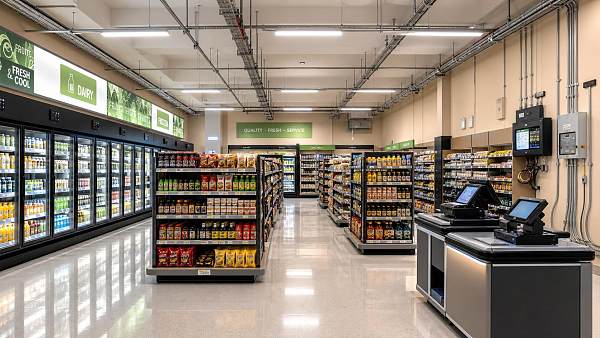
Modern Marketplace Insights for 2026 Planning
Time
Click Count
For business evaluators shaping 2026 strategies, modern marketplace insights are essential to understanding how retail environments, supply chains, and consumer expectations are evolving together.
This article explores the commercial, technological, and sustainability benchmarks influencing global decision-making, helping professionals assess resilient opportunities, compare international standards, and identify where operational performance meets long-term market value.
What do modern marketplace insights mean for 2026 planning?

Modern marketplace insights describe the combined reading of retail design, digital systems, supply continuity, compliance standards, and sustainability performance.
They are not limited to sales trends.
They also reveal how commercial spaces function, how products move, and how customer expectations reshape physical environments.
For 2026 planning, this broader view matters because market value increasingly depends on integrated performance rather than isolated product pricing.
A premium store fixture without digital compatibility can limit future upgrades.
A fast-moving consumer product without packaging traceability can weaken compliance confidence.
Modern marketplace insights help connect these issues early.
In cross-sector evaluation, five signals deserve close attention:
- commercial fixture durability and flexibility
- smart retail technology interoperability
- supply chain visibility across regions
- lighting, signage, and brand experience consistency
- sustainable packaging verified by measurable standards
When these signals are measured together, modern marketplace insights become a planning framework, not just a trend summary.
Why are retail environments and supply chains now evaluated together?
The separation between front-end commerce and back-end logistics is disappearing.
Consumers experience both at once, even if they never see the warehouse, sourcing workflow, or packaging conversion process.
A visually strong retail environment can lose credibility if stocked products arrive late or inconsistent in quality.
Likewise, an efficient supply chain creates limited advantage if commercial presentation feels outdated or operationally rigid.
This is where modern marketplace insights become practical.
They show that commercial furniture, digital checkout systems, signage, and packaging all contribute to one shared customer impression.
In 2026 planning, integrated evaluation often includes:
- Can the store format adapt to changing product categories?
- Do hardware and software support data continuity?
- Are materials aligned with cost, durability, and sustainability goals?
- Can global standards reduce risk during expansion?
These questions support stronger comparisons across markets.
They also reduce the risk of investing in short-lived upgrades that fail under scale or regulation.
Which benchmarks matter most when comparing international commercial solutions?
Benchmarking is central to modern marketplace insights because international sourcing and deployment require a common language of performance.
Without recognized benchmarks, comparisons become subjective and vulnerable to marketing claims.
Three benchmark categories usually carry the most weight.
1. Safety and compliance standards
UL and CE remain important for electrical systems, illuminated displays, and connected retail devices.
They help confirm baseline safety and market acceptance.
2. Ergonomic and structural standards
BIFMA references are useful for office systems, seating, and fixtures in commercial interiors.
They support durability reviews, user comfort, and lifecycle planning.
3. Sustainability and traceability metrics
Material origin, recycled content, energy efficiency, and packaging recovery data increasingly shape procurement confidence.
These indicators influence cost, reputation, and future compliance exposure.
The strongest modern marketplace insights do not treat benchmarks as isolated certifications.
Instead, they examine whether standards support a consistent commercial experience across stores, regions, and product lines.
How should decision-makers judge smart retail technology without overvaluing novelty?
One common mistake is assuming that newer technology always produces stronger commercial performance.
Modern marketplace insights suggest a more disciplined approach.
Technology should be reviewed through operational usefulness, integration effort, maintenance stability, and measurable customer impact.
AI-enabled POS terminals, digital signage analytics, shelf sensors, and mobile payment infrastructure can create value.
However, value appears only when the tools fit the commercial environment and data ecosystem.
A balanced review often asks:
- Does the technology solve a clear friction point?
- Can it connect with existing systems without costly redesign?
- Is support available across target markets?
- Will data outputs improve planning, not just reporting?
This method keeps modern marketplace insights grounded in results.
It also prevents digital investments from becoming isolated hardware projects with weak commercial relevance.
What risks and misconceptions can weaken 2026 marketplace planning?
Several planning errors appear repeatedly across sectors.
Each one reduces the usefulness of modern marketplace insights.
Mistaking trend visibility for long-term viability
A visible concept may attract attention but fail to scale operationally.
Short-term excitement should not replace evidence of durability, compliance, and replacement support.
Treating sustainability as a branding layer only
Sustainability affects sourcing resilience, packaging cost, transport efficiency, and regulatory alignment.
If it is measured only through messaging, strategic value remains incomplete.
Ignoring cross-regional standards differences
Solutions accepted in one market may require redesign elsewhere.
This affects lead times, approval cycles, and total implementation cost.
Underestimating physical environment performance
Fixtures, lighting, and signage still shape conversion, navigation, and brand trust.
Digital intelligence works best when physical settings are well designed.
The best modern marketplace insights account for both hidden infrastructure and visible experience.
How can organizations turn modern marketplace insights into practical next steps?
The transition from insight to execution should be structured, measurable, and phased.
That is especially important in complex commercial ecosystems involving interiors, technology, packaging, and international sourcing.
A useful action path includes five steps.
- Map current assets across fixtures, systems, packaging, and compliance exposure.
- Identify weak links affecting lifecycle cost or customer experience.
- Compare options against recognized performance standards.
- Pilot improvements in one controlled environment.
- Scale only after operational and financial proof appears.
This approach supports resilient modernization.
It also makes modern marketplace insights easier to apply across multiple categories rather than a single purchasing event.
Quick FAQ table: how to interpret modern marketplace insights efficiently?
Modern marketplace insights will matter even more in 2026 because commercial success now depends on connected decisions.
Retail spaces, smart systems, product flow, material responsibility, and global standards are no longer separate planning topics.
They form one marketplace reality.
The most effective next step is to evaluate current commercial assets against future-fit benchmarks, then prioritize improvements with measurable operational impact.
Using modern marketplace insights in this disciplined way can strengthen resilience, improve customer-facing quality, and support long-term international market value.
News Recommendations
 How to compare commercial linear light wholesale quotes accurately
![51a6ab95581761cc26f4318be6520c15]()
Aris Katos
Future of Carbide Coatings
 How to verify international standards compliance for Middle East exports
![51a6ab95581761cc26f4318be6520c15]()
Aris Katos
Future of Carbide Coatings
 How to select laboratory instruments for reproducible test results
![51a6ab95581761cc26f4318be6520c15]()
Aris Katos
Future of Carbide Coatings
 When does a sheet metal prototype reveal design flaws early?
![51a6ab95581761cc26f4318be6520c15]()
Aris Katos
Future of Carbide Coatings
 When PE air column bags reduce damage in e-commerce fulfillment
![51a6ab95581761cc26f4318be6520c15]()
Aris Katos
Future of Carbide Coatings
 How energy-efficient design reduces operating costs in retail lighting
![51a6ab95581761cc26f4318be6520c15]()
Aris Katos
Future of Carbide Coatings
 When commercial aluminum storefronts make sense for a retail renovation
![51a6ab95581761cc26f4318be6520c15]()
Aris Katos
Future of Carbide Coatings
 What makes LED lights durable in high-use commercial spaces?
![51a6ab95581761cc26f4318be6520c15]()
Aris Katos
Future of Carbide Coatings
 Which industry categories offer the strongest export potential in Latin America?
![51a6ab95581761cc26f4318be6520c15]()
Aris Katos
Future of Carbide Coatings
 How to choose an ultra bright waterproof window display for storefronts
![51a6ab95581761cc26f4318be6520c15]()
Aris Katos
Future of Carbide Coatings
 How to verify suppliers on a trade portal for global sourcing
![51a6ab95581761cc26f4318be6520c15]()
Aris Katos
Future of Carbide Coatings
 How RoHS requirements should be stated in product specifications
![51a6ab95581761cc26f4318be6520c15]()
Aris Katos
Future of Carbide Coatings
 What affects the lead time for custom retail counter displays?
![51a6ab95581761cc26f4318be6520c15]()
Aris Katos
Future of Carbide Coatings
 What consumer packaging USA importers need to verify before ordering
![51a6ab95581761cc26f4318be6520c15]()
Aris Katos
Future of Carbide Coatings
 How commercial spaces interiors shape customer dwell time
![51a6ab95581761cc26f4318be6520c15]()
Aris Katos
Future of Carbide Coatings
 How LED commercial lighting design reduces glare in retail spaces
![51a6ab95581761cc26f4318be6520c15]()
Aris Katos
Future of Carbide Coatings
 How industrial technology information improves RFID inventory accuracy
![51a6ab95581761cc26f4318be6520c15]()
Aris Katos
Future of Carbide Coatings
 When drip garden watering systems make more sense than sprinklers
![51a6ab95581761cc26f4318be6520c15]()
Aris Katos
Future of Carbide Coatings
 When category comparison improves sourcing for industrial applications
![51a6ab95581761cc26f4318be6520c15]()
Aris Katos
Future of Carbide Coatings
 Industrial application guidance for selecting the right LED lighting
![51a6ab95581761cc26f4318be6520c15]()
Aris Katos
Future of Carbide Coatings
 Which commercial architecture standards apply to European retail fit-outs?
![51a6ab95581761cc26f4318be6520c15]()
Aris Katos
Future of Carbide Coatings
 How to verify FDA requirements for maternity care products
![51a6ab95581761cc26f4318be6520c15]()
Aris Katos
Future of Carbide Coatings
 How to verify BPA-free claims for food-contact products
![51a6ab95581761cc26f4318be6520c15]()
Aris Katos
Future of Carbide Coatings
 When does a European wholesale supplier suit modular office projects?
![51a6ab95581761cc26f4318be6520c15]()
Aris Katos
Future of Carbide Coatings
 When consumer ecosystem solutions improve the in-store shopping journey
![51a6ab95581761cc26f4318be6520c15]()
Aris Katos
Future of Carbide Coatings
 How a commercial developers network can reduce site selection risk
![51a6ab95581761cc26f4318be6520c15]()
Aris Katos
Future of Carbide Coatings
 How clear purchasing specifications prevent costly supplier deviations
![51a6ab95581761cc26f4318be6520c15]()
Aris Katos
Future of Carbide Coatings
 What an ISTA drop test lab checks before your packaging ships
![51a6ab95581761cc26f4318be6520c15]()
Aris Katos
Future of Carbide Coatings
 Which commercial furniture standards apply to workplace seating?
![51a6ab95581761cc26f4318be6520c15]()
Aris Katos
Future of Carbide Coatings
 How to evaluate smart lighting module OEM compatibility before sampling
![51a6ab95581761cc26f4318be6520c15]()
Aris Katos
Future of Carbide Coatings
 How to assess whether sustainable technology delivers real impact
![51a6ab95581761cc26f4318be6520c15]()
Aris Katos
Future of Carbide Coatings
 How to assess an OEM supplier’s quality control before ordering
![51a6ab95581761cc26f4318be6520c15]()
Aris Katos
Future of Carbide Coatings
 How consumer ecosystem solutions data can improve retail personalization
![51a6ab95581761cc26f4318be6520c15]()
Aris Katos
Future of Carbide Coatings
 When does consumer packaging design justify a higher product price?
![51a6ab95581761cc26f4318be6520c15]()
Aris Katos
Future of Carbide Coatings
 Supermarket Fixture Installation: Planning Layouts, Wiring, and Handover
![51a6ab95581761cc26f4318be6520c15]()
Aris Katos
Future of Carbide Coatings
 Automated Lighting and Smart Lighting Control in Bergerac: Key Project Considerations
![51a6ab95581761cc26f4318be6520c15]()
Aris Katos
Future of Carbide Coatings
 Segment Streetlight Controllers: Choosing Control Modes for Urban Roads
![51a6ab95581761cc26f4318be6520c15]()
Aris Katos
Future of Carbide Coatings
 IEC 62471-2 Explained: How to Assess Photobiological Risks in LED Lighting
![51a6ab95581761cc26f4318be6520c15]()
Aris Katos
Future of Carbide Coatings
 Food Grade Packaging Requirements by Product Type, Temperature, and Contact Risk
![51a6ab95581761cc26f4318be6520c15]()
Aris Katos
Future of Carbide Coatings