UL-SMQ Launch Fast-Track Kiosk Certification Channel
Time
Click Count
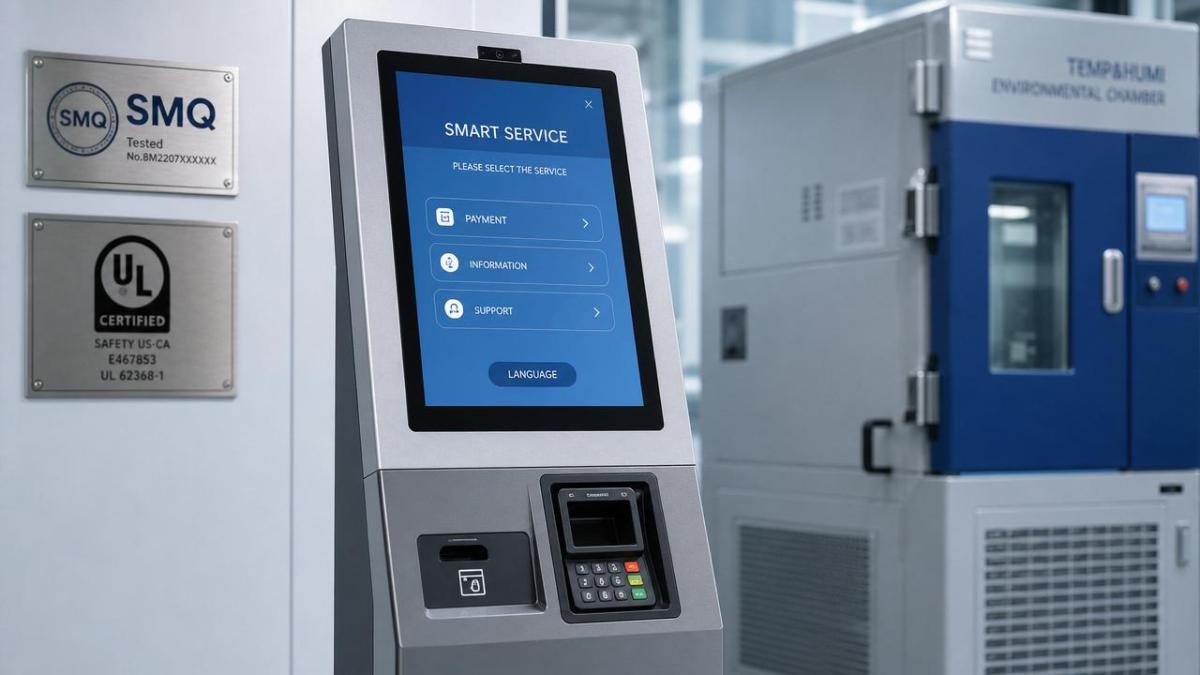
A new cross-border certification channel for POS and self-service kiosks—jointly established by UL Solutions (USA) and the Shenzhen Institute of Metrology and Quality Inspection (SMQ)—went live on May 18, 2026. The initiative significantly accelerates market access for kiosk manufacturers targeting North America, Latin America, and Southeast Asia, cutting certification turnaround from an average of 28 days to just five working days. This development directly addresses long-standing bottlenecks in global compliance for interactive retail and service hardware.
Event Overview
On May 18, 2026, UL Solutions and SMQ signed a formal agreement to launch the ‘Shenzhen Direct Access Channel’ for UL 60950-1 and UL 62368-1 certification of POS terminals and self-service kiosks. Under this arrangement, testing is conducted locally at SMQ’s accredited labs, while UL provides remote technical review and endorsement of test reports. The first phase covers three core assessment areas: touchscreen scratch resistance, EMVCo compatibility of payment modules, and environmental adaptability (e.g., temperature/humidity resilience). No third-party lab duplication or overseas shipment of samples is required.
Industries Impacted
Direct trade enterprises — Exporters of kiosks and POS systems face immediate implications: faster time-to-market reduces inventory holding costs and improves responsiveness to regional RFPs or retail rollouts. However, tighter timelines also increase pressure on documentation accuracy and pre-test readiness; errors now trigger longer delays due to compressed review windows.
Raw material procurement enterprises — Suppliers of critical components—including touch sensors, secure payment SoCs, and industrial-grade enclosures—must ensure their materials meet UL 62368-1’s updated safety-by-design expectations. While not directly certified under this channel, their component-level compliance now influences end-product certification success rates more visibly than before.
Contract manufacturing and OEM enterprises — Factories producing kiosks for global brands must realign internal QA checkpoints to align with SMQ’s test protocols (e.g., accelerated environmental stress screening, EMVCo interface validation). The five-day cycle leaves little margin for rework; design-for-certification practices are no longer optional but operationally essential.
Supply chain service enterprises — Logistics providers, regulatory consultants, and certification brokers serving the kiosk ecosystem need to update service packages to include SMQ-UL joint reporting coordination, local sample handling, and rapid document translation/localization support—particularly for Spanish (Latin America) and Bahasa (Southeast Asia) markets.
Key Considerations and Recommended Actions
Verify eligibility of product configurations early
Not all kiosk variants qualify automatically. Devices with non-standard power architectures, custom thermal management, or hybrid payment stacks (e.g., NFC + QR + contactless card) may require pre-submission technical alignment with both SMQ and UL before entering the five-day workflow.
Prepare EMVCo-compliant firmware and test logs in advance
EMVCo interoperability testing is now part of the mandatory scope—not a post-certification add-on. Manufacturers must supply version-controlled firmware binaries, full communication trace logs, and evidence of secure element integration prior to lab submission.
Engage SMQ for pre-assessment audits
Although not mandatory, SMQ offers optional pre-test gap assessments. Given the narrow window for corrections, this step helps identify documentation gaps, labeling inconsistencies, or mechanical tolerances that could delay final report issuance.
Editorial Perspective / Industry Observation
Observably, this collaboration reflects a broader shift: global conformity assessment is increasingly decentralizing—not through dilution of standards, but via trusted local execution backed by international brand assurance. Analysis shows that such ‘hybrid trust models’ reduce geographic friction without compromising technical rigor. From an industry standpoint, it signals growing recognition that speed and compliance are no longer trade-offs—but co-dependent enablers in high-velocity hardware markets. Current momentum suggests similar channels may emerge for IoT gateways and EV charging interfaces within 12–18 months.
Conclusion
This channel does not lower safety or performance thresholds—it re-engineers process efficiency. For the kiosk industry, it represents a pragmatic recalibration: faster access is enabled not by relaxing requirements, but by optimizing verification pathways. That distinction matters for long-term credibility in regulated markets.
Source Attribution
Official announcements issued by UL Solutions (ul.com/press-release/may2026-smq-partnership) and SMQ (smq.gov.cn/en/news/20260518-ul-collab). Note: Full test protocol documents and fee structures remain pending publication; ongoing monitoring advised for updates on expanded coverage (e.g., UL 2900-1 cybersecurity annex inclusion).
News Recommendations
 How to select laboratory instruments for reproducible test results
![51a6ab95581761cc26f4318be6520c15]()
Aris Katos
Future of Carbide Coatings
 When does a sheet metal prototype reveal design flaws early?
![51a6ab95581761cc26f4318be6520c15]()
Aris Katos
Future of Carbide Coatings
 When PE air column bags reduce damage in e-commerce fulfillment
![51a6ab95581761cc26f4318be6520c15]()
Aris Katos
Future of Carbide Coatings
 How energy-efficient design reduces operating costs in retail lighting
![51a6ab95581761cc26f4318be6520c15]()
Aris Katos
Future of Carbide Coatings
 When commercial aluminum storefronts make sense for a retail renovation
![51a6ab95581761cc26f4318be6520c15]()
Aris Katos
Future of Carbide Coatings
 What makes LED lights durable in high-use commercial spaces?
![51a6ab95581761cc26f4318be6520c15]()
Aris Katos
Future of Carbide Coatings
 Which industry categories offer the strongest export potential in Latin America?
![51a6ab95581761cc26f4318be6520c15]()
Aris Katos
Future of Carbide Coatings
 How to choose an ultra bright waterproof window display for storefronts
![51a6ab95581761cc26f4318be6520c15]()
Aris Katos
Future of Carbide Coatings
 How to verify suppliers on a trade portal for global sourcing
![51a6ab95581761cc26f4318be6520c15]()
Aris Katos
Future of Carbide Coatings
 How RoHS requirements should be stated in product specifications
![51a6ab95581761cc26f4318be6520c15]()
Aris Katos
Future of Carbide Coatings
 What affects the lead time for custom retail counter displays?
![51a6ab95581761cc26f4318be6520c15]()
Aris Katos
Future of Carbide Coatings
 What consumer packaging USA importers need to verify before ordering
![51a6ab95581761cc26f4318be6520c15]()
Aris Katos
Future of Carbide Coatings
 How commercial spaces interiors shape customer dwell time
![51a6ab95581761cc26f4318be6520c15]()
Aris Katos
Future of Carbide Coatings
 How LED commercial lighting design reduces glare in retail spaces
![51a6ab95581761cc26f4318be6520c15]()
Aris Katos
Future of Carbide Coatings
 How industrial technology information improves RFID inventory accuracy
![51a6ab95581761cc26f4318be6520c15]()
Aris Katos
Future of Carbide Coatings
 When drip garden watering systems make more sense than sprinklers
![51a6ab95581761cc26f4318be6520c15]()
Aris Katos
Future of Carbide Coatings
 When category comparison improves sourcing for industrial applications
![51a6ab95581761cc26f4318be6520c15]()
Aris Katos
Future of Carbide Coatings
 Industrial application guidance for selecting the right LED lighting
![51a6ab95581761cc26f4318be6520c15]()
Aris Katos
Future of Carbide Coatings
 Which commercial architecture standards apply to European retail fit-outs?
![51a6ab95581761cc26f4318be6520c15]()
Aris Katos
Future of Carbide Coatings
 How to verify FDA requirements for maternity care products
![51a6ab95581761cc26f4318be6520c15]()
Aris Katos
Future of Carbide Coatings
 How to verify BPA-free claims for food-contact products
![51a6ab95581761cc26f4318be6520c15]()
Aris Katos
Future of Carbide Coatings
 When does a European wholesale supplier suit modular office projects?
![51a6ab95581761cc26f4318be6520c15]()
Aris Katos
Future of Carbide Coatings
 When consumer ecosystem solutions improve the in-store shopping journey
![51a6ab95581761cc26f4318be6520c15]()
Aris Katos
Future of Carbide Coatings
 How a commercial developers network can reduce site selection risk
![51a6ab95581761cc26f4318be6520c15]()
Aris Katos
Future of Carbide Coatings
 How clear purchasing specifications prevent costly supplier deviations
![51a6ab95581761cc26f4318be6520c15]()
Aris Katos
Future of Carbide Coatings
 What an ISTA drop test lab checks before your packaging ships
![51a6ab95581761cc26f4318be6520c15]()
Aris Katos
Future of Carbide Coatings
 Which commercial furniture standards apply to workplace seating?
![51a6ab95581761cc26f4318be6520c15]()
Aris Katos
Future of Carbide Coatings
 How to evaluate smart lighting module OEM compatibility before sampling
![51a6ab95581761cc26f4318be6520c15]()
Aris Katos
Future of Carbide Coatings
 How to assess whether sustainable technology delivers real impact
![51a6ab95581761cc26f4318be6520c15]()
Aris Katos
Future of Carbide Coatings
 How to assess an OEM supplier’s quality control before ordering
![51a6ab95581761cc26f4318be6520c15]()
Aris Katos
Future of Carbide Coatings
 How consumer ecosystem solutions data can improve retail personalization
![51a6ab95581761cc26f4318be6520c15]()
Aris Katos
Future of Carbide Coatings
 When does consumer packaging design justify a higher product price?
![51a6ab95581761cc26f4318be6520c15]()
Aris Katos
Future of Carbide Coatings
 Supermarket Fixture Installation: Planning Layouts, Wiring, and Handover
![51a6ab95581761cc26f4318be6520c15]()
Aris Katos
Future of Carbide Coatings
 Automated Lighting and Smart Lighting Control in Bergerac: Key Project Considerations
![51a6ab95581761cc26f4318be6520c15]()
Aris Katos
Future of Carbide Coatings
 Segment Streetlight Controllers: Choosing Control Modes for Urban Roads
![51a6ab95581761cc26f4318be6520c15]()
Aris Katos
Future of Carbide Coatings
 IEC 62471-2 Explained: How to Assess Photobiological Risks in LED Lighting
![51a6ab95581761cc26f4318be6520c15]()
Aris Katos
Future of Carbide Coatings
 Food Grade Packaging Requirements by Product Type, Temperature, and Contact Risk
![51a6ab95581761cc26f4318be6520c15]()
Aris Katos
Future of Carbide Coatings
 Food Packaging Compliance Checklist: Tests, Records, and Labeling Before Shipment
![51a6ab95581761cc26f4318be6520c15]()
Aris Katos
Future of Carbide Coatings
 NSF Food Packaging Standards: When Certification Matters for Commercial Food Use
![51a6ab95581761cc26f4318be6520c15]()
Aris Katos
Future of Carbide Coatings