Sustainable Materials: What Meets New Compliance Rules
Time
Click Count
As new compliance rules tighten across global markets, choosing sustainable materials is no longer just a branding decision but a critical quality and safety priority. For quality control and safety managers, understanding how materials perform against regulatory, environmental, and supply chain standards is essential to reducing risk, ensuring product integrity, and supporting long-term commercial resilience.
What do sustainable materials need to meet under new compliance rules?
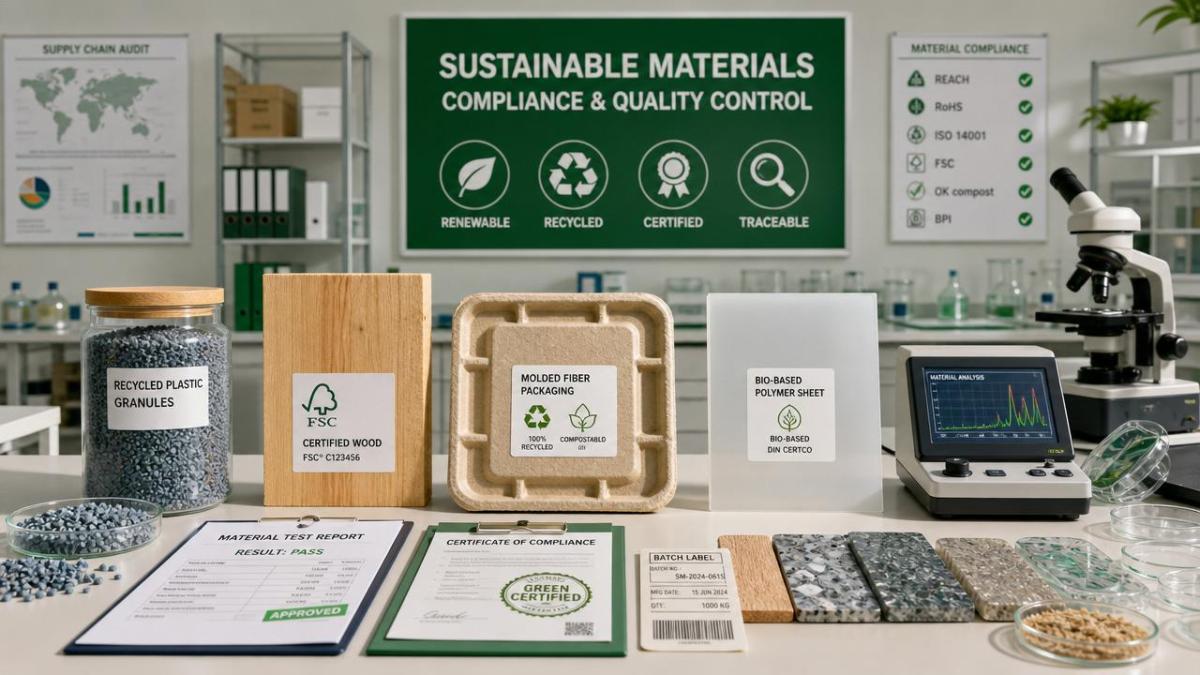
For quality and safety teams, sustainable materials must now satisfy more than recycled content claims. They need documented traceability, controlled chemical composition, stable physical performance, and alignment with market-specific rules covering product safety, emissions, labeling, and restricted substances.
This matters across the broader commercial ecosystem. The same sourcing decision can affect retail fixtures, packaging, lighting components, consumer goods housings, and smart hardware enclosures. A material that looks compliant on paper may still fail under fire behavior limits, VOC thresholds, migration testing, or mechanical durability expectations.
In practical terms, sustainable materials should be evaluated across four linked dimensions:
- Regulatory fit: Does the material align with destination-market rules such as REACH-related substance controls, RoHS-style restrictions where relevant, packaging directives, and product-category safety requirements?
- Performance consistency: Can it maintain strength, finish, dimensional stability, cleanability, and service life in real operating conditions?
- Supply chain evidence: Is there batch-level documentation for origin, composition, test reports, declarations, and change control?
- Commercial usability: Can the material scale without causing lead-time delays, high scrap rates, or installation issues?
Why quality control managers are under more pressure
New compliance rules are converging with customer audits, ESG screening, and stricter vendor approval processes. That means QC teams are no longer checking only incoming quality. They are also validating declarations, comparing test methods, and identifying hidden substitution risks before products reach stores, projects, or end consumers.
For safety managers, the challenge is even sharper when one product system combines multiple material families such as plastics, engineered wood, coatings, foams, metals, and paper-based packaging. Risk can enter through adhesives, flame retardants, surface treatments, inks, or fillers rather than the base substrate alone.
Which compliance checkpoints matter most when reviewing sustainable materials?
Before approving sustainable materials, teams need a structured review framework. The table below helps translate broad compliance language into practical checkpoints for cross-industry sourcing, especially in commercial interiors, retail technology, and consumer-facing supply chains.
The key lesson is that sustainable materials should be reviewed as systems, not labels. A board made with recycled fibers may still fail because of non-compliant resin. A molded plastic with bio-based content may still raise issues if pigments or flame-retardant packages are undocumented.
How G-BCE supports better compliance interpretation
G-BCE’s value is not limited to listing standards. Its cross-sector benchmarking approach helps procurement, QC, and safety functions compare how sustainable materials perform across commercial furniture, smart retail hardware, packaging, lighting, and display systems. This matters because many sourcing teams now manage mixed categories under one approval workflow.
By connecting Asian manufacturing capability with international commercial expectations, G-BCE helps teams identify where specification language is too weak, where supplier evidence is incomplete, and where a lower-cost material creates downstream compliance exposure.
How do common sustainable materials compare for safety, durability, and compliance?
Not all sustainable materials carry the same risk profile. The right choice depends on application, exposure conditions, and the level of documentation available. The comparison below is useful when screening materials for commercial and consumer product ecosystems.
This comparison shows why selection should never be based on sustainability claims alone. For example, recycled content may improve environmental positioning, but it does not automatically satisfy load-bearing or flame performance requirements. Certified wood may support sourcing transparency, but emissions and finishing systems remain critical.
A useful decision rule
If a material enters a customer-facing, enclosed, electrical-adjacent, or food-contact-adjacent environment, increase the evidence threshold. Ask for more than a declaration. Request test method details, sample retention plans, and consistency controls across production lots.
What should procurement and safety teams check before approving sustainable materials?
Approving sustainable materials is not a one-step document review. It is a gated decision process that balances risk, performance, and supply continuity. A practical workflow helps teams avoid last-minute redesigns and failed inspections.
Recommended approval workflow
- Define the use case clearly. Separate structural, decorative, protective, and packaging functions because each function requires different tests and compliance evidence.
- Map the destination market. A material accepted in one region may require different declarations, labels, or emission thresholds in another.
- Review the full bill of materials. In many failures, the issue is not the substrate but the coating, adhesive, ink, or laminated layer.
- Request representative test data. Confirm the sample condition, standard version, and whether the result applies to the exact formulation you plan to buy.
- Run pilot validation. Check assembly compatibility, appearance stability, cleaning resistance, and packaging performance under realistic logistics conditions.
- Establish change control. Sustainable materials often evolve as suppliers adjust recycled feedstock or resin blends. Approval without change notification is a hidden risk.
Procurement red flags that deserve escalation
- The supplier provides only marketing certificates but no technical declarations tied to the actual lot or formulation.
- The material passes one market’s requirement, but the same evidence is reused for unrelated regions or categories.
- Recycled or bio-based content percentages are stated without a verification method or tolerance range.
- Lead times are highly unstable, suggesting weak upstream control over sustainable feedstock sourcing.
How can teams balance compliance, cost, and replacement options?
A common mistake is assuming sustainable materials always increase cost. In reality, cost depends on certification scope, yield loss, finishing complexity, transport efficiency, and failure risk. A cheaper substitute can become more expensive if it causes retesting, damage claims, or installation rework.
The table below helps compare selection paths from a total-risk perspective rather than unit price alone.
For QC and safety managers, the best choice is often the material that minimizes verification uncertainty. That may not be the lowest quote. It is the option that reduces hidden variation, prevents compliance disputes, and performs reliably throughout shipment, installation, use, and disposal.
Where are sustainable materials most sensitive in real commercial applications?
Material sensitivity changes by application. In a cross-sector ecosystem like the one covered by G-BCE, one sourcing policy may affect store fixtures, tech terminals, illuminated displays, and consumer packaging at the same time. Each use case creates different quality priorities.
High-risk application scenarios
- Retail fixtures and commercial furniture: Watch structural integrity, edge wear, cleanability, and emissions in enclosed spaces.
- Smart retail hardware housings: Review flame behavior, thermal stability, dimensional precision, and restricted substance control.
- Commercial lighting and signage: Check heat exposure, color fastness, electrical proximity compatibility, and long-term deformation risk.
- Sustainable packaging: Focus on migration risk, transport durability, compression strength, humidity resistance, and disposal claims.
This is where a benchmarking platform becomes valuable. G-BCE helps teams compare not just material names, but the technical trade-offs between aesthetic goals, sourcing routes, compliance documentation, and operational durability.
What are the most common mistakes when specifying sustainable materials?
Many compliance failures start with good intentions and weak specifications. Sustainable materials are often approved under time pressure, especially when customers request greener options late in the sourcing cycle.
Frequent misconceptions
- Assuming “recycled” equals compliant. It does not. Input variation can increase the need for testing and source control.
- Approving only the base material. Surface layers, binders, inks, and adhesives often drive actual non-compliance.
- Copying one market’s documentation for all regions. Requirements for declarations, labels, and emissions can differ significantly.
- Ignoring service environment. A sustainable material that performs well in packaging may fail in a heated display area or high-touch retail zone.
The corrective action is simple: define the application, specify the evidence, and lock the change-control process. That approach protects both sustainability goals and operational reliability.
FAQ: how should quality and safety teams evaluate sustainable materials?
How do we choose sustainable materials when regulations vary by market?
Start with the final destination and product category, then work backward. Build a requirement matrix covering substance restrictions, emissions, labeling, and any category-specific performance rules. Do not rely on one generic declaration. Ask suppliers to map evidence to each target market.
What documents should we request before approving a supplier?
At minimum, request material specifications, substance declarations, relevant test reports, traceability records, and a change-notification commitment. If the material includes coatings or adhesives, request supporting data for those layers as well. When claims involve recycled or bio-based content, ask how that content is measured and controlled.
Which sustainable materials are easier to implement quickly?
Materials that preserve the same conversion process and form factor usually qualify faster. Examples include certified wood alternatives for existing fixture formats or recycled-content plastics in non-critical parts, provided the supplier can demonstrate stable composition and appearance. Full material-family changes often require more validation time.
What should we prioritize if budget is limited?
Prioritize materials with the highest compliance exposure first: enclosed-space components, electrical-adjacent housings, food-adjacent packaging, and high-touch commercial surfaces. Budget should go first to applications where a failure creates regulatory, safety, or reputational consequences rather than only cosmetic loss.
Why choose us for sustainable materials benchmarking and sourcing decisions?
G-BCE helps quality control and safety managers move beyond broad sustainability claims into evidence-based selection. Our cross-sector intelligence connects commercial furniture, smart retail technology, consumer goods supply chains, lighting and signage, and sustainable packaging under one practical evaluation lens.
If you are reviewing sustainable materials for a new rollout, retrofit, or supplier transition, we can help you assess specification gaps, compare alternative materials, and clarify which compliance documents matter for your application and target market.
- Parameter confirmation for performance, emissions, durability, and material consistency
- Product selection support across fixtures, retail hardware, packaging, and commercial environment components
- Guidance on delivery timelines, pilot validation scope, and supplier document readiness
- Custom benchmarking for certification expectations, sample review, and quotation alignment
If your team needs support with sustainable materials selection, sample evaluation, certification-related questions, or quotation discussions tied to global commercial use cases, G-BCE can provide a more structured path to safer, more resilient sourcing decisions.
News Recommendations
 How to assess a workplace interior supplier's installation scope
![51a6ab95581761cc26f4318be6520c15]()
Aris Katos
Future of Carbide Coatings
 What records are needed for an ISO 9001 furniture factory audit?
![51a6ab95581761cc26f4318be6520c15]()
Aris Katos
Future of Carbide Coatings
 How to choose AI marketing tools that work with your existing CRM
![51a6ab95581761cc26f4318be6520c15]()
Aris Katos
Future of Carbide Coatings
 Do freight costs erase savings when buying retail fixtures wholesale?
![51a6ab95581761cc26f4318be6520c15]()
Aris Katos
Future of Carbide Coatings
 How to check whether an OEM retail shelf screen fits existing shelving
![51a6ab95581761cc26f4318be6520c15]()
Aris Katos
Future of Carbide Coatings
 What brightness should an OEM shelf LCD screen have for retail use?
![51a6ab95581761cc26f4318be6520c15]()
Aris Katos
Future of Carbide Coatings
 Can smart retail IT solutions for CPG work with legacy POS systems?
![51a6ab95581761cc26f4318be6520c15]()
Aris Katos
Future of Carbide Coatings
 What permit approvals belong in a commercial fitout planning checklist?
![51a6ab95581761cc26f4318be6520c15]()
Aris Katos
Future of Carbide Coatings
 Which Technical Factors Matter When Comparing Smart Retail Hardware?
![51a6ab95581761cc26f4318be6520c15]()
Aris Katos
Future of Carbide Coatings
 Does Data Transparency Matter When Selecting Consumer Goods Suppliers?
![51a6ab95581761cc26f4318be6520c15]()
Aris Katos
Future of Carbide Coatings
 How Does Commercial Design Differ from Interior Decoration?
![51a6ab95581761cc26f4318be6520c15]()
Aris Katos
Future of Carbide Coatings
 How Long Does It Take to Verify a Commercial Furniture Supplier?
![51a6ab95581761cc26f4318be6520c15]()
Aris Katos
Future of Carbide Coatings
 How to verify compostability claims from a bubble mailer manufacturer
![51a6ab95581761cc26f4318be6520c15]()
Aris Katos
Future of Carbide Coatings
 Will commercial smart infrastructure solutions work with legacy systems?
![51a6ab95581761cc26f4318be6520c15]()
Aris Katos
Future of Carbide Coatings
 How to verify a preschool furniture manufacturer's safety standards
![51a6ab95581761cc26f4318be6520c15]()
Aris Katos
Future of Carbide Coatings
 A technical comparison of semiconductor processes for power devices
![51a6ab95581761cc26f4318be6520c15]()
Aris Katos
Future of Carbide Coatings
 How to verify that a BIFMA ergonomic chair meets the standard
![51a6ab95581761cc26f4318be6520c15]()
Aris Katos
Future of Carbide Coatings
 How to use a CRI value chart when choosing LED lighting
![51a6ab95581761cc26f4318be6520c15]()
Aris Katos
Future of Carbide Coatings
 How to compare hotel aroma diffuser wholesale options by coverage area
![51a6ab95581761cc26f4318be6520c15]()
Aris Katos
Future of Carbide Coatings
 How to prevent O-rings and seals from failing in food equipment
![51a6ab95581761cc26f4318be6520c15]()
Aris Katos
Future of Carbide Coatings
 How to compare commercial linear light wholesale quotes accurately
![51a6ab95581761cc26f4318be6520c15]()
Aris Katos
Future of Carbide Coatings
 How to verify international standards compliance for Middle East exports
![51a6ab95581761cc26f4318be6520c15]()
Aris Katos
Future of Carbide Coatings
 How to select laboratory instruments for reproducible test results
![51a6ab95581761cc26f4318be6520c15]()
Aris Katos
Future of Carbide Coatings
 When does a sheet metal prototype reveal design flaws early?
![51a6ab95581761cc26f4318be6520c15]()
Aris Katos
Future of Carbide Coatings
 When PE air column bags reduce damage in e-commerce fulfillment
![51a6ab95581761cc26f4318be6520c15]()
Aris Katos
Future of Carbide Coatings
 How energy-efficient design reduces operating costs in retail lighting
![51a6ab95581761cc26f4318be6520c15]()
Aris Katos
Future of Carbide Coatings
 When commercial aluminum storefronts make sense for a retail renovation
![51a6ab95581761cc26f4318be6520c15]()
Aris Katos
Future of Carbide Coatings
 What makes LED lights durable in high-use commercial spaces?
![51a6ab95581761cc26f4318be6520c15]()
Aris Katos
Future of Carbide Coatings
 Which industry categories offer the strongest export potential in Latin America?
![51a6ab95581761cc26f4318be6520c15]()
Aris Katos
Future of Carbide Coatings
 How to choose an ultra bright waterproof window display for storefronts
![51a6ab95581761cc26f4318be6520c15]()
Aris Katos
Future of Carbide Coatings
 How to verify suppliers on a trade portal for global sourcing
![51a6ab95581761cc26f4318be6520c15]()
Aris Katos
Future of Carbide Coatings
 How RoHS requirements should be stated in product specifications
![51a6ab95581761cc26f4318be6520c15]()
Aris Katos
Future of Carbide Coatings
 What affects the lead time for custom retail counter displays?
![51a6ab95581761cc26f4318be6520c15]()
Aris Katos
Future of Carbide Coatings
 What consumer packaging USA importers need to verify before ordering
![51a6ab95581761cc26f4318be6520c15]()
Aris Katos
Future of Carbide Coatings
 How commercial spaces interiors shape customer dwell time
![51a6ab95581761cc26f4318be6520c15]()
Aris Katos
Future of Carbide Coatings
 How LED commercial lighting design reduces glare in retail spaces
![51a6ab95581761cc26f4318be6520c15]()
Aris Katos
Future of Carbide Coatings
 How industrial technology information improves RFID inventory accuracy
![51a6ab95581761cc26f4318be6520c15]()
Aris Katos
Future of Carbide Coatings
 When drip garden watering systems make more sense than sprinklers
![51a6ab95581761cc26f4318be6520c15]()
Aris Katos
Future of Carbide Coatings
 When category comparison improves sourcing for industrial applications
![51a6ab95581761cc26f4318be6520c15]()
Aris Katos
Future of Carbide Coatings