How to verify compostability claims from a bubble mailer manufacturer
Time
Click Count
How to verify compostability claims from a bubble mailer manufacturer
A compostable label is not proof that a bubble mailer will break down under conditions your customers can access. For procurement teams, choosing a compostable bubble mailer manufacturer requires checking more than marketing claims: certification scope, material composition, and available disposal infrastructure all matter. The critical question is whether the evidence covers the finished mailer you intend to buy—not merely the resin used in one layer.
This distinction becomes expensive when discovered late. A supplier may provide a legitimate certificate for a film, while the delivered envelope contains a different cushioning layer, an unverified adhesive, or printing outside the approved specification. None of those differences automatically proves the mailer is unsuitable. They do mean that the certificate cannot be treated as a blanket guarantee.
Start by defining exactly what “compostable” means
Before requesting documents, ask the manufacturer to state its claim in writing: industrially compostable, home compostable, or both. “Biodegradable,” “plant-based,” and “made with compostable materials” are not interchangeable with a verified finished-product compostability claim.
Industrial compostability concerns managed conditions, including elevated temperatures, moisture, and biological activity. Home composting operates at lower and more variable temperatures. A mailer certified for industrial composting should not be presented as suitable for a garden compost heap unless separate evidence supports that use.
Also separate feedstock from disposal performance. Bio-based content describes where some material originates; it does not establish compostability. Conversely, a compostable formulation can include fossil-derived ingredients. A purchasing specification that simply demands “100% plant-based and biodegradable” leaves important technical questions unanswered.
Choose the standard before comparing certificates
For packaging destined for Europe, EN 13432 is a common reference for industrial compostability. In North America, ASTM D6400 is commonly relevant to compostable plastics, while ASTM D6868 addresses end items incorporating plastics or polymers as coatings or additives with paper and other substrates. The appropriate route depends on construction and the intended certification scheme, not simply the destination country.
Home-compostability evidence follows a different route. Examples include AS 5810 and NF T51-800, alongside certification schemes with their own requirements. Ask which standard or scheme the claim relies on and what conditions it covers. Do not accept an industrial-compostability report repackaged as home-compostability evidence.
Compostability assessment generally considers biodegradation, disintegration, and effects on compost quality, including relevant chemical limits. These are different questions. A material can fragment visibly without demonstrating adequate biodegradation; a photograph of a torn or partially decomposed mailer cannot replace standardized testing.
Verify the certificate independently—not through the sales presentation
Request the complete certificate, including annexes, rather than a cropped logo or screenshot. Recognized certification bodies and programs include TÜV AUSTRIA, DIN CERTCO, and BPI, although their schemes, geographical relevance, and product requirements differ. A familiar logo is a starting point for verification, not the conclusion.
Use the issuing organization’s official product database or verification channel. Where the public listing is abbreviated, ask the issuer to confirm the scope. A supplier’s explanation can clarify the supply chain, but it should not substitute for independent confirmation of an ambiguous certificate.
- Certificate holder: Does the named company manufacture the mailer, supply its film, or license the material to a converter?
- Product identification: Do the product family, grade, and commercial reference match the quotation and specification?
- Status and scope: Is the certification current, and does it cover industrial or home compostability?
- Technical restrictions: Are thickness, colors, printing, or approved formulations limited by the certificate or annex?
- Mark authorization: Is the supplier entitled to apply the certification mark to the finished product?
A certificate held by a material producer is not inherently suspicious. Many converters use certified inputs. The gap appears when nobody can show how that input certification connects to the finished envelope. Ask for the documented link, including any approval required by the certification scheme.
Follow the evidence through every layer of the mailer
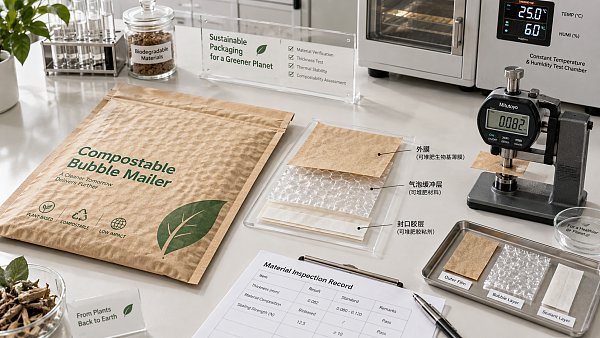
Bubble mailers are assemblies. Their compostability cannot be inferred from the outer surface alone. Request a bill of materials identifying the outer film or paper, bubble cushioning, bonding layers, closure adhesive, inks, and any coatings. Where formulations are confidential, the manufacturer can provide controlled references or arrange confirmation through the certifier.
The useful document is not necessarily a detailed chemical recipe. It is a component map showing which materials are included in the certified construction, which are subject to restrictions, and which must be removed before disposal.
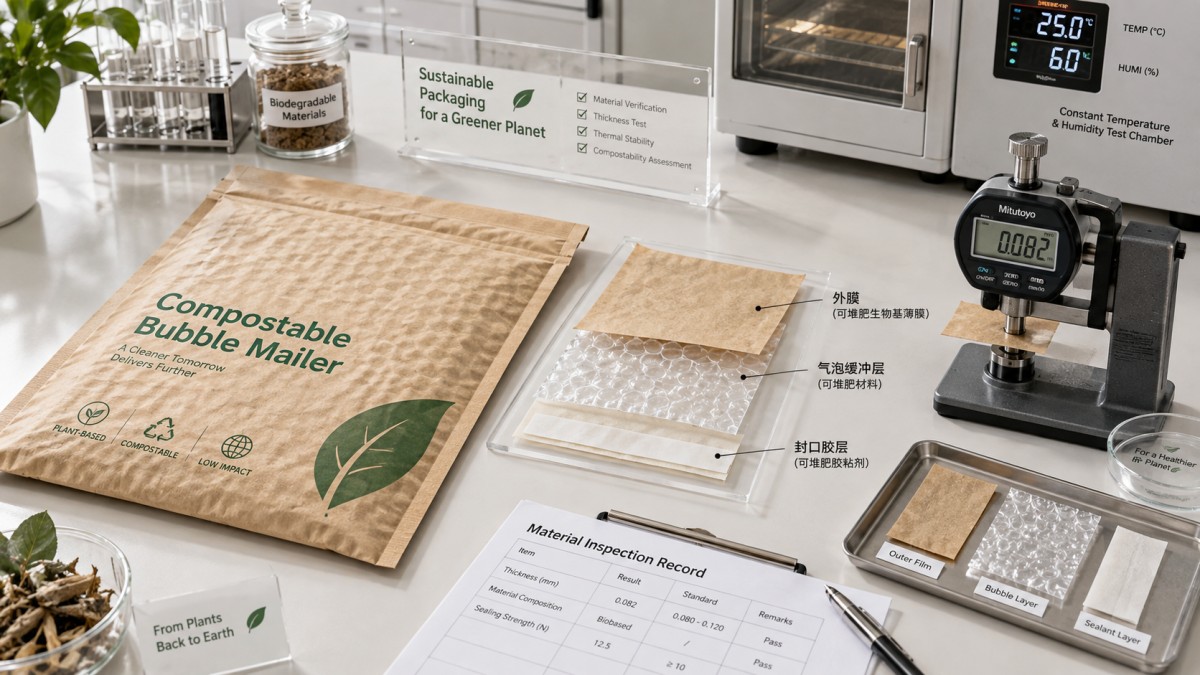
Pay particular attention to the cushioning film. Evidence for a flat outer film does not automatically establish compliance for the assembled bubble structure. Film gauge, bonded layers, and construction can affect disintegration. Ask whether the proposed structure is covered within the approved limits, rather than assuming that chemically similar materials behave identically.
Closure details deserve the same scrutiny. The sealing adhesive remains on the envelope after use; a release liner is typically removed before dispatch. These are separate disposal items and may have different routes. A defensible claim should explain any exclusion clearly rather than calling the entire shipment “fully compostable.”
Shipping labels are another practical weak point. Even if the supplied mailer is certified, the fulfillment operation may add a conventional pressure-sensitive label. Confirm whether that addition is covered, must be removed, or changes the permissible disposal instruction. Approval for an unprinted mailer also should not be assumed to cover a heavily printed branded version.
Read test reports for applicability, not just a passing result
Certification and laboratory testing are related but distinct. A test report describes the sample evaluated and the results obtained. Certification adds assessment under a particular scheme, which may include requirements for product identification, mark use, and ongoing conformity. Neither document should be stretched beyond its stated scope.
When reviewing reports, match the sample description to the proposed production specification. Check material grade, thickness, construction, printing condition, test methods, and report dates. Confirm that all relevant assessment elements are addressed; a biodegradation result alone is not equivalent to a complete compostability assessment.
Laboratory competence matters too. ISO/IEC 17025 accreditation is useful evidence, but verify whether the relevant methods fall within the laboratory’s accreditation scope. The presence of an accreditation logo does not mean every test the laboratory offers is accredited.
An older report is not automatically invalid. The important question is whether the tested formulation and construction still represent current production, and whether the certification remains valid. If the supplier has changed resin grades or increased film thickness, request confirmation that the change remains within scope.
Check whether customers can actually compost it
A technically valid industrial-compostability certificate does not guarantee collection or acceptance. Some composting facilities exclude compostable packaging even when certified, because their process, sorting arrangements, or contamination policies do not accommodate it. Acceptance of food scraps does not imply acceptance of bubble mailers.
For a controlled return program, ask the receiving facility about the exact mailer before purchase. For direct-to-consumer shipments across multiple regions, disposal access will be harder to establish. Customer instructions should distinguish the certified conditions from locally available options and avoid suggesting that the mailer belongs in ordinary plastic-film recycling.
This is where procurement may need to make an uncomfortable trade-off. A certified compostable mailer can still be a poor fit for a market without an accessible collection route. Depending on product protection needs and local recovery systems, a different packaging format may offer a more practical end-of-life pathway. Certification answers a technical question; it does not settle the entire packaging decision.
Make the verified construction part of the purchase agreement
Once the documentation checks out, prevent the approved sample from becoming disconnected from routine production. Attach a controlled specification to the purchase order, with material references, allowable thicknesses, printing limits, closure details, and the applicable certification. Require written approval before substitutions, including changes described as “equivalent.”
Retain an approved sample and establish lot traceability. Ask what production records connect delivered batches to the approved materials. If the certificate expires, is suspended, or changes scope, the supplier should notify you before further shipments or use of the certification mark.
Do not neglect transit performance. Test the mailer with the actual packed product for seal integrity, puncture resistance, and cushioning suitability. Check the supplier’s storage guidance against warehouse temperature, humidity, and expected stock age. A compostability certificate does not establish that the envelope will protect a sharp-edged accessory or survive your distribution conditions.
For cross-border sourcing, this evidence-led approach fits Global Business & Consumer Ecosystem (G-BCE)’s broader benchmarking focus: connecting manufacturing specifications with the requirements of commercial operators and consumer brands. Sustainable packaging needs its own technical assessment; standards used for furniture, lighting, or electrical equipment do not validate compostability.
Before approving a compostable bubble mailer manufacturer, you should be able to connect three things without guesswork: the exact product being purchased, independently verifiable evidence covering its construction, and disposal instructions appropriate to its destination. If one link is missing, keep the claim out of customer-facing artwork until the gap is resolved.
News Recommendations
 How to verify compostability claims from a bubble mailer manufacturer
![51a6ab95581761cc26f4318be6520c15]()
Aris Katos
Future of Carbide Coatings
 Will commercial smart infrastructure solutions work with legacy systems?
![51a6ab95581761cc26f4318be6520c15]()
Aris Katos
Future of Carbide Coatings
 How to verify a preschool furniture manufacturer's safety standards
![51a6ab95581761cc26f4318be6520c15]()
Aris Katos
Future of Carbide Coatings
 A technical comparison of semiconductor processes for power devices
![51a6ab95581761cc26f4318be6520c15]()
Aris Katos
Future of Carbide Coatings
 How to verify that a BIFMA ergonomic chair meets the standard
![51a6ab95581761cc26f4318be6520c15]()
Aris Katos
Future of Carbide Coatings
 How to use a CRI value chart when choosing LED lighting
![51a6ab95581761cc26f4318be6520c15]()
Aris Katos
Future of Carbide Coatings
 How to compare hotel aroma diffuser wholesale options by coverage area
![51a6ab95581761cc26f4318be6520c15]()
Aris Katos
Future of Carbide Coatings
 How to prevent O-rings and seals from failing in food equipment
![51a6ab95581761cc26f4318be6520c15]()
Aris Katos
Future of Carbide Coatings
 How to compare commercial linear light wholesale quotes accurately
![51a6ab95581761cc26f4318be6520c15]()
Aris Katos
Future of Carbide Coatings
 How to verify international standards compliance for Middle East exports
![51a6ab95581761cc26f4318be6520c15]()
Aris Katos
Future of Carbide Coatings
 How to select laboratory instruments for reproducible test results
![51a6ab95581761cc26f4318be6520c15]()
Aris Katos
Future of Carbide Coatings
 When does a sheet metal prototype reveal design flaws early?
![51a6ab95581761cc26f4318be6520c15]()
Aris Katos
Future of Carbide Coatings
 When PE air column bags reduce damage in e-commerce fulfillment
![51a6ab95581761cc26f4318be6520c15]()
Aris Katos
Future of Carbide Coatings
 How energy-efficient design reduces operating costs in retail lighting
![51a6ab95581761cc26f4318be6520c15]()
Aris Katos
Future of Carbide Coatings
 When commercial aluminum storefronts make sense for a retail renovation
![51a6ab95581761cc26f4318be6520c15]()
Aris Katos
Future of Carbide Coatings
 What makes LED lights durable in high-use commercial spaces?
![51a6ab95581761cc26f4318be6520c15]()
Aris Katos
Future of Carbide Coatings
 Which industry categories offer the strongest export potential in Latin America?
![51a6ab95581761cc26f4318be6520c15]()
Aris Katos
Future of Carbide Coatings
 How to choose an ultra bright waterproof window display for storefronts
![51a6ab95581761cc26f4318be6520c15]()
Aris Katos
Future of Carbide Coatings
 How to verify suppliers on a trade portal for global sourcing
![51a6ab95581761cc26f4318be6520c15]()
Aris Katos
Future of Carbide Coatings
 How RoHS requirements should be stated in product specifications
![51a6ab95581761cc26f4318be6520c15]()
Aris Katos
Future of Carbide Coatings
 What affects the lead time for custom retail counter displays?
![51a6ab95581761cc26f4318be6520c15]()
Aris Katos
Future of Carbide Coatings
 What consumer packaging USA importers need to verify before ordering
![51a6ab95581761cc26f4318be6520c15]()
Aris Katos
Future of Carbide Coatings
 How commercial spaces interiors shape customer dwell time
![51a6ab95581761cc26f4318be6520c15]()
Aris Katos
Future of Carbide Coatings
 How LED commercial lighting design reduces glare in retail spaces
![51a6ab95581761cc26f4318be6520c15]()
Aris Katos
Future of Carbide Coatings
 How industrial technology information improves RFID inventory accuracy
![51a6ab95581761cc26f4318be6520c15]()
Aris Katos
Future of Carbide Coatings
 When drip garden watering systems make more sense than sprinklers
![51a6ab95581761cc26f4318be6520c15]()
Aris Katos
Future of Carbide Coatings
 When category comparison improves sourcing for industrial applications
![51a6ab95581761cc26f4318be6520c15]()
Aris Katos
Future of Carbide Coatings
 Industrial application guidance for selecting the right LED lighting
![51a6ab95581761cc26f4318be6520c15]()
Aris Katos
Future of Carbide Coatings
 Which commercial architecture standards apply to European retail fit-outs?
![51a6ab95581761cc26f4318be6520c15]()
Aris Katos
Future of Carbide Coatings
 How to verify FDA requirements for maternity care products
![51a6ab95581761cc26f4318be6520c15]()
Aris Katos
Future of Carbide Coatings
 How to verify BPA-free claims for food-contact products
![51a6ab95581761cc26f4318be6520c15]()
Aris Katos
Future of Carbide Coatings
 When does a European wholesale supplier suit modular office projects?
![51a6ab95581761cc26f4318be6520c15]()
Aris Katos
Future of Carbide Coatings
 When consumer ecosystem solutions improve the in-store shopping journey
![51a6ab95581761cc26f4318be6520c15]()
Aris Katos
Future of Carbide Coatings
 How a commercial developers network can reduce site selection risk
![51a6ab95581761cc26f4318be6520c15]()
Aris Katos
Future of Carbide Coatings
 How clear purchasing specifications prevent costly supplier deviations
![51a6ab95581761cc26f4318be6520c15]()
Aris Katos
Future of Carbide Coatings
 What an ISTA drop test lab checks before your packaging ships
![51a6ab95581761cc26f4318be6520c15]()
Aris Katos
Future of Carbide Coatings
 Which commercial furniture standards apply to workplace seating?
![51a6ab95581761cc26f4318be6520c15]()
Aris Katos
Future of Carbide Coatings
 How to evaluate smart lighting module OEM compatibility before sampling
![51a6ab95581761cc26f4318be6520c15]()
Aris Katos
Future of Carbide Coatings
 How to assess whether sustainable technology delivers real impact
![51a6ab95581761cc26f4318be6520c15]()
Aris Katos
Future of Carbide Coatings