How energy-efficient design reduces operating costs in retail lighting
Time
Click Count
A retail lighting proposal can look inexpensive at purchase order stage and still create a costly operating pattern across every store. The usual warning signs appear later: utility bills remain high despite a recent refresh, maintenance teams replace lamps or drivers more often than expected, and different locations deliver uneven light levels that require ad hoc adjustments. For finance teams approving capital expenditure, these are not separate facilities issues. They are recurring costs tied to the original design choices.
Energy-efficient design reduces operating costs when it is evaluated as a system rather than as a lamp substitution. Efficient luminaires lower connected load, but the stronger financial result comes from combining appropriate light levels, effective optical control, durable components, zoning, controls, and a realistic maintenance plan. The relevant question is not simply “Which fixture uses fewer watts?” It is “Which design delivers the required retail environment at the lowest credible lifecycle cost?”
Start with the cost pattern, not the fixture catalog
Retail lighting costs usually fall into four linked categories: electricity consumption, replacement materials, maintenance labor, and disruption to store operations. A low-price fixture may reduce the first cost while increasing the other three. Conversely, a higher-quality LED luminaire may cost more to purchase but reduce energy demand and avoid frequent interventions above shelving, in fitting rooms, at entrances, or over staffed counters.
A useful early distinction is between connected load and actual energy use. Connected load is the total rated wattage installed in a space. Actual use depends on operating hours, dimming schedules, occupancy patterns, daylight availability, and whether the lighting is switched on when a zone is not serving customers. A store with efficient fixtures but no zoning may still waste energy by fully lighting stock areas, window displays, and back-of-house circulation routes for the entire trading day.
Before comparing proposals, collect information that reflects real operation:
- Existing fixture counts, wattages, lamp types, and control methods.
- Store opening hours, cleaning hours, replenishment periods, and overnight requirements.
- Areas where lighting remains on continuously because circuits are too broad.
- Records of lamp, driver, or fixture failures, including access equipment and labor needs.
- Required illumination and visual emphasis for merchandise, signage, checkouts, changing rooms, and stock areas.
- Site conditions such as ceiling height, ambient temperature, dust, vibration, or voltage quality that can affect fixture life.
This review often exposes a problem hidden by average energy figures: not every square meter needs the same quantity or quality of light for the same number of hours. Energy-efficient design begins by matching light to task, merchandise, and operating time rather than applying a uniform layout everywhere.
Use lighting power only after confirming that the light is usable
Watts matter because they drive electricity consumption, but wattage alone does not show whether a fixture is efficient in the retail environment. The design must provide usable illumination on the selling surface, vertical light on displays and signage where needed, visual comfort for customers and staff, and adequate contrast for navigation. A fixture with a lower wattage can be a poor economic choice if weak distribution requires more units, causes dark merchandise zones, or produces glare that leads to later modifications.
Review photometric information in relation to the store layout. Beam angle, mounting height, spacing, tilt, shielding, and reflectance of ceilings and walls all affect how much light reaches the intended area. Accent lighting for premium displays may require controlled beams and good color quality, while general circulation lighting may favor wider distribution and lower wattage. Loading docks and stock rooms have different needs again. Applying the same fixture type everywhere may simplify procurement, but it can raise energy use or compromise function in one or more zones.
Color performance should also be treated as a functional requirement, not a decorative upgrade. Merchandise with subtle tones, cosmetics, food, textiles, or premium finishes may need more accurate and consistent rendering than a back-of-house corridor. Selecting high-performance color characteristics only where they support sales presentation can prevent unnecessary specification costs across the entire estate.

Controls are where operating hours become negotiable
Retailers often receive the largest avoidable energy savings from controls, especially where a store’s daily routine is more complex than a single opening and closing time. A simple switching arrangement may leave entire floors illuminated for security, cleaning, replenishment, or a small number of staff. Better zoning allows necessary areas to remain active while other areas dim or switch off.
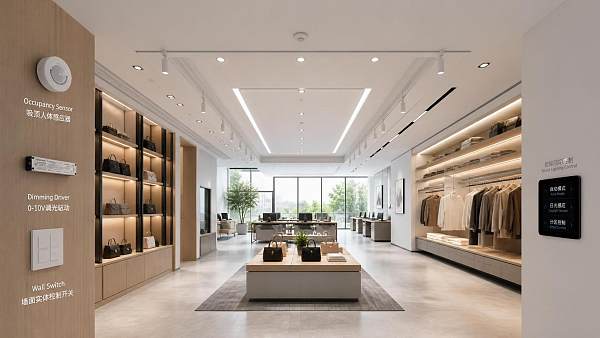
The appropriate control strategy depends on the zone. Sales floors may use programmed scenes that support opening, trading, restocking, and closing periods. Daylight-responsive dimming can be useful near glazed façades or skylights, provided sensors are properly commissioned and do not create visible fluctuations. Occupancy or vacancy controls are usually more appropriate in meeting rooms, storage rooms, staff facilities, service corridors, and low-traffic back-of-house spaces. Exterior signage, entrances, and display windows may require schedules that reflect operating policies and local visibility needs.
Control complexity should not be purchased for its own sake. A networked system can provide granular scheduling, fault monitoring, and portfolio-level visibility, but it also introduces commissioning requirements, interfaces, training, and potential support obligations. In a small store with stable hours and limited zones, well-designed local controls may offer a stronger return. In a multi-store portfolio with varied schedules or high maintenance coordination costs, centralized visibility may justify a more sophisticated approach.
Questions that prevent control savings from being lost in operation
- Who sets schedules after handover, and can store managers make temporary adjustments without overriding the base program?
- Are emergency, security, cleaning, and trading circuits clearly separated?
- Will sensors be positioned away from air movement, display changes, and other sources of false triggering?
- Has the dimming range been checked with the selected drivers, rather than assumed from a controls specification?
- Is there a documented commissioning process to verify scenes, time schedules, sensor response, and manual override behavior?
Controls that are difficult to understand tend to be bypassed. The financial case should therefore include the practical cost of keeping the strategy in use, not just the theoretical reduction in energy demand.
Maintenance economics deserve the same scrutiny as energy economics
LED lighting is often described as low maintenance, which can be true compared with older lamp technologies, but it does not mean maintenance-free. Lumen output gradually declines, drivers can fail before the LED array, and a failed unit in a high ceiling can require access equipment and coordination outside normal trading hours. The design should make those events manageable.
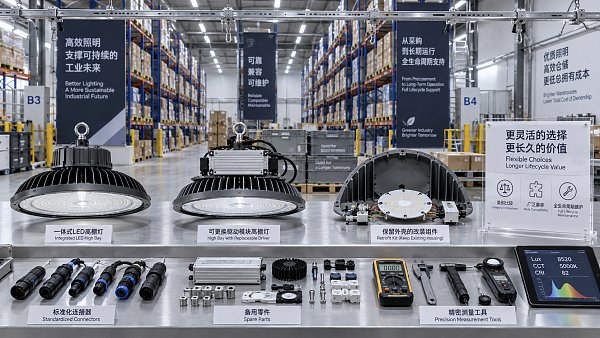
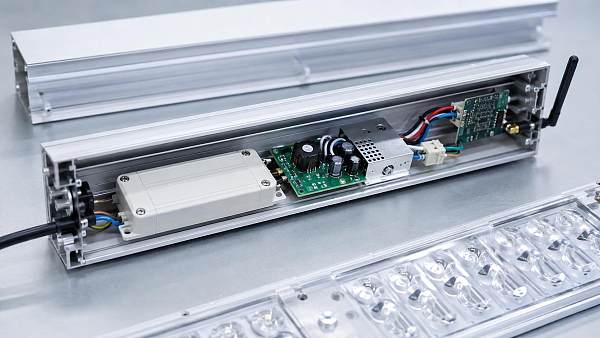
When reviewing a luminaire, ask whether the driver is replaceable, whether replacement requires removing the entire fixture, and whether compatible components are likely to remain available through the intended operating period. A sealed integrated fixture can be appropriate in some locations, particularly where access is simple and the fixture cost is modest. It becomes harder to justify where each failure requires a lift, closure of a selling zone, or specialist labor.
Durability also has an energy and cost dimension. Heat management influences component life. Fixtures installed in enclosed ceiling voids, near heat-producing equipment, or in high ambient temperatures may not perform as they would in ideal test conditions. Dust accumulation can reduce optical output and lead teams to increase lighting levels unnecessarily. In entrance areas or covered exterior locations, moisture and environmental exposure may require a housing and ingress-protection level suited to the actual site condition.
Procurement documents should identify the maintenance assumptions behind the proposal. That includes cleaning intervals, expected component replacement procedures, spare-part strategy, access constraints, and whether failure reporting is available. A design that is economical on paper but difficult to service can produce unplanned costs throughout the portfolio.
Build the approval case around lifecycle comparison
A credible comparison does not need speculative claims or exaggerated savings figures. It needs consistent assumptions applied to each option. Evaluate proposed designs over the same review period and include costs that the organization will actually bear.
The basic model can be expressed as:
Lifecycle cost = initial equipment and installation cost + electricity cost + planned maintenance cost + expected replacement and disruption cost.
Electricity cost should be based on estimated annual operating hours by zone, not a single blanket value for the store. Where controls are proposed, show the assumed hours or dimming profiles separately. That makes it easier to challenge unrealistic assumptions and to understand which part of the benefit depends on commissioning and operating discipline.
Maintenance estimates should distinguish between routine cleaning, replaceable drivers or lamps where applicable, complete fixture replacement, labor, access equipment, and work undertaken outside trading hours. It is also useful to identify costs that are difficult to quantify but operationally material, such as blocked aisles, disruption to visual merchandising, or inconsistent appearance caused by mixed replacement products.
For a portfolio decision, avoid allowing a single flagship location to determine the specification for every site. High-ceiling stores, mall units with limited daylight, compact street locations, and stores with long operating hours may justify different control and fixture choices. Standardization still has value because it simplifies spares, training, and maintenance procedures, but it should be based on a limited family of proven applications rather than one identical solution forced into every format.
Separate capital cost reductions from false economies
Pressure to reduce project cost often produces a familiar set of changes: fewer control zones, lower-grade drivers, fixtures with limited serviceability, reduced commissioning time, or a broad replacement of efficient luminaires with lower-cost alternatives. Some reductions may be sensible. Others transfer cost from the capital budget into operations without a clear record of the trade-off.
A practical approval process asks the design and procurement teams to identify each proposed value-engineering change in plain terms. What cost is removed now? Which operating assumption changes? Does the change affect energy, maintenance access, product presentation, or future replacement compatibility? Is the saving repeated across the portfolio, and does the risk repeat as well?
This approach is especially important when comparing quotations that appear similar. Two LED fixture schedules may show comparable wattage and color temperature while differing substantially in optical performance, thermal construction, driver quality, controls compatibility, warranty terms, and serviceability. The lower quotation may be justified, but it should not be treated as equivalent until those operational differences are visible.
Approve energy-efficient design with measurable handover requirements
The expected operating cost reduction should survive beyond installation. Require an asset record that lists fixture types, locations, circuit or control zones, driver details, dimming method, and replacement procedures. Ask for final settings for time schedules and scenes, along with a clear record of any changes made during commissioning. Without this information, later maintenance teams may replace failed items with unsuitable alternatives or reset controls to full output simply because the original logic is unclear.
After opening, compare actual operating behavior with the approved assumptions. This does not require an elaborate audit. Check whether scheduled zones are operating as intended, whether daylight and occupancy controls are accepted by staff, whether display areas are being over-lit to compensate for poor aiming, and whether early failures cluster in a specific fixture type or location. These observations help distinguish a design issue from an installation, commissioning, or operating issue.
Energy-efficient design delivers its strongest financial value when light output, hours of use, controls, and maintainability are considered together. A proposal that documents those relationships gives approvers a clearer basis for choosing between low initial price and lower long-term operating cost.
News Recommendations
 How energy-efficient design reduces operating costs in retail lighting
![51a6ab95581761cc26f4318be6520c15]()
Aris Katos
Future of Carbide Coatings
 When commercial aluminum storefronts make sense for a retail renovation
![51a6ab95581761cc26f4318be6520c15]()
Aris Katos
Future of Carbide Coatings
 What makes LED lights durable in high-use commercial spaces?
![51a6ab95581761cc26f4318be6520c15]()
Aris Katos
Future of Carbide Coatings
 Which industry categories offer the strongest export potential in Latin America?
![51a6ab95581761cc26f4318be6520c15]()
Aris Katos
Future of Carbide Coatings
 How to choose an ultra bright waterproof window display for storefronts
![51a6ab95581761cc26f4318be6520c15]()
Aris Katos
Future of Carbide Coatings
 How to verify suppliers on a trade portal for global sourcing
![51a6ab95581761cc26f4318be6520c15]()
Aris Katos
Future of Carbide Coatings
 How RoHS requirements should be stated in product specifications
![51a6ab95581761cc26f4318be6520c15]()
Aris Katos
Future of Carbide Coatings
 What affects the lead time for custom retail counter displays?
![51a6ab95581761cc26f4318be6520c15]()
Aris Katos
Future of Carbide Coatings
 What consumer packaging USA importers need to verify before ordering
![51a6ab95581761cc26f4318be6520c15]()
Aris Katos
Future of Carbide Coatings
 How commercial spaces interiors shape customer dwell time
![51a6ab95581761cc26f4318be6520c15]()
Aris Katos
Future of Carbide Coatings
 How LED commercial lighting design reduces glare in retail spaces
![51a6ab95581761cc26f4318be6520c15]()
Aris Katos
Future of Carbide Coatings
 How industrial technology information improves RFID inventory accuracy
![51a6ab95581761cc26f4318be6520c15]()
Aris Katos
Future of Carbide Coatings
 When drip garden watering systems make more sense than sprinklers
![51a6ab95581761cc26f4318be6520c15]()
Aris Katos
Future of Carbide Coatings
 When category comparison improves sourcing for industrial applications
![51a6ab95581761cc26f4318be6520c15]()
Aris Katos
Future of Carbide Coatings
 Industrial application guidance for selecting the right LED lighting
![51a6ab95581761cc26f4318be6520c15]()
Aris Katos
Future of Carbide Coatings
 Which commercial architecture standards apply to European retail fit-outs?
![51a6ab95581761cc26f4318be6520c15]()
Aris Katos
Future of Carbide Coatings
 How to verify FDA requirements for maternity care products
![51a6ab95581761cc26f4318be6520c15]()
Aris Katos
Future of Carbide Coatings
 How to verify BPA-free claims for food-contact products
![51a6ab95581761cc26f4318be6520c15]()
Aris Katos
Future of Carbide Coatings
 When does a European wholesale supplier suit modular office projects?
![51a6ab95581761cc26f4318be6520c15]()
Aris Katos
Future of Carbide Coatings
 When consumer ecosystem solutions improve the in-store shopping journey
![51a6ab95581761cc26f4318be6520c15]()
Aris Katos
Future of Carbide Coatings
 How a commercial developers network can reduce site selection risk
![51a6ab95581761cc26f4318be6520c15]()
Aris Katos
Future of Carbide Coatings
 How clear purchasing specifications prevent costly supplier deviations
![51a6ab95581761cc26f4318be6520c15]()
Aris Katos
Future of Carbide Coatings
 What an ISTA drop test lab checks before your packaging ships
![51a6ab95581761cc26f4318be6520c15]()
Aris Katos
Future of Carbide Coatings
 Which commercial furniture standards apply to workplace seating?
![51a6ab95581761cc26f4318be6520c15]()
Aris Katos
Future of Carbide Coatings
 How to evaluate smart lighting module OEM compatibility before sampling
![51a6ab95581761cc26f4318be6520c15]()
Aris Katos
Future of Carbide Coatings
 How to assess whether sustainable technology delivers real impact
![51a6ab95581761cc26f4318be6520c15]()
Aris Katos
Future of Carbide Coatings
 How to assess an OEM supplier’s quality control before ordering
![51a6ab95581761cc26f4318be6520c15]()
Aris Katos
Future of Carbide Coatings
 How consumer ecosystem solutions data can improve retail personalization
![51a6ab95581761cc26f4318be6520c15]()
Aris Katos
Future of Carbide Coatings
 When does consumer packaging design justify a higher product price?
![51a6ab95581761cc26f4318be6520c15]()
Aris Katos
Future of Carbide Coatings
 Supermarket Fixture Installation: Planning Layouts, Wiring, and Handover
![51a6ab95581761cc26f4318be6520c15]()
Aris Katos
Future of Carbide Coatings
 Automated Lighting and Smart Lighting Control in Bergerac: Key Project Considerations
![51a6ab95581761cc26f4318be6520c15]()
Aris Katos
Future of Carbide Coatings
 Segment Streetlight Controllers: Choosing Control Modes for Urban Roads
![51a6ab95581761cc26f4318be6520c15]()
Aris Katos
Future of Carbide Coatings
 IEC 62471-2 Explained: How to Assess Photobiological Risks in LED Lighting
![51a6ab95581761cc26f4318be6520c15]()
Aris Katos
Future of Carbide Coatings
 Food Grade Packaging Requirements by Product Type, Temperature, and Contact Risk
![51a6ab95581761cc26f4318be6520c15]()
Aris Katos
Future of Carbide Coatings
 Food Packaging Compliance Checklist: Tests, Records, and Labeling Before Shipment
![51a6ab95581761cc26f4318be6520c15]()
Aris Katos
Future of Carbide Coatings
 NSF Food Packaging Standards: When Certification Matters for Commercial Food Use
![51a6ab95581761cc26f4318be6520c15]()
Aris Katos
Future of Carbide Coatings
 FDA Food Grade Compliance: Which Materials and Documents Do Buyers Need?
![51a6ab95581761cc26f4318be6520c15]()
Aris Katos
Future of Carbide Coatings
 What Should a Food Grade Declaration Include for Packaging Compliance?
![51a6ab95581761cc26f4318be6520c15]()
Aris Katos
Future of Carbide Coatings
 Housewares Importing: How to Evaluate Suppliers, Costs, and Compliance Risks
![51a6ab95581761cc26f4318be6520c15]()
Aris Katos
Future of Carbide Coatings