
What an ISTA drop test lab checks before your packaging ships
Time
Click Count
An ISTA drop test lab examines whether a packaged product remains protected after the handling shocks that occur between dispatch and delivery. The test is not a simple exercise in dropping a box until it fails. It evaluates the relationship between the product, its protective materials, the outer pack, the closure method, and the distribution environment represented by the selected test procedure.
A package can look undamaged after a drop while the product inside has shifted, cracked, leaked, lost calibration, or sustained a cosmetic defect that becomes visible only after unpacking. The lab therefore assesses both external package condition and internal product condition. A meaningful result requires the test sample to represent the actual shipping configuration: the same carton size, corrugated grade, inserts, tape pattern, void fill, product orientation, and declared gross weight intended for shipment.
Test selection starts with the distribution profile
ISTA procedures are selected to simulate defined distribution hazards rather than to create a universal “pass” or “fail” label. A parcel shipped individually through a parcel network faces a different handling pattern from a unit load moving by pallet, or a retail-ready carton transported in a mixed load. The lab first needs to understand how the pack travels, how it is handled, and whether it remains intact as a single shipment unit.
Drop height, impact sequence, package orientation, and preconditioning requirements are tied to the procedure and the package category. A small parcel, a long narrow carton, a heavy boxed item, and a palletized load do not receive the same treatment. Using an unsuitable profile can produce an apparently positive result that has little relevance to real distribution.
The chosen test should also match the product’s shipment state. A consumer appliance tested with all loose accessories separately bagged may perform differently from the production pack with accessories placed in the same cavity as the main item. Likewise, a display carton intended to ship inside a master case should not be assessed as though it were a direct-to-consumer parcel unless both channels are genuinely used.
What the first inspection reveals
Before any drop, the lab records identifying details and examines the sample for conditions that would distort the result. This includes the outer dimensions, mass, center-of-gravity tendencies, carton construction, seam location, flap arrangement, closure material, labels, and visible damage from prior handling. Measurements establish whether the submitted sample matches the specification rather than merely resembling it.
Corrugated board requires particular attention. Its compression and cushioning behavior change with moisture exposure and storage conditions. A carton converted from board with adequate strength can still perform poorly when excessive humidity softens the structure, especially around edges and score lines. Conversely, a dry sample may appear more robust than stock exposed to a humid shipping route. Conditioning is therefore part of test validity when the selected procedure calls for it.
The lab also verifies the actual filled weight. Packaging often changes after development: a revised product component, heavier instruction set, larger battery, added retail security element, or different insert can shift the load enough to alter impact performance. A lightweight early sample is not a substitute for the released configuration.
Impact orientation is a diagnostic tool
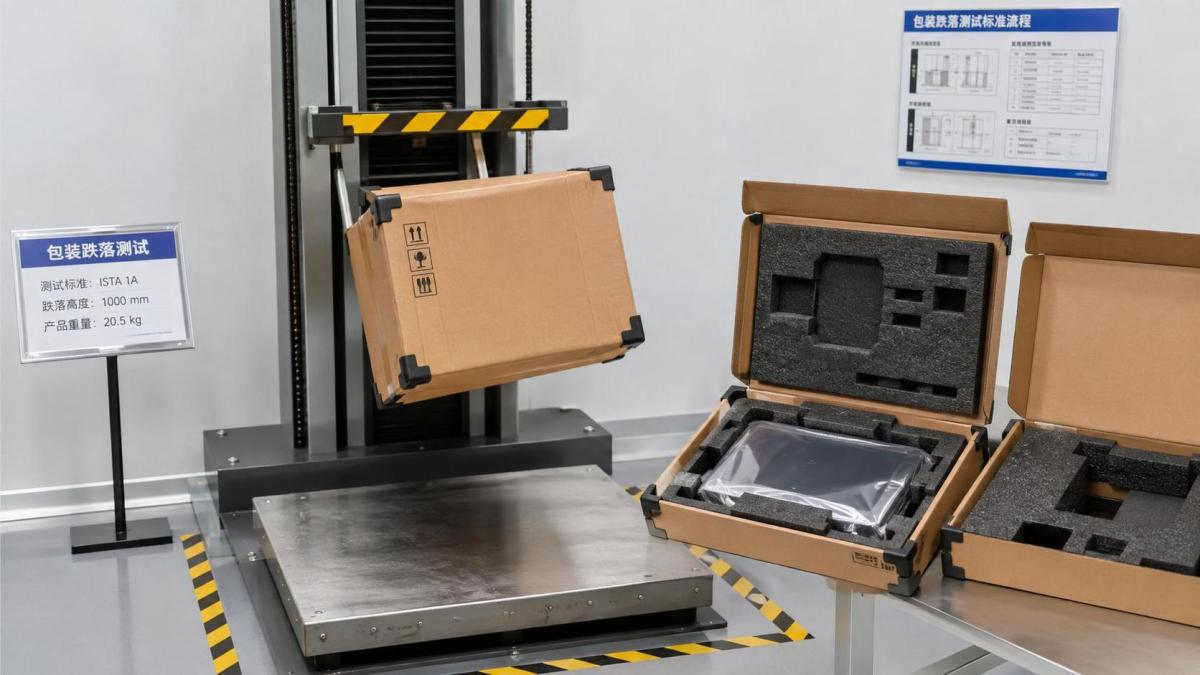
Drop testing deliberately exposes the package to different impact orientations because each orientation loads a different part of the system. A flat-face drop distributes force over a wider area. An edge drop concentrates the impact along a narrow line and often exposes weak score lines, inadequate corner protection, or poor load transfer between inner and outer packs. A corner drop creates a concentrated shock path that can damage a product even when the carton shows only a small dent.
The sequence matters. Early impacts can loosen tape, fracture a molded pulp feature, compress foam, or create a partial tear in the corrugated board. A later drop then acts on a package that no longer has its original integrity. Treating each drop as an isolated event can hide this cumulative effect. The inspection after every event records progression: whether deformation remains local, whether a seam opens further, whether the contents migrate, and whether protective components stay seated.
Long products deserve separate scrutiny because the center of gravity may not sit at the geometric center of the carton. A long lighting fixture, framed panel, furniture component, or equipment enclosure can rotate unexpectedly at impact. The visible corner may receive the first contact, while internal bending transfers force toward a distant support point. In such packs, the placement and stiffness of end caps often matter as much as their thickness.
The outer carton is only one part of the result
A common interpretation error is to judge performance from carton appearance alone. Moderate crushing of an outer carton is not automatically a failure if the deformation is expected and the product remains protected. On the other hand, a carton that springs back neatly may conceal severe internal acceleration if the cushioning material is too rigid, too thin, or poorly positioned.
The lab looks for evidence that the packaging system managed energy in a controlled way. That may include designed compression of cushioning, controlled panel flexing, or sacrificial deformation at a protective corner. The important question is whether the package preserved the required protection and functional condition of the contents after the prescribed sequence.
Internal examination commonly focuses on the following failure patterns:
- Product migration: the item moves within the pack and reaches a carton wall, leaving insufficient clearance for later impacts.
- Cushion collapse: foam, paper-based pads, air cells, or molded inserts compress permanently and no longer maintain the intended stand-off distance.
- Load concentration: a rigid feature such as a metal bracket, bottle base, connector, or sharp product edge presses through a local area of the insert.
- Component-to-component contact: accessories, cables, fasteners, or multiple units strike one another because partitions or retaining features do not hold them apart.
- Closure loss: tape peels, adhesive bonds release, staples pull through, or interlocking flaps disengage after impact.
These observations distinguish a packaging-material problem from a pack-out problem. Adding stronger board will not correct an insert that leaves a heavy product free to slide. Adding thicker foam will not reliably solve a closure failure caused by contaminated tape application surfaces or an unsuitable flap geometry.
Damage criteria must be defined before the sample is dropped
An ISTA drop test lab needs clear acceptance criteria for both the package and the contents. “No damage” is often too vague to support a defensible release decision. A dent hidden by a retail sleeve, a scuff on an internal component, and a cracked functional housing have different significance. The criteria should identify what constitutes unacceptable cosmetic damage, loss of functionality, leakage, opening, breakage, unsafe exposed edges, loss of tamper evidence, or inability to stack and handle the pack afterward.
Functional inspection should reflect the product’s actual vulnerabilities. For an electronic item, that can include fit of connectors, switch operation, display condition, or retention of battery contacts. For containers and refill packs, cap integrity, seam condition, and leakage are relevant. For commercial fixtures and assembled goods, inspect glass, coatings, fastener retention, alignment, and any component that could detach during handling. The test report is stronger when the observed condition is connected to a stated acceptance requirement rather than subjective language such as “looks acceptable.”
Photography supports traceability, but it does not replace direct examination. Interior damage can be missed when the product is removed before the package condition is documented, or when the sample is reassembled between drops. Recording the orientation, impact number, visible package change, and product condition preserves the chain of evidence needed to compare later design revisions.
Carton construction and closure details often decide the outcome
Drop performance is sensitive to small construction choices. A manufacturer’s joint placed near a repeatedly impacted edge may open sooner than a joint located on a less exposed panel. Tape width alone does not define closure strength; overlap, application pressure, adhesive compatibility, dust on the board surface, and the amount of stress carried by the flaps all influence release behavior.
Board strength values should not be interpreted in isolation. A carton with heavier board may resist puncture and compression, yet transmit a harsher shock to a fragile product if the internal protective system is unchanged. Board direction, score quality, die-cut geometry, hand holes, ventilation openings, and print coverage can create local weak zones. Recycled-content materials and fiber variation can also require closer control of converting quality, because a packaging design that is tolerant of one board supply may have less margin with another.
For multi-pack or master-carton designs, the relationship between units matters. Empty headspace can allow an upper layer to gather momentum and crush a lower layer. A tightly filled carton can create the opposite issue: direct product contact transfers impact across the entire load. Dividers need enough structural support to keep separation through the drop sequence, not simply enough height to look protective before shipment.
Preconditioning and sample control prevent misleading passes
Packages do not enter every distribution route in laboratory-fresh condition. Exposure to temperature and humidity can alter paperboard stiffness, tape performance, adhesive bonds, plastic brittleness, and the resilience of cushioning. When conditioning applies, the sample must be held under the required environment for the appropriate period and tested without uncontrolled delay. A carton left in a different environment for too long before testing may no longer represent the conditioned state.
Sample variation is another source of false confidence. Hand-built prototypes frequently have cleaner folds, more carefully applied tape, and more precisely placed inserts than production packs. The test sample should include normal manufacturing tolerances: the intended adhesives, actual cutting and scoring, realistic sealing method, final labeling, and the pack-out sequence used on the line. Where a design depends on tight insert placement, small dimensional drift in the product or die-cut part should be examined rather than assumed away.
Retesting after a failure should isolate the change being evaluated. If board grade, insert geometry, tape, product mass, and packing method all change at once, a passing retest identifies no reliable cause. Controlled revision makes the result useful for release and for future troubleshooting.
Reading common failures correctly
A crushed corner does not always mean the corner protector failed. The impact may have driven the product toward that corner because clearance on the opposite side was excessive. A split carton seam can indicate weak tape adhesion, but it can also show that internal load shifted and forced the flaps outward. A broken molded pulp insert may result from insufficient section thickness, poor support beneath the insert, or a product feature applying pressure at a point outside the intended load path.
Damage that appears only after several drops deserves close analysis. It often signals progressive loss of protection: cushioning set, loosening retention, expanding board tears, or a closure that has started to peel. By contrast, immediate damage on the first corner impact more often points to inadequate local clearance, a brittle component, a sharply concentrated load, or a package orientation that leaves a vulnerable area directly exposed.
Drop-test results should be read alongside the shipment configuration. A package that survives laboratory drops but is later overpacked, stretch-wrapped too tightly, strapped across a weak panel, or loaded under incompatible weight can encounter a different failure mechanism. The tested configuration should remain identifiable through packaging specifications, approved materials, and packing instructions so that production shipment does not drift away from the evaluated design.
A useful lab outcome is therefore a documented understanding of where impact energy travels, which component absorbs it, and what condition remains after the prescribed sequence. That evidence supports a packaging release based on the real shipping unit rather than the appearance of an undamaged box.
News Recommendations
 How to verify Zigbee compatibility when sourcing lighting sensors
![51a6ab95581761cc26f4318be6520c15]()
Aris Katos
Future of Carbide Coatings
 How do packaging customization options affect minimum order quantities in Europe?
![51a6ab95581761cc26f4318be6520c15]()
Aris Katos
Future of Carbide Coatings
 Transom to Acquire Cree LED in Commercial Lighting Ownership Change
![51a6ab95581761cc26f4318be6520c15]()
Aris Katos
Future of Carbide Coatings
 How to plan customer flow in commercial design planning
![51a6ab95581761cc26f4318be6520c15]()
Aris Katos
Future of Carbide Coatings
 USTR Urged to Permanently Suspend Fees on China-Linked Ships
![51a6ab95581761cc26f4318be6520c15]()
Aris Katos
Future of Carbide Coatings
 How to choose comparable stores for retail benchmarking
![51a6ab95581761cc26f4318be6520c15]()
Aris Katos
Future of Carbide Coatings
 How does anchoring affect modular building wind load resistance?
![51a6ab95581761cc26f4318be6520c15]()
Aris Katos
Future of Carbide Coatings
 Amazon Raises European FBA Surcharge to 2% in Ten Markets From November 2
![51a6ab95581761cc26f4318be6520c15]()
Aris Katos
Future of Carbide Coatings
 How to verify a BPA-free test report for baby products
![51a6ab95581761cc26f4318be6520c15]()
Aris Katos
Future of Carbide Coatings
 China's Mandatory Classroom Lighting Standard GB 7793-2025 Takes Effect November 1
![51a6ab95581761cc26f4318be6520c15]()
Aris Katos
Future of Carbide Coatings
 How order volume affects the price of wholesale poly mailers
![51a6ab95581761cc26f4318be6520c15]()
Aris Katos
Future of Carbide Coatings
 US Imposes 50% Tariff on Certain Canadian PET Resin Imports
![51a6ab95581761cc26f4318be6520c15]()
Aris Katos
Future of Carbide Coatings
 How to read the maximum ratings in a semiconductor datasheet
![51a6ab95581761cc26f4318be6520c15]()
Aris Katos
Future of Carbide Coatings
 University of Maryland Develops Bio-Based Packaging to Extend Avocado and Cucumber Shelf Life
![51a6ab95581761cc26f4318be6520c15]()
Aris Katos
Future of Carbide Coatings
 How to verify a cookware manufacturer's induction compatibility claims
![51a6ab95581761cc26f4318be6520c15]()
Aris Katos
Future of Carbide Coatings
 Omdia Forecasts 11.6% Annual Growth in LED Display Revenue Through 2030
![51a6ab95581761cc26f4318be6520c15]()
Aris Katos
Future of Carbide Coatings
 How to verify a pulp molding packaging factory's production capacity
![51a6ab95581761cc26f4318be6520c15]()
Aris Katos
Future of Carbide Coatings
 Curion Survey: Half of Consumers Frustrated by Sustainable Packaging
![51a6ab95581761cc26f4318be6520c15]()
Aris Katos
Future of Carbide Coatings
 How to assess the credibility of market insight content
![51a6ab95581761cc26f4318be6520c15]()
Aris Katos
Future of Carbide Coatings
 US Removes 50% Additional Tariff on Selected Canadian Packaging Products
![51a6ab95581761cc26f4318be6520c15]()
Aris Katos
Future of Carbide Coatings
 Will a waterproof dimmable LED driver work with your existing dimmer?
![51a6ab95581761cc26f4318be6520c15]()
Aris Katos
Future of Carbide Coatings
 Charter Next Generation Raises Film PCR Use 30%, Advances Food-Grade Applications
![51a6ab95581761cc26f4318be6520c15]()
Aris Katos
Future of Carbide Coatings
 How to choose a dog harness and leash for a dog that pulls hard
![51a6ab95581761cc26f4318be6520c15]()
Aris Katos
Future of Carbide Coatings
 How to respect local customs when negotiating with overseas suppliers
![51a6ab95581761cc26f4318be6520c15]()
Aris Katos
Future of Carbide Coatings
 RFID Recycling Challenges Bring Paper-Based and Chipless Tags Into Focus
![51a6ab95581761cc26f4318be6520c15]()
Aris Katos
Future of Carbide Coatings
 How to choose commercial lighting for offices that reduces glare
![51a6ab95581761cc26f4318be6520c15]()
Aris Katos
Future of Carbide Coatings
 Queue Launches Fully Automated Robotic Pharmacy Kiosk for 30-Second Dispensing
![51a6ab95581761cc26f4318be6520c15]()
Aris Katos
Future of Carbide Coatings
 Can your supermarket store fixtures supplier meet your opening date?
![51a6ab95581761cc26f4318be6520c15]()
Aris Katos
Future of Carbide Coatings
 Shopify POS UI Extensions 2026-10 Adds Virtual Lists and Custom Row Templates
![51a6ab95581761cc26f4318be6520c15]()
Aris Katos
Future of Carbide Coatings
 How to assess smart office furniture suppliers’ North American support
![51a6ab95581761cc26f4318be6520c15]()
Aris Katos
Future of Carbide Coatings
 Aqara Launches Smart Lighting Range to Advance AI Spatial Intelligence
![51a6ab95581761cc26f4318be6520c15]()
Aris Katos
Future of Carbide Coatings
 How to assess demand forecasts in a lighting intelligence report
![51a6ab95581761cc26f4318be6520c15]()
Aris Katos
Future of Carbide Coatings
 Billerud推出PharmaKraft纤维基医药包装材料
![51a6ab95581761cc26f4318be6520c15]()
Aris Katos
Future of Carbide Coatings
 How to assess supplier reliability in global supply chain sourcing
![51a6ab95581761cc26f4318be6520c15]()
Aris Katos
Future of Carbide Coatings
 Omdia Forecasts 11.6% CAGR for Global LED Video Display Market in 2026–2030
![51a6ab95581761cc26f4318be6520c15]()
Aris Katos
Future of Carbide Coatings
 How to verify an LFGB testing laboratory's accreditation scope
![51a6ab95581761cc26f4318be6520c15]()
Aris Katos
Future of Carbide Coatings
 How to assess a workplace interior supplier's installation scope
![51a6ab95581761cc26f4318be6520c15]()
Aris Katos
Future of Carbide Coatings
 What records are needed for an ISO 9001 furniture factory audit?
![51a6ab95581761cc26f4318be6520c15]()
Aris Katos
Future of Carbide Coatings
 How to choose AI marketing tools that work with your existing CRM
![51a6ab95581761cc26f4318be6520c15]()
Aris Katos
Future of Carbide Coatings







































