
How to verify BPA-free claims for food-contact products
Time
Click Count
For quality control and safety managers, a “BPA-free” label can look reassuring and still leave important questions unanswered. Which component is BPA-free: the bottle, the lid, the printed coating, or the entire finished article? Was the claim based on a supplier declaration, a screening result, or testing under realistic food-contact conditions? And does the evidence support the markets where the product will actually be sold?
A dependable bpa free compliance guide has to go beyond marketing language. It should connect material identity, formulation control, migration risk, applicable regulations, laboratory evidence, and document traceability. This is particularly important for food packaging, reusable containers, beverage-service items, can linings, food-processing accessories, and retail-ready consumer goods that pass through several converters before reaching a brand owner.
The goal is not merely to obtain a test report. It is to build a verification record that can withstand internal audits, retailer reviews, customer questions, and regulatory scrutiny.
“BPA-free” is a claim, not a complete compliance conclusion
Bisphenol A (BPA) is a chemical historically associated with certain polycarbonate plastics and epoxy resins. In food-contact applications, its relevance often extends beyond an obvious plastic container. Epoxy-based coatings in metal packaging, internal lacquer layers, adhesives, inks, thermal labels, recycled-content streams, and assembled components may all require review depending on the product design.
This creates a common but costly mistake: a purchaser confirms that the main substrate is not polycarbonate and assumes the product is BPA-free. That conclusion may be incomplete. A food-contact article is usually a system of materials, and a consumer’s food or beverage may touch more than one of them.
Quality teams should also distinguish among three statements that are often treated as interchangeable:
- “No BPA intentionally added” indicates a formulation or manufacturing declaration. It does not automatically address impurities, recycled feedstock, contamination, or migration.
- “BPA not detected” depends on the test method, sample preparation, reporting limit, and laboratory scope. A non-detect result is only meaningful when those details are known.
- “Compliant for food contact” is a broader regulatory conclusion. It may require assessment of overall migration, specific migration, substances other than BPA, and conditions of intended use.
A defensible claim should say only what the evidence supports. If the available proof concerns the base resin alone, do not extend the statement to a decorated, coated, assembled product without additional verification.
Start with the actual product and its food-contact map
Before requesting documents from a supplier, define what is being assessed. A brief product map makes later testing and document review far more efficient. Record the product SKU, revision, bill of materials, food-contact surfaces, non-food-contact components that could transfer substances, intended food types, temperature exposure, contact duration, reuse cycle, and destination markets.
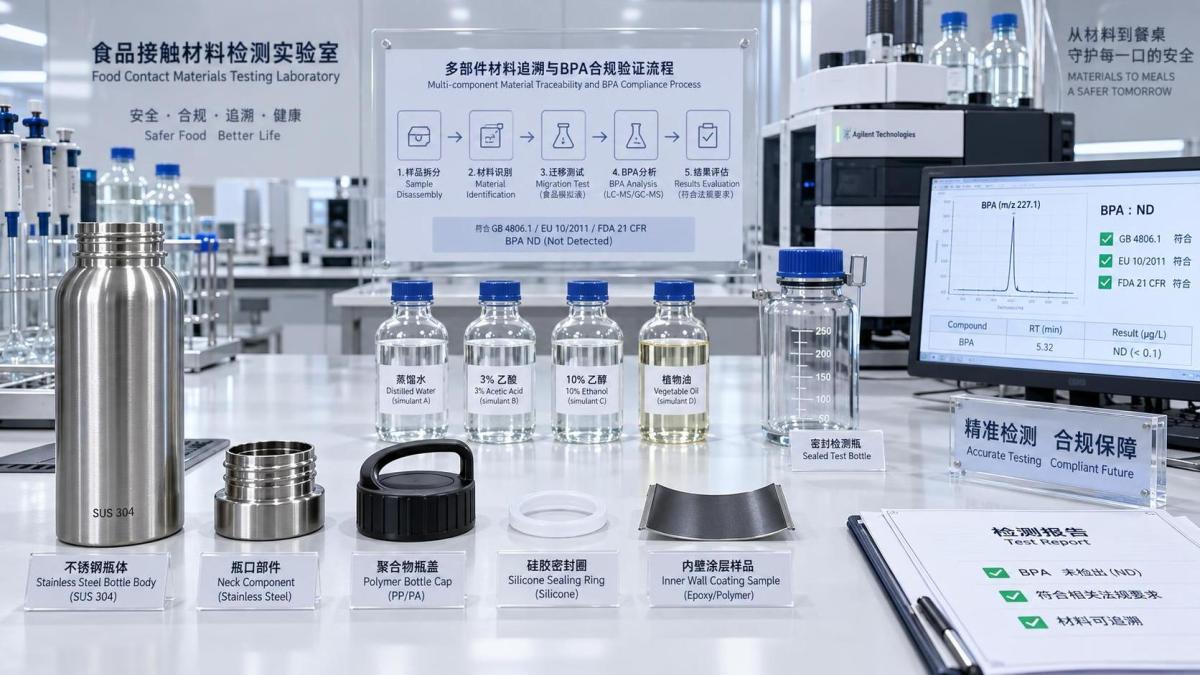
For example, a reusable drink bottle may have a stainless-steel body, polymer cap, silicone seal, printed exterior, adhesive label, and a coating on the inside of the cap. The BPA risk profile is not the same for each part. Hot-fill beverages, acidic drinks, dishwashing, microwave use, and repeated refill cycles also change the migration scenario.
Ask suppliers to identify every material layer and every party responsible for it: resin producer, masterbatch provider, coating manufacturer, printer, molder, converter, and final assembler. A declaration that simply says “BPA-free product” without a component-level scope is weak evidence because it does not reveal where the conclusion came from.
Build the evidence file from the inside out
The strongest verification files begin with traceable source information, then use testing to confirm that the finished product performs as expected. This approach is more reliable than treating a single laboratory report as a substitute for supply-chain control.
1. Obtain a scoped supplier declaration
A useful declaration should identify the exact product or material, supplier legal entity, manufacturing site where relevant, document date, and revision or batch linkage. It should clearly state whether BPA is intentionally used in the formulation and whether the statement applies to the complete finished article or only specified components.
It should also reference the intended food-contact use. A cap suitable for ambient dry food may not have the same supporting rationale as a component intended for high-temperature fatty food contact. Vague phrases such as “meets international standards” should trigger follow-up questions, not approval.
For multi-layer packaging or assembled consumer products, request separate declarations for coatings, adhesives, inks, seals, colorants, and recycled materials when they are relevant to the contact pathway. This is especially important where a converter relies on proprietary formulations and a brand cannot see the full chemical composition.
2. Review technical material identity
Confirm the declared polymer, coating chemistry, or substrate against the product specification and purchase order. Material codes, technical data sheets, resin grades, color specifications, and process records should align. A mismatch between documents is often more revealing than a failed test: it can show uncontrolled substitution or incomplete change management.
For recycled materials, ask how incoming feedstock is controlled and whether the supplier has evaluated potential legacy contamination. “BPA-free” is not established merely because BPA was not deliberately added during the current production run.
3. Use analytical testing for the right question
Analytical testing is valuable, but only when the protocol matches the claim. A direct extraction or screening test may help identify BPA in a material. Migration testing addresses a different question: whether BPA transfers from the finished food-contact article under defined conditions. Neither approach should be described as universally sufficient.
Review the laboratory report for the tested sample description, sample condition, method reference, extraction or migration conditions, simulants used, temperature, time, analytical technique, limit of detection, limit of quantification, measurement uncertainty where reported, and the laboratory’s accreditation scope. The report should identify the laboratory and be traceable to the relevant SKU, lot, or representative production sample.
A report stating “pass” without these essentials is difficult to defend. Equally, a non-detect result with a reporting limit above a customer requirement or applicable threshold may not support the intended claim.
Match the compliance review to the market, not a generic checklist
Food-contact rules vary by jurisdiction, material type, and use condition. There is no single global BPA-free certificate that automatically clears a product for every market. Regulatory review should be market-specific and should distinguish legal restrictions from voluntary retailer or brand policies.
In the United States, FDA food-contact requirements are evaluated within a framework that includes authorized food-contact substances, relevant clearances, and good manufacturing practice considerations. In the European Union, food-contact compliance may involve framework requirements, material-specific rules, declarations of compliance, and migration testing principles. BPA restrictions have also evolved, including more recent EU measures affecting BPA and certain other bisphenols in food-contact materials and articles. Transitional provisions may apply, so teams should verify the current legal text and effective dates for the precise product category.
Other markets may apply their own positive lists, migration limits, labeling expectations, or import documentation practices. A European declaration cannot simply be relabeled as a universal compliance document, and a US-focused supplier letter may not satisfy an EU customer’s documentation expectations.
For global sourcing programs, maintain a regulatory matrix that links each SKU family to destination markets, applicable material rules, customer specifications, required documentation, test frequency, and responsible owner. This is where an intelligence repository such as G-BCE can support sourcing and technical teams: not by replacing legal review, but by helping compare material evidence, technical benchmarks, and supply-chain documentation across regions and product categories.
Choose migration conditions that reflect foreseeable use
A laboratory result is only as relevant as its test conditions. Food simulants and exposure parameters should represent reasonably foreseeable use, including the most demanding credible scenario. A cold-storage tray, a hot soup cup, and a reusable food container exposed to dishwashing do not present the same migration challenge.
When reviewing a proposed test plan, ask practical questions:
- Will the article contact aqueous, acidic, alcoholic, fatty, or dry foods?
- Is it filled hot, heated in use, sterilized, frozen, or stored for long periods?
- Is it single-use or repeatedly used and washed?
- Which surface actually contacts food, and what is its surface-area-to-volume relationship?
- Could a coating, adhesive, or print layer migrate through the structure or transfer during stacking?
The answer may justify additional testing, a more conservative simulant selection, or separate assessment of components. Do not assume that a test on a flat plaque represents a molded article with seams, closures, flex points, or a different material thickness.
Watch for the evidence gaps that repeatedly cause trouble
Some documentation packages look complete until they are reviewed line by line. The following gaps deserve immediate attention:
- Outdated reports: The test predates a formulation, colorant, coating, supplier, or tooling change.
- Wrong sample: Testing was performed on generic resin pellets, while the supplied article includes pigments, additives, coatings, or recycled content.
- Unclear scope: A declaration covers “plastic parts” but says nothing about seals, cap liners, inks, adhesives, or metal coatings.
- Missing use conditions: The report does not identify food simulants, temperature, contact time, or repeated-use cycles.
- Unsupported language: Sales materials say “100% BPA-free,” while technical documents only say BPA is not intentionally added.
- No change notification process: The supplier cannot demonstrate that a material or process change would trigger renewed assessment.
One subtle risk is relying on BPA testing while ignoring substitute chemistry. A BPA-free claim does not mean a product has been evaluated for every bisphenol or every other substance of concern. If a customer specification addresses BPS, BPF, or broader restricted-substance criteria, those requirements must be assessed separately. The compliance question should never be narrowed so far that it misses the actual procurement requirement.
A practical approval workflow for quality teams
Rather than approving claims case by case through email, establish a repeatable workflow. It does not need to be bureaucratic; it needs to make decisions visible and reproducible.
- Define the claim and market scope. Decide whether the business needs “BPA-free,” “no intentionally added BPA,” a food-contact compliance statement, or a combination of these.
- Create the product contact map. Identify materials, layers, food-contact surfaces, use conditions, and manufacturing sites.
- Collect supplier evidence. Request scoped declarations, technical specifications, regulatory statements, and traceability records.
- Assess risk and testing needs. Prioritize complex assemblies, coatings, recycled materials, hot or fatty-food applications, and high-volume products.
- Review test relevance. Confirm that samples, methods, reporting limits, and migration conditions support the intended claim.
- Approve controlled wording. Ensure packaging, e-commerce copy, and customer documents use language consistent with the evidence.
- Maintain the file. Link records to SKU revisions, supplier lots where appropriate, and change-control triggers.
Approval should be conditional where evidence is incomplete. For instance, a product may be approved for a limited market or use condition while additional migration data is pending. This is more honest—and often safer—than forcing a universal conclusion from partial information.
Document control is what makes the claim defensible
A strong file should allow a new quality manager, auditor, or customer reviewer to understand the decision without relying on institutional memory. Keep the claim rationale, declarations, specifications, test reports, correspondence that clarifies scope, risk assessment, approval record, artwork language, and change history together under document control.
Set renewal triggers rather than relying solely on arbitrary annual updates. Reassessment should occur when a supplier changes resin grade, additive package, coating, colorant, manufacturing location, recycled-content source, curing process, or intended use. A regulation change or a new customer requirement may also require review. For stable, low-risk products, periodic reconfirmation can supplement change-based control.
For global commercial environments, where product sourcing intersects with retail operations, hospitality, workplace services, and sustainable packaging programs, this discipline protects more than a label. It helps procurement teams compare like with like, gives safety managers a clear escalation path, and reduces the chance that a reassuring consumer-facing statement outruns the technical evidence behind it.
When can you reasonably sign off on a BPA-free claim?
A claim is ready for release when its wording is defined, its scope is clear, the product’s contact materials are mapped, supplier declarations are traceable, testing is relevant where needed, and applicable market requirements have been reviewed. There should also be a documented owner for future changes.
The most useful bpa free compliance guide is therefore not a one-page certificate checklist. It is a controlled decision process. When material declarations, migration evidence, regulatory interpretation, and supply-chain change management all point in the same direction, quality teams can communicate with confidence—without making broader promises than the product can support.
News Recommendations
 How do packaging customization options affect minimum order quantities in Europe?
![51a6ab95581761cc26f4318be6520c15]()
Aris Katos
Future of Carbide Coatings
 Transom to Acquire Cree LED in Commercial Lighting Ownership Change
![51a6ab95581761cc26f4318be6520c15]()
Aris Katos
Future of Carbide Coatings
 How to plan customer flow in commercial design planning
![51a6ab95581761cc26f4318be6520c15]()
Aris Katos
Future of Carbide Coatings
 USTR Urged to Permanently Suspend Fees on China-Linked Ships
![51a6ab95581761cc26f4318be6520c15]()
Aris Katos
Future of Carbide Coatings
 How to choose comparable stores for retail benchmarking
![51a6ab95581761cc26f4318be6520c15]()
Aris Katos
Future of Carbide Coatings
 How does anchoring affect modular building wind load resistance?
![51a6ab95581761cc26f4318be6520c15]()
Aris Katos
Future of Carbide Coatings
 Amazon Raises European FBA Surcharge to 2% in Ten Markets From November 2
![51a6ab95581761cc26f4318be6520c15]()
Aris Katos
Future of Carbide Coatings
 How to verify a BPA-free test report for baby products
![51a6ab95581761cc26f4318be6520c15]()
Aris Katos
Future of Carbide Coatings
 China's Mandatory Classroom Lighting Standard GB 7793-2025 Takes Effect November 1
![51a6ab95581761cc26f4318be6520c15]()
Aris Katos
Future of Carbide Coatings
 How order volume affects the price of wholesale poly mailers
![51a6ab95581761cc26f4318be6520c15]()
Aris Katos
Future of Carbide Coatings
 US Imposes 50% Tariff on Certain Canadian PET Resin Imports
![51a6ab95581761cc26f4318be6520c15]()
Aris Katos
Future of Carbide Coatings
 How to read the maximum ratings in a semiconductor datasheet
![51a6ab95581761cc26f4318be6520c15]()
Aris Katos
Future of Carbide Coatings
 University of Maryland Develops Bio-Based Packaging to Extend Avocado and Cucumber Shelf Life
![51a6ab95581761cc26f4318be6520c15]()
Aris Katos
Future of Carbide Coatings
 How to verify a cookware manufacturer's induction compatibility claims
![51a6ab95581761cc26f4318be6520c15]()
Aris Katos
Future of Carbide Coatings
 Omdia Forecasts 11.6% Annual Growth in LED Display Revenue Through 2030
![51a6ab95581761cc26f4318be6520c15]()
Aris Katos
Future of Carbide Coatings
 How to verify a pulp molding packaging factory's production capacity
![51a6ab95581761cc26f4318be6520c15]()
Aris Katos
Future of Carbide Coatings
 Curion Survey: Half of Consumers Frustrated by Sustainable Packaging
![51a6ab95581761cc26f4318be6520c15]()
Aris Katos
Future of Carbide Coatings
 How to assess the credibility of market insight content
![51a6ab95581761cc26f4318be6520c15]()
Aris Katos
Future of Carbide Coatings
 US Removes 50% Additional Tariff on Selected Canadian Packaging Products
![51a6ab95581761cc26f4318be6520c15]()
Aris Katos
Future of Carbide Coatings
 Will a waterproof dimmable LED driver work with your existing dimmer?
![51a6ab95581761cc26f4318be6520c15]()
Aris Katos
Future of Carbide Coatings
 Charter Next Generation Raises Film PCR Use 30%, Advances Food-Grade Applications
![51a6ab95581761cc26f4318be6520c15]()
Aris Katos
Future of Carbide Coatings
 How to choose a dog harness and leash for a dog that pulls hard
![51a6ab95581761cc26f4318be6520c15]()
Aris Katos
Future of Carbide Coatings
 How to respect local customs when negotiating with overseas suppliers
![51a6ab95581761cc26f4318be6520c15]()
Aris Katos
Future of Carbide Coatings
 RFID Recycling Challenges Bring Paper-Based and Chipless Tags Into Focus
![51a6ab95581761cc26f4318be6520c15]()
Aris Katos
Future of Carbide Coatings
 How to choose commercial lighting for offices that reduces glare
![51a6ab95581761cc26f4318be6520c15]()
Aris Katos
Future of Carbide Coatings
 Queue Launches Fully Automated Robotic Pharmacy Kiosk for 30-Second Dispensing
![51a6ab95581761cc26f4318be6520c15]()
Aris Katos
Future of Carbide Coatings
 Can your supermarket store fixtures supplier meet your opening date?
![51a6ab95581761cc26f4318be6520c15]()
Aris Katos
Future of Carbide Coatings
 Shopify POS UI Extensions 2026-10 Adds Virtual Lists and Custom Row Templates
![51a6ab95581761cc26f4318be6520c15]()
Aris Katos
Future of Carbide Coatings
 How to assess smart office furniture suppliers’ North American support
![51a6ab95581761cc26f4318be6520c15]()
Aris Katos
Future of Carbide Coatings
 Aqara Launches Smart Lighting Range to Advance AI Spatial Intelligence
![51a6ab95581761cc26f4318be6520c15]()
Aris Katos
Future of Carbide Coatings
 How to assess demand forecasts in a lighting intelligence report
![51a6ab95581761cc26f4318be6520c15]()
Aris Katos
Future of Carbide Coatings
 Billerud推出PharmaKraft纤维基医药包装材料
![51a6ab95581761cc26f4318be6520c15]()
Aris Katos
Future of Carbide Coatings
 How to assess supplier reliability in global supply chain sourcing
![51a6ab95581761cc26f4318be6520c15]()
Aris Katos
Future of Carbide Coatings
 Omdia Forecasts 11.6% CAGR for Global LED Video Display Market in 2026–2030
![51a6ab95581761cc26f4318be6520c15]()
Aris Katos
Future of Carbide Coatings
 How to verify an LFGB testing laboratory's accreditation scope
![51a6ab95581761cc26f4318be6520c15]()
Aris Katos
Future of Carbide Coatings
 How to assess a workplace interior supplier's installation scope
![51a6ab95581761cc26f4318be6520c15]()
Aris Katos
Future of Carbide Coatings
 What records are needed for an ISO 9001 furniture factory audit?
![51a6ab95581761cc26f4318be6520c15]()
Aris Katos
Future of Carbide Coatings
 How to choose AI marketing tools that work with your existing CRM
![51a6ab95581761cc26f4318be6520c15]()
Aris Katos
Future of Carbide Coatings
 Do freight costs erase savings when buying retail fixtures wholesale?
![51a6ab95581761cc26f4318be6520c15]()
Aris Katos
Future of Carbide Coatings







































