What makes LED lights durable in high-use commercial spaces?
Time
Click Count
What Makes LED Lights Durable in High-Use Commercial Spaces?
In high-use commercial spaces, lighting is rarely a background utility. It supports customer perception, task accuracy, security, navigation, and the day-to-day rhythm of operations. A retail store may run lights for long trading hours; a distribution area may face dust, vibration, and repeated switching; a hospitality venue may combine heat, humidity, dimming, and demanding visual requirements. Under these conditions, durable LED lights are not defined simply by a long life claim on a datasheet.
For technical evaluators, durability is the ability of a complete lighting system to maintain safe, stable, and usable performance over time. That means considering the LED package, optical materials, heat dissipation path, driver electronics, wiring, seals, mounting method, controls compatibility, and manufacturing consistency as one system. A luminaire can use capable LEDs and still fail early because its driver overheats, its diffuser yellows, its connector corrodes, or its enclosure traps moisture.
The practical question is therefore not “How many hours is the LED rated for?” It is: “What conditions will this luminaire experience, and what evidence shows that the whole assembly can tolerate them?”
Lifetime claims are useful, but they do not describe the whole risk
LED lifetime is commonly expressed as lumen maintenance, such as L70, the point at which light output is expected to fall to 70% of its initial level. This is relevant, but it is not a direct guarantee of luminaire survival in a particular commercial installation. A projection based on LED package testing does not automatically account for the driver, ambient temperature, surge exposure, optical aging, or installation quality.
Where manufacturers reference LM-80 testing and TM-21 projections, evaluators should clarify what has actually been tested and what is being projected. LM-80 concerns the lumen maintenance behavior of LED light sources under specified conditions. TM-21 provides a method for projecting long-term behavior from that type of data. Both are valuable tools, but they should sit alongside evidence for the finished product rather than replace it.
A more complete durability review separates three failure patterns: gradual lumen depreciation, sudden electrical failure, and environmental degradation. The first affects appearance and light levels. The second can create maintenance disruption. The third is often slow and difficult to detect until corrosion, condensation, discoloration, flicker, or seal failure becomes visible.
Heat management determines how well the system ages
Heat is the central durability issue in commercial LED lighting. LEDs generate less heat in the beam direction than many legacy sources, but electrical energy that does not become light is still converted into heat within the luminaire. If that heat cannot move efficiently from the LED board through the housing and into the surrounding air, junction temperature rises. Elevated temperature can accelerate light-output decline, shift color over time, weaken solder joints, and shorten driver component life.
The relevant design details are often unglamorous: the thermal conductivity and mass of the heat sink, contact quality between the LED board and housing, thermal interface materials, fin geometry, airflow around the fixture, and the driver’s placement relative to heat sources. A compact fitting installed in a shallow ceiling void can behave very differently from the same fitting operating in open air.
Ambient temperature limits deserve close attention. A stated operating range should be read against actual site conditions, including ceiling plenum temperatures, solar gain near glazing, kitchen-adjacent zones, enclosed display cases, and hot loading bays. It is not enough that the room is normally comfortable for occupants. The luminaire’s local thermal environment may be substantially warmer.
Overdriving is another warning sign. Higher drive current can produce more initial output from a small LED array, yet it may increase thermal stress and make output maintenance harder. For long-hour applications, a design that uses adequate LED surface area and conservative electrical loading is often more resilient than one optimized only for initial lumens per fixture.
The driver is frequently the weakest link
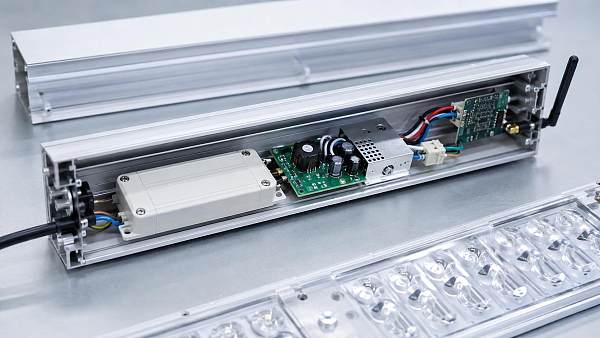
In many commercial luminaires, LEDs are not the first components to fail. The driver, which converts incoming power into controlled current for the LED array, is often more sensitive to temperature, voltage disturbance, incompatible controls, and component aging. A durable lighting specification should treat the driver as a critical subsystem rather than a generic accessory.
Useful review points include the driver’s declared temperature rating, expected service life under its actual operating conditions, input voltage range, power factor and harmonic performance where relevant, surge protection, dimming protocol, and replaceability. A driver located in a ventilated and accessible position is easier to maintain than one permanently enclosed in a high-temperature fixture body or inaccessible ceiling cavity.
Dimming compatibility needs particular discipline. A luminaire may be described as dimmable, but that does not establish reliable operation with every phase-cut dimmer, 0–10 V system, DALI controller, or wireless control platform. Common symptoms of a poor match include flicker at low output, dropout, audible noise, delayed response, or premature driver stress. Technical submittals should identify the intended control interface and, where possible, confirm compatibility at the system level.
Electrical disturbances should also be considered by location. Sites with large motors, refrigeration equipment, lifts, outdoor circuits, or unstable utility conditions may have a different surge profile from a small office. Surge protection requirements are project-specific, but a vague statement that a fixture is “surge resistant” is less useful than a documented rating and a clear explanation of the test basis.
Housing, optics, and seals must suit the actual environment
Durability can be lost through materials selection long before an electronic failure occurs. In public-facing retail, offices, transit-adjacent areas, and warehouses, housings may be exposed to cleaning chemicals, airborne contaminants, handling damage, impact, vibration, or UV exposure. The housing needs mechanical stability, corrosion resistance appropriate to the environment, and a finish that does not quickly degrade into a visual maintenance issue.
Optical components deserve equal scrutiny. Diffusers and lenses influence glare, uniformity, and visual comfort, but they also age. Some polymer materials may discolor, craze, or lose transmission under sustained heat, UV, or chemical exposure. In food service, healthcare-adjacent, industrial, or high-cleaning environments, the cleaning process itself can determine whether the material remains serviceable. Requesting material information and approved cleaning guidance is usually more informative than relying on a product photograph.
Ingress protection is another area where specifications are often oversimplified. IEC 60529 IP ratings describe resistance to defined solid-object and water ingress conditions; they do not mean a product is suitable for every harsh environment. An IP rating must be interpreted with the fixture orientation, cable entry, condensation risk, washdown method, and maintenance practices in mind. A luminaire in a humid canopy or cold-store transition zone can face moisture cycling that differs from a fixture exposed to direct rain.
Similarly, an IK rating can help indicate resistance to mechanical impact, but it should not be treated as a substitute for good mounting design. In active commercial environments, brackets, fasteners, cable glands, and ceiling interfaces can be as consequential as the fixture body.
Standards help establish a baseline, not a complete specification
Recognized standards provide a common language for evaluating safety and performance. Depending on the product category and target market, technical teams may encounter IEC 60598 for luminaires, IEC 61347 for lamp controlgear, IEC 62031 for LED modules, IEC 62471 for photobiological safety, and IEC 60529 for IP classification. North American projects may require evaluation to applicable UL standards, while CE marking is relevant to products placed on the European market under applicable legislation. Requirements must always be checked against the destination market and the product’s intended use.
These references should be read carefully. A test report applies to a defined product configuration, not automatically to every optional driver, lens, cable, mounting accessory, or control version. If a supplier proposes substitutions after approval, the evaluator should determine whether the changed configuration remains covered by the same technical evidence.
Standards also do not answer every operational question. They do not by themselves establish whether replacement parts will be available after several years, whether binning will remain consistent across phased rollouts, or whether a maintenance team can replace a driver without removing an entire ceiling assembly. Those are procurement and lifecycle questions, but they directly affect practical durability.
A sound evaluation starts with the site, then tests the evidence
For high-use installations, a short technical review can prevent a long maintenance problem. Begin with operating hours, switching frequency, ambient temperature, dust and moisture exposure, cleaning regime, control system, mounting condition, and access constraints. Then assess whether the submitted luminaire is designed for those conditions rather than merely capable of producing the required initial illuminance.
- Confirm the complete luminaire configuration, including driver, optics, mounting, cables, and controls.
- Review thermal limits against the fixture’s real installed location, not only room temperature.
- Check the basis for lifetime and lumen-maintenance statements, including operating temperature assumptions.
- Match IP, impact resistance, material selection, and corrosion protection to environmental exposure.
- Verify market-specific safety, electromagnetic compatibility, and regulatory documentation before release.
- Ask how drivers, LED boards, lenses, and spare parts can be serviced or replaced.
Sampling remains valuable, especially where lighting is integrated with shelving, signage, refrigerated displays, smart retail equipment, or custom fixtures. A sample review can reveal glare, connector access, driver placement, fit tolerance, color consistency, and heat accumulation that drawings do not fully show. For a large rollout, pre-production samples and documented change control are often as important as the original approval.
Durability is a supply-chain and maintenance decision
The most durable LED lights are supported by a repeatable supply chain. Commercial projects may be delivered in phases across regions, and a visually similar replacement fixture can produce noticeably different color, output, beam distribution, or control behavior. Technical evaluators should ask how configuration control is maintained, what substitutions require approval, and whether key components can be traced across production batches.
This broader view is central to the benchmarking work of Global Business & Consumer Ecosystem (G-BCE). Commercial lighting and signage cannot be assessed in isolation from fixtures, smart retail technology, consumer-facing materials, and the operational demands of a physical space. By comparing commercial hardware against applicable international expectations and project requirements, G-BCE helps architects, sourcing directors, and technical teams examine the structural details behind a consistent customer environment.
A low maintenance burden is not created by a single headline specification. It comes from a credible thermal design, a dependable driver, suitable materials, verified environmental protection, controlled production, and a maintenance path that works after installation. Before final selection, the most useful next step is to map those factors against the actual operating environment and request evidence for the exact luminaire configuration being proposed.
News Recommendations
 What makes LED lights durable in high-use commercial spaces?
![51a6ab95581761cc26f4318be6520c15]()
Aris Katos
Future of Carbide Coatings
 Which industry categories offer the strongest export potential in Latin America?
![51a6ab95581761cc26f4318be6520c15]()
Aris Katos
Future of Carbide Coatings
 How to choose an ultra bright waterproof window display for storefronts
![51a6ab95581761cc26f4318be6520c15]()
Aris Katos
Future of Carbide Coatings
 How to verify suppliers on a trade portal for global sourcing
![51a6ab95581761cc26f4318be6520c15]()
Aris Katos
Future of Carbide Coatings
 How RoHS requirements should be stated in product specifications
![51a6ab95581761cc26f4318be6520c15]()
Aris Katos
Future of Carbide Coatings
 What affects the lead time for custom retail counter displays?
![51a6ab95581761cc26f4318be6520c15]()
Aris Katos
Future of Carbide Coatings
 What consumer packaging USA importers need to verify before ordering
![51a6ab95581761cc26f4318be6520c15]()
Aris Katos
Future of Carbide Coatings
 How commercial spaces interiors shape customer dwell time
![51a6ab95581761cc26f4318be6520c15]()
Aris Katos
Future of Carbide Coatings
 How LED commercial lighting design reduces glare in retail spaces
![51a6ab95581761cc26f4318be6520c15]()
Aris Katos
Future of Carbide Coatings
 How industrial technology information improves RFID inventory accuracy
![51a6ab95581761cc26f4318be6520c15]()
Aris Katos
Future of Carbide Coatings
 When drip garden watering systems make more sense than sprinklers
![51a6ab95581761cc26f4318be6520c15]()
Aris Katos
Future of Carbide Coatings
 When category comparison improves sourcing for industrial applications
![51a6ab95581761cc26f4318be6520c15]()
Aris Katos
Future of Carbide Coatings
 Industrial application guidance for selecting the right LED lighting
![51a6ab95581761cc26f4318be6520c15]()
Aris Katos
Future of Carbide Coatings
 Which commercial architecture standards apply to European retail fit-outs?
![51a6ab95581761cc26f4318be6520c15]()
Aris Katos
Future of Carbide Coatings
 How to verify FDA requirements for maternity care products
![51a6ab95581761cc26f4318be6520c15]()
Aris Katos
Future of Carbide Coatings
 How to verify BPA-free claims for food-contact products
![51a6ab95581761cc26f4318be6520c15]()
Aris Katos
Future of Carbide Coatings
 When does a European wholesale supplier suit modular office projects?
![51a6ab95581761cc26f4318be6520c15]()
Aris Katos
Future of Carbide Coatings
 When consumer ecosystem solutions improve the in-store shopping journey
![51a6ab95581761cc26f4318be6520c15]()
Aris Katos
Future of Carbide Coatings
 How a commercial developers network can reduce site selection risk
![51a6ab95581761cc26f4318be6520c15]()
Aris Katos
Future of Carbide Coatings
 How clear purchasing specifications prevent costly supplier deviations
![51a6ab95581761cc26f4318be6520c15]()
Aris Katos
Future of Carbide Coatings
 What an ISTA drop test lab checks before your packaging ships
![51a6ab95581761cc26f4318be6520c15]()
Aris Katos
Future of Carbide Coatings
 Which commercial furniture standards apply to workplace seating?
![51a6ab95581761cc26f4318be6520c15]()
Aris Katos
Future of Carbide Coatings
 How to evaluate smart lighting module OEM compatibility before sampling
![51a6ab95581761cc26f4318be6520c15]()
Aris Katos
Future of Carbide Coatings
 How to assess whether sustainable technology delivers real impact
![51a6ab95581761cc26f4318be6520c15]()
Aris Katos
Future of Carbide Coatings
 How to assess an OEM supplier’s quality control before ordering
![51a6ab95581761cc26f4318be6520c15]()
Aris Katos
Future of Carbide Coatings
 How consumer ecosystem solutions data can improve retail personalization
![51a6ab95581761cc26f4318be6520c15]()
Aris Katos
Future of Carbide Coatings
 When does consumer packaging design justify a higher product price?
![51a6ab95581761cc26f4318be6520c15]()
Aris Katos
Future of Carbide Coatings
 Supermarket Fixture Installation: Planning Layouts, Wiring, and Handover
![51a6ab95581761cc26f4318be6520c15]()
Aris Katos
Future of Carbide Coatings
 Automated Lighting and Smart Lighting Control in Bergerac: Key Project Considerations
![51a6ab95581761cc26f4318be6520c15]()
Aris Katos
Future of Carbide Coatings
 Segment Streetlight Controllers: Choosing Control Modes for Urban Roads
![51a6ab95581761cc26f4318be6520c15]()
Aris Katos
Future of Carbide Coatings
 IEC 62471-2 Explained: How to Assess Photobiological Risks in LED Lighting
![51a6ab95581761cc26f4318be6520c15]()
Aris Katos
Future of Carbide Coatings
 Food Grade Packaging Requirements by Product Type, Temperature, and Contact Risk
![51a6ab95581761cc26f4318be6520c15]()
Aris Katos
Future of Carbide Coatings
 Food Packaging Compliance Checklist: Tests, Records, and Labeling Before Shipment
![51a6ab95581761cc26f4318be6520c15]()
Aris Katos
Future of Carbide Coatings
 NSF Food Packaging Standards: When Certification Matters for Commercial Food Use
![51a6ab95581761cc26f4318be6520c15]()
Aris Katos
Future of Carbide Coatings
 FDA Food Grade Compliance: Which Materials and Documents Do Buyers Need?
![51a6ab95581761cc26f4318be6520c15]()
Aris Katos
Future of Carbide Coatings
 What Should a Food Grade Declaration Include for Packaging Compliance?
![51a6ab95581761cc26f4318be6520c15]()
Aris Katos
Future of Carbide Coatings
 Housewares Importing: How to Evaluate Suppliers, Costs, and Compliance Risks
![51a6ab95581761cc26f4318be6520c15]()
Aris Katos
Future of Carbide Coatings
 Why Freeze-Dried Fruit Ingredients Lose Crispness—and How to Prevent It
![51a6ab95581761cc26f4318be6520c15]()
Aris Katos
Future of Carbide Coatings
 What industry veterans look for before choosing a new supplier
![51a6ab95581761cc26f4318be6520c15]()
Aris Katos
Future of Carbide Coatings