How to verify a building facade lighting manufacturer's warranty
Time
Click Count
A facade lighting warranty is only as useful as the remedy it delivers when a fixture fails high above the ground. A replacement luminaire may be free, yet the building owner could still face substantial costs for access equipment, electricians, shipping, and restoring the facade. Before selecting a building facade lighting manufacturer, establish who pays those costs, what evidence is needed for a claim, and whether the proposed installation falls within the written terms.
Start with the project-specific warranty document, not the duration printed in a brochure. Compare it with the fixture schedule, installation design, operating conditions, and purchase contract. A shorter warranty with clear remedies and realistic conditions can provide better protection than a longer promise with broad exclusions.
Identify exactly what is covered and when coverage begins
Ask for the complete warranty that will apply to the quoted products, including any schedules, exclusions, and claim procedures. The document should identify the manufacturer or other company providing the warranty, the products covered, and the party entitled to make a claim. Check that the legal entity matches the supplier named in the contract or that the relationship between them is clear.
Facade lighting systems often combine luminaires, LED modules, drivers, power supplies, controls, connectors, and mounting hardware. These components may have different warranty periods or be supplied by different companies. A statement covering “the lighting system” is less useful if the detailed terms exclude the driver or leave control equipment to a separate supplier’s policy.
Record the start date for each component. Coverage might begin at shipment, delivery, installation, commissioning, or another stated event. This distinction matters when fixtures are purchased early but installed much later. For a phased project, request a schedule showing how the start date applies to each delivery or building section.
Also check whether coverage transfers if the property is sold or the operator changes. If the warranty belongs only to the original purchaser, the building owner may need a written assignment or direct warranty rights as part of the purchase arrangement.
Check what a successful claim actually pays for
Read the remedy clause before comparing warranty periods. Manufacturers commonly reserve the choice to repair, replace, or credit a defective product. These options have different financial consequences: a credit may help fund a substitute fixture but may not cover the cost of matching the existing installation.
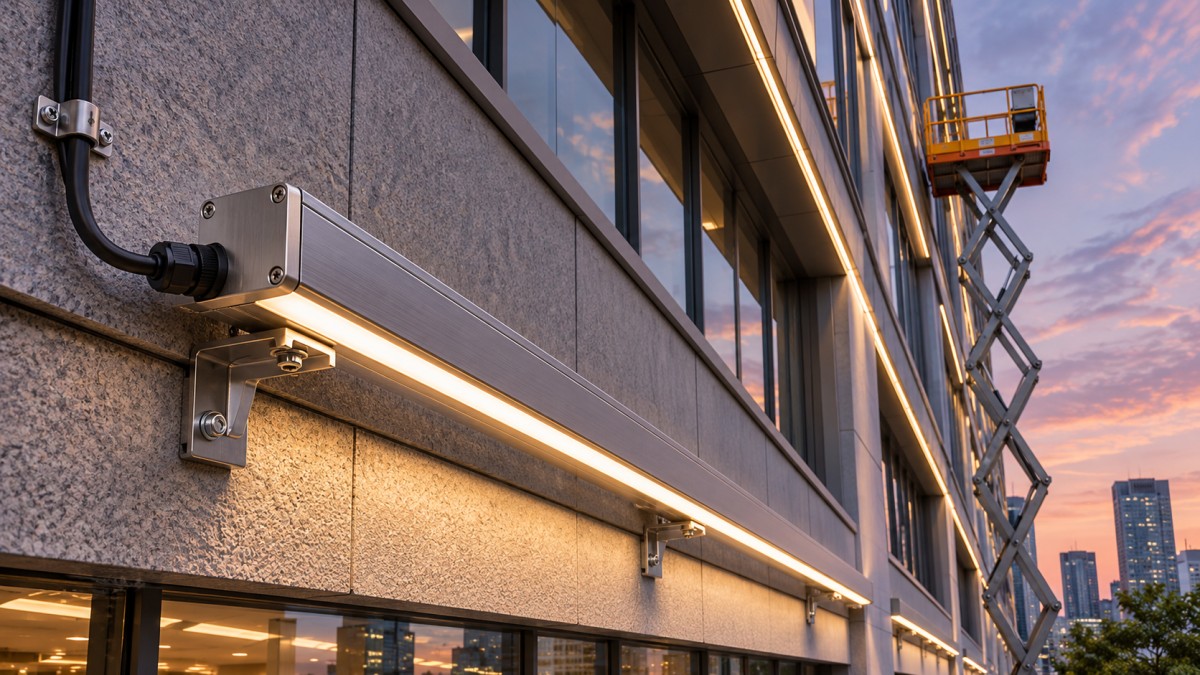
For facade applications, access can cost more than the replacement component. A failed fixture may require a lift, suspended access equipment, traffic management, or work outside normal building hours. Identify whether the warranty covers any of the following:
- Removal of the failed fixture and installation of its replacement.
- Access equipment and site safety arrangements.
- Freight, customs charges, and return shipping.
- Diagnosis, commissioning, and reprogramming of controls.
- Repairs to finishes or weatherproofing disturbed during replacement.
If these costs are excluded, include them in the project’s maintenance budget or negotiate a separate service commitment. Do not assume an installer’s workmanship warranty fills the gap: a product defect and an installation defect may fall under different agreements, each with its own remedy.
Ask how replacements will be supplied if the original fixture is discontinued. A functionally similar product may have a different appearance, beam distribution, color temperature, or control interface. For a visually prominent facade, agree on an acceptable replacement approach and consider holding spare units from the project’s production batch. Spares reduce dependence on future availability, although they still require suitable storage and periodic review.
Test exclusions against the actual facade conditions
Warranty exclusions are often reasonable in principle but difficult to apply if they do not match the design. Give the manufacturer a written description of the site and request written acceptance of the intended use. Include exposure, mounting positions, supply characteristics, controls, expected operating schedule, and maintenance arrangements.
Pay particular attention to conditions that can turn an apparent product failure into a disputed claim:
- Water and moisture: Check whether the terms address rain exposure, drainage, condensation, cleaning methods, and the orientation in which fixtures may be mounted. An outdoor rating does not automatically mean every installation position or cleaning practice is covered.
- Corrosion: Coastal air, pool chemicals, industrial emissions, and cleaning agents can affect housings and finishes. Establish whether the proposed finish and mounting hardware are accepted for the site.
- Electrical events: Review exclusions for voltage variation, surges, grounding faults, and lightning. Determine what protective devices the manufacturer requires and where responsibility for supplying them sits.
- Heat and ventilation: Recessed fixtures, enclosed cavities, and locations near exhaust outlets can operate differently from exposed mounting positions. Confirm that the design provides the clearances and ventilation the product requires.
- Maintenance and modification: Identify which cleaning products, inspection routines, replacement parts, and repair personnel are permitted. Restrictions that cannot be followed by the building’s maintenance team may make a claim difficult.
A clause excluding damage caused by improper installation needs a practical boundary. Request installation instructions before award, and ensure the electrical contractor can meet them. Where responsibility is shared, such as waterproofing a cable entry, document which party supplies and installs each component.
If the site has unusual exposure, do not rely on a sales representative’s verbal reassurance. Add the accepted conditions to the contract or obtain a signed project-specific warranty endorsement from the entity providing coverage.
Separate product failure from lighting performance
A warranty against manufacturing defects may cover a fixture that stops working without promising that the facade will maintain a particular appearance. For architectural lighting, that distinction matters. A luminaire can remain operational while its output declines, its color shifts, or its appearance no longer matches adjacent fixtures.
Review any performance commitment for its measurement conditions, permitted variation, and remedy. If the design depends on consistent white light or coordinated color effects, establish how a performance concern will be assessed and what happens if only part of the installation needs replacement. A promise to replace a visibly different fixture may still leave a mismatch between new and aged units.
For RGB or tunable systems, check the responsibilities for controls, addressing, programming, and compatibility. A luminaire warranty may not cover a controller failure or the labor needed to restore programmed scenes. Where several suppliers are involved, designate a lead party for diagnosis so a fault is not left unresolved while each supplier points to another component.
Assess whether the warranty can be enforced
A well-written warranty still depends on a reachable party that can process the claim and provide the remedy. Confirm the full legal name, address, and contact route of the warrantor, along with the role of any local distributor. Ask whether claims are handled locally or sent to another country, and which party is responsible for shipping failed products.
For an international purchase, review the contract’s governing law, dispute process, and any limits on recovery with the project’s legal team. A manufacturer’s warranty, the supplier’s contractual obligations, and any rights available under applicable law may operate differently. The purchasing documents should make clear who remains responsible if the distributor changes or stops trading.
Evidence of product certification or conformity can support a technical assessment, but it does not establish that a warranty claim will be paid. Likewise, a distributor’s marketing statement is not a substitute for the manufacturer’s written commitment unless that distributor is the party accepting the obligation.
Walk through a claim before placing the order
Ask the supplier to explain the claim process using a fixture installed in a difficult-to-reach location. The purpose is to expose missing information while there is still an opportunity to negotiate.
- Report: Who receives the claim, what information is required, and is there a deadline for notification?
- Diagnose: Can the initial assessment use photographs, logs, and electrical measurements, or must the unit be removed and returned?
- Authorize: Who approves removal and replacement, and can urgent safety work proceed before approval?
- Supply: Will the supplier repair the unit, send a replacement, or issue a credit? What delivery commitment applies?
- Close: Who pays each cost, and does the replacement carry the remaining original warranty or a separately stated period?
A requirement to return every failed unit before a replacement is dispatched can extend downtime, especially across borders. For a facade with limited access windows, consider negotiating advance replacement, local spare stock, or a defined response procedure. The right arrangement depends on how visible the outage is and how quickly the site can accommodate repair work.
Keep the records needed to support a future claim in a location the building’s operations team can access: purchase documents, product and serial numbers, approved drawings, commissioning records, installation photographs, maintenance instructions, and correspondence accepting site conditions. The installation contractor should hand these over before the project is closed out.
Compare bids using the cost of a failure
When two quotations offer different warranty terms, compare them against a plausible failure at the actual site. For each bid, estimate the buyer’s likely exposure to access, labor, shipping, replacement parts, and reinstatement. This makes an excluded cost visible even when the fixture itself is covered.
For example, a readily accessible entrance fixture may be economical to replace using in-house staff, so a parts-only remedy could be acceptable. The same terms may be less attractive for a high-level installation that requires specialist access. A broader warranty can justify a higher purchase price when it covers costs the project would otherwise bear; a longer term alone does not establish that value.
Before award, incorporate the agreed warranty document, accepted operating conditions, component schedule, claim procedure, and any service commitments into the purchase contract. Resolve conflicts between the quotation, standard terms, and project specifications in writing. This gives the eventual claimant a clear set of obligations to rely on when a fixture fails.
News Recommendations
 EU Ban on Plastic Waste Exports to Non-OECD Countries Takes Effect
![51a6ab95581761cc26f4318be6520c15]()
Aris Katos
Future of Carbide Coatings
 How to choose dining furniture for a small restaurant
![51a6ab95581761cc26f4318be6520c15]()
Aris Katos
Future of Carbide Coatings
 EU Bans Plastic Waste Exports to Non-OECD Countries
![51a6ab95581761cc26f4318be6520c15]()
Aris Katos
Future of Carbide Coatings
 How to verify an NSF certification claim for food packaging
![51a6ab95581761cc26f4318be6520c15]()
Aris Katos
Future of Carbide Coatings
 Germany Flags Chinese LED Lighting Product in RAPEX Alert
![51a6ab95581761cc26f4318be6520c15]()
Aris Katos
Future of Carbide Coatings
 How can satellite crop data help estimate crop yields?
![51a6ab95581761cc26f4318be6520c15]()
Aris Katos
Future of Carbide Coatings
 EU Food-Contact Recycled Plastics Regulation Takes Effect on November 18
![51a6ab95581761cc26f4318be6520c15]()
Aris Katos
Future of Carbide Coatings
 How to match a constant current dimmable LED driver to your LEDs
![51a6ab95581761cc26f4318be6520c15]()
Aris Katos
Future of Carbide Coatings
 EU PPWR Takes Effect as Flexible Packaging Faces PFAS and Recyclability Rules
![51a6ab95581761cc26f4318be6520c15]()
Aris Katos
Future of Carbide Coatings
 How to choose commercial lighting for restaurant dining rooms
![51a6ab95581761cc26f4318be6520c15]()
Aris Katos
Future of Carbide Coatings
 Invidis Explores Shenzhen's Digital Signage Supply Chain During APEC 2026
![51a6ab95581761cc26f4318be6520c15]()
Aris Katos
Future of Carbide Coatings
 How to verify a building facade lighting manufacturer's warranty
![51a6ab95581761cc26f4318be6520c15]()
Aris Katos
Future of Carbide Coatings
 IndexBox: Healthy Lighting and Smart Homes Drive Warm-White Night-Light Growth
![51a6ab95581761cc26f4318be6520c15]()
Aris Katos
Future of Carbide Coatings
 How to assess laminate finish durability for hotel furniture
![51a6ab95581761cc26f4318be6520c15]()
Aris Katos
Future of Carbide Coatings
 Which consumer goods need CE marking in Europe?
![51a6ab95581761cc26f4318be6520c15]()
Aris Katos
Future of Carbide Coatings
 Uniguest and Extreme Networks Partner to Simplify Digital Signage Deployment
![51a6ab95581761cc26f4318be6520c15]()
Aris Katos
Future of Carbide Coatings
 How to assess electronics compliance whitepapers for regulatory accuracy
![51a6ab95581761cc26f4318be6520c15]()
Aris Katos
Future of Carbide Coatings
 Packaging Data Hub Launches With Plastic Recycling Findings for 50 Countries
![51a6ab95581761cc26f4318be6520c15]()
Aris Katos
Future of Carbide Coatings
 How to verify an ergonomic office chair supplier's warranty terms
![51a6ab95581761cc26f4318be6520c15]()
Aris Katos
Future of Carbide Coatings
 Curion Survey: 64% Value Sustainable Beauty Packaging, but Quality Comes First
![51a6ab95581761cc26f4318be6520c15]()
Aris Katos
Future of Carbide Coatings
 Can minimalist fit out solutions make a small office feel larger?
![51a6ab95581761cc26f4318be6520c15]()
Aris Katos
Future of Carbide Coatings
 Kiosk Industry Releases IAAPA 2026 Self-Service Guide
![51a6ab95581761cc26f4318be6520c15]()
Aris Katos
Future of Carbide Coatings
 How to improve global supply chain visibility beyond tier-one suppliers
![51a6ab95581761cc26f4318be6520c15]()
Aris Katos
Future of Carbide Coatings
 Austria’s MM Group to Sell 70% of Packaging Business to KPS for $2.7 Billion
![51a6ab95581761cc26f4318be6520c15]()
Aris Katos
Future of Carbide Coatings
 How to assess delivery reliability of airport terminal seating suppliers in Europe
![51a6ab95581761cc26f4318be6520c15]()
Aris Katos
Future of Carbide Coatings
 USTR Extends China-Linked Vessel Fee Pause and 178 Product Exemptions to January 2027
![51a6ab95581761cc26f4318be6520c15]()
Aris Katos
Future of Carbide Coatings
 How to choose smart sensors for automated lighting
![51a6ab95581761cc26f4318be6520c15]()
Aris Katos
Future of Carbide Coatings
 Shanghai Retail Buyers Sign Deals at Ninth China International Import Expo
![51a6ab95581761cc26f4318be6520c15]()
Aris Katos
Future of Carbide Coatings
 Which toys are subject to EN 71 toy safety requirements?
![51a6ab95581761cc26f4318be6520c15]()
Aris Katos
Future of Carbide Coatings
 Report: Global Kraft Paper Market Forecast to Reach $20.5 Billion by 2033
![51a6ab95581761cc26f4318be6520c15]()
Aris Katos
Future of Carbide Coatings
 How to verify Zigbee compatibility when sourcing lighting sensors
![51a6ab95581761cc26f4318be6520c15]()
Aris Katos
Future of Carbide Coatings
 How do packaging customization options affect minimum order quantities in Europe?
![51a6ab95581761cc26f4318be6520c15]()
Aris Katos
Future of Carbide Coatings
 Transom to Acquire Cree LED in Commercial Lighting Ownership Change
![51a6ab95581761cc26f4318be6520c15]()
Aris Katos
Future of Carbide Coatings
 How to plan customer flow in commercial design planning
![51a6ab95581761cc26f4318be6520c15]()
Aris Katos
Future of Carbide Coatings
 USTR Urged to Permanently Suspend Fees on China-Linked Ships
![51a6ab95581761cc26f4318be6520c15]()
Aris Katos
Future of Carbide Coatings
 How to choose comparable stores for retail benchmarking
![51a6ab95581761cc26f4318be6520c15]()
Aris Katos
Future of Carbide Coatings
 How does anchoring affect modular building wind load resistance?
![51a6ab95581761cc26f4318be6520c15]()
Aris Katos
Future of Carbide Coatings
 Amazon Raises European FBA Surcharge to 2% in Ten Markets From November 2
![51a6ab95581761cc26f4318be6520c15]()
Aris Katos
Future of Carbide Coatings
 How to verify a BPA-free test report for baby products
![51a6ab95581761cc26f4318be6520c15]()
Aris Katos
Future of Carbide Coatings