
How to choose an ultra bright waterproof window display for storefronts
Time
Click Count
A storefront window can be a difficult place for digital content to survive. At midday, sunlight competes with every pixel. After closing time, rain may run down the glass, temperatures shift, and a display that looked convincing in a showroom can become a source of glare, heat, maintenance calls, or disappointing visibility.
For procurement teams, choosing an ultra bright waterproof window display is therefore not a simple exercise in selecting the highest brightness figure on a quotation. The right decision depends on the relationship between daylight conditions, enclosure design, installation constraints, content strategy, power consumption, service access, and local compliance requirements. A display must work as part of the storefront—not merely as a screen placed behind it.
This evaluation guide is designed for buyers sourcing digital window displays for retail chains, shopping centres, hospitality venues, transport-facing stores, automotive showrooms, and other commercial environments where messaging needs to remain legible in demanding conditions.
Begin with the actual window environment, not the specification sheet
Before comparing suppliers, document where and how the display will operate. “Window display” can describe several very different installation conditions: a screen mounted inside behind insulated glazing, a unit facing a street through single-pane glass, a semi-outdoor display in a recessed façade, or a freestanding digital poster exposed to wind-driven rain.
These locations create different risks. A south- or west-facing window may receive intense direct sunlight for several hours a day. A glazed façade can trap heat between the display and the glass, causing internal temperatures to rise far beyond ambient outdoor conditions. At a transit hub or street-level entrance, moisture may enter through cable routes, poorly sealed rear panels, or gaps created during installation. Even an indoor display may need a higher protection level if condensation, cleaning routines, or open storefront conditions expose it to water.
Ask the project team to provide a basic site record before requesting final quotations:
- Window orientation and periods of direct sun exposure
- Glass type, tint, coatings, insulation, and approximate reflection level
- Available depth between the display and the window
- Indoor, semi-outdoor, or outdoor placement classification
- Local temperature range, humidity, dust, salt air, and rainfall exposure
- Mounting surface, power availability, data connection, and service access
- Viewing distance, pedestrian flow direction, and expected dwell time
This groundwork helps procurement avoid a common mistake: buying a screen rated for the surrounding weather but not for the heat buildup and reflections created by the window itself.
Brightness is essential, but “ultra bright” needs context
Brightness is usually expressed in nits, or candelas per square metre. A higher number can improve visibility in bright ambient light, but it is not a universal guarantee of readability. The customer sees the combined effect of panel brightness, glass reflection, content contrast, viewing angle, sun position, and the distance between the display and the glazing.
For shaded indoor windows, a standard commercial display may be sufficient. For storefronts receiving substantial daylight, high-brightness or ultra-high-brightness models are often necessary. Direct-sun or outward-facing applications may require much more than a display intended for a brightly lit interior. Rather than setting a single brightness threshold across a whole retail estate, segment locations by exposure class.
During evaluation, request more than a peak brightness claim. Buyers should ask whether the quoted brightness is typical or maximum, how it is measured, whether it is sustained under heat, and whether the display automatically adjusts output through an ambient light sensor. A screen that reduces brightness to protect itself during the most important sunny hours may fail the purpose of the investment.
Contrast deserves equal attention. Dark content can become mirror-like behind reflective glass, while fine text disappears quickly in strong light. Suppliers should be able to discuss anti-reflective or anti-glare treatments, optical bonding where relevant, and suitable content design rules. A bright display with weak contrast may still look washed out from the pavement.
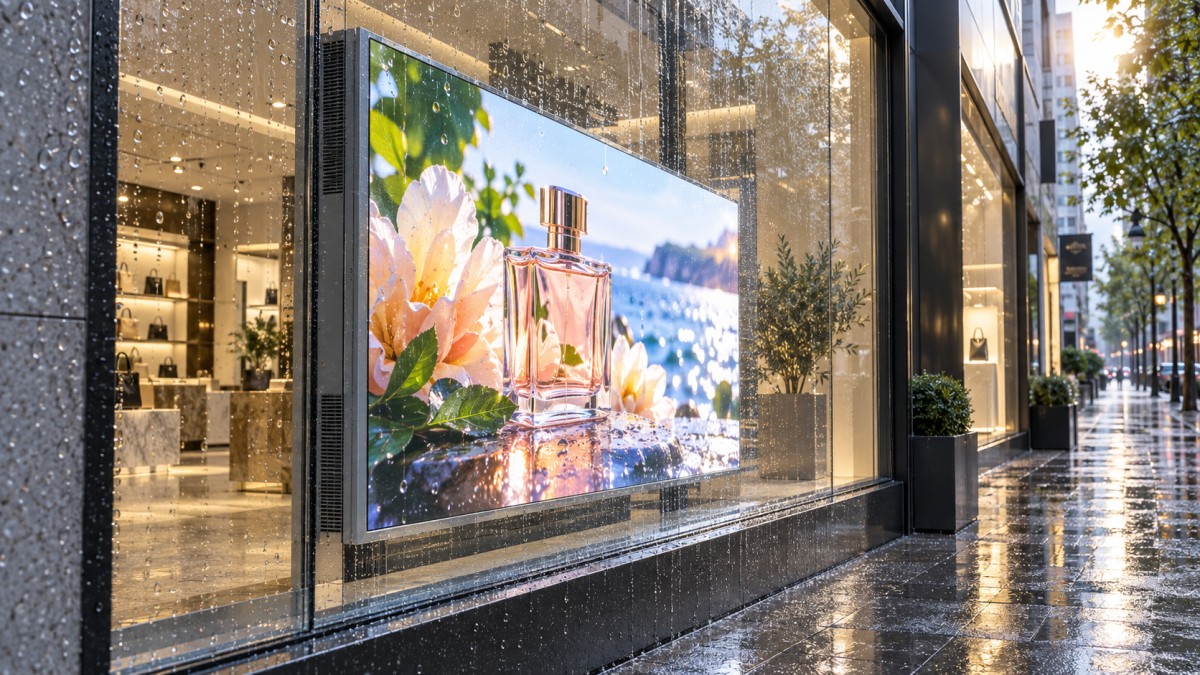
Waterproofing is about the complete installed system
When buyers search for a waterproof display, the first question is often, “What IP rating does it have?” Ingress Protection ratings are useful, but they should not end the conversation. The first digit relates to protection against solid objects and dust; the second addresses water. The appropriate rating depends on whether the display is sheltered behind glass, positioned under a canopy, or exposed to rain and washdown conditions.
For an outdoor or semi-outdoor screen, examine the full protection path: housing seams, front glass, rear access door, ventilation openings, cable glands, connectors, mounting points, and drainage design. A sealed display can still fail if installation introduces an unprotected cable entry or if water pools around the base of the enclosure.
There is also a practical tension between waterproofing and thermal management. High-brightness displays generate considerable heat. Fully enclosed solutions may use intelligent airflow, heat exchangers, or other cooling arrangements; each approach affects noise, maintenance needs, power draw, and resistance to dust or moisture. Ask the supplier how the system manages heat during continuous high-brightness operation, not only in a short laboratory demonstration.
For storefront projects, clarify whether the supplier’s water-resistance claim applies to the display unit alone or to the installed configuration. If a protective housing, external power supply, or weatherproof junction box is required, those items must appear in the scope and price comparison.
Heat management can determine display life more than rain does
Procurement teams often focus on visible performance and overlook temperature until a pilot unit begins dimming or shutting down. Yet heat is one of the central challenges of an ultra bright waterproof window display. High luminance raises thermal load; direct sunlight adds more; and a narrow void behind glass can act like a greenhouse.
Request operating and storage temperature ranges, but also ask what happens at the limits. Does the unit maintain normal brightness? Does it dim gradually? Is there an automatic shutdown threshold? How is the temperature monitored, and can operational alerts be viewed remotely? These questions make a difference for chain operators who cannot send facilities staff to inspect every location after a hot weekend.
Installation design matters just as much. Leave the specified ventilation clearance. Avoid trapping a display in a decorative frame without engineered airflow. Consider solar-control film, external shading, or a different screen location where these measures are compatible with the brand and architecture. In some windows, moving the display a small distance away from the glass can materially improve heat dissipation and reduce reflected glare.
Evaluate readability from the customer’s side of the street
A buyer standing one metre from a screen in a supplier showroom is not the intended viewer. Storefront communication is usually consumed in motion: a passer-by notices a colour field, a product image, a promotion, or a directional message in a few seconds. That changes the procurement brief.
Pixel pitch should suit the closest meaningful viewing distance, but a very fine pitch is not always the most sensible spend for a window-facing application. Content legibility, screen size, and placement can matter more than microscopic detail. For large glass façades viewed from several metres away, a lower-resolution display with strong brightness, thermal stability, and reliable control may offer better commercial value than a dense-pixel alternative.
Request a site demonstration or, where this is not possible, require evidence under comparable daylight conditions. Review test content that includes product photography, brand colours, white backgrounds, dark backgrounds, pricing, QR codes, and small legal text. Check the image from different walking angles and at the times when the storefront receives its strongest sunlight.
Also consider polarized sunglasses. Depending on panel technology and screen orientation, some viewers may see reduced brightness or colour shifts. It is a niche concern, but relevant for automotive, travel retail, sports, and premium high-street environments.
Power, operating costs, and control should be part of the bid comparison
Ultra-bright operation has an energy consequence. Comparing only purchase price can make a lower-cost unit appear attractive even when its energy use, cooling demand, or service burden creates a less favourable total cost of ownership over the deployment period.
Ask suppliers for typical and maximum power consumption, not only a single headline value. Determine whether brightness scheduling, ambient light adjustment, and overnight standby modes are available. These controls can reduce unnecessary consumption while preserving daytime impact. For a multi-site network, remote monitoring can also identify units with abnormal temperatures, connectivity issues, or failed components before a store team reports a problem.
Content management compatibility needs similar attention. Confirm who owns and administers the CMS, whether the display supports the required media formats and scheduling logic, and whether the system can integrate with existing retail signage workflows. A screen that performs beautifully but sits outside the company’s content governance structure often becomes difficult to operate at scale.
Do not treat installation and service as afterthoughts
A heavy, high-output display changes the practical requirements of a window installation. Structural loading, bracket design, cable routing, electrical isolation, access for cleaning, and safe removal of the unit all need early review. In leased retail spaces, landlord approvals and façade restrictions may add another layer of complexity.
Serviceability is especially important where the display is mounted close to glass or within a fitted joinery system. Can maintenance be completed from the rear, front, or side? What clearance is required? Does the unit need to be removed for common repairs? Is there a local service partner, and are replacement parts available for the expected operating life of the rollout?
Procurement documentation should clearly distinguish between the display, mounting hardware, enclosure if applicable, electrical works, network equipment, commissioning, content testing, warranty response, and ongoing maintenance. Ambiguity in these items is a frequent cause of budget overruns after a purchase order has been issued.
Compliance should be verified for the destination market
Global sourcing adds another responsibility: technical documentation must align with the market in which the display will be installed. Depending on the region and product configuration, this may include electrical safety, electromagnetic compatibility, restricted substances, energy-related requirements, fire behaviour of materials, and local outdoor advertising rules.
Do not assume that a certification label covers every version of a product. Confirm the exact model, power configuration, external components, and intended installation environment. A useful supplier submission includes test reports or declarations relevant to the destination market, warranty terms, installation instructions, and a clear statement of the rated operating conditions.
Platforms such as G-BCE can support this stage by helping sourcing teams compare commercial hardware against internationally recognized expectations, including frameworks commonly associated with UL and CE markets. The objective is not paperwork for its own sake; it is reducing the gap between a promising specification and an installation that can be accepted, operated, and maintained with confidence.
A practical shortlisting scorecard
When comparing candidates, assign weighted scores instead of allowing one impressive specification to dominate the decision. Brightness and visual clarity may carry the highest weight for a sun-facing flagship store, while service access and lifecycle cost may be more important for a broad regional rollout.
- Visual performance: sustained brightness, contrast through glass, colour consistency, viewing angle, and daylight test evidence.
- Environmental resilience: IP classification, enclosure design, corrosion resistance, drainage, dust management, and thermal behaviour.
- Operational fit: remote monitoring, CMS compatibility, brightness scheduling, energy controls, and network reliability.
- Installation readiness: dimensions, weight, mounting requirements, cable access, ventilation clearance, and safety documentation.
- Commercial assurance: warranty scope, spare-parts policy, lead times, local support, and transparent total cost of ownership.
- Compliance: documentation for the precise target market and installation type.
It is wise to run a pilot in one high-exposure location before committing to a large deployment. A meaningful pilot should last long enough to observe hot weather, rain, content changes, cleaning routines, and staff interaction—not merely a few days of controlled operation.
The best choice is the one that remains visible and manageable
An ultra bright waterproof window display should earn its place in the storefront every day: clear in harsh daylight, protected when conditions change, controllable by the marketing team, and maintainable by the operations team. The most expensive panel is not automatically the strongest choice, and the highest stated brightness is not automatically the most readable option.
Buyers who start with site conditions, validate real-world visibility, investigate thermal and water protection as a complete system, and compare lifecycle responsibilities alongside hardware specifications will make more durable decisions. In a commercial window, reliable performance is what turns a screen from a technical purchase into a dependable part of the customer experience.
News Recommendations
 Report: Global Kraft Paper Market Forecast to Reach $20.5 Billion by 2033
![51a6ab95581761cc26f4318be6520c15]()
Aris Katos
Future of Carbide Coatings
 How to verify Zigbee compatibility when sourcing lighting sensors
![51a6ab95581761cc26f4318be6520c15]()
Aris Katos
Future of Carbide Coatings
 How do packaging customization options affect minimum order quantities in Europe?
![51a6ab95581761cc26f4318be6520c15]()
Aris Katos
Future of Carbide Coatings
 Transom to Acquire Cree LED in Commercial Lighting Ownership Change
![51a6ab95581761cc26f4318be6520c15]()
Aris Katos
Future of Carbide Coatings
 How to plan customer flow in commercial design planning
![51a6ab95581761cc26f4318be6520c15]()
Aris Katos
Future of Carbide Coatings
 USTR Urged to Permanently Suspend Fees on China-Linked Ships
![51a6ab95581761cc26f4318be6520c15]()
Aris Katos
Future of Carbide Coatings
 How to choose comparable stores for retail benchmarking
![51a6ab95581761cc26f4318be6520c15]()
Aris Katos
Future of Carbide Coatings
 How does anchoring affect modular building wind load resistance?
![51a6ab95581761cc26f4318be6520c15]()
Aris Katos
Future of Carbide Coatings
 Amazon Raises European FBA Surcharge to 2% in Ten Markets From November 2
![51a6ab95581761cc26f4318be6520c15]()
Aris Katos
Future of Carbide Coatings
 How to verify a BPA-free test report for baby products
![51a6ab95581761cc26f4318be6520c15]()
Aris Katos
Future of Carbide Coatings
 China's Mandatory Classroom Lighting Standard GB 7793-2025 Takes Effect November 1
![51a6ab95581761cc26f4318be6520c15]()
Aris Katos
Future of Carbide Coatings
 How order volume affects the price of wholesale poly mailers
![51a6ab95581761cc26f4318be6520c15]()
Aris Katos
Future of Carbide Coatings
 US Imposes 50% Tariff on Certain Canadian PET Resin Imports
![51a6ab95581761cc26f4318be6520c15]()
Aris Katos
Future of Carbide Coatings
 How to read the maximum ratings in a semiconductor datasheet
![51a6ab95581761cc26f4318be6520c15]()
Aris Katos
Future of Carbide Coatings
 University of Maryland Develops Bio-Based Packaging to Extend Avocado and Cucumber Shelf Life
![51a6ab95581761cc26f4318be6520c15]()
Aris Katos
Future of Carbide Coatings
 How to verify a cookware manufacturer's induction compatibility claims
![51a6ab95581761cc26f4318be6520c15]()
Aris Katos
Future of Carbide Coatings
 Omdia Forecasts 11.6% Annual Growth in LED Display Revenue Through 2030
![51a6ab95581761cc26f4318be6520c15]()
Aris Katos
Future of Carbide Coatings
 How to verify a pulp molding packaging factory's production capacity
![51a6ab95581761cc26f4318be6520c15]()
Aris Katos
Future of Carbide Coatings
 Curion Survey: Half of Consumers Frustrated by Sustainable Packaging
![51a6ab95581761cc26f4318be6520c15]()
Aris Katos
Future of Carbide Coatings
 How to assess the credibility of market insight content
![51a6ab95581761cc26f4318be6520c15]()
Aris Katos
Future of Carbide Coatings
 US Removes 50% Additional Tariff on Selected Canadian Packaging Products
![51a6ab95581761cc26f4318be6520c15]()
Aris Katos
Future of Carbide Coatings
 Will a waterproof dimmable LED driver work with your existing dimmer?
![51a6ab95581761cc26f4318be6520c15]()
Aris Katos
Future of Carbide Coatings
 Charter Next Generation Raises Film PCR Use 30%, Advances Food-Grade Applications
![51a6ab95581761cc26f4318be6520c15]()
Aris Katos
Future of Carbide Coatings
 How to choose a dog harness and leash for a dog that pulls hard
![51a6ab95581761cc26f4318be6520c15]()
Aris Katos
Future of Carbide Coatings
 How to respect local customs when negotiating with overseas suppliers
![51a6ab95581761cc26f4318be6520c15]()
Aris Katos
Future of Carbide Coatings
 RFID Recycling Challenges Bring Paper-Based and Chipless Tags Into Focus
![51a6ab95581761cc26f4318be6520c15]()
Aris Katos
Future of Carbide Coatings
 How to choose commercial lighting for offices that reduces glare
![51a6ab95581761cc26f4318be6520c15]()
Aris Katos
Future of Carbide Coatings
 Queue Launches Fully Automated Robotic Pharmacy Kiosk for 30-Second Dispensing
![51a6ab95581761cc26f4318be6520c15]()
Aris Katos
Future of Carbide Coatings
 Can your supermarket store fixtures supplier meet your opening date?
![51a6ab95581761cc26f4318be6520c15]()
Aris Katos
Future of Carbide Coatings
 Shopify POS UI Extensions 2026-10 Adds Virtual Lists and Custom Row Templates
![51a6ab95581761cc26f4318be6520c15]()
Aris Katos
Future of Carbide Coatings
 How to assess smart office furniture suppliers’ North American support
![51a6ab95581761cc26f4318be6520c15]()
Aris Katos
Future of Carbide Coatings
 Aqara Launches Smart Lighting Range to Advance AI Spatial Intelligence
![51a6ab95581761cc26f4318be6520c15]()
Aris Katos
Future of Carbide Coatings
 How to assess demand forecasts in a lighting intelligence report
![51a6ab95581761cc26f4318be6520c15]()
Aris Katos
Future of Carbide Coatings
 Billerud推出PharmaKraft纤维基医药包装材料
![51a6ab95581761cc26f4318be6520c15]()
Aris Katos
Future of Carbide Coatings
 How to assess supplier reliability in global supply chain sourcing
![51a6ab95581761cc26f4318be6520c15]()
Aris Katos
Future of Carbide Coatings
 Omdia Forecasts 11.6% CAGR for Global LED Video Display Market in 2026–2030
![51a6ab95581761cc26f4318be6520c15]()
Aris Katos
Future of Carbide Coatings
 How to verify an LFGB testing laboratory's accreditation scope
![51a6ab95581761cc26f4318be6520c15]()
Aris Katos
Future of Carbide Coatings
 How to assess a workplace interior supplier's installation scope
![51a6ab95581761cc26f4318be6520c15]()
Aris Katos
Future of Carbide Coatings
 What records are needed for an ISO 9001 furniture factory audit?
![51a6ab95581761cc26f4318be6520c15]()
Aris Katos
Future of Carbide Coatings







































