
IEC 62471-2 Explained: How to Assess Photobiological Risks in LED Lighting
Time
Click Count
IEC 62471-2 Explained: How to Assess Photobiological Risks in LED Lighting
LED lighting assessment is often dominated by familiar questions: efficacy, colour rendering, flicker, glare, driver life, ingress protection, and electrical compliance. Those checks matter, but they do not answer a separate safety question: can the optical radiation from a light source create a photobiological risk under foreseeable use?
That question becomes more relevant in commercial interiors, illuminated retail displays, high-output signage, machine-vision-adjacent installations, task lighting, portable products, and consumer devices with intense blue or white LED emitters. A luminaire may be electrically safe and visually impressive while still requiring careful review of optical radiation classification, accessible viewing distance, and installation controls.
The phrase IEC 62471-2 is often used loosely in product specifications. In practice, assessors should distinguish it from the core photobiological safety assessment document. IEC/TR 62471-2 is a technical report providing guidance on manufacturing requirements related to non-laser optical radiation safety. It helps manufacturers and supply-chain participants think through product design, evaluation, communication, and risk control. Risk-group determination itself is generally based on the hazard limits and measurement principles associated with IEC 62471 and, where applicable, related product or luminaire standards.
That distinction is not semantic. It changes what should be requested from a supplier, what a test report actually proves, and whether a declared risk group remains valid once the source is installed in a real commercial environment.
What IEC 62471-2 contributes to an LED safety review
IEC 62471-2 is best understood as a practical bridge between laboratory photobiological assessment and responsible product delivery. It is concerned with the manufacturing and communication side of non-laser optical radiation safety: identifying foreseeable hazards, applying suitable controls, maintaining appropriate documentation, and ensuring that warnings or instructions are meaningful rather than copied into a datasheet without context.
For LED products, this matters because the apparent simplicity of an LED module can be misleading. The final optical output depends on more than the diode. Optics, phosphor conversion, lens shape, reflector geometry, dimming state, drive current, beam angle, diffuser transmission, and the distance at which the source can be viewed all influence the assessment. A bare LED package, an LED module behind a narrow optic, and the completed luminaire are not automatically equivalent test objects.
In a sourcing or technical-benchmarking workflow, the useful question is not merely, “Does the supplier say IEC 62471?” A better question is: “Which configuration was assessed, under what operating condition and viewing geometry, to which edition or applicable requirement, and how does that configuration match the product being supplied?”
Risk groups are exposure categories, not product-quality ratings
Photobiological safety classifications commonly describe four risk groups: Exempt Group, Risk Group 1, Risk Group 2, and Risk Group 3. They are based on whether applicable exposure limits can be exceeded within specified exposure durations and conditions. The group is not a statement that a product is “good” or “bad,” nor does it replace a proper lighting design review.
The critical point is that a risk group has conditions attached to it. A linear accent light mounted above a retail shelf may be difficult for customers to view directly at close range. The same product, installed at eye level inside a display niche or used as an exposed under-shelf fitting, creates a different exposure scenario. Technical assessors should resist treating the risk-group label as a universal pass/fail result detached from installation.
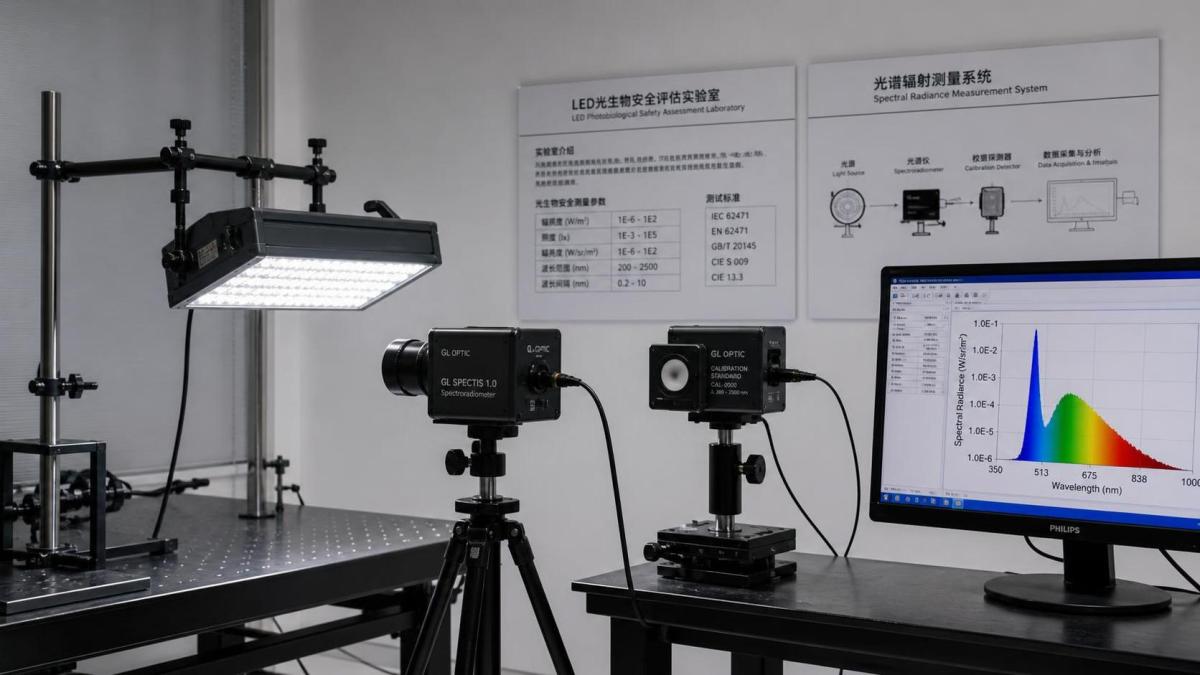
Which photobiological hazards need attention?
IEC 62471-based evaluations can address several spectral hazard functions, depending on the source and its emission profile. In general LED lighting work, blue-light retinal hazard is often the issue that receives the closest scrutiny, particularly for intense cool-white, blue-rich, narrow-beam, or small apparent-source products. This does not mean every blue or cool-white LED is hazardous. It means the conclusion must come from relevant spectral and geometrical data, not colour temperature alone.
Other hazards may include actinic ultraviolet, near-UV effects on the eye and skin, retinal thermal hazard, infrared radiation, and thermal effects on skin. Their relevance varies substantially by technology. A conventional white LED luminaire may not present the same UV or infrared profile as a specialty curing source, horticultural product, entertainment fixture, or hybrid light engine. A report that only states “IEC 62471 compliant” without identifying the evaluated hazards, source type, and result is therefore of limited technical value.
There is also a practical difference between a broad luminous panel and a sharply imaged emitter. Retinal hazard assessment may depend on radiance, apparent source size, and angular subtense. In plain terms, the eye does not experience every bright source in the same way. A small intense point viewed through a clear optic can require closer examination than a similarly powered source spread across a large diffusing surface.
How to read a photobiological test report without over-reading it
A credible report should allow a reviewer to trace the classification back to the actual item assessed. Begin with product identity: model number, LED module or engine, optic, diffuser, driver setting, and any relevant accessory. If the purchased luminaire uses a different beam angle, higher current, altered lens, or a new LED bin, the original result may no longer be directly transferable.
Next, review the test conditions. Useful documentation normally identifies the operating state, measurement distance or assessment geometry, the relevant hazard category, and the resulting risk group or exposure information. For tunable-white, RGBW, dim-to-warm, and programmable systems, one “normal” setting is rarely enough. The technically conservative review considers states capable of producing the highest relevant hazard-weighted output, including full-output scenes, calibration modes, or default commissioning settings where these can be accessed in service.
Be careful with declarations that apply only to an LED component. A component-level report can be useful during design qualification, but it does not automatically classify the finished product. Enclosures and optics may reduce accessible radiation; they can also concentrate it. Installation hardware may make a source less accessible, while a transparent cover or open maintenance position may make it more accessible. The finished luminaire, or the applicable final assembly, is usually the more meaningful object for an end-use decision.
The same caution applies to a report from a reputable laboratory. Laboratory competence supports confidence in the measurement, but it does not solve a configuration mismatch. Traceability is the issue: does the report describe what will actually be installed?
Start with the exposure scenario, not the certificate
In commercial projects, assessors get better results by mapping foreseeable viewing conditions before requesting documents. Consider where the product sits, who can approach it, whether it is aimed toward normal sightlines, and whether users are likely to look into it intentionally. A decorative pendant over a dining table, a checkout-lane spot, an interactive shelf display, and a backlit cosmetic mirror can all use LEDs, yet their exposure patterns are very different.
Maintenance access deserves separate attention. Installers, electricians, merchandisers, cleaning staff, and service technicians can sometimes view a source at a closer distance than the public ever will. A luminaire that is satisfactory in normal operation may need a warning, isolation procedure, or servicing instruction if its cover is removed or its aiming mechanism is adjusted while energized.
Children and other potentially vulnerable users should not be treated as an afterthought in consumer-facing applications. Natural aversion responses are not a reliable design strategy where a product encourages close inspection, play, or prolonged direct viewing. This is particularly relevant to illuminated furniture, toys, personal-care devices, decorative desktop products, and digital retail fixtures that place light near the face.
A workable assessment sequence for LED projects
A disciplined review need not become bureaucratic. The following sequence is usually more useful than collecting broad compliance statements late in procurement:
- Define the final product configuration, including LEDs, optics, controls, diffuser, output settings, and any field-adjustable elements.
- Describe normal use, foreseeable misuse, close viewing, and maintenance access rather than relying only on the architectural rendering.
- Request the relevant photobiological assessment report and verify the exact test object, operating mode, hazards evaluated, and conclusion.
- Compare the report assumptions with the intended mounting height, aiming direction, shielding, and accessible distance.
- Where the product is programmable or modular, confirm which configuration governs the safety conclusion and how changes are controlled.
- Document any required warnings, minimum distances, aiming restrictions, commissioning limits, or service instructions in project handover materials.
If any of those comparisons produces uncertainty, the correct response is not to infer compliance from a similar product. It may be necessary to seek clarification from the manufacturer, review applicable local requirements, or arrange assessment of the actual finished configuration.
Common mistakes in LED risk-group reviews
One recurring mistake is using the phrase “no blue-light risk” because a product is warm white. Correlated colour temperature is not a substitute for spectral measurement and hazard weighting. Another is assuming that a diffuser always resolves the matter. Diffusion can alter accessible radiance and source geometry, but its effect must be demonstrated for the specific optical assembly.
A third mistake is treating CE, UL, or general luminaire safety documentation as evidence of a complete photobiological assessment. These frameworks and marks may be relevant to a wider conformity route, but they do not make a vague optical-safety claim more specific. The technical file still needs to show how the relevant optical radiation question was addressed.
Finally, assessors should watch for product-family reports that cover a range so broad that the tested maximum condition is unclear. A family declaration can be valid, but only where the manufacturer identifies the worst-case configuration and shows why the conclusion extends to the models supplied.
Using IEC 62471-2 in a wider commercial specification process
For chain retail operators, developers, lighting designers, and sourcing teams, photobiological safety is one part of a wider technical decision. It should sit alongside electrical safety, electromagnetic compatibility, energy performance, flicker behaviour, glare control, material durability, repairability, and project-specific installation rules. The goal is not to create a separate paper trail for every LED product; it is to identify where optical exposure changes the design or procurement decision.
This is also where cross-sector benchmarking is useful. Platforms such as Global Business & Consumer Ecosystem (G-BCE) bring commercial lighting and signage into the same technical conversation as retail fixtures, smart hardware, consumer products, and sustainable material systems. In a modern commercial environment, a light source may be embedded in shelving, packaging displays, POS equipment, furniture, or architectural signage. The safety review should follow the actual assembled experience, not the traditional category assigned to one component.
IEC 62471-2 provides a sensible manufacturing-oriented lens: identify the accessible radiation, understand foreseeable exposure, preserve evidence for the supplied configuration, and communicate controls where they are genuinely needed. For LED lighting, the most reliable assessment is rarely the shortest declaration. It is the one that clearly connects the measured product, its risk-group result, and the way people will encounter it after installation.
News Recommendations
 How to verify Zigbee compatibility when sourcing lighting sensors
![51a6ab95581761cc26f4318be6520c15]()
Aris Katos
Future of Carbide Coatings
 How do packaging customization options affect minimum order quantities in Europe?
![51a6ab95581761cc26f4318be6520c15]()
Aris Katos
Future of Carbide Coatings
 Transom to Acquire Cree LED in Commercial Lighting Ownership Change
![51a6ab95581761cc26f4318be6520c15]()
Aris Katos
Future of Carbide Coatings
 How to plan customer flow in commercial design planning
![51a6ab95581761cc26f4318be6520c15]()
Aris Katos
Future of Carbide Coatings
 USTR Urged to Permanently Suspend Fees on China-Linked Ships
![51a6ab95581761cc26f4318be6520c15]()
Aris Katos
Future of Carbide Coatings
 How to choose comparable stores for retail benchmarking
![51a6ab95581761cc26f4318be6520c15]()
Aris Katos
Future of Carbide Coatings
 How does anchoring affect modular building wind load resistance?
![51a6ab95581761cc26f4318be6520c15]()
Aris Katos
Future of Carbide Coatings
 Amazon Raises European FBA Surcharge to 2% in Ten Markets From November 2
![51a6ab95581761cc26f4318be6520c15]()
Aris Katos
Future of Carbide Coatings
 How to verify a BPA-free test report for baby products
![51a6ab95581761cc26f4318be6520c15]()
Aris Katos
Future of Carbide Coatings
 China's Mandatory Classroom Lighting Standard GB 7793-2025 Takes Effect November 1
![51a6ab95581761cc26f4318be6520c15]()
Aris Katos
Future of Carbide Coatings
 How order volume affects the price of wholesale poly mailers
![51a6ab95581761cc26f4318be6520c15]()
Aris Katos
Future of Carbide Coatings
 US Imposes 50% Tariff on Certain Canadian PET Resin Imports
![51a6ab95581761cc26f4318be6520c15]()
Aris Katos
Future of Carbide Coatings
 How to read the maximum ratings in a semiconductor datasheet
![51a6ab95581761cc26f4318be6520c15]()
Aris Katos
Future of Carbide Coatings
 University of Maryland Develops Bio-Based Packaging to Extend Avocado and Cucumber Shelf Life
![51a6ab95581761cc26f4318be6520c15]()
Aris Katos
Future of Carbide Coatings
 How to verify a cookware manufacturer's induction compatibility claims
![51a6ab95581761cc26f4318be6520c15]()
Aris Katos
Future of Carbide Coatings
 Omdia Forecasts 11.6% Annual Growth in LED Display Revenue Through 2030
![51a6ab95581761cc26f4318be6520c15]()
Aris Katos
Future of Carbide Coatings
 How to verify a pulp molding packaging factory's production capacity
![51a6ab95581761cc26f4318be6520c15]()
Aris Katos
Future of Carbide Coatings
 Curion Survey: Half of Consumers Frustrated by Sustainable Packaging
![51a6ab95581761cc26f4318be6520c15]()
Aris Katos
Future of Carbide Coatings
 How to assess the credibility of market insight content
![51a6ab95581761cc26f4318be6520c15]()
Aris Katos
Future of Carbide Coatings
 US Removes 50% Additional Tariff on Selected Canadian Packaging Products
![51a6ab95581761cc26f4318be6520c15]()
Aris Katos
Future of Carbide Coatings
 Will a waterproof dimmable LED driver work with your existing dimmer?
![51a6ab95581761cc26f4318be6520c15]()
Aris Katos
Future of Carbide Coatings
 Charter Next Generation Raises Film PCR Use 30%, Advances Food-Grade Applications
![51a6ab95581761cc26f4318be6520c15]()
Aris Katos
Future of Carbide Coatings
 How to choose a dog harness and leash for a dog that pulls hard
![51a6ab95581761cc26f4318be6520c15]()
Aris Katos
Future of Carbide Coatings
 How to respect local customs when negotiating with overseas suppliers
![51a6ab95581761cc26f4318be6520c15]()
Aris Katos
Future of Carbide Coatings
 RFID Recycling Challenges Bring Paper-Based and Chipless Tags Into Focus
![51a6ab95581761cc26f4318be6520c15]()
Aris Katos
Future of Carbide Coatings
 How to choose commercial lighting for offices that reduces glare
![51a6ab95581761cc26f4318be6520c15]()
Aris Katos
Future of Carbide Coatings
 Queue Launches Fully Automated Robotic Pharmacy Kiosk for 30-Second Dispensing
![51a6ab95581761cc26f4318be6520c15]()
Aris Katos
Future of Carbide Coatings
 Can your supermarket store fixtures supplier meet your opening date?
![51a6ab95581761cc26f4318be6520c15]()
Aris Katos
Future of Carbide Coatings
 Shopify POS UI Extensions 2026-10 Adds Virtual Lists and Custom Row Templates
![51a6ab95581761cc26f4318be6520c15]()
Aris Katos
Future of Carbide Coatings
 How to assess smart office furniture suppliers’ North American support
![51a6ab95581761cc26f4318be6520c15]()
Aris Katos
Future of Carbide Coatings
 Aqara Launches Smart Lighting Range to Advance AI Spatial Intelligence
![51a6ab95581761cc26f4318be6520c15]()
Aris Katos
Future of Carbide Coatings
 How to assess demand forecasts in a lighting intelligence report
![51a6ab95581761cc26f4318be6520c15]()
Aris Katos
Future of Carbide Coatings
 Billerud推出PharmaKraft纤维基医药包装材料
![51a6ab95581761cc26f4318be6520c15]()
Aris Katos
Future of Carbide Coatings
 How to assess supplier reliability in global supply chain sourcing
![51a6ab95581761cc26f4318be6520c15]()
Aris Katos
Future of Carbide Coatings
 Omdia Forecasts 11.6% CAGR for Global LED Video Display Market in 2026–2030
![51a6ab95581761cc26f4318be6520c15]()
Aris Katos
Future of Carbide Coatings
 How to verify an LFGB testing laboratory's accreditation scope
![51a6ab95581761cc26f4318be6520c15]()
Aris Katos
Future of Carbide Coatings
 How to assess a workplace interior supplier's installation scope
![51a6ab95581761cc26f4318be6520c15]()
Aris Katos
Future of Carbide Coatings
 What records are needed for an ISO 9001 furniture factory audit?
![51a6ab95581761cc26f4318be6520c15]()
Aris Katos
Future of Carbide Coatings
 How to choose AI marketing tools that work with your existing CRM
![51a6ab95581761cc26f4318be6520c15]()
Aris Katos
Future of Carbide Coatings







































