
How to verify international standards compliance for Middle East exports
Time
Click Count
Export compliance for the Middle East should be verified as a market-entry decision, not as a document collection exercise. A CE mark, UL report, BIFMA test result, or factory quality certificate can be useful evidence, but none automatically proves that a product may be imported, installed, or sold in every Middle Eastern market. The practical question is whether the exact product, in its final configuration, meets the requirements of the destination country and can be supported by a traceable technical file.
For quality and safety teams, the most reliable approach is to work backwards from the destination market, product category, and intended use. Start before production is released. By the time a shipment is packed, gaps involving electrical ratings, Arabic labelling, local conformity documentation, or mismatched test samples can become expensive delays rather than routine corrections.
Begin with the destination country and the product’s regulatory identity
“Middle East” is a commercial shorthand, not a single compliance jurisdiction. Requirements may differ between Gulf states and other markets in the region, and they can also differ between product classes within the same country. A commercial LED fixture, a smart point-of-sale terminal, an office chair, a retail display, and a food-contact packaging component should not be reviewed through one generic export checklist.
The first verification step is to define the product in terms that regulators, customs authorities, project consultants, and test laboratories will recognize. That includes its function, power source, materials, end-use setting, users, and whether it is supplied alone or as part of a system. A metal shelving unit with integrated lighting and digital price displays may involve furniture stability, electrical safety, electromagnetic compatibility, radio functionality, and installation requirements. Treating it as “retail furniture” alone leaves obvious compliance exposure.
A usable internal product profile should identify:
- The exact SKU, model family, variants, and accessories intended for export.
- The destination country, importer of record, and intended sales or project channel.
- Whether the item is consumer-facing, commercial equipment, building-installed equipment, or industrial hardware.
- Electrical input, battery type, wireless functions, chargers, adapters, and replaceable parts.
- Material composition where flammability, chemical restrictions, food contact, recyclability, or heavy-metal controls may be relevant.
- Required labels, user instructions, warning statements, country-of-origin marking, and language needs.
This classification exercise often identifies the real compliance path earlier than any test report review. It also prevents a recurring error in export files: using documents for a broad product description while the shipment contains a more complex final configuration.
Use international standards as evidence, not as a passport
International standards are valuable because they create a common technical baseline. They help purchasers compare products, help laboratories define test methods, and help manufacturers establish repeatable controls. Yet conformity to an international or widely recognized standard does not automatically equal legal market access.
CE documentation, for example, is associated with defined European product frameworks and is meaningful only where the underlying requirements, declaration process, and product scope apply. A UL certification may provide strong electrical-safety evidence, especially when the report clearly identifies the tested construction, but it is not a universal export approval. BIFMA testing can support a commercial furniture claim, but a buyer should still assess local project specifications, fire requirements, load conditions, installation methods, and any mandatory national rules.
The distinction matters because standards, certifications, and regulatory approvals answer different questions:
For international standards compliance in Middle East exports, the correct working assumption is that foreign test evidence may support the local route, but acceptance must be confirmed for the destination and product class. Importers, local regulatory advisers, accredited laboratories, and project authorities can each affect the applicable path. Their roles should be clarified before a supplier is told which documents are sufficient.
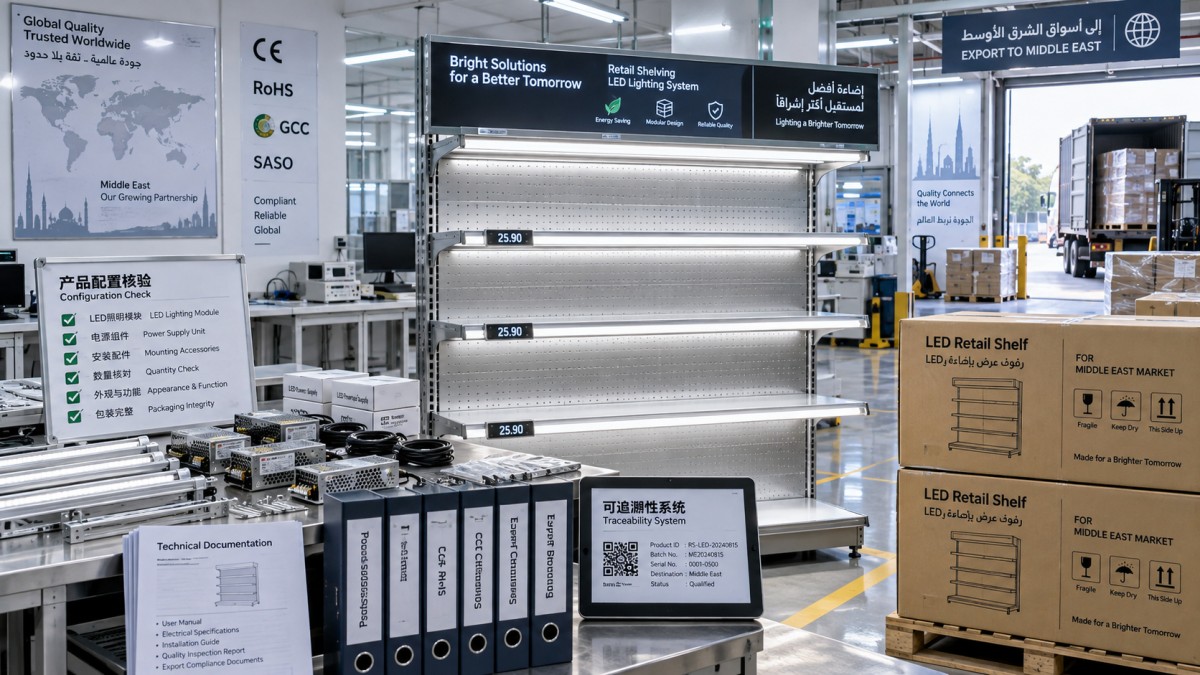
Review the technical file for product-to-document traceability
Most avoidable compliance failures are traceability failures. The supplier may possess a credible report, while the exported product differs in a component that affects safety or performance. The difference may be an alternative power supply, a revised plastic resin, a new wireless module, a changed upholstery fabric, or a modified mounting bracket. A document is only persuasive when it can be tied to the product that will enter the market.
Quality teams should review documents in a chain rather than in isolation. The model number on the purchase order should match the invoice, packing list, labels, declaration, test report, certificate, drawings, and product manual. Where a report covers a product family, the file should make clear why the exported variant falls within that family. Vague references such as “similar model,” “same series,” or “equivalent material” are weak unless supported by a controlled comparison.
Pay particular attention to components that are often substituted during normal sourcing activity. For electrical and smart retail products, these include mains plugs, cords, power supplies, batteries, chargers, circuit boards, displays, radio modules, over-current protection, and enclosure materials. For commercial furniture and fixtures, examine structural members, fasteners, castors, gas lifts, glass, upholstery, foam, surface coatings, and anchoring hardware. For packaging, verify the exact substrate, inks, adhesives, recycled-content claims, barrier layers, and intended contact conditions.
Questions that expose weak evidence quickly
- Does the report identify the exact manufacturer, factory, product model, and revision?
- Are the photographs, drawings, ratings, materials, and component lists consistent with the current bill of materials?
- Does the report cover the voltage, frequency, plug, charging method, wireless feature, or installation arrangement used in the destination market?
- Was the product assessed as a complete assembly, or are critical subcomponents being treated as proof for the final product?
- Is the certificate still valid, and has any required surveillance or follow-up activity remained in force?
- Can the supplier show a formal change-control record for differences since testing?
Test dates deserve context. An older report is not automatically invalid, particularly when the product and applicable requirements have not changed. It becomes unreliable when the product has changed, the report does not identify the tested construction adequately, or the destination requires a more current procedure. Document age should lead to a scope review, not an arbitrary rejection rule.
Check the details most likely to affect shipment release and site acceptance
Technical conformity can still fail at the border or at handover if labelling, language, importer information, or document presentation is incomplete. These controls may appear secondary to an engineering team, but they are often the most visible proof available to customs officers, distributors, installers, and facility managers.
Product labels should be reviewed against the destination requirements and against the actual shipment. Confirm ratings, warnings, model identification, country-of-origin statements where required, serial or batch traceability, and any required certification or conformity markings. For products intended for retail display or end-user operation, instructions and safety information need the appropriate language content and must remain legible after normal handling. A translated warning applied as a loose insert may be inadequate where information is expected on the unit, packaging, or durable label.
For building-related products, the installation package is equally important. Commercial lighting, signage, fixtures, and smart retail devices may be accepted on paper but rejected by a project consultant because mounting loads, ingress protection, electrical connection methods, emergency access, or fire-interface details are not documented. Export verification should therefore include installation drawings, wiring diagrams where applicable, maintenance instructions, and site constraints. Product compliance and installation compliance are related but separate decisions.
The local importer’s role should also be established early. In many trade flows, the importer is responsible for registrations, declarations, local labels, or retention of documents. A supplier can prepare the technical evidence but may not be able to complete a destination-specific step without the importer’s legal details. Leaving this responsibility undefined invites last-minute document changes and inconsistent product labels across the same shipment.
Do not let a certificate replace a risk review
A certificate can create false confidence when it is read as a blanket approval. This is particularly risky for mixed commercial environments, where the product may be subject to use conditions outside its original test scope. An indoor luminaire placed near an entrance, a seating product used in a high-traffic hospitality area, or a POS terminal connected to a different power arrangement may face conditions that the supporting evidence does not cover.
A focused risk review should look at the gap between the tested or certified state and the delivered application. The following conditions deserve escalation before shipment:
- A product is being sold under a different brand, model number, or legal entity than the one shown in the evidence.
- Factory substitutions have been approved commercially but not evaluated for their effect on safety, flammability, electrical performance, or chemical composition.
- A product combines separately certified modules into a configuration that has not been assessed as an assembly.
- The supplier provides only a certificate image, with no report, scope, issuing-body details, or controlled product documentation.
- Labels, manuals, and declarations are prepared after production rather than controlled as part of the approved product release.
- The project specification demands a named standard or fire, ingress, load, or environmental classification that the available report does not address.
In these cases, the appropriate response is not always a new full test program. Sometimes a manufacturer’s declaration supported by engineering comparison, an updated label review, additional component evidence, or a destination-specific approval can resolve the gap. The response should match the regulatory and safety significance of the change. What should be avoided is filling the gap with a generic statement that the product “meets international standards.”
Build verification into supplier release, not just pre-shipment inspection
Pre-shipment inspection can confirm visible condition, quantities, packaging, and label presence. It cannot reliably establish whether the product’s conformity basis remains valid. Compliance verification needs to begin during supplier qualification and continue through engineering changes, production approval, and shipment release.
For repeat export programs, a controlled compliance matrix is more useful than a folder of certificates. The matrix can link each destination, product family, applicable requirement, required evidence, document owner, certificate expiry, label version, and change trigger. It gives quality and safety managers a way to see when a new market, revised product, new supplier factory, or alternate component requires review.
Supplier contracts and quality agreements should make this operational. Require notification before changes to critical materials, electrical components, manufacturing location, product markings, and certified construction. Define who owns translations, local registrations, retention of technical records, and the cost of corrective action when documents do not match shipped goods. Without change notification, an export team may be relying on evidence that became obsolete months earlier.
The final release decision should be based on a concise question: can the exporter show a coherent, destination-appropriate chain from the shipped item to the required safety and conformity evidence? When the answer is clear, CE, UL, BIFMA, and other international benchmarks become useful tools in a defensible process. When the answer depends on assumptions about local acceptance, model coverage, or undocumented substitutions, the shipment is carrying a compliance risk that inspection alone will not catch.
News Recommendations
 How to verify Zigbee compatibility when sourcing lighting sensors
![51a6ab95581761cc26f4318be6520c15]()
Aris Katos
Future of Carbide Coatings
 How do packaging customization options affect minimum order quantities in Europe?
![51a6ab95581761cc26f4318be6520c15]()
Aris Katos
Future of Carbide Coatings
 Transom to Acquire Cree LED in Commercial Lighting Ownership Change
![51a6ab95581761cc26f4318be6520c15]()
Aris Katos
Future of Carbide Coatings
 How to plan customer flow in commercial design planning
![51a6ab95581761cc26f4318be6520c15]()
Aris Katos
Future of Carbide Coatings
 USTR Urged to Permanently Suspend Fees on China-Linked Ships
![51a6ab95581761cc26f4318be6520c15]()
Aris Katos
Future of Carbide Coatings
 How to choose comparable stores for retail benchmarking
![51a6ab95581761cc26f4318be6520c15]()
Aris Katos
Future of Carbide Coatings
 How does anchoring affect modular building wind load resistance?
![51a6ab95581761cc26f4318be6520c15]()
Aris Katos
Future of Carbide Coatings
 Amazon Raises European FBA Surcharge to 2% in Ten Markets From November 2
![51a6ab95581761cc26f4318be6520c15]()
Aris Katos
Future of Carbide Coatings
 How to verify a BPA-free test report for baby products
![51a6ab95581761cc26f4318be6520c15]()
Aris Katos
Future of Carbide Coatings
 China's Mandatory Classroom Lighting Standard GB 7793-2025 Takes Effect November 1
![51a6ab95581761cc26f4318be6520c15]()
Aris Katos
Future of Carbide Coatings
 How order volume affects the price of wholesale poly mailers
![51a6ab95581761cc26f4318be6520c15]()
Aris Katos
Future of Carbide Coatings
 US Imposes 50% Tariff on Certain Canadian PET Resin Imports
![51a6ab95581761cc26f4318be6520c15]()
Aris Katos
Future of Carbide Coatings
 How to read the maximum ratings in a semiconductor datasheet
![51a6ab95581761cc26f4318be6520c15]()
Aris Katos
Future of Carbide Coatings
 University of Maryland Develops Bio-Based Packaging to Extend Avocado and Cucumber Shelf Life
![51a6ab95581761cc26f4318be6520c15]()
Aris Katos
Future of Carbide Coatings
 How to verify a cookware manufacturer's induction compatibility claims
![51a6ab95581761cc26f4318be6520c15]()
Aris Katos
Future of Carbide Coatings
 Omdia Forecasts 11.6% Annual Growth in LED Display Revenue Through 2030
![51a6ab95581761cc26f4318be6520c15]()
Aris Katos
Future of Carbide Coatings
 How to verify a pulp molding packaging factory's production capacity
![51a6ab95581761cc26f4318be6520c15]()
Aris Katos
Future of Carbide Coatings
 Curion Survey: Half of Consumers Frustrated by Sustainable Packaging
![51a6ab95581761cc26f4318be6520c15]()
Aris Katos
Future of Carbide Coatings
 How to assess the credibility of market insight content
![51a6ab95581761cc26f4318be6520c15]()
Aris Katos
Future of Carbide Coatings
 US Removes 50% Additional Tariff on Selected Canadian Packaging Products
![51a6ab95581761cc26f4318be6520c15]()
Aris Katos
Future of Carbide Coatings
 Will a waterproof dimmable LED driver work with your existing dimmer?
![51a6ab95581761cc26f4318be6520c15]()
Aris Katos
Future of Carbide Coatings
 Charter Next Generation Raises Film PCR Use 30%, Advances Food-Grade Applications
![51a6ab95581761cc26f4318be6520c15]()
Aris Katos
Future of Carbide Coatings
 How to choose a dog harness and leash for a dog that pulls hard
![51a6ab95581761cc26f4318be6520c15]()
Aris Katos
Future of Carbide Coatings
 How to respect local customs when negotiating with overseas suppliers
![51a6ab95581761cc26f4318be6520c15]()
Aris Katos
Future of Carbide Coatings
 RFID Recycling Challenges Bring Paper-Based and Chipless Tags Into Focus
![51a6ab95581761cc26f4318be6520c15]()
Aris Katos
Future of Carbide Coatings
 How to choose commercial lighting for offices that reduces glare
![51a6ab95581761cc26f4318be6520c15]()
Aris Katos
Future of Carbide Coatings
 Queue Launches Fully Automated Robotic Pharmacy Kiosk for 30-Second Dispensing
![51a6ab95581761cc26f4318be6520c15]()
Aris Katos
Future of Carbide Coatings
 Can your supermarket store fixtures supplier meet your opening date?
![51a6ab95581761cc26f4318be6520c15]()
Aris Katos
Future of Carbide Coatings
 Shopify POS UI Extensions 2026-10 Adds Virtual Lists and Custom Row Templates
![51a6ab95581761cc26f4318be6520c15]()
Aris Katos
Future of Carbide Coatings
 How to assess smart office furniture suppliers’ North American support
![51a6ab95581761cc26f4318be6520c15]()
Aris Katos
Future of Carbide Coatings
 Aqara Launches Smart Lighting Range to Advance AI Spatial Intelligence
![51a6ab95581761cc26f4318be6520c15]()
Aris Katos
Future of Carbide Coatings
 How to assess demand forecasts in a lighting intelligence report
![51a6ab95581761cc26f4318be6520c15]()
Aris Katos
Future of Carbide Coatings
 Billerud推出PharmaKraft纤维基医药包装材料
![51a6ab95581761cc26f4318be6520c15]()
Aris Katos
Future of Carbide Coatings
 How to assess supplier reliability in global supply chain sourcing
![51a6ab95581761cc26f4318be6520c15]()
Aris Katos
Future of Carbide Coatings
 Omdia Forecasts 11.6% CAGR for Global LED Video Display Market in 2026–2030
![51a6ab95581761cc26f4318be6520c15]()
Aris Katos
Future of Carbide Coatings
 How to verify an LFGB testing laboratory's accreditation scope
![51a6ab95581761cc26f4318be6520c15]()
Aris Katos
Future of Carbide Coatings
 How to assess a workplace interior supplier's installation scope
![51a6ab95581761cc26f4318be6520c15]()
Aris Katos
Future of Carbide Coatings
 What records are needed for an ISO 9001 furniture factory audit?
![51a6ab95581761cc26f4318be6520c15]()
Aris Katos
Future of Carbide Coatings
 How to choose AI marketing tools that work with your existing CRM
![51a6ab95581761cc26f4318be6520c15]()
Aris Katos
Future of Carbide Coatings







































