As agricultural margins tighten and supply chains demand greater transparency, drones in agriculture are moving from experimental tools to strategic field assets.
For enterprise decision-makers, the value is no longer limited to aerial imagery. It includes faster scouting, targeted inputs, labor optimization, forecasting, and risk reduction.
This article examines real costs, measurable yield impacts, and practical field use cases, helping commercial operators assess where drones can deliver advantage.
What Business Leaders Really Need to Know First
The core question is not whether drones can fly over fields. It is whether they improve decisions faster than existing methods.
For large farms, cooperatives, food processors, and agricultural investors, drones create value when they reduce uncertainty across critical operational windows.
That means identifying crop stress earlier, applying inputs more precisely, documenting field conditions, and supporting procurement or insurance decisions with credible data.
Drones in agriculture are most valuable where field scale, labor scarcity, crop value, or compliance requirements make traditional scouting too slow or inconsistent.
They are less compelling when fields are small, crop margins are thin, or management teams lack processes to use aerial data effectively.
The Main Cost Components Behind Agricultural Drone Adoption
Enterprise buyers should evaluate drone costs as a system, not as a single hardware purchase. The aircraft is only one line item.
A basic mapping drone may cost a few thousand dollars, while advanced spraying or multispectral platforms can reach tens of thousands.
Additional costs include batteries, chargers, sensors, software subscriptions, data storage, pilot training, maintenance, insurance, and local regulatory compliance.
For agricultural spraying drones, payload capacity, tank size, nozzle quality, flight stability, and chemical compatibility significantly influence operating economics.
For imaging drones, the most important cost drivers are sensor type, accuracy requirements, analytics software, and integration with farm management systems.
Many businesses underestimate the cost of turning images into decisions. Data processing, interpretation, and operational follow-through determine the real return.
A practical budget should separate one-time capital expenditure from recurring costs, including software renewals, seasonal service contracts, and staff time.
Typical ROI: Where Drones Can Pay Back Fastest
The strongest return usually appears in high-value crops, large acreage operations, and fields where input timing strongly affects yield or quality.
Specialty crops, orchards, vineyards, seed production, and irrigated row crops often justify drone adoption faster than low-margin commodity fields.
ROI comes from several sources: reduced scouting labor, lower chemical usage, fewer missed disease outbreaks, better irrigation decisions, and improved harvest planning.
For example, early detection of pest pressure can prevent localized damage from spreading into a field-wide yield loss event.
In spraying use cases, targeted application may reduce product waste, especially when drone data identifies treatment zones instead of uniform field coverage.
In mapping use cases, value often comes from better timing. A decision made three days earlier can protect significant seasonal revenue.
Executives should avoid assuming automatic yield gains. Drones improve yield only when insights trigger timely, agronomically sound action.
Yield Impact: What Is Realistic and What Is Overstated
Drones do not increase yield by themselves. They provide visibility, speed, and precision that can improve management decisions.
Realistic yield impact depends on crop type, baseline management quality, weather volatility, pest pressure, and the farm’s ability to act quickly.
Where manual scouting is already frequent and highly accurate, incremental yield improvement may be modest, though documentation and labor savings still matter.
Where scouting is inconsistent, fields are large, or problems develop rapidly, drones can materially reduce undetected stress and prevent avoidable losses.
Multispectral imaging can reveal plant vigor patterns before visible symptoms appear, but it must be interpreted alongside ground truth observations.
Thermal imaging can support irrigation management, especially when water stress affects crop quality, fruit sizing, or uniformity before harvest.
The best performance metric is not only yield per acre. Leaders should also track input efficiency, crop uniformity, quality grades, and rejected volume.
Field Use Case 1: Faster Crop Scouting and Stress Detection
Crop scouting is one of the most practical entry points for drones in agriculture because it addresses a clear operational pain point.
Large farms often cannot inspect every field frequently enough during peak risk periods. Drones compress scouting time and improve coverage.
Aerial imagery helps identify poor emergence, nutrient deficiencies, waterlogging, pest hotspots, lodging, storm damage, and uneven crop development.
The business value is strongest when scouting outputs are connected to a standard response workflow for agronomists, field managers, and contractors.
Without a response workflow, drone maps can become attractive reports that do not change field outcomes or financial performance.
Decision-makers should define scouting frequency, responsibility, escalation thresholds, and documentation standards before investing in equipment or services.
Field Use Case 2: Precision Spraying and Targeted Input Application
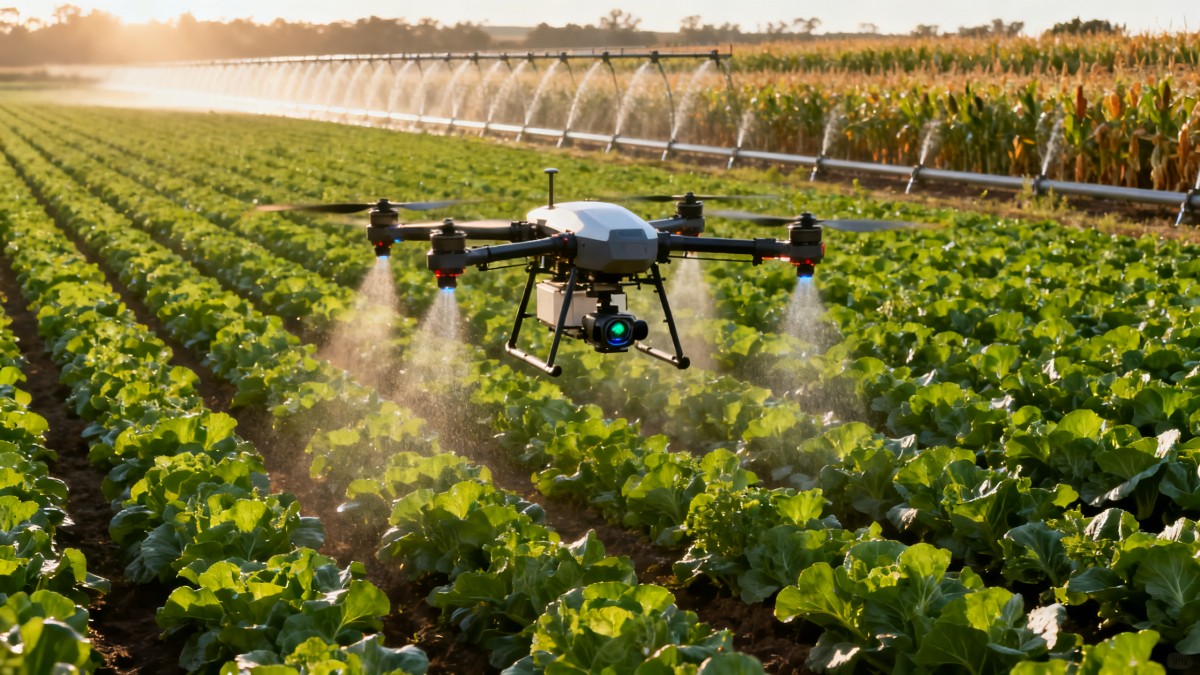
Spraying drones are gaining attention because they address labor shortages, terrain limitations, and the need for more precise application.
They are especially useful in areas where tractors may damage crops, fields are fragmented, or ground access is difficult after rainfall.
Drone spraying can support pesticides, foliar nutrients, biologicals, and spot treatments, depending on local regulations and chemical label approvals.
The financial case depends on application volume, acreage, labor availability, crop value, and whether drones replace or supplement existing machinery.
In some operations, drones reduce outsourced application costs. In others, they improve timing when contractors are unavailable during narrow windows.
Executives should evaluate droplet control, drift risk, coverage uniformity, operator certification, and chemical stewardship before approving deployment.
Precision spraying delivers the highest value when guided by reliable field intelligence, not when used as a direct substitute for broad spraying.
Field Use Case 3: Irrigation, Drainage, and Water Risk Management
Water management is becoming a board-level issue as drought, flooding, and resource regulation affect agricultural productivity and sourcing reliability.
Drones help identify irrigation failures, blocked emitters, drainage problems, standing water, and zones suffering from early water stress.
Thermal and multispectral data can support irrigation scheduling when combined with soil moisture sensors, weather data, and crop stage information.
For high-value crops, early water stress detection can protect size, quality, and marketable yield before symptoms become visually obvious.
For supply chain leaders, drone-based water documentation can strengthen sustainability reporting and support supplier performance verification.
The greatest benefit comes when drone insights are integrated into irrigation decisions, not stored as isolated seasonal imagery.
Field Use Case 4: Yield Forecasting and Harvest Planning
Yield forecasting is valuable because it influences labor planning, storage allocation, logistics, processing capacity, and commercial commitments.
Drones can support stand counts, canopy assessment, fruit load estimation, biomass measurement, and variability mapping across production blocks.
They are not a replacement for agronomic models, but they improve the field-level data feeding those models.
Processors and buyers can use drone-supported forecasts to reduce procurement uncertainty and identify supply risks earlier in the season.
Harvest teams can prioritize fields based on maturity patterns, crop uniformity, access conditions, and expected quality variation.
For enterprises managing multiple farms, consistent aerial data creates a comparable view of performance across regions and suppliers.
Field Use Case 5: Compliance, Insurance, and Supply Chain Transparency
Modern agricultural businesses face rising pressure to prove what happened in the field, not merely report final production numbers.
Drones can document flood damage, storm impact, pest outbreaks, crop loss, replanting needs, and conservation practice implementation.
This evidence can support insurance claims, internal audits, sustainability reporting, and supplier verification programs across complex sourcing networks.
For food brands and retailers, aerial documentation may strengthen traceability narratives when combined with farm records and digital compliance platforms.
However, drone imagery must be managed carefully. Data ownership, privacy, retention policies, and third-party access should be defined contractually.
Enterprise programs should treat drone data as operational intelligence, with governance standards comparable to other commercial information assets.
Build, Buy, or Partner: Choosing the Right Operating Model
Organizations can build an internal drone program, hire service providers, or use a hybrid model depending on scale and strategic importance.
Internal programs provide control, faster response, and deeper operational learning, but require training, compliance management, and equipment maintenance.
Service providers reduce upfront investment and can provide specialized analytics, making them attractive for pilots or seasonal applications.
A hybrid model often works best. Internal teams handle routine scouting, while external experts support spraying, advanced sensors, or complex analysis.
The decision should consider acreage, crop value, frequency of use, regulatory burden, internal technical capacity, and required response speed.
Before scaling, enterprises should run a controlled pilot with clear metrics, comparable baseline data, and defined operational owners.
Key Buying Criteria for Enterprise Decision-Makers
Procurement teams should not select drones based only on flight time, camera resolution, or brand reputation.
The better question is whether the system fits the organization’s agronomic decisions, field conditions, data workflow, and compliance responsibilities.
For mapping, assess sensor accuracy, repeatability, georeferencing capability, software compatibility, and the clarity of analytics outputs.
For spraying, evaluate payload, application rate, battery logistics, terrain handling, nozzle options, safety features, and local service support.
Decision-makers should also examine training requirements, spare parts availability, warranty terms, data export options, and integration with existing systems.
Global operators must verify regulatory compliance across jurisdictions, including flight permissions, pilot certification, chemical application rules, and privacy restrictions.
A technically impressive drone can still fail commercially if it creates friction for field teams or delays time-sensitive decisions.
Implementation Roadmap: From Pilot to Scaled Program
A successful drone program starts with a specific business problem, not with a general desire to adopt new technology.
Leaders should define whether the priority is labor reduction, yield protection, input savings, compliance documentation, or supply forecasting.
The next step is selecting fields where measurable results can be compared against historical performance or control areas.
During the pilot, teams should track flight frequency, issue detection rate, response time, input changes, labor hours, and financial outcomes.
It is important to involve agronomists, operators, procurement staff, and finance teams early, because each group sees different value drivers.
After the pilot, standardize workflows, reporting formats, training requirements, data storage rules, and escalation procedures before expanding acreage.
Scaling too quickly without process discipline can create data overload and reduce confidence among managers expected to act on drone insights.
Risks and Limitations That Should Not Be Ignored
Drones have operational limits, including weather restrictions, battery constraints, regulatory barriers, data interpretation challenges, and potential equipment downtime.
Wind, rain, dust, and poor visibility can reduce flight reliability exactly when field intelligence may be most urgent.
False positives are another risk. A vegetation index may indicate stress, but the cause still requires agronomic confirmation.
Data overload can also become a management problem if teams receive frequent maps without clear decision rules or priorities.
Cybersecurity and data control matter when drone platforms store field information on third-party cloud systems or external service networks.
Enterprises should manage these risks through training, governance, service-level agreements, and realistic expectations about what drones can automate.
How to Measure Success Beyond Technology Adoption
The most useful drone programs are measured by business outcomes, not by flight hours or the number of images captured.
Relevant metrics include reduced scouting time, lower input waste, earlier issue detection, fewer rejected loads, improved forecast accuracy, and faster claims processing.
Financial teams should calculate savings and revenue protection separately, because avoided losses are often harder to see than direct cost reductions.
Operations teams should measure whether drone insights changed decisions, how quickly action was taken, and whether outcomes improved afterward.
Over several seasons, organizations can build benchmark data that supports better budgeting, supplier evaluation, and risk management.
This is where drones become strategic assets: they transform field variability into structured intelligence for commercial planning.
Conclusion: When Drones in Agriculture Make Strategic Sense
Drones in agriculture make the most sense when they address a costly information gap across large, high-value, or operationally complex fields.
They can improve scouting, spraying, irrigation management, forecasting, documentation, and supply chain transparency when connected to disciplined workflows.
The strongest business cases combine realistic cost modeling, measurable decision improvements, and clear ownership of field-level action.
For enterprise leaders, drones should be evaluated as part of a broader agricultural intelligence system, not as isolated hardware.
When deployed with the right use case, governance, and operating model, they can protect margins and strengthen long-term supply resilience.