EN 17402:2026 Raises Testing Bar for LED and Signage
Time
Click Count
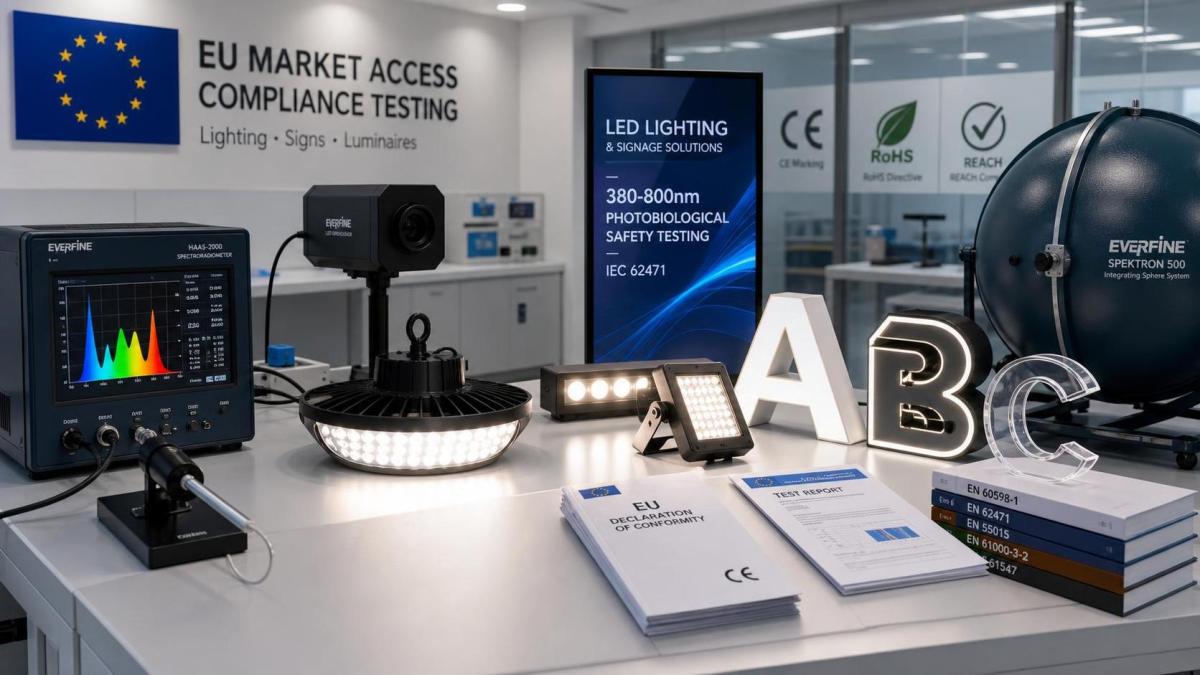
On July 17, 2026, the EU formally implemented EN 17402:2026, introducing a stricter photobiological safety assessment route for commercial LED lighting and signage systems. The change matters because it extends mandatory risk evaluation across the 380-800 nm range and directly affects CE market access for Architectural LED Lighting, 3D Channel Letters & Signs, and Digital Signage Solutions. For manufacturers, exporters, buyers, and compliance-related service providers, this is not just a technical update; it changes what product files, test evidence, and certification preparation may now be required before shipment into the EU.
What the new standard now requires
According to the provided information, the EU formally implemented EN 17402:2026 on July 17, 2026 under the title Photobiological Safety Assessment - Extended Spectral Requirements for Commercial LED Lighting and Signage Systems. The standard brings blue light, near-ultraviolet, and infrared radiation within the 380-800 nm full spectral range into the scope of mandatory risk assessment.
The change directly affects the compliance pathway for Architectural LED Lighting, 3D Channel Letters & Signs, and Digital Signage Solutions exported to the EU. Products that do not obtain the required certification will not be able to enter the EU CE market. The new requirement also states that manufacturers must provide third-party spectral power distribution (SPD) reports and dynamic scene simulation test data.
Where the pressure will likely appear first in the supply chain
Export documentation is becoming more test-dependent
From an industry perspective, exporters of affected LED lighting and signage products may face the most immediate operational pressure because EU market entry is now tied more clearly to expanded photobiological safety evidence. The main impact is likely to appear in pre-shipment compliance review, technical file preparation, and product qualification timing. What deserves closer attention is whether existing product dossiers already contain third-party SPD reports and dynamic scene simulation data in a form that can support CE-related compliance work.
Manufacturing teams may need earlier alignment with testing scope
For manufacturers, the rule change matters because the mandatory assessment range is broader than before in the provided description, covering blue light, near-UV, and infrared within 380-800 nm. Analysis shows this may shift attention toward how products are prepared for laboratory review, how test samples are selected, and how technical documentation is organized. For product categories such as Architectural LED Lighting, 3D Channel Letters & Signs, and Digital Signage Solutions, compliance work may need to begin earlier in the production and release process to avoid delays at the certification stage.
Procurement and project delivery may need stricter supplier checks
Buyers, sourcing teams, and channel partners may also be affected because compliance status is no longer a secondary issue once products are already moving toward delivery. Observably, procurement review may need to focus more closely on whether suppliers can provide the required third-party SPD reports and dynamic scene simulation test data. In practical terms, this can affect supplier qualification, document collection, order confirmation, and handover packages tied to cross-border delivery.
Testing and certification support functions gain a larger role
Certification-related service providers and testing support organizations may see a more central role in transaction readiness, since the new standard explicitly refers to third-party testing evidence. Analysis shows the operational issue is not only whether a product can be tested, but whether the supporting reports match the compliance expectations attached to EU market access. That makes report completeness, document consistency, and timing of evidence submission more relevant to exporters and manufacturers alike.
What companies should review now
Check whether current technical files match the new evidence threshold
It is more appropriate to understand this as an immediate document and assessment issue for affected product lines. Companies shipping relevant products to the EU should closely review whether current technical files already cover the newly required spectral assessment scope and whether third-party SPD reports and dynamic scene simulation test data are available for the products being offered.
Watch for changes in certification wording and acceptance practice
Analysis shows that businesses should pay attention not only to the existence of EN 17402:2026, but also to how compliance language may appear in certification reviews, customer specifications, and market-entry checks. Since the provided information does not include detailed execution procedures, companies should treat downstream acceptance criteria as an area that still requires monitoring rather than assuming all practical interpretations are already settled.
Reassess delivery schedules for affected export orders
Where product approval depends on new testing evidence, delivery planning may need to be reviewed. What deserves closer attention is whether orders involving Architectural LED Lighting, 3D Channel Letters & Signs, or Digital Signage Solutions are relying on legacy compliance files that may no longer be sufficient for EU CE market access under the new standard.
Review supplier and after-sales traceability materials
Observably, the requirement for third-party reports and dynamic simulation data increases the importance of document traceability across the supply chain. Companies may need to verify whether supplier files, batch-related records, and post-delivery support materials can be linked clearly to the tested product configuration, especially where exports depend on a consistent compliance record.
Why this should be read as an execution signal
Analysis shows this development is better understood as a rule already entering practical compliance territory rather than a distant policy direction. The reason is straightforward: the provided information points to formal implementation on July 17, 2026, ties the standard to CE market access, and identifies specific testing evidence that manufacturers must provide.
At the same time, it would be premature to treat every downstream consequence as fully settled. Observably, the market will still need to watch how certification practice, customer document requests, tender specifications, and industry feedback develop around the standard's implementation. That makes this both a landed compliance change and a continuing area for execution-level observation.
How the market may need to interpret the change
In summary, EN 17402:2026 signals that photobiological safety assessment for relevant LED lighting and signage products is becoming more documentation-driven and more closely tied to expanded spectral testing evidence. The immediate meaning for the industry is not simply that a new standard exists, but that export compliance, supplier screening, testing preparation, and delivery readiness may now need tighter coordination.
It is more appropriate to understand this as a concrete compliance change with direct market-access implications, while still recognizing that detailed enforcement practice and market response require continued observation.
Basis of this article and what still needs verification
This article is generated based on the user-provided news title, event date, and event summary. For developments of this kind, commonly relevant source categories may include official announcements, regulatory publications, trade authority updates, industry association notices, standards organization documents, and reporting by authoritative media.
No specific official source link was provided in the input, so the underlying official link and subsequent implementation details still require continued verification. What should continue to be monitored includes detailed policy language, certification interpretation, changes in tender or procurement documents, market feedback, and how companies are executing against the new requirements in practice.
News Recommendations
 What records are needed for an ISO 9001 furniture factory audit?
![51a6ab95581761cc26f4318be6520c15]()
Aris Katos
Future of Carbide Coatings
 How to choose AI marketing tools that work with your existing CRM
![51a6ab95581761cc26f4318be6520c15]()
Aris Katos
Future of Carbide Coatings
 Do freight costs erase savings when buying retail fixtures wholesale?
![51a6ab95581761cc26f4318be6520c15]()
Aris Katos
Future of Carbide Coatings
 Can smart retail IT solutions for CPG work with legacy POS systems?
![51a6ab95581761cc26f4318be6520c15]()
Aris Katos
Future of Carbide Coatings
 What permit approvals belong in a commercial fitout planning checklist?
![51a6ab95581761cc26f4318be6520c15]()
Aris Katos
Future of Carbide Coatings
 How Does Commercial Design Differ from Interior Decoration?
![51a6ab95581761cc26f4318be6520c15]()
Aris Katos
Future of Carbide Coatings
 How Long Does It Take to Verify a Commercial Furniture Supplier?
![51a6ab95581761cc26f4318be6520c15]()
Aris Katos
Future of Carbide Coatings
 How to verify compostability claims from a bubble mailer manufacturer
![51a6ab95581761cc26f4318be6520c15]()
Aris Katos
Future of Carbide Coatings
 Will commercial smart infrastructure solutions work with legacy systems?
![51a6ab95581761cc26f4318be6520c15]()
Aris Katos
Future of Carbide Coatings
 How to verify a preschool furniture manufacturer's safety standards
![51a6ab95581761cc26f4318be6520c15]()
Aris Katos
Future of Carbide Coatings
 A technical comparison of semiconductor processes for power devices
![51a6ab95581761cc26f4318be6520c15]()
Aris Katos
Future of Carbide Coatings
 How to verify that a BIFMA ergonomic chair meets the standard
![51a6ab95581761cc26f4318be6520c15]()
Aris Katos
Future of Carbide Coatings
 How to use a CRI value chart when choosing LED lighting
![51a6ab95581761cc26f4318be6520c15]()
Aris Katos
Future of Carbide Coatings
 How to compare hotel aroma diffuser wholesale options by coverage area
![51a6ab95581761cc26f4318be6520c15]()
Aris Katos
Future of Carbide Coatings
 How to prevent O-rings and seals from failing in food equipment
![51a6ab95581761cc26f4318be6520c15]()
Aris Katos
Future of Carbide Coatings
 How to compare commercial linear light wholesale quotes accurately
![51a6ab95581761cc26f4318be6520c15]()
Aris Katos
Future of Carbide Coatings
 How to verify international standards compliance for Middle East exports
![51a6ab95581761cc26f4318be6520c15]()
Aris Katos
Future of Carbide Coatings
 How to select laboratory instruments for reproducible test results
![51a6ab95581761cc26f4318be6520c15]()
Aris Katos
Future of Carbide Coatings
 When does a sheet metal prototype reveal design flaws early?
![51a6ab95581761cc26f4318be6520c15]()
Aris Katos
Future of Carbide Coatings
 When PE air column bags reduce damage in e-commerce fulfillment
![51a6ab95581761cc26f4318be6520c15]()
Aris Katos
Future of Carbide Coatings
 How energy-efficient design reduces operating costs in retail lighting
![51a6ab95581761cc26f4318be6520c15]()
Aris Katos
Future of Carbide Coatings
 When commercial aluminum storefronts make sense for a retail renovation
![51a6ab95581761cc26f4318be6520c15]()
Aris Katos
Future of Carbide Coatings
 What makes LED lights durable in high-use commercial spaces?
![51a6ab95581761cc26f4318be6520c15]()
Aris Katos
Future of Carbide Coatings
 Which industry categories offer the strongest export potential in Latin America?
![51a6ab95581761cc26f4318be6520c15]()
Aris Katos
Future of Carbide Coatings
 How to choose an ultra bright waterproof window display for storefronts
![51a6ab95581761cc26f4318be6520c15]()
Aris Katos
Future of Carbide Coatings
 How to verify suppliers on a trade portal for global sourcing
![51a6ab95581761cc26f4318be6520c15]()
Aris Katos
Future of Carbide Coatings
 How RoHS requirements should be stated in product specifications
![51a6ab95581761cc26f4318be6520c15]()
Aris Katos
Future of Carbide Coatings
 What affects the lead time for custom retail counter displays?
![51a6ab95581761cc26f4318be6520c15]()
Aris Katos
Future of Carbide Coatings
 What consumer packaging USA importers need to verify before ordering
![51a6ab95581761cc26f4318be6520c15]()
Aris Katos
Future of Carbide Coatings
 How commercial spaces interiors shape customer dwell time
![51a6ab95581761cc26f4318be6520c15]()
Aris Katos
Future of Carbide Coatings
 How LED commercial lighting design reduces glare in retail spaces
![51a6ab95581761cc26f4318be6520c15]()
Aris Katos
Future of Carbide Coatings
 How industrial technology information improves RFID inventory accuracy
![51a6ab95581761cc26f4318be6520c15]()
Aris Katos
Future of Carbide Coatings
 When drip garden watering systems make more sense than sprinklers
![51a6ab95581761cc26f4318be6520c15]()
Aris Katos
Future of Carbide Coatings
 When category comparison improves sourcing for industrial applications
![51a6ab95581761cc26f4318be6520c15]()
Aris Katos
Future of Carbide Coatings
 Industrial application guidance for selecting the right LED lighting
![51a6ab95581761cc26f4318be6520c15]()
Aris Katos
Future of Carbide Coatings
 Which commercial architecture standards apply to European retail fit-outs?
![51a6ab95581761cc26f4318be6520c15]()
Aris Katos
Future of Carbide Coatings
 How to verify FDA requirements for maternity care products
![51a6ab95581761cc26f4318be6520c15]()
Aris Katos
Future of Carbide Coatings
 How to verify BPA-free claims for food-contact products
![51a6ab95581761cc26f4318be6520c15]()
Aris Katos
Future of Carbide Coatings
 When does a European wholesale supplier suit modular office projects?
![51a6ab95581761cc26f4318be6520c15]()
Aris Katos
Future of Carbide Coatings