Office Acoustic Panels: How to Compare Noise Control and Cost
Time
Click Count
Office Acoustic Panels: How to Compare Noise Control and Cost
When evaluating office acoustic panels, price alone rarely tells the full story.
The better comparison looks at acoustic performance, material stability, compliance, installation speed, and maintenance over time.
That matters even more in offices where open layouts, hybrid meetings, and dense occupancy raise the cost of poor sound control.
A cheap panel can become expensive if it underperforms, fails certification, or creates rework during fit-out.
This guide explains how to compare office acoustic panels in a sourcing-focused way, with practical criteria that support better buying decisions.
Start With the Real Noise Problem
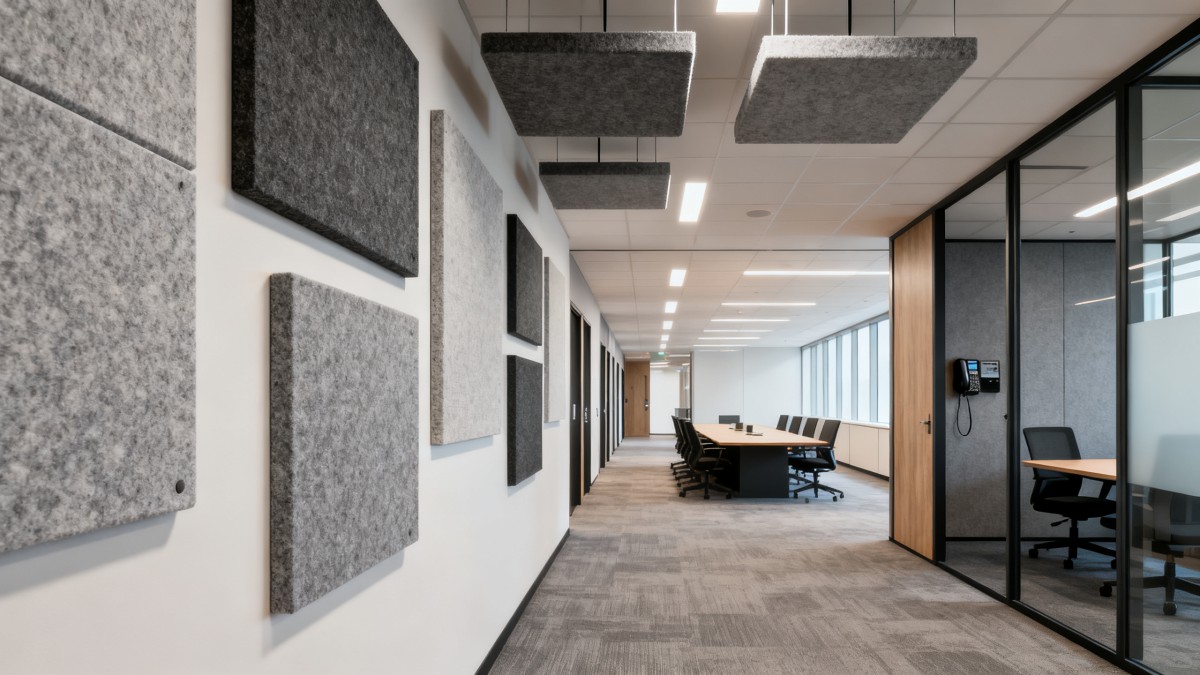
Before comparing office acoustic panels, define what kind of noise needs control.
Speech distraction in open offices requires a different solution than echo in meeting rooms or reverberation in reception areas.
This is where many comparisons go wrong.
Teams often compare unit price across products that solve different acoustic problems.
A more useful starting point is to map noise by space type:
- Open-plan zones: speech absorption and reduced distraction
- Meeting rooms: echo control and clearer voice transmission
- Phone booths: privacy support and sound containment
- Corridors and lobbies: reverberation reduction
- Executive spaces: acoustic comfort with stronger visual expectations
Once the acoustic target is clear, office acoustic panels become easier to compare on a like-for-like basis.
Compare Performance Before Comparing Price
Noise control value begins with measurable performance, not appearance.
For office acoustic panels, the most common benchmark is NRC, or Noise Reduction Coefficient.
Higher NRC usually means better sound absorption, but only when the test method matches actual installation conditions.
A wall panel fixed tightly to a hard surface will not behave like a suspended baffle in the same material.
Ask suppliers for these performance details:
- NRC or equivalent absorption rating
- Test standard and lab source
- Panel thickness and density
- Mounting method used during testing
- Performance by frequency, especially speech range
In practical terms, office acoustic panels should be judged by how well they improve speech comfort, not by one headline number alone.
That also means reviewing the acoustic plan for panel coverage, spacing, and placement.
Understand What Drives Cost
The cost of office acoustic panels is shaped by more than material price per square meter.
Several hidden factors can change the total budget significantly.
From a sourcing view, the right comparison is total installed cost against expected acoustic outcome.
That is a stronger decision model than comparing office acoustic panels by invoice price alone.
Evaluate Materials for Long-Term Value
Material choice affects durability, appearance retention, indoor air quality, and maintenance cost.
In recent projects, PET felt office acoustic panels have gained attention for recyclability, dimensional stability, and clean visual integration.
Fabric-wrapped systems still perform well where a softer, higher-end finish is required.
At the same time, lower-cost foam products may struggle with aging, staining, or inconsistent fire performance.
Useful material checks include:
- Resistance to sagging, warping, and edge damage
- VOC and indoor air quality documentation
- Scratch, stain, and dust performance
- Color consistency across production batches
- Recycled content and end-of-life considerations
For commercial interiors, office acoustic panels should support both performance and finish quality over the full lease cycle.
Check Compliance, Testing, and Documentation
Documentation is often the dividing line between a usable quotation and a risky one.
Office acoustic panels used in commercial spaces should be reviewed against project standards and local code expectations.
Depending on the market, that may include fire testing, VOC declarations, and references to UL, CE, or related compliance frameworks.
It is also smart to confirm whether certificates apply to the full product assembly or only to a raw material component.
A reliable supplier package should include:
- Acoustic test reports from a recognized lab
- Fire rating documentation for the specified configuration
- Material safety or VOC data where relevant
- Installation instructions and hardware details
- Warranty terms with clear exclusions
This step may feel administrative, but it protects budget, timeline, and approval flow.
Do Not Ignore Installation Efficiency
Installation labor can shift the economics of office acoustic panels faster than expected.
A panel that looks inexpensive on paper may require extra framing, alignment time, or special site conditions.
That creates delays, especially in multi-site rollouts and fast-track commercial fit-outs.
During comparison, ask how each system performs in real site conditions:
- Can the panel tolerate wall irregularities?
- Does it need skilled labor or specialist tools?
- Can damaged units be replaced individually?
- How much site cutting is required?
- Are suspension parts included and standardized?
More efficient office acoustic panels reduce not only labor cost, but also coordination risk across contractors and schedules.
Use a Simple Comparison Framework
In actual buying decisions, a weighted scorecard is often more useful than a long product narrative.
A practical framework for office acoustic panels can include five decision areas.
This kind of structure keeps office acoustic panels under disciplined review, especially when several stakeholders influence the final choice.
Common Buying Mistakes to Avoid
Several mistakes appear repeatedly in acoustic sourcing.
- Choosing office acoustic panels only by unit cost
- Using the same panel type across every space
- Accepting test data without checking mounting conditions
- Ignoring replacement and cleaning requirements
- Treating aesthetics and acoustics as separate decisions
The stronger approach is balanced and specific.
Well-selected office acoustic panels should support comfort, visual quality, and operational efficiency at the same time.
Make the Final Decision With Total Value in Mind
The best office acoustic panels are not always the cheapest option, and they are not always the highest-spec option either.
The right choice is the one that delivers reliable noise control, clear compliance, efficient installation, and stable lifecycle cost.
For commercial projects, that usually means comparing office acoustic panels through a full performance-and-cost lens.
A short pilot review, sample mock-up, and document check can remove a surprising amount of risk before rollout.
When the comparison is structured well, office acoustic panels stop being a decorative add-on and become a measurable workplace investment.
That is usually where better sound control and better budget discipline finally meet.
News Recommendations
 What records are needed for an ISO 9001 furniture factory audit?
![51a6ab95581761cc26f4318be6520c15]()
Aris Katos
Future of Carbide Coatings
 How to choose AI marketing tools that work with your existing CRM
![51a6ab95581761cc26f4318be6520c15]()
Aris Katos
Future of Carbide Coatings
 Do freight costs erase savings when buying retail fixtures wholesale?
![51a6ab95581761cc26f4318be6520c15]()
Aris Katos
Future of Carbide Coatings
 What brightness should an OEM shelf LCD screen have for retail use?
![51a6ab95581761cc26f4318be6520c15]()
Aris Katos
Future of Carbide Coatings
 Can smart retail IT solutions for CPG work with legacy POS systems?
![51a6ab95581761cc26f4318be6520c15]()
Aris Katos
Future of Carbide Coatings
 What permit approvals belong in a commercial fitout planning checklist?
![51a6ab95581761cc26f4318be6520c15]()
Aris Katos
Future of Carbide Coatings
 Does Data Transparency Matter When Selecting Consumer Goods Suppliers?
![51a6ab95581761cc26f4318be6520c15]()
Aris Katos
Future of Carbide Coatings
 How Does Commercial Design Differ from Interior Decoration?
![51a6ab95581761cc26f4318be6520c15]()
Aris Katos
Future of Carbide Coatings
 How Long Does It Take to Verify a Commercial Furniture Supplier?
![51a6ab95581761cc26f4318be6520c15]()
Aris Katos
Future of Carbide Coatings
 How to verify compostability claims from a bubble mailer manufacturer
![51a6ab95581761cc26f4318be6520c15]()
Aris Katos
Future of Carbide Coatings
 Will commercial smart infrastructure solutions work with legacy systems?
![51a6ab95581761cc26f4318be6520c15]()
Aris Katos
Future of Carbide Coatings
 How to verify a preschool furniture manufacturer's safety standards
![51a6ab95581761cc26f4318be6520c15]()
Aris Katos
Future of Carbide Coatings
 A technical comparison of semiconductor processes for power devices
![51a6ab95581761cc26f4318be6520c15]()
Aris Katos
Future of Carbide Coatings
 How to verify that a BIFMA ergonomic chair meets the standard
![51a6ab95581761cc26f4318be6520c15]()
Aris Katos
Future of Carbide Coatings
 How to use a CRI value chart when choosing LED lighting
![51a6ab95581761cc26f4318be6520c15]()
Aris Katos
Future of Carbide Coatings
 How to compare hotel aroma diffuser wholesale options by coverage area
![51a6ab95581761cc26f4318be6520c15]()
Aris Katos
Future of Carbide Coatings
 How to prevent O-rings and seals from failing in food equipment
![51a6ab95581761cc26f4318be6520c15]()
Aris Katos
Future of Carbide Coatings
 How to compare commercial linear light wholesale quotes accurately
![51a6ab95581761cc26f4318be6520c15]()
Aris Katos
Future of Carbide Coatings
 How to verify international standards compliance for Middle East exports
![51a6ab95581761cc26f4318be6520c15]()
Aris Katos
Future of Carbide Coatings
 How to select laboratory instruments for reproducible test results
![51a6ab95581761cc26f4318be6520c15]()
Aris Katos
Future of Carbide Coatings
 When does a sheet metal prototype reveal design flaws early?
![51a6ab95581761cc26f4318be6520c15]()
Aris Katos
Future of Carbide Coatings
 When PE air column bags reduce damage in e-commerce fulfillment
![51a6ab95581761cc26f4318be6520c15]()
Aris Katos
Future of Carbide Coatings
 How energy-efficient design reduces operating costs in retail lighting
![51a6ab95581761cc26f4318be6520c15]()
Aris Katos
Future of Carbide Coatings
 When commercial aluminum storefronts make sense for a retail renovation
![51a6ab95581761cc26f4318be6520c15]()
Aris Katos
Future of Carbide Coatings
 What makes LED lights durable in high-use commercial spaces?
![51a6ab95581761cc26f4318be6520c15]()
Aris Katos
Future of Carbide Coatings
 Which industry categories offer the strongest export potential in Latin America?
![51a6ab95581761cc26f4318be6520c15]()
Aris Katos
Future of Carbide Coatings
 How to choose an ultra bright waterproof window display for storefronts
![51a6ab95581761cc26f4318be6520c15]()
Aris Katos
Future of Carbide Coatings
 How to verify suppliers on a trade portal for global sourcing
![51a6ab95581761cc26f4318be6520c15]()
Aris Katos
Future of Carbide Coatings
 How RoHS requirements should be stated in product specifications
![51a6ab95581761cc26f4318be6520c15]()
Aris Katos
Future of Carbide Coatings
 What affects the lead time for custom retail counter displays?
![51a6ab95581761cc26f4318be6520c15]()
Aris Katos
Future of Carbide Coatings
 What consumer packaging USA importers need to verify before ordering
![51a6ab95581761cc26f4318be6520c15]()
Aris Katos
Future of Carbide Coatings
 How commercial spaces interiors shape customer dwell time
![51a6ab95581761cc26f4318be6520c15]()
Aris Katos
Future of Carbide Coatings
 How LED commercial lighting design reduces glare in retail spaces
![51a6ab95581761cc26f4318be6520c15]()
Aris Katos
Future of Carbide Coatings
 How industrial technology information improves RFID inventory accuracy
![51a6ab95581761cc26f4318be6520c15]()
Aris Katos
Future of Carbide Coatings
 When drip garden watering systems make more sense than sprinklers
![51a6ab95581761cc26f4318be6520c15]()
Aris Katos
Future of Carbide Coatings
 When category comparison improves sourcing for industrial applications
![51a6ab95581761cc26f4318be6520c15]()
Aris Katos
Future of Carbide Coatings
 Industrial application guidance for selecting the right LED lighting
![51a6ab95581761cc26f4318be6520c15]()
Aris Katos
Future of Carbide Coatings
 Which commercial architecture standards apply to European retail fit-outs?
![51a6ab95581761cc26f4318be6520c15]()
Aris Katos
Future of Carbide Coatings
 How to verify FDA requirements for maternity care products
![51a6ab95581761cc26f4318be6520c15]()
Aris Katos
Future of Carbide Coatings