EU Sets EN 13432 Gate for Biodegradable Packaging
Time
Click Count
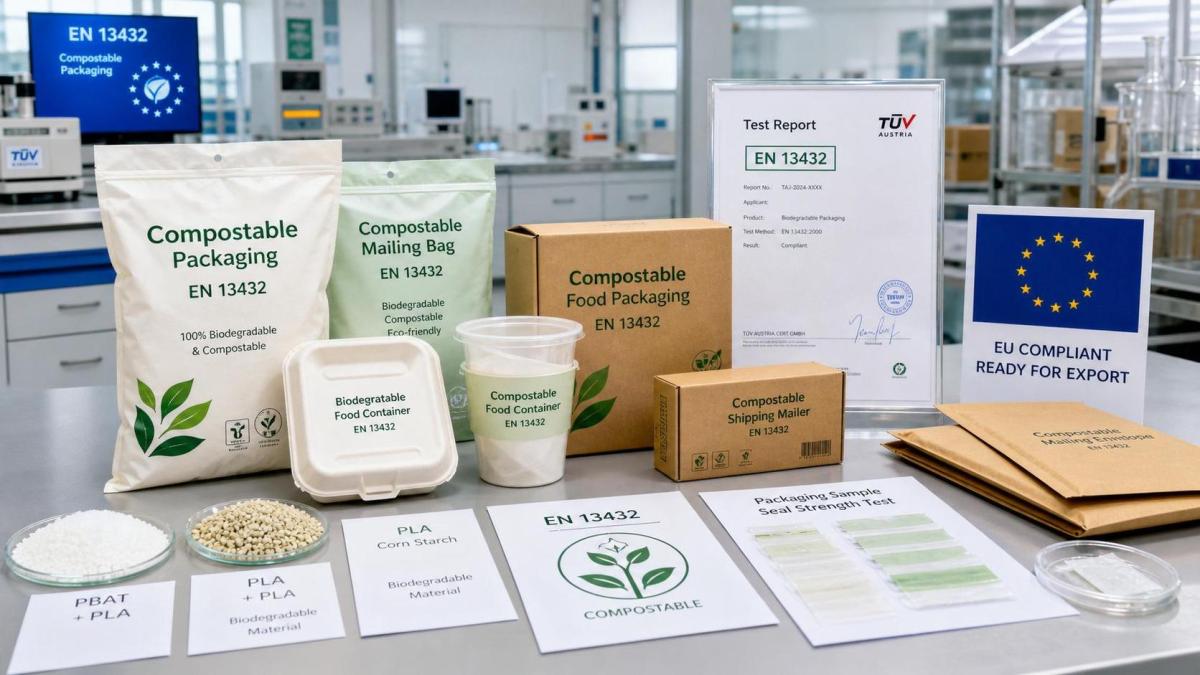
Effective July 11, 2026, the European Commission has put into force Regulation (EU) 2026/1189 on the transition to sustainable packaging, creating a new entry requirement for biodegradable packaging materials shipped into the EU. The change matters not only for material suppliers using PLA, PBAT, and PHA, but also for exporters, packaging converters, fulfillment operators, food-contact packaging suppliers, and procurement teams that depend on smooth customs clearance and delivery performance. What deserves closer attention is that this is not just a labeling or marketing issue; it directly links certification status and third-party verification to market access.
A Clearer Compliance Threshold at the Border
According to the provided information, Regulation (EU) 2026/1189 took effect on July 11, 2026. It requires all biodegradable packaging materials imported into the EU to obtain EN 13432 industrial compostability certification and to provide a third-party verification report. The rule applies to packaging used for e-commerce fulfillment and food-grade compliance. Products that do not meet the requirement may be denied entry by customs or returned.
The materials explicitly referenced in the provided summary include PLA, PBAT, and PHA. The policy is described as having a direct effect on the fulfillment capability and certification costs of Chinese exporters serving the EU market.
Where the Pressure Is Most Likely to Appear
Export packaging now faces a stricter access condition
For exporters shipping biodegradable packaging into the EU, the immediate issue is no longer only product positioning or buyer acceptance, but whether the packaging can legally enter the market. The main impact is likely to fall on pre-shipment compliance review, customs documentation readiness, and delivery planning. Companies in this position should pay close attention to whether EN 13432 certification and third-party validation documents are complete and aligned with the specific packaging being exported.
Material sourcing and conversion decisions may need rechecking
For companies purchasing or converting PLA, PBAT, PHA, and related biodegradable materials, the rule change may affect supplier selection, specification confirmation, and internal approval steps. From an industry perspective, the practical question is whether sourced materials and converted packaging formats can support the required certification path, especially when the end use falls under e-commerce fulfillment or food-grade packaging.
Certification and testing functions move closer to shipment risk control
For certification-related service providers and testing support functions, the development signals that documentation is becoming part of trade execution rather than a secondary technical file. Observably, the impact is likely to be strongest where exporters must coordinate third-party verification, shipment timing, and customs entry requirements at the same time. Buyers and logistics-facing teams should therefore monitor not only the existence of a certificate, but also whether supporting verification materials are ready for transaction and delivery use.
What Companies Should Watch in the Near Term
Check whether current product lines fall inside the rule scope
Companies dealing in biodegradable packaging should first review whether their products are used in e-commerce fulfillment packaging or food-grade compliance packaging, because these uses are explicitly covered in the provided summary. This is a basic screening step before discussing sales continuity, lead times, or pricing.
Review certification status together with supporting files
Analysis shows that EN 13432 certification alone should not be treated as the only checkpoint, because the provided information also requires a third-party verification report. Firms should therefore look at the full documentation set that may be needed for trade, customs, and customer review, rather than handling certification as a standalone item.
Reassess delivery commitments to EU customers
Because non-compliant goods may be refused entry or returned, exporters and supply chain teams should pay closer attention to shipment scheduling, contract execution risk, and handover timing. This does not by itself confirm broader market disruption, but it does indicate that packaging compliance can directly affect order fulfillment performance.
Watch for execution language and downstream document changes
The provided information confirms the rule and its core requirements, but it does not provide detailed enforcement procedures. It is therefore more appropriate to monitor how the requirement may appear in customer specifications, tender documents, customs-facing paperwork, and supplier qualification requests, rather than assume a fully uniform execution outcome at this stage.
How This Signal Should Be Read
As an editorial observation, this development is better understood as a landed compliance signal rather than a distant policy direction. The effective date is defined, the certification requirement is explicit, and the consequence of non-compliance is tied to customs treatment. At the same time, observably, the market still needs to watch how certification review, third-party verification acceptance, and downstream procurement language are applied in practice.
From an industry perspective, the significance lies in the shift from a general sustainability narrative to a document-based market entry condition. That makes the issue relevant not only to sustainability or regulatory teams, but also to sales operations, sourcing, packaging design, and cross-border delivery management.
What This Means for the Market Now
At this stage, the development is most appropriately understood as an implemented rule change with immediate trade relevance for biodegradable packaging entering the EU. The clearest near-term implication is that certification readiness and supporting verification documents may become part of normal delivery qualification for affected packaging categories.
Analysis shows that the market impact should be assessed through actual compliance execution points such as sourcing, documentation, shipment release, and buyer acceptance, rather than through broad claims about long-term structural change. For companies exposed to EU-bound packaging business, the practical issue is preparedness, not abstract policy interpretation.
Basis of This Article
This article is based on the user-provided news title, event date, and event summary. For events of this kind, commonly relevant source types may include official notices, publications from regulatory authorities, customs or trade administration updates, industry association releases, standards organization documents, and reporting from established trade or industry media.
No specific official source link was provided in the input, so the underlying source documentation still needs to be verified on an ongoing basis. What also requires continued observation includes any further policy detail, certification enforcement interpretation, wording in procurement or tender documents, market feedback, and how affected companies implement the requirement in practice.
News Recommendations
 What records are needed for an ISO 9001 furniture factory audit?
![51a6ab95581761cc26f4318be6520c15]()
Aris Katos
Future of Carbide Coatings
 How to choose AI marketing tools that work with your existing CRM
![51a6ab95581761cc26f4318be6520c15]()
Aris Katos
Future of Carbide Coatings
 Do freight costs erase savings when buying retail fixtures wholesale?
![51a6ab95581761cc26f4318be6520c15]()
Aris Katos
Future of Carbide Coatings
 Can smart retail IT solutions for CPG work with legacy POS systems?
![51a6ab95581761cc26f4318be6520c15]()
Aris Katos
Future of Carbide Coatings
 What permit approvals belong in a commercial fitout planning checklist?
![51a6ab95581761cc26f4318be6520c15]()
Aris Katos
Future of Carbide Coatings
 How Does Commercial Design Differ from Interior Decoration?
![51a6ab95581761cc26f4318be6520c15]()
Aris Katos
Future of Carbide Coatings
 How Long Does It Take to Verify a Commercial Furniture Supplier?
![51a6ab95581761cc26f4318be6520c15]()
Aris Katos
Future of Carbide Coatings
 How to verify compostability claims from a bubble mailer manufacturer
![51a6ab95581761cc26f4318be6520c15]()
Aris Katos
Future of Carbide Coatings
 Will commercial smart infrastructure solutions work with legacy systems?
![51a6ab95581761cc26f4318be6520c15]()
Aris Katos
Future of Carbide Coatings
 How to verify a preschool furniture manufacturer's safety standards
![51a6ab95581761cc26f4318be6520c15]()
Aris Katos
Future of Carbide Coatings
 A technical comparison of semiconductor processes for power devices
![51a6ab95581761cc26f4318be6520c15]()
Aris Katos
Future of Carbide Coatings
 How to verify that a BIFMA ergonomic chair meets the standard
![51a6ab95581761cc26f4318be6520c15]()
Aris Katos
Future of Carbide Coatings
 How to use a CRI value chart when choosing LED lighting
![51a6ab95581761cc26f4318be6520c15]()
Aris Katos
Future of Carbide Coatings
 How to compare hotel aroma diffuser wholesale options by coverage area
![51a6ab95581761cc26f4318be6520c15]()
Aris Katos
Future of Carbide Coatings
 How to prevent O-rings and seals from failing in food equipment
![51a6ab95581761cc26f4318be6520c15]()
Aris Katos
Future of Carbide Coatings
 How to compare commercial linear light wholesale quotes accurately
![51a6ab95581761cc26f4318be6520c15]()
Aris Katos
Future of Carbide Coatings
 How to verify international standards compliance for Middle East exports
![51a6ab95581761cc26f4318be6520c15]()
Aris Katos
Future of Carbide Coatings
 How to select laboratory instruments for reproducible test results
![51a6ab95581761cc26f4318be6520c15]()
Aris Katos
Future of Carbide Coatings
 When does a sheet metal prototype reveal design flaws early?
![51a6ab95581761cc26f4318be6520c15]()
Aris Katos
Future of Carbide Coatings
 When PE air column bags reduce damage in e-commerce fulfillment
![51a6ab95581761cc26f4318be6520c15]()
Aris Katos
Future of Carbide Coatings
 How energy-efficient design reduces operating costs in retail lighting
![51a6ab95581761cc26f4318be6520c15]()
Aris Katos
Future of Carbide Coatings
 When commercial aluminum storefronts make sense for a retail renovation
![51a6ab95581761cc26f4318be6520c15]()
Aris Katos
Future of Carbide Coatings
 What makes LED lights durable in high-use commercial spaces?
![51a6ab95581761cc26f4318be6520c15]()
Aris Katos
Future of Carbide Coatings
 Which industry categories offer the strongest export potential in Latin America?
![51a6ab95581761cc26f4318be6520c15]()
Aris Katos
Future of Carbide Coatings
 How to choose an ultra bright waterproof window display for storefronts
![51a6ab95581761cc26f4318be6520c15]()
Aris Katos
Future of Carbide Coatings
 How to verify suppliers on a trade portal for global sourcing
![51a6ab95581761cc26f4318be6520c15]()
Aris Katos
Future of Carbide Coatings
 How RoHS requirements should be stated in product specifications
![51a6ab95581761cc26f4318be6520c15]()
Aris Katos
Future of Carbide Coatings
 What affects the lead time for custom retail counter displays?
![51a6ab95581761cc26f4318be6520c15]()
Aris Katos
Future of Carbide Coatings
 What consumer packaging USA importers need to verify before ordering
![51a6ab95581761cc26f4318be6520c15]()
Aris Katos
Future of Carbide Coatings
 How commercial spaces interiors shape customer dwell time
![51a6ab95581761cc26f4318be6520c15]()
Aris Katos
Future of Carbide Coatings
 How LED commercial lighting design reduces glare in retail spaces
![51a6ab95581761cc26f4318be6520c15]()
Aris Katos
Future of Carbide Coatings
 How industrial technology information improves RFID inventory accuracy
![51a6ab95581761cc26f4318be6520c15]()
Aris Katos
Future of Carbide Coatings
 When drip garden watering systems make more sense than sprinklers
![51a6ab95581761cc26f4318be6520c15]()
Aris Katos
Future of Carbide Coatings
 When category comparison improves sourcing for industrial applications
![51a6ab95581761cc26f4318be6520c15]()
Aris Katos
Future of Carbide Coatings
 Industrial application guidance for selecting the right LED lighting
![51a6ab95581761cc26f4318be6520c15]()
Aris Katos
Future of Carbide Coatings
 Which commercial architecture standards apply to European retail fit-outs?
![51a6ab95581761cc26f4318be6520c15]()
Aris Katos
Future of Carbide Coatings
 How to verify FDA requirements for maternity care products
![51a6ab95581761cc26f4318be6520c15]()
Aris Katos
Future of Carbide Coatings
 How to verify BPA-free claims for food-contact products
![51a6ab95581761cc26f4318be6520c15]()
Aris Katos
Future of Carbide Coatings
 When does a European wholesale supplier suit modular office projects?
![51a6ab95581761cc26f4318be6520c15]()
Aris Katos
Future of Carbide Coatings