Saudi SASO Tightens Testing for Architectural LED Imports
Time
Click Count
On July 13, 2026, the Saudi Standards, Metrology and Quality Organization (SASO) notified a revision to SASO IEC 62471:2026 that changes the compliance path for imported architectural LED lighting in Saudi Arabia. From September 2026, products such as recessed ceiling luminaires and linear track lights will need an additional local photobiological safety test in Riyadh, on top of existing SABER certification. For exporters, importers, project suppliers, and supply chain service providers, this matters because the new requirement directly affects testing arrangements, document acceptance, and delivery timing.
What the rule change explicitly requires
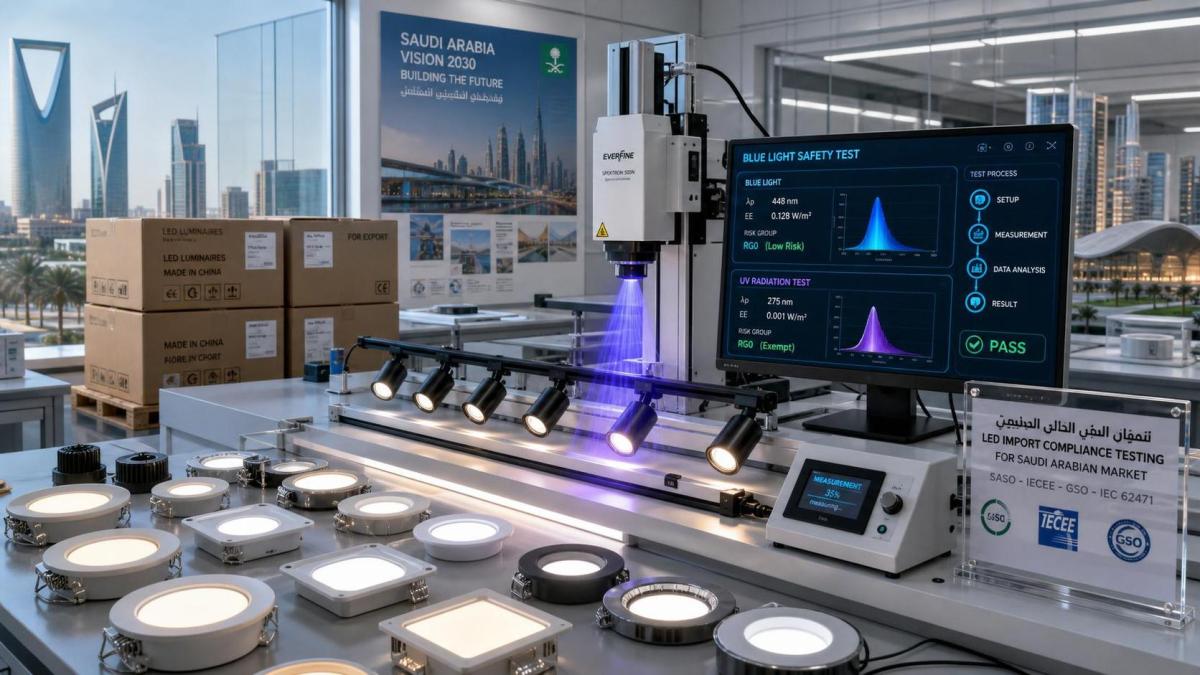
According to the provided information, SASO announced on July 13, 2026 a revised version of SASO IEC 62471:2026. The revision applies to imported architectural LED lighting products entering Saudi Arabia, including categories such as recessed ceiling fixtures and linear track lighting.
The confirmed requirement is that, starting in September 2026, these products must complete an additional on-site photobiological safety test covering blue light hazard and UV radiation. The test must be carried out at a Riyadh laboratory by a SASO-authorized body. The same information also states that a CB report cannot be used as a substitute for this local test. In addition, the adjustment is expected to significantly extend the export delivery cycle for architectural LED lighting.
Where the operational pressure is likely to appear
Export and trading teams face a more complex market-entry sequence
From an industry perspective, companies directly exporting architectural LED lighting to Saudi Arabia are likely to feel the change first. The reason is straightforward: the compliance route no longer stops at existing SABER-related preparation, and the inability to replace local testing with a CB report adds another required step before shipment or final delivery planning can be considered stable. The main impact is likely to appear in scheduling, document coordination, and customer commitment dates.
Manufacturers may need tighter alignment between product readiness and test booking
Analysis shows that manufacturers supplying project-grade luminaires will need to pay closer attention to when products are ready for testing and which specific models fall within the revised requirement. Because the local test is tied to a Riyadh laboratory authorized by SASO, the operational issue is not only technical compliance but also whether product samples, paperwork, and approval sequencing are aligned early enough to avoid extended lead times.
Project suppliers and channel partners may see delivery risk move upstream
For distributors, project suppliers, and other channel participants serving Saudi projects, the likely effect is upstream uncertainty rather than a simple paperwork burden. If testing must be completed locally and cannot be replaced by an existing CB report, delivery promises may depend more heavily on laboratory timing and compliance coordination. What deserves closer attention is whether sales and procurement teams continue quoting lead times based on the old certification rhythm.
Supply chain service providers may need to recalibrate milestones
Observably, logistics coordinators, compliance service providers, and related support firms may need to adjust the order of execution across shipment preparation, documentation review, and customs-facing compliance planning. The key issue is not that the rule changes every supply chain function equally, but that an extra mandatory local test can shift the critical path for cross-border orders.
What companies should watch now
Track whether official wording is further clarified
Companies should closely monitor whether SASO or authorized bodies issue additional clarification on scope, applicable product interpretation, or implementation details tied to the September 2026 start. The current information confirms the new local test requirement, but day-to-day execution often depends on how authorities define covered models and procedural expectations.
Identify which product lines are exposed first
A practical priority is to review product portfolios against the categories already referenced in the notice, including recessed ceiling products and linear track lighting. This is especially relevant for businesses shipping multiple architectural lighting types into Saudi Arabia, because the immediate exposure may not be identical across all SKUs or project packages.
Rework customer communication around lead times
Analysis shows that sales, project delivery, and account management teams should revisit the way lead times are communicated to buyers. Since the provided information explicitly states that the adjustment will significantly extend export delivery cycles, companies should avoid treating prior turnaround assumptions as still valid without review.
Check document strategy and supplier readiness
Another immediate focus is internal and upstream coordination. Because a CB report cannot replace the required local photobiological safety test, firms should verify that suppliers, compliance teams, and local partners are working from the same assumption set. This includes checking whether product documentation, sample preparation, and scheduling plans are built around the revised requirement rather than older certification habits.
Why this reads as more than a routine paperwork update
As an editorial observation, this development is better understood as an operational compliance signal rather than a purely formal standards update. The combination of three elements matters here: the requirement is additional to existing SABER certification, the testing must be carried out locally in Riyadh by a SASO-authorized body, and a CB report is explicitly not accepted as a substitute. Together, these points suggest that companies should focus less on whether the rule exists and more on how it reshapes execution timing.
It is more appropriate to understand this as a near-term compliance change with immediate business consequences, while still treating the broader market impact as something that requires continued observation. The confirmed facts already indicate longer delivery cycles, but the full effect on quoting practices, project planning, and supplier coordination will depend on implementation in real transactions.
How the market should read the change at this stage
At this stage, the most balanced reading is that Saudi market access for imported architectural LED lighting is becoming more locally test-dependent in this area of compliance. That does not by itself justify broader conclusions beyond the provided facts, but it does justify a more cautious approach to order planning and delivery commitments. For industry participants, the immediate significance lies in execution risk, not in abstract policy language.
Current observation suggests this should be treated neither as a minor short-term procedural adjustment nor as a basis for sweeping market conclusions. It is more appropriately read as a concrete rule change with direct lead-time implications and with details that still merit close follow-up as implementation progresses.
Basis of this article and what still needs verification
This article is based on the user-provided news title, event date, and event summary regarding the SASO IEC 62471:2026 revision announced on July 13, 2026. For this type of industry update, commonly relevant source categories may include official notices, standard organization documents, company compliance notices, industry association updates, and reporting from established trade media.
No specific official source link was provided in the input, so the exact official publication path still needs ongoing verification. Follow-up attention should focus on any further SASO wording, implementation guidance from authorized bodies, and any additional clarification on product scope and testing procedures.
News Recommendations
 What records are needed for an ISO 9001 furniture factory audit?
![51a6ab95581761cc26f4318be6520c15]()
Aris Katos
Future of Carbide Coatings
 How to choose AI marketing tools that work with your existing CRM
![51a6ab95581761cc26f4318be6520c15]()
Aris Katos
Future of Carbide Coatings
 Do freight costs erase savings when buying retail fixtures wholesale?
![51a6ab95581761cc26f4318be6520c15]()
Aris Katos
Future of Carbide Coatings
 Can smart retail IT solutions for CPG work with legacy POS systems?
![51a6ab95581761cc26f4318be6520c15]()
Aris Katos
Future of Carbide Coatings
 What permit approvals belong in a commercial fitout planning checklist?
![51a6ab95581761cc26f4318be6520c15]()
Aris Katos
Future of Carbide Coatings
 How Does Commercial Design Differ from Interior Decoration?
![51a6ab95581761cc26f4318be6520c15]()
Aris Katos
Future of Carbide Coatings
 How Long Does It Take to Verify a Commercial Furniture Supplier?
![51a6ab95581761cc26f4318be6520c15]()
Aris Katos
Future of Carbide Coatings
 How to verify compostability claims from a bubble mailer manufacturer
![51a6ab95581761cc26f4318be6520c15]()
Aris Katos
Future of Carbide Coatings
 Will commercial smart infrastructure solutions work with legacy systems?
![51a6ab95581761cc26f4318be6520c15]()
Aris Katos
Future of Carbide Coatings
 How to verify a preschool furniture manufacturer's safety standards
![51a6ab95581761cc26f4318be6520c15]()
Aris Katos
Future of Carbide Coatings
 A technical comparison of semiconductor processes for power devices
![51a6ab95581761cc26f4318be6520c15]()
Aris Katos
Future of Carbide Coatings
 How to verify that a BIFMA ergonomic chair meets the standard
![51a6ab95581761cc26f4318be6520c15]()
Aris Katos
Future of Carbide Coatings
 How to use a CRI value chart when choosing LED lighting
![51a6ab95581761cc26f4318be6520c15]()
Aris Katos
Future of Carbide Coatings
 How to compare hotel aroma diffuser wholesale options by coverage area
![51a6ab95581761cc26f4318be6520c15]()
Aris Katos
Future of Carbide Coatings
 How to prevent O-rings and seals from failing in food equipment
![51a6ab95581761cc26f4318be6520c15]()
Aris Katos
Future of Carbide Coatings
 How to compare commercial linear light wholesale quotes accurately
![51a6ab95581761cc26f4318be6520c15]()
Aris Katos
Future of Carbide Coatings
 How to verify international standards compliance for Middle East exports
![51a6ab95581761cc26f4318be6520c15]()
Aris Katos
Future of Carbide Coatings
 How to select laboratory instruments for reproducible test results
![51a6ab95581761cc26f4318be6520c15]()
Aris Katos
Future of Carbide Coatings
 When does a sheet metal prototype reveal design flaws early?
![51a6ab95581761cc26f4318be6520c15]()
Aris Katos
Future of Carbide Coatings
 When PE air column bags reduce damage in e-commerce fulfillment
![51a6ab95581761cc26f4318be6520c15]()
Aris Katos
Future of Carbide Coatings
 How energy-efficient design reduces operating costs in retail lighting
![51a6ab95581761cc26f4318be6520c15]()
Aris Katos
Future of Carbide Coatings
 When commercial aluminum storefronts make sense for a retail renovation
![51a6ab95581761cc26f4318be6520c15]()
Aris Katos
Future of Carbide Coatings
 What makes LED lights durable in high-use commercial spaces?
![51a6ab95581761cc26f4318be6520c15]()
Aris Katos
Future of Carbide Coatings
 Which industry categories offer the strongest export potential in Latin America?
![51a6ab95581761cc26f4318be6520c15]()
Aris Katos
Future of Carbide Coatings
 How to choose an ultra bright waterproof window display for storefronts
![51a6ab95581761cc26f4318be6520c15]()
Aris Katos
Future of Carbide Coatings
 How to verify suppliers on a trade portal for global sourcing
![51a6ab95581761cc26f4318be6520c15]()
Aris Katos
Future of Carbide Coatings
 How RoHS requirements should be stated in product specifications
![51a6ab95581761cc26f4318be6520c15]()
Aris Katos
Future of Carbide Coatings
 What affects the lead time for custom retail counter displays?
![51a6ab95581761cc26f4318be6520c15]()
Aris Katos
Future of Carbide Coatings
 What consumer packaging USA importers need to verify before ordering
![51a6ab95581761cc26f4318be6520c15]()
Aris Katos
Future of Carbide Coatings
 How commercial spaces interiors shape customer dwell time
![51a6ab95581761cc26f4318be6520c15]()
Aris Katos
Future of Carbide Coatings
 How LED commercial lighting design reduces glare in retail spaces
![51a6ab95581761cc26f4318be6520c15]()
Aris Katos
Future of Carbide Coatings
 How industrial technology information improves RFID inventory accuracy
![51a6ab95581761cc26f4318be6520c15]()
Aris Katos
Future of Carbide Coatings
 When drip garden watering systems make more sense than sprinklers
![51a6ab95581761cc26f4318be6520c15]()
Aris Katos
Future of Carbide Coatings
 When category comparison improves sourcing for industrial applications
![51a6ab95581761cc26f4318be6520c15]()
Aris Katos
Future of Carbide Coatings
 Industrial application guidance for selecting the right LED lighting
![51a6ab95581761cc26f4318be6520c15]()
Aris Katos
Future of Carbide Coatings
 Which commercial architecture standards apply to European retail fit-outs?
![51a6ab95581761cc26f4318be6520c15]()
Aris Katos
Future of Carbide Coatings
 How to verify FDA requirements for maternity care products
![51a6ab95581761cc26f4318be6520c15]()
Aris Katos
Future of Carbide Coatings
 How to verify BPA-free claims for food-contact products
![51a6ab95581761cc26f4318be6520c15]()
Aris Katos
Future of Carbide Coatings
 When does a European wholesale supplier suit modular office projects?
![51a6ab95581761cc26f4318be6520c15]()
Aris Katos
Future of Carbide Coatings