EU Carbon Label Rule Adds LCA Filing for Biodegradable Packaging
Time
Click Count
On July 13, 2026, the European Commission released the Sustainable Packaging Carbon Label Implementation Guidelines, a move that shifts carbon disclosure for biodegradable packaging from a general sustainability topic into a concrete export compliance issue. From an industry perspective, this deserves close attention from biodegradable materials exporters, packaging manufacturers, cross-border supply chain teams, and EU-facing buyers because the change connects CE documentation, third-party verified life cycle assessment (LCA), and on-pack QR code disclosure in a single compliance path.
What the new requirement says
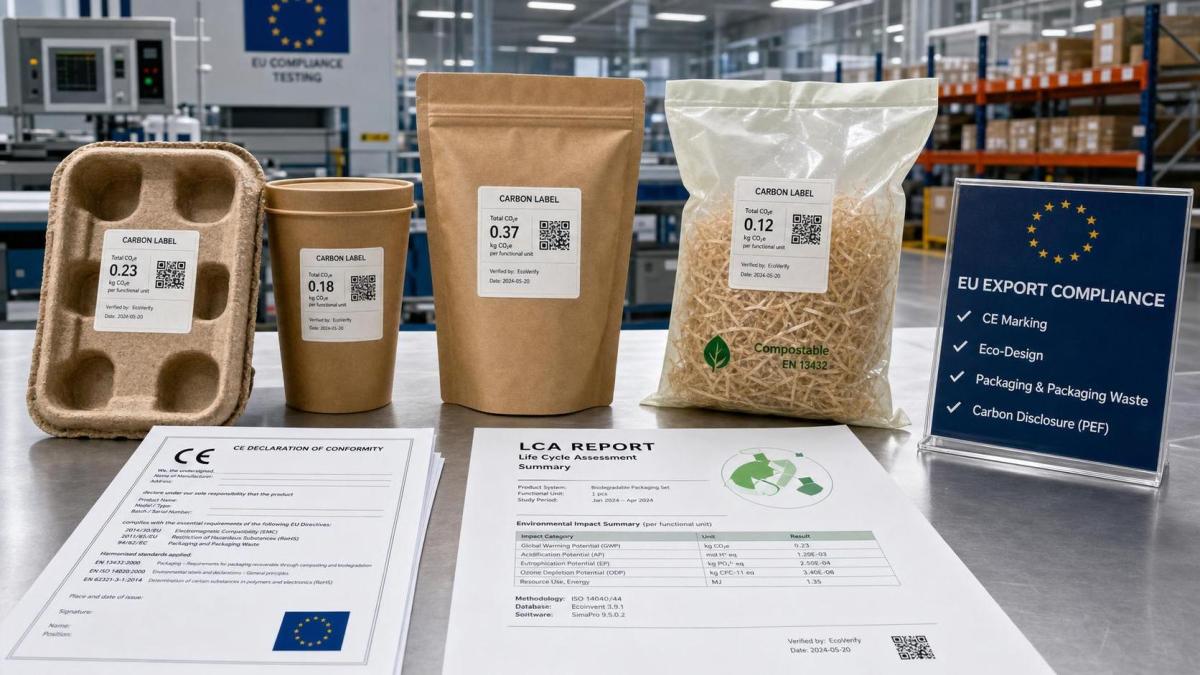
The document issued by the European Commission is titled Sustainable Packaging Carbon Label Implementation Guidelines (C(2026)4589 final). According to the information provided, starting in January 2027, all biodegradable packaging products sold into the European Union must attach a life cycle assessment report verified by a recognized body to the CE declaration of conformity.
The requirement applies to biodegradable packaging products including E-commerce Fulfillment Pack and Food-Grade Compliance packaging. The same information provided also states that carbon footprint data must be presented on the packaging in the form of a QR code.
The reported impact identified in the source material is direct: the rule changes the export compliance route and certification cost structure for Chinese biodegradable materials suppliers serving the EU market.
Where the pressure is likely to appear first
Export-facing packaging suppliers will face a tighter documentation chain
Analysis shows that companies selling biodegradable packaging into the EU may be affected first because the rule ties market access to both formal conformity documentation and verified environmental reporting. The pressure is likely to appear in product file preparation, certification coordination, and packaging artwork or labeling execution.
Manufacturing and conversion teams may need closer data coordination
From an industry perspective, processors and packaging manufacturers may be affected where production data, material inputs, and product specifications feed into LCA preparation and verification. What deserves closer attention is whether internal production records and supplier information can support a report that is accepted within the required compliance workflow.
Cross-border supply chain service providers may see added execution complexity
Observably, service providers involved in export documentation, order fulfillment, and delivery planning may need to adjust timelines and document checkpoints. The impact is less about the physical movement of goods alone and more about whether shipments can move with complete compliance files and packaging that matches the declared carbon disclosure format.
EU buyers and downstream users may raise pre-shipment requirements
Buyers using biodegradable packaging in e-commerce or food-related applications may pay closer attention to supplier readiness. Analysis shows that the practical impact could appear in supplier qualification, procurement communication, and order confirmation, especially where buyers want evidence that CE declarations, verified LCA reports, and QR-based carbon footprint presentation are aligned before goods are shipped.
What companies should watch now
Track whether official wording changes in later clarification
What deserves closer attention is whether follow-up interpretations, implementation notes, or procedural clarifications change how the requirement is applied in practice. The current information establishes the core obligation, but businesses should distinguish between the announced rule and later operational detail.
Review which product lines fall within the immediate compliance scope
Companies with biodegradable packaging portfolios should focus on the product categories explicitly referenced in the provided information, particularly E-commerce Fulfillment Pack and Food-Grade Compliance packaging. This matters because product mapping will affect which SKUs need document updates, verification work, and packaging revisions first.
Prepare for longer lead times around verification and labeling
Analysis shows that the combined requirement for recognized-body verification and QR code disclosure may affect delivery preparation, customer communication, and release schedules. Firms should pay attention to document completeness, packaging version control, and the timing relationship between LCA verification and shipment readiness.
Strengthen supplier and customer communication around proof of compliance
For exporters and upstream suppliers, a practical point is how compliance evidence will be presented and shared. What deserves closer attention is whether customers will ask for verified LCA materials earlier in the sales process and whether suppliers can respond with a clear set of conformity documents, supporting files, and packaging-level disclosure evidence.
Why this looks bigger than a routine labeling update
Observably, this is not just a packaging design change. The rule described in the provided information links three elements that are often handled separately: conformity documentation, third-party verified life cycle assessment, and visible carbon footprint disclosure on the package itself. Analysis shows that this makes the development more than a short-term labeling adjustment, because it reaches into documentation control, certification planning, and export execution.
At the same time, it is more appropriate to understand this as a defined regulatory signal rather than a fully settled end state for every operational detail. The requirement itself is clear in direction, but the way individual companies absorb the cost, timing, and workflow impact will still need continued observation.
How the market may need to interpret this step
The immediate significance of this update is that biodegradable packaging exports to the EU are moving toward a more evidence-based carbon disclosure model. From an industry perspective, the practical issue is not only whether companies acknowledge the rule, but whether they can connect verification, CE documentation, and packaging presentation without disrupting orders.
A balanced reading is that this is already a concrete compliance development with a stated start date, while its full business effect still depends on how companies, buyers, and service providers adapt their workflows. It is more appropriate to understand the news as both a near-term compliance task and a longer-term signal that carbon-related packaging disclosure is becoming more embedded in market access requirements.
Basis of this article and points for continued verification
This article is based on the user-provided news title, event date, and event summary concerning the European Commission's July 13, 2026 release of the Sustainable Packaging Carbon Label Implementation Guidelines (C(2026)4589 final).
For this type of industry update, commonly relevant source categories may include official announcements, company disclosures, industry association information, authoritative media reporting, and standard-setting documents. The specific official source link was not provided in the input, so further verification remains necessary.
Areas that warrant continued monitoring include any later official clarification on implementation wording, the practical interpretation of the covered packaging scope, and how verification and QR-based carbon footprint disclosure are applied in actual export workflows.
News Recommendations
 What records are needed for an ISO 9001 furniture factory audit?
![51a6ab95581761cc26f4318be6520c15]()
Aris Katos
Future of Carbide Coatings
 How to choose AI marketing tools that work with your existing CRM
![51a6ab95581761cc26f4318be6520c15]()
Aris Katos
Future of Carbide Coatings
 Do freight costs erase savings when buying retail fixtures wholesale?
![51a6ab95581761cc26f4318be6520c15]()
Aris Katos
Future of Carbide Coatings
 Can smart retail IT solutions for CPG work with legacy POS systems?
![51a6ab95581761cc26f4318be6520c15]()
Aris Katos
Future of Carbide Coatings
 What permit approvals belong in a commercial fitout planning checklist?
![51a6ab95581761cc26f4318be6520c15]()
Aris Katos
Future of Carbide Coatings
 How Does Commercial Design Differ from Interior Decoration?
![51a6ab95581761cc26f4318be6520c15]()
Aris Katos
Future of Carbide Coatings
 How Long Does It Take to Verify a Commercial Furniture Supplier?
![51a6ab95581761cc26f4318be6520c15]()
Aris Katos
Future of Carbide Coatings
 How to verify compostability claims from a bubble mailer manufacturer
![51a6ab95581761cc26f4318be6520c15]()
Aris Katos
Future of Carbide Coatings
 Will commercial smart infrastructure solutions work with legacy systems?
![51a6ab95581761cc26f4318be6520c15]()
Aris Katos
Future of Carbide Coatings
 How to verify a preschool furniture manufacturer's safety standards
![51a6ab95581761cc26f4318be6520c15]()
Aris Katos
Future of Carbide Coatings
 A technical comparison of semiconductor processes for power devices
![51a6ab95581761cc26f4318be6520c15]()
Aris Katos
Future of Carbide Coatings
 How to verify that a BIFMA ergonomic chair meets the standard
![51a6ab95581761cc26f4318be6520c15]()
Aris Katos
Future of Carbide Coatings
 How to use a CRI value chart when choosing LED lighting
![51a6ab95581761cc26f4318be6520c15]()
Aris Katos
Future of Carbide Coatings
 How to compare hotel aroma diffuser wholesale options by coverage area
![51a6ab95581761cc26f4318be6520c15]()
Aris Katos
Future of Carbide Coatings
 How to prevent O-rings and seals from failing in food equipment
![51a6ab95581761cc26f4318be6520c15]()
Aris Katos
Future of Carbide Coatings
 How to compare commercial linear light wholesale quotes accurately
![51a6ab95581761cc26f4318be6520c15]()
Aris Katos
Future of Carbide Coatings
 How to verify international standards compliance for Middle East exports
![51a6ab95581761cc26f4318be6520c15]()
Aris Katos
Future of Carbide Coatings
 How to select laboratory instruments for reproducible test results
![51a6ab95581761cc26f4318be6520c15]()
Aris Katos
Future of Carbide Coatings
 When does a sheet metal prototype reveal design flaws early?
![51a6ab95581761cc26f4318be6520c15]()
Aris Katos
Future of Carbide Coatings
 When PE air column bags reduce damage in e-commerce fulfillment
![51a6ab95581761cc26f4318be6520c15]()
Aris Katos
Future of Carbide Coatings
 How energy-efficient design reduces operating costs in retail lighting
![51a6ab95581761cc26f4318be6520c15]()
Aris Katos
Future of Carbide Coatings
 When commercial aluminum storefronts make sense for a retail renovation
![51a6ab95581761cc26f4318be6520c15]()
Aris Katos
Future of Carbide Coatings
 What makes LED lights durable in high-use commercial spaces?
![51a6ab95581761cc26f4318be6520c15]()
Aris Katos
Future of Carbide Coatings
 Which industry categories offer the strongest export potential in Latin America?
![51a6ab95581761cc26f4318be6520c15]()
Aris Katos
Future of Carbide Coatings
 How to choose an ultra bright waterproof window display for storefronts
![51a6ab95581761cc26f4318be6520c15]()
Aris Katos
Future of Carbide Coatings
 How to verify suppliers on a trade portal for global sourcing
![51a6ab95581761cc26f4318be6520c15]()
Aris Katos
Future of Carbide Coatings
 How RoHS requirements should be stated in product specifications
![51a6ab95581761cc26f4318be6520c15]()
Aris Katos
Future of Carbide Coatings
 What affects the lead time for custom retail counter displays?
![51a6ab95581761cc26f4318be6520c15]()
Aris Katos
Future of Carbide Coatings
 What consumer packaging USA importers need to verify before ordering
![51a6ab95581761cc26f4318be6520c15]()
Aris Katos
Future of Carbide Coatings
 How commercial spaces interiors shape customer dwell time
![51a6ab95581761cc26f4318be6520c15]()
Aris Katos
Future of Carbide Coatings
 How LED commercial lighting design reduces glare in retail spaces
![51a6ab95581761cc26f4318be6520c15]()
Aris Katos
Future of Carbide Coatings
 How industrial technology information improves RFID inventory accuracy
![51a6ab95581761cc26f4318be6520c15]()
Aris Katos
Future of Carbide Coatings
 When drip garden watering systems make more sense than sprinklers
![51a6ab95581761cc26f4318be6520c15]()
Aris Katos
Future of Carbide Coatings
 When category comparison improves sourcing for industrial applications
![51a6ab95581761cc26f4318be6520c15]()
Aris Katos
Future of Carbide Coatings
 Industrial application guidance for selecting the right LED lighting
![51a6ab95581761cc26f4318be6520c15]()
Aris Katos
Future of Carbide Coatings
 Which commercial architecture standards apply to European retail fit-outs?
![51a6ab95581761cc26f4318be6520c15]()
Aris Katos
Future of Carbide Coatings
 How to verify FDA requirements for maternity care products
![51a6ab95581761cc26f4318be6520c15]()
Aris Katos
Future of Carbide Coatings
 How to verify BPA-free claims for food-contact products
![51a6ab95581761cc26f4318be6520c15]()
Aris Katos
Future of Carbide Coatings
 When does a European wholesale supplier suit modular office projects?
![51a6ab95581761cc26f4318be6520c15]()
Aris Katos
Future of Carbide Coatings