FDA Tightens U.S. Entry Rules for Kitchenware
Time
Click Count
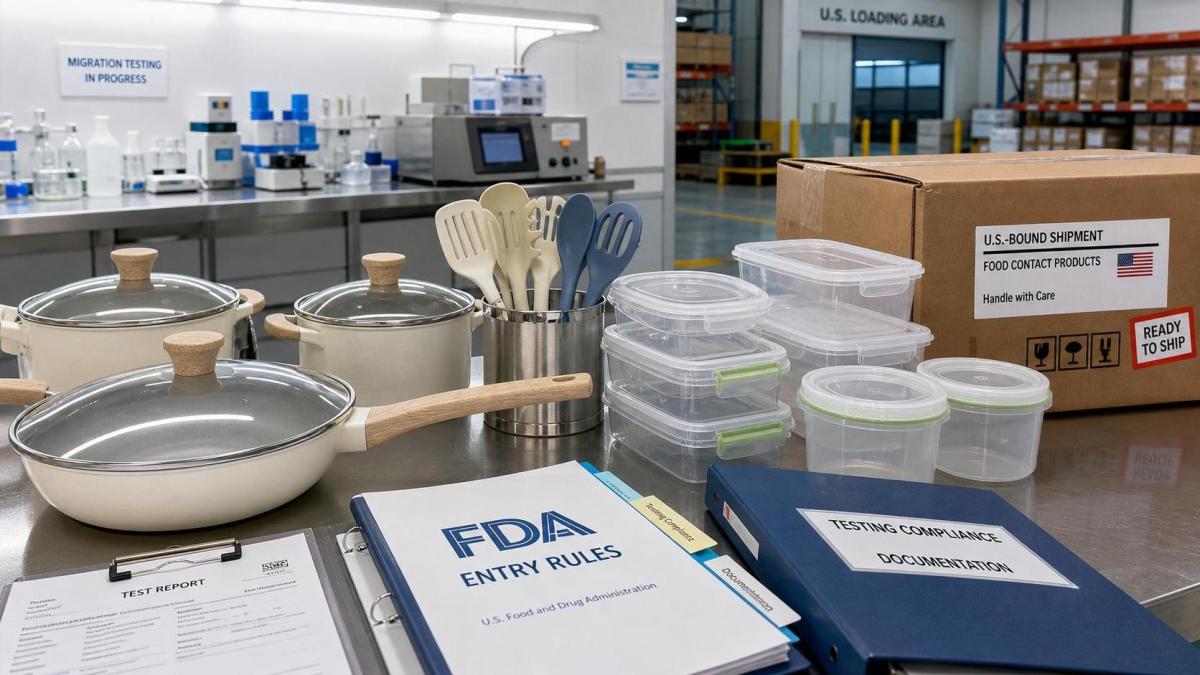
On July 18, 2026, the U.S. FDA issued Advisory Update No. 26-3 under its Food Contact Substance Notification Program, setting a new compliance threshold for kitchenware and home goods shipped to the United States. Products in scope include coated cookware, silicone utensils, and reusable food containers, and the change deserves close attention from exporters, manufacturers, import coordinators, and buyers because it links market access directly to testing documents and pre-review filing before the new requirement takes effect on October 1, 2026.
What the FDA update requires
According to the information provided, the FDA's July 18, 2026 update requires all Kitchenware & Home Goods products exported to the United States to provide migration test reports issued by laboratories accredited under ISO/IEC 17025 starting October 1, 2026.
The same update also requires completion of FDA FCN pre-review filing for covered products. The rule applies to categories expressly referenced in the input, including coated cookware, silicone kitchen utensils, and reusable lunch boxes or food containers.
The stated enforcement consequence is that products without the required filing may be refused entry by U.S. Customs and Border Protection at the port.
Where the pressure will appear first
Export sellers will face tighter shipment readiness checks
From an industry perspective, direct exporters to the U.S. market may be affected first because shipment release will depend not only on commercial order timing but also on whether testing reports and FCN pre-review materials are complete before dispatch. The main pressure point is likely to appear in delivery scheduling, document preparation, and customer confirmation before shipment.
Manufacturing sites will need closer coordination with compliance work
Analysis shows that manufacturers producing coated cookware, silicone utensils, and reusable food-contact containers may see the rule reflected in production planning and model management. The operational impact is not limited to factory output; it also extends to how each product version is matched with valid migration testing documents and filing status for the U.S. market.
Supply chain and trade service providers may be pulled into earlier-stage review
Observably, logistics coordinators, documentation teams, and other supply chain service providers may need to move their checkpoints forward. The issue is not only transport execution but whether supporting compliance materials are ready early enough to avoid delays, rework, or port-side disruption.
Buyers and import-side counterparts may tighten document expectations
For buyers and sourcing teams connected to U.S.-bound orders, the change may shift attention toward supplier qualification, testing report validity, and filing completion before purchase or shipment approval. What deserves closer attention is that compliance may become a gate in commercial communication rather than a document handled only after production.
What companies should watch now
The October 1 timing versus current order cycles
What deserves closer attention is the gap between the publication date and the effective date. Companies handling U.S.-bound kitchenware and home goods should watch how existing orders, production already in queue, and near-term shipments line up against the October 1, 2026 requirement.
The readiness of testing and filing materials
From a practical standpoint, the core issue is whether migration test reports from ISO/IEC 17025 accredited laboratories and FDA FCN pre-review filing materials can be assembled in time for shipment. This is especially relevant for product lines with multiple materials, coatings, or reusable food-contact applications.
Supplier and customer communication before shipment
Analysis shows that supplier-side and customer-side communication may need to start earlier than before. Companies should pay attention to whether product documentation, filing status, and shipment plans are aligned well before goods reach export release or U.S. entry stages.
Further official wording and implementation details
It is also important to continue monitoring any further official wording related to implementation. The current information confirms the testing, filing, and port-entry consequences, but businesses should keep watching for any additional clarification that may affect execution in daily trade operations.
Why this reads as more than a routine paperwork change
Analysis shows that this update should not be viewed only as another document request. Based on the information provided, the FDA has tied U.S. entry for covered kitchenware and home goods to both accredited migration testing and FCN pre-review filing, which moves compliance closer to the front of the transaction process.
It is more appropriate to understand this as a clear regulatory signal with immediate operational implications, especially for China-based exporters serving the U.S. market. At the same time, it remains necessary to keep observing how implementation unfolds in practice, because the business effect will depend on how quickly companies can adapt their testing, filing, and shipment preparation workflows.
How the market is likely to interpret this step
At this stage, the most reasonable reading is that the update creates a concrete near-term compliance change rather than a distant policy direction. The confirmed facts already point to possible effects on lead time, compliance cost, and port-entry risk for unfiled products.
That said, it should still be treated with a measured view. The current significance lies in its direct impact on U.S.-bound trade execution for covered categories, while the broader long-term effect on sourcing and product planning will require continued observation.
Basis of this article and what still needs verification
This article is based on the user-provided news title, event date, and event summary concerning the FDA advisory update issued on July 18, 2026. The discussion above separates confirmed facts from analysis and observation.
For developments of this kind, relevant source types usually include official notices, company disclosures, industry association updates, authoritative media reporting, and standards-related documentation. A specific official source link was not provided in the input, so the exact underlying publication should be continuously verified. Follow-up attention should remain on any additional official clarification related to implementation, filing practice, and port-entry enforcement.
News Recommendations
 How to assess a workplace interior supplier's installation scope
![51a6ab95581761cc26f4318be6520c15]()
Aris Katos
Future of Carbide Coatings
 What records are needed for an ISO 9001 furniture factory audit?
![51a6ab95581761cc26f4318be6520c15]()
Aris Katos
Future of Carbide Coatings
 How to choose AI marketing tools that work with your existing CRM
![51a6ab95581761cc26f4318be6520c15]()
Aris Katos
Future of Carbide Coatings
 Do freight costs erase savings when buying retail fixtures wholesale?
![51a6ab95581761cc26f4318be6520c15]()
Aris Katos
Future of Carbide Coatings
 How to check whether an OEM retail shelf screen fits existing shelving
![51a6ab95581761cc26f4318be6520c15]()
Aris Katos
Future of Carbide Coatings
 What brightness should an OEM shelf LCD screen have for retail use?
![51a6ab95581761cc26f4318be6520c15]()
Aris Katos
Future of Carbide Coatings
 Can smart retail IT solutions for CPG work with legacy POS systems?
![51a6ab95581761cc26f4318be6520c15]()
Aris Katos
Future of Carbide Coatings
 What permit approvals belong in a commercial fitout planning checklist?
![51a6ab95581761cc26f4318be6520c15]()
Aris Katos
Future of Carbide Coatings
 Which Technical Factors Matter When Comparing Smart Retail Hardware?
![51a6ab95581761cc26f4318be6520c15]()
Aris Katos
Future of Carbide Coatings
 Does Data Transparency Matter When Selecting Consumer Goods Suppliers?
![51a6ab95581761cc26f4318be6520c15]()
Aris Katos
Future of Carbide Coatings
 How Does Commercial Design Differ from Interior Decoration?
![51a6ab95581761cc26f4318be6520c15]()
Aris Katos
Future of Carbide Coatings
 How Long Does It Take to Verify a Commercial Furniture Supplier?
![51a6ab95581761cc26f4318be6520c15]()
Aris Katos
Future of Carbide Coatings
 How to verify compostability claims from a bubble mailer manufacturer
![51a6ab95581761cc26f4318be6520c15]()
Aris Katos
Future of Carbide Coatings
 Will commercial smart infrastructure solutions work with legacy systems?
![51a6ab95581761cc26f4318be6520c15]()
Aris Katos
Future of Carbide Coatings
 How to verify a preschool furniture manufacturer's safety standards
![51a6ab95581761cc26f4318be6520c15]()
Aris Katos
Future of Carbide Coatings
 A technical comparison of semiconductor processes for power devices
![51a6ab95581761cc26f4318be6520c15]()
Aris Katos
Future of Carbide Coatings
 How to verify that a BIFMA ergonomic chair meets the standard
![51a6ab95581761cc26f4318be6520c15]()
Aris Katos
Future of Carbide Coatings
 How to use a CRI value chart when choosing LED lighting
![51a6ab95581761cc26f4318be6520c15]()
Aris Katos
Future of Carbide Coatings
 How to compare hotel aroma diffuser wholesale options by coverage area
![51a6ab95581761cc26f4318be6520c15]()
Aris Katos
Future of Carbide Coatings
 How to prevent O-rings and seals from failing in food equipment
![51a6ab95581761cc26f4318be6520c15]()
Aris Katos
Future of Carbide Coatings
 How to compare commercial linear light wholesale quotes accurately
![51a6ab95581761cc26f4318be6520c15]()
Aris Katos
Future of Carbide Coatings
 How to verify international standards compliance for Middle East exports
![51a6ab95581761cc26f4318be6520c15]()
Aris Katos
Future of Carbide Coatings
 How to select laboratory instruments for reproducible test results
![51a6ab95581761cc26f4318be6520c15]()
Aris Katos
Future of Carbide Coatings
 When does a sheet metal prototype reveal design flaws early?
![51a6ab95581761cc26f4318be6520c15]()
Aris Katos
Future of Carbide Coatings
 When PE air column bags reduce damage in e-commerce fulfillment
![51a6ab95581761cc26f4318be6520c15]()
Aris Katos
Future of Carbide Coatings
 How energy-efficient design reduces operating costs in retail lighting
![51a6ab95581761cc26f4318be6520c15]()
Aris Katos
Future of Carbide Coatings
 When commercial aluminum storefronts make sense for a retail renovation
![51a6ab95581761cc26f4318be6520c15]()
Aris Katos
Future of Carbide Coatings
 What makes LED lights durable in high-use commercial spaces?
![51a6ab95581761cc26f4318be6520c15]()
Aris Katos
Future of Carbide Coatings
 Which industry categories offer the strongest export potential in Latin America?
![51a6ab95581761cc26f4318be6520c15]()
Aris Katos
Future of Carbide Coatings
 How to choose an ultra bright waterproof window display for storefronts
![51a6ab95581761cc26f4318be6520c15]()
Aris Katos
Future of Carbide Coatings
 How to verify suppliers on a trade portal for global sourcing
![51a6ab95581761cc26f4318be6520c15]()
Aris Katos
Future of Carbide Coatings
 How RoHS requirements should be stated in product specifications
![51a6ab95581761cc26f4318be6520c15]()
Aris Katos
Future of Carbide Coatings
 What affects the lead time for custom retail counter displays?
![51a6ab95581761cc26f4318be6520c15]()
Aris Katos
Future of Carbide Coatings
 What consumer packaging USA importers need to verify before ordering
![51a6ab95581761cc26f4318be6520c15]()
Aris Katos
Future of Carbide Coatings
 How commercial spaces interiors shape customer dwell time
![51a6ab95581761cc26f4318be6520c15]()
Aris Katos
Future of Carbide Coatings
 How LED commercial lighting design reduces glare in retail spaces
![51a6ab95581761cc26f4318be6520c15]()
Aris Katos
Future of Carbide Coatings
 How industrial technology information improves RFID inventory accuracy
![51a6ab95581761cc26f4318be6520c15]()
Aris Katos
Future of Carbide Coatings
 When drip garden watering systems make more sense than sprinklers
![51a6ab95581761cc26f4318be6520c15]()
Aris Katos
Future of Carbide Coatings
 When category comparison improves sourcing for industrial applications
![51a6ab95581761cc26f4318be6520c15]()
Aris Katos
Future of Carbide Coatings