Bakery Ovens Comparison: Deck, Rack, and Convection Models
Time
Click Count
Choosing among deck, rack, and convection bakeryovens is rarely a simple equipment decision. It shapes product quality, workflow design, energy use, maintenance planning, and the customer experience across modern bakery operations.
That matters even more as food retail spaces become part of a wider commercial ecosystem. Store design, back-of-house efficiency, digital monitoring, and supply chain resilience now influence oven selection as much as baking performance.
From the broader perspective promoted by G-BCE, bakeryovens should be assessed as operational assets. They connect production capability with international sourcing standards, retail consistency, and long-term business adaptability.
Why oven type now has wider business significance
A bakery oven used to be judged mainly by baking results. That is still central, but current decisions involve more variables than crust color or batch volume.
Operators now compare labor intensity, ventilation needs, floor space efficiency, utility costs, and compatibility with growing menu complexity. In many locations, sustainability targets also affect capital planning.
This is where bakeryovens fit naturally into a cross-sector discussion. Equipment performance interacts with commercial fixtures, smart retail systems, consumer goods logistics, and compliance expectations.
A poor match between oven type and business model can create hidden costs. These often appear in staffing pressure, uneven product quality, delayed service, or excess energy consumption.
Understanding the three core bakeryovens categories
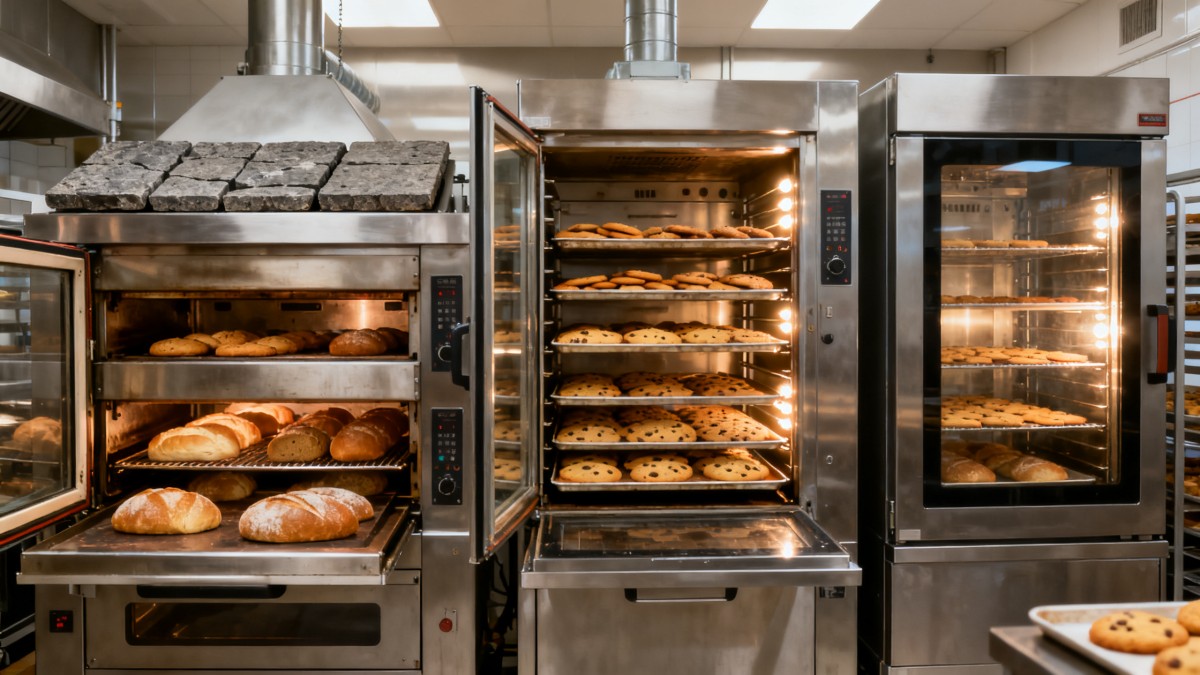
Deck, rack, and convection bakeryovens each solve different production problems. Their value becomes clearer when compared through heat delivery, batch handling, and menu suitability.
Deck ovens
Deck ovens use radiant and conductive heat. Bakers place products directly on a stone or steel deck, or on trays, depending on the product style.
They are often preferred for artisan bread, pizza-style items, rustic loaves, and products that need strong bottom heat and controlled crust development.
Their strength is precision. Their tradeoff is throughput, especially when compared with high-volume rotating systems.
Rack ovens
Rack bakeryovens are built for scale. Full racks move into the chamber, and the rotation helps distribute heat around large quantities of products.
They work well for wholesale bakeries, commissaries, supermarkets, and operations producing many trays of similar items in each cycle.
The main advantage is batch efficiency. The main concern is that some delicate products may need closer airflow tuning.
Convection ovens
Convection bakeryovens circulate heated air with fans. This creates faster, more even baking for pastries, cookies, cakes, and many small-format baked goods.
They are common in cafés, in-store bakeries, hotels, and compact production sites where flexibility matters more than very high-capacity output.
They are versatile, though some bread applications may not achieve the same crust profile delivered by deck systems.
A practical comparison beyond simple specifications
Looking only at temperature range or chamber size rarely leads to the right decision. In practice, the best bakeryovens are the ones aligned with actual production behavior.
This comparison also helps when evaluating imported bakeryovens against local market expectations. Consistency, serviceability, and standards alignment should be reviewed together, not separately.
Where each model tends to create the most value
The best oven choice often reflects the commercial format rather than the menu alone. A flagship bakery and a transit retail kiosk may sell similar products, yet need different equipment logic.
Premium retail and brand expression
Deck bakeryovens support premium positioning when visible craftsmanship matters. Open-bake concepts, signature loaves, and sensory retail environments benefit from this format.
In these settings, oven performance influences not only texture but also brand storytelling, merchandising rhythm, and perceived authenticity.
Central production and multi-site supply
Rack bakeryovens are often more suitable when serving supermarkets, chain outlets, or regional distribution points. The operational gain comes from repeatable large-batch output.
That makes them relevant to supply chain optimization, especially where transport schedules, packaging flow, and inventory timing affect freshness windows.
Flexible foodservice and compact commercial sites
Convection bakeryovens usually perform well in mixed-service environments. They suit menus that change through the day and locations where speed and space utilization matter.
This includes hospitality venues, café chains, convenience retail, and smaller urban stores where adaptability can matter more than maximum volume.
What decision quality depends on
Comparing bakeryovens becomes more reliable when decision criteria are tied to measurable operating realities. That reduces the risk of buying for theoretical capacity instead of actual need.
- Map the product mix by revenue share, not by menu length.
- Check whether demand peaks require speed, chamber stability, or bulk loading.
- Review utility infrastructure, including gas, electric load, steam, and ventilation.
- Estimate labor impact, especially loading, unloading, cleaning, and training time.
- Compare maintenance access, spare parts availability, and local service response.
- Assess certification and compliance if equipment will cross multiple markets.
This is where a benchmarking approach becomes useful. G-BCE’s cross-border perspective highlights how technical selection, sourcing discipline, and commercial design increasingly overlap.
The role of efficiency, data, and long-term resilience
The conversation around bakeryovens is moving beyond heat performance alone. Energy tracking, digital controls, and lifecycle cost visibility are becoming central to capital decisions.
Smarter oven platforms can support recipe storage, programmable cycles, and production consistency across locations. That matters when quality must remain stable across a chain or franchise network.
Resilience also comes from supply-side thinking. Equipment that is easy to source, maintain, and integrate with future layout changes can outperform a technically impressive but rigid solution.
In other words, the strongest bakeryovens decision often balances three layers at once: baking result, operational fit, and ecosystem compatibility.
How to move from comparison to a workable shortlist
A useful next step is to build a shortlist around real scenarios instead of broad preferences. Test each model against expected batch size, flagship products, staffing pattern, and site constraints.
If crust definition and artisan positioning lead the business case, deck bakeryovens deserve closer review. If scale and standardized output lead, rack models usually become more relevant.
If menu flexibility, compact design, and quick service matter most, convection bakeryovens often provide the best balance. The key is to match the oven to the operating system, not just the recipe list.
A final comparison should include trial baking, ownership cost modeling, and standards verification. That framework turns oven selection into a strategic decision rather than a short-term purchase.
News Recommendations
 What consumer packaging USA importers need to verify before ordering
![51a6ab95581761cc26f4318be6520c15]()
Aris Katos
Future of Carbide Coatings
 How commercial spaces interiors shape customer dwell time
![51a6ab95581761cc26f4318be6520c15]()
Aris Katos
Future of Carbide Coatings
 How LED commercial lighting design reduces glare in retail spaces
![51a6ab95581761cc26f4318be6520c15]()
Aris Katos
Future of Carbide Coatings
 How industrial technology information improves RFID inventory accuracy
![51a6ab95581761cc26f4318be6520c15]()
Aris Katos
Future of Carbide Coatings
 When drip garden watering systems make more sense than sprinklers
![51a6ab95581761cc26f4318be6520c15]()
Aris Katos
Future of Carbide Coatings
 When category comparison improves sourcing for industrial applications
![51a6ab95581761cc26f4318be6520c15]()
Aris Katos
Future of Carbide Coatings
 Industrial application guidance for selecting the right LED lighting
![51a6ab95581761cc26f4318be6520c15]()
Aris Katos
Future of Carbide Coatings
 Which commercial architecture standards apply to European retail fit-outs?
![51a6ab95581761cc26f4318be6520c15]()
Aris Katos
Future of Carbide Coatings
 How to verify FDA requirements for maternity care products
![51a6ab95581761cc26f4318be6520c15]()
Aris Katos
Future of Carbide Coatings
 How to verify BPA-free claims for food-contact products
![51a6ab95581761cc26f4318be6520c15]()
Aris Katos
Future of Carbide Coatings
 When does a European wholesale supplier suit modular office projects?
![51a6ab95581761cc26f4318be6520c15]()
Aris Katos
Future of Carbide Coatings
 When consumer ecosystem solutions improve the in-store shopping journey
![51a6ab95581761cc26f4318be6520c15]()
Aris Katos
Future of Carbide Coatings
 How a commercial developers network can reduce site selection risk
![51a6ab95581761cc26f4318be6520c15]()
Aris Katos
Future of Carbide Coatings
 How clear purchasing specifications prevent costly supplier deviations
![51a6ab95581761cc26f4318be6520c15]()
Aris Katos
Future of Carbide Coatings
 What an ISTA drop test lab checks before your packaging ships
![51a6ab95581761cc26f4318be6520c15]()
Aris Katos
Future of Carbide Coatings
 Which commercial furniture standards apply to workplace seating?
![51a6ab95581761cc26f4318be6520c15]()
Aris Katos
Future of Carbide Coatings
 How to evaluate smart lighting module OEM compatibility before sampling
![51a6ab95581761cc26f4318be6520c15]()
Aris Katos
Future of Carbide Coatings
 How to assess whether sustainable technology delivers real impact
![51a6ab95581761cc26f4318be6520c15]()
Aris Katos
Future of Carbide Coatings
 How to assess an OEM supplier’s quality control before ordering
![51a6ab95581761cc26f4318be6520c15]()
Aris Katos
Future of Carbide Coatings
 How consumer ecosystem solutions data can improve retail personalization
![51a6ab95581761cc26f4318be6520c15]()
Aris Katos
Future of Carbide Coatings
 When does consumer packaging design justify a higher product price?
![51a6ab95581761cc26f4318be6520c15]()
Aris Katos
Future of Carbide Coatings
 Supermarket Fixture Installation: Planning Layouts, Wiring, and Handover
![51a6ab95581761cc26f4318be6520c15]()
Aris Katos
Future of Carbide Coatings
 Automated Lighting and Smart Lighting Control in Bergerac: Key Project Considerations
![51a6ab95581761cc26f4318be6520c15]()
Aris Katos
Future of Carbide Coatings
 Segment Streetlight Controllers: Choosing Control Modes for Urban Roads
![51a6ab95581761cc26f4318be6520c15]()
Aris Katos
Future of Carbide Coatings
 IEC 62471-2 Explained: How to Assess Photobiological Risks in LED Lighting
![51a6ab95581761cc26f4318be6520c15]()
Aris Katos
Future of Carbide Coatings
 Food Grade Packaging Requirements by Product Type, Temperature, and Contact Risk
![51a6ab95581761cc26f4318be6520c15]()
Aris Katos
Future of Carbide Coatings
 Food Packaging Compliance Checklist: Tests, Records, and Labeling Before Shipment
![51a6ab95581761cc26f4318be6520c15]()
Aris Katos
Future of Carbide Coatings
 NSF Food Packaging Standards: When Certification Matters for Commercial Food Use
![51a6ab95581761cc26f4318be6520c15]()
Aris Katos
Future of Carbide Coatings
 FDA Food Grade Compliance: Which Materials and Documents Do Buyers Need?
![51a6ab95581761cc26f4318be6520c15]()
Aris Katos
Future of Carbide Coatings
 What Should a Food Grade Declaration Include for Packaging Compliance?
![51a6ab95581761cc26f4318be6520c15]()
Aris Katos
Future of Carbide Coatings
 Housewares Importing: How to Evaluate Suppliers, Costs, and Compliance Risks
![51a6ab95581761cc26f4318be6520c15]()
Aris Katos
Future of Carbide Coatings
 Why Freeze-Dried Fruit Ingredients Lose Crispness—and How to Prevent It
![51a6ab95581761cc26f4318be6520c15]()
Aris Katos
Future of Carbide Coatings
 What industry veterans look for before choosing a new supplier
![51a6ab95581761cc26f4318be6520c15]()
Aris Katos
Future of Carbide Coatings
 How material fatigue can shorten the service life of retail shelving
![51a6ab95581761cc26f4318be6520c15]()
Aris Katos
Future of Carbide Coatings
 What makes a global sourcing platform reliable for supplier verification?
![51a6ab95581761cc26f4318be6520c15]()
Aris Katos
Future of Carbide Coatings
 When are double platinum spark plugs a better choice than iridium?
![51a6ab95581761cc26f4318be6520c15]()
Aris Katos
Future of Carbide Coatings
 How to assess a POS terminal manufacturer in Europe for long-term support
![51a6ab95581761cc26f4318be6520c15]()
Aris Katos
Future of Carbide Coatings
 How data transparency in retail helps prevent inventory discrepancies
![51a6ab95581761cc26f4318be6520c15]()
Aris Katos
Future of Carbide Coatings
 What makes a product comparison guide actually useful for buying decisions
![51a6ab95581761cc26f4318be6520c15]()
Aris Katos
Future of Carbide Coatings