Engine Components That Most Affect Service Life
Time
Click Count
Service life is rarely decided by one dramatic failure. In most engines, it is shaped by a small group of engine components that manage friction, heat, sealing, timing, and load transfer every operating hour.
That is why maintenance decisions around these parts have a direct effect on uptime, overhaul intervals, and repair cost. In supply chains where equipment reliability supports retail, logistics, and commercial operations, component-level judgment matters.
From the broader G-BCE perspective, durability is not only a mechanical topic. It is also a benchmarking issue tied to procurement quality, lifecycle planning, and consistent performance across global operating environments.
Why service life begins with component interaction
An engine wears out when protective systems stop working together. Lubrication may weaken, combustion heat may rise, sealing may degrade, or timing accuracy may drift beyond a safe margin.
In practical terms, the most critical engine components are not always the most expensive ones. They are the parts whose condition affects many other parts at the same time.
A worn bearing, restricted oil passage, or unstable cooling circuit can shorten the life of pistons, liners, valves, and turbo systems together. That chain effect is what makes early diagnosis so valuable.
The engine components with the greatest influence
Some engine components affect service life more than others because they sit at the center of lubrication, combustion, or thermal control. These parts deserve closer inspection intervals and stronger failure records.
Bearings and crankshaft surfaces
Main and rod bearings operate on a thin oil film. Once that film breaks down, metal contact increases rapidly, and the crankshaft can suffer scoring, heat marks, or out-of-round wear.
These engine components often reveal system-wide problems. Contaminated oil, pressure loss, delayed oil delivery, and overload conditions usually appear here before a catastrophic failure occurs.
Pistons, rings, and cylinder liners
This group controls combustion sealing, oil consumption, and compression stability. If piston rings stick, crack, or lose tension, blow-by increases and lubricant contamination rises.
Cylinder liner wear also changes the life curve of the entire engine. Even a moderate wear pattern can reduce efficiency and accelerate damage to neighboring engine components.
Valves, guides, and seats
Exhaust valves face extreme thermal stress. Poor seating, carbon buildup, or guide wear can lead to compression loss, hot spots, and eventually valve burning or head damage.
When evaluating service life, valve train wear should be treated as a reliability indicator, not just a top-end repair issue. It reflects cooling quality, combustion balance, and maintenance discipline.
Timing system parts
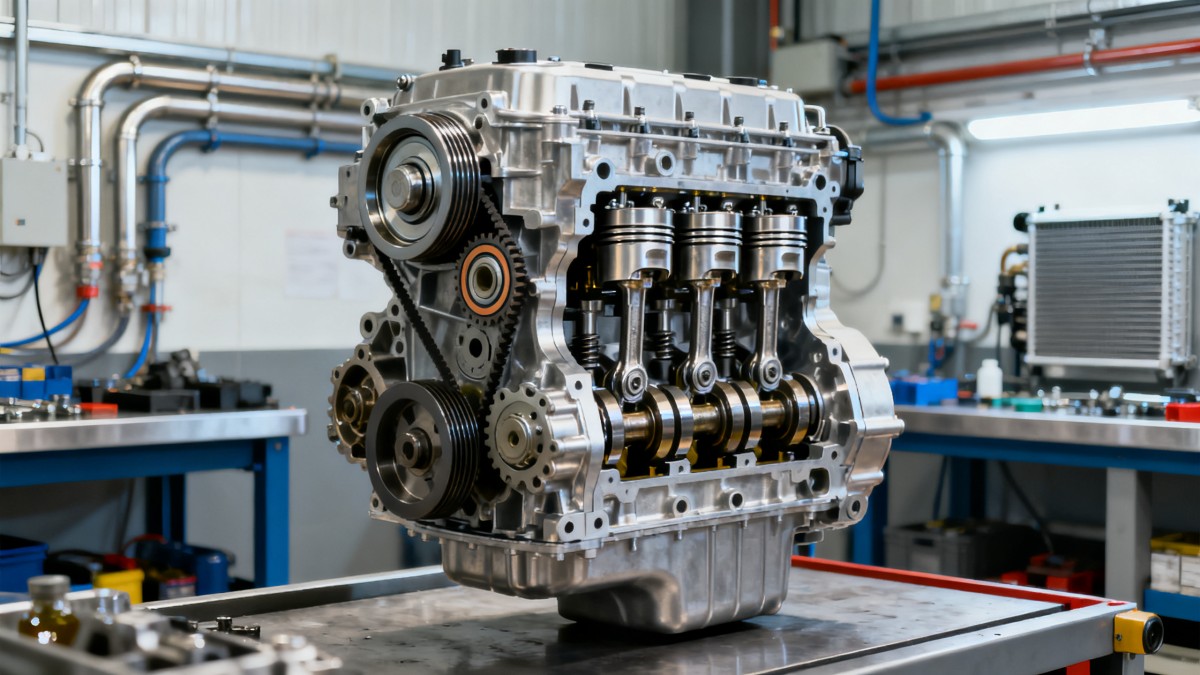
Chains, belts, gears, and tensioners keep valve timing aligned with piston movement. A small timing shift can reduce efficiency first, then lead to contact damage in interference designs.
These engine components should never be judged by appearance alone. Noise, elongation, tension loss, and startup behavior provide a more reliable picture of remaining service life.
Oil pump and filtration elements
An engine can survive cosmetic wear. It cannot survive poor lubrication for long. Oil pumps, pickup screens, filters, and pressure regulation parts protect nearly every moving surface inside the engine.
For many fleets and fixed-power applications, these engine components are the most cost-effective focus area because lubrication failures tend to spread faster than other defect types.
Cooling system hardware
Water pumps, thermostats, radiators, oil coolers, and hoses control thermal stability. Persistent overheating changes clearances, weakens seals, oxidizes oil, and distorts metal surfaces.
Heat is often the hidden reason otherwise sound engine components fail early. A cooling problem may first appear as gasket leakage, injector stress, or unusual piston crown deposits.
What the industry is watching now
Current attention is shifting from simple replacement intervals to evidence-based maintenance. That change is driven by tighter uptime targets, longer asset cycles, and closer scrutiny of total operating cost.
Within cross-border equipment sourcing, part consistency also matters more. Benchmarking platforms such as G-BCE highlight how manufacturing tolerance, material traceability, and compliance culture affect service outcomes.
For engine components, this means two similar-looking parts may perform very differently in the field. Surface treatment quality, hardness control, seal material, and machining accuracy often decide real durability.
The same logic applies across commercial ecosystems. When a supply chain depends on transport units, backup generators, refrigeration assets, or service vehicles, engine life becomes an operational continuity issue.
Where failures usually begin
Most premature failures start in one of four places: lubrication quality, thermal imbalance, contamination, or sealing breakdown. The table below helps connect those risks to specific engine components.
This pattern shows why service life should be managed as a system. Replacing one damaged part without tracing the root condition often leads to repeat repairs.
How to judge critical engine components in practice
Useful inspection is not only about checking whether a part still works. It is about deciding whether wear is normal, progressive, or already affecting adjacent engine components.
A practical review usually combines physical evidence, operating history, and pattern comparison across similar units. That approach is more reliable than single-point visual checks.
High-value inspection signals
- Oil analysis trends, especially viscosity shift, fuel dilution, and metal content.
- Compression variation between cylinders rather than one isolated reading.
- Coolant condition, pressure stability, and signs of mixed-fluid contamination.
- Exhaust color, startup noise, and load-response behavior under repeat conditions.
- Wear patterns on seals, liners, and bearings that point to alignment or heat issues.
When these signals are recorded over time, engine components can be ranked by actual risk instead of assumed risk. That helps control both spare inventory and unplanned downtime.
Why part quality and sourcing standards matter
Not all replacement parts protect service life equally. Some failures come from incorrect specification, but many come from inconsistent metallurgy, weak surface finishing, or poor dimensional control.
This is where technical benchmarking becomes useful. G-BCE emphasizes performance transparency across industrial and commercial hardware because repeatability is essential in global support environments.
For engine components, comparable principles apply: certification culture, process discipline, and supplier verification reduce variation before a part reaches the field. Better sourcing supports longer engine life indirectly but decisively.
In mixed fleets or distributed service networks, standardizing critical parts can also improve diagnosis. It becomes easier to compare wear patterns, establish thresholds, and forecast replacement timing.
A sensible next step for longer service life
The most effective starting point is to identify which engine components create the highest downstream risk in each asset category. For many operations, that list includes bearings, ring packs, valves, oil delivery parts, and cooling hardware.
Then build a simple review standard around condition trends, failure history, and replacement quality. A short, disciplined checklist often delivers more value than a large but rarely used maintenance procedure.
Where supply reliability is business-critical, it also helps to compare parts against traceable technical benchmarks and verified manufacturing consistency. That makes service life planning more predictable across locations and operating cycles.
In the end, longer engine life comes from understanding which engine components deserve the closest attention, and acting before wear becomes a system-level failure.
News Recommendations
 What consumer packaging USA importers need to verify before ordering
![51a6ab95581761cc26f4318be6520c15]()
Aris Katos
Future of Carbide Coatings
 How commercial spaces interiors shape customer dwell time
![51a6ab95581761cc26f4318be6520c15]()
Aris Katos
Future of Carbide Coatings
 How LED commercial lighting design reduces glare in retail spaces
![51a6ab95581761cc26f4318be6520c15]()
Aris Katos
Future of Carbide Coatings
 How industrial technology information improves RFID inventory accuracy
![51a6ab95581761cc26f4318be6520c15]()
Aris Katos
Future of Carbide Coatings
 When drip garden watering systems make more sense than sprinklers
![51a6ab95581761cc26f4318be6520c15]()
Aris Katos
Future of Carbide Coatings
 When category comparison improves sourcing for industrial applications
![51a6ab95581761cc26f4318be6520c15]()
Aris Katos
Future of Carbide Coatings
 Industrial application guidance for selecting the right LED lighting
![51a6ab95581761cc26f4318be6520c15]()
Aris Katos
Future of Carbide Coatings
 Which commercial architecture standards apply to European retail fit-outs?
![51a6ab95581761cc26f4318be6520c15]()
Aris Katos
Future of Carbide Coatings
 How to verify FDA requirements for maternity care products
![51a6ab95581761cc26f4318be6520c15]()
Aris Katos
Future of Carbide Coatings
 How to verify BPA-free claims for food-contact products
![51a6ab95581761cc26f4318be6520c15]()
Aris Katos
Future of Carbide Coatings
 When does a European wholesale supplier suit modular office projects?
![51a6ab95581761cc26f4318be6520c15]()
Aris Katos
Future of Carbide Coatings
 When consumer ecosystem solutions improve the in-store shopping journey
![51a6ab95581761cc26f4318be6520c15]()
Aris Katos
Future of Carbide Coatings
 How a commercial developers network can reduce site selection risk
![51a6ab95581761cc26f4318be6520c15]()
Aris Katos
Future of Carbide Coatings
 How clear purchasing specifications prevent costly supplier deviations
![51a6ab95581761cc26f4318be6520c15]()
Aris Katos
Future of Carbide Coatings
 What an ISTA drop test lab checks before your packaging ships
![51a6ab95581761cc26f4318be6520c15]()
Aris Katos
Future of Carbide Coatings
 Which commercial furniture standards apply to workplace seating?
![51a6ab95581761cc26f4318be6520c15]()
Aris Katos
Future of Carbide Coatings
 How to evaluate smart lighting module OEM compatibility before sampling
![51a6ab95581761cc26f4318be6520c15]()
Aris Katos
Future of Carbide Coatings
 How to assess whether sustainable technology delivers real impact
![51a6ab95581761cc26f4318be6520c15]()
Aris Katos
Future of Carbide Coatings
 How to assess an OEM supplier’s quality control before ordering
![51a6ab95581761cc26f4318be6520c15]()
Aris Katos
Future of Carbide Coatings
 How consumer ecosystem solutions data can improve retail personalization
![51a6ab95581761cc26f4318be6520c15]()
Aris Katos
Future of Carbide Coatings
 When does consumer packaging design justify a higher product price?
![51a6ab95581761cc26f4318be6520c15]()
Aris Katos
Future of Carbide Coatings
 Supermarket Fixture Installation: Planning Layouts, Wiring, and Handover
![51a6ab95581761cc26f4318be6520c15]()
Aris Katos
Future of Carbide Coatings
 Automated Lighting and Smart Lighting Control in Bergerac: Key Project Considerations
![51a6ab95581761cc26f4318be6520c15]()
Aris Katos
Future of Carbide Coatings
 Segment Streetlight Controllers: Choosing Control Modes for Urban Roads
![51a6ab95581761cc26f4318be6520c15]()
Aris Katos
Future of Carbide Coatings
 IEC 62471-2 Explained: How to Assess Photobiological Risks in LED Lighting
![51a6ab95581761cc26f4318be6520c15]()
Aris Katos
Future of Carbide Coatings
 Food Grade Packaging Requirements by Product Type, Temperature, and Contact Risk
![51a6ab95581761cc26f4318be6520c15]()
Aris Katos
Future of Carbide Coatings
 Food Packaging Compliance Checklist: Tests, Records, and Labeling Before Shipment
![51a6ab95581761cc26f4318be6520c15]()
Aris Katos
Future of Carbide Coatings
 NSF Food Packaging Standards: When Certification Matters for Commercial Food Use
![51a6ab95581761cc26f4318be6520c15]()
Aris Katos
Future of Carbide Coatings
 FDA Food Grade Compliance: Which Materials and Documents Do Buyers Need?
![51a6ab95581761cc26f4318be6520c15]()
Aris Katos
Future of Carbide Coatings
 What Should a Food Grade Declaration Include for Packaging Compliance?
![51a6ab95581761cc26f4318be6520c15]()
Aris Katos
Future of Carbide Coatings
 Housewares Importing: How to Evaluate Suppliers, Costs, and Compliance Risks
![51a6ab95581761cc26f4318be6520c15]()
Aris Katos
Future of Carbide Coatings
 Why Freeze-Dried Fruit Ingredients Lose Crispness—and How to Prevent It
![51a6ab95581761cc26f4318be6520c15]()
Aris Katos
Future of Carbide Coatings
 What industry veterans look for before choosing a new supplier
![51a6ab95581761cc26f4318be6520c15]()
Aris Katos
Future of Carbide Coatings
 How material fatigue can shorten the service life of retail shelving
![51a6ab95581761cc26f4318be6520c15]()
Aris Katos
Future of Carbide Coatings
 What makes a global sourcing platform reliable for supplier verification?
![51a6ab95581761cc26f4318be6520c15]()
Aris Katos
Future of Carbide Coatings
 When are double platinum spark plugs a better choice than iridium?
![51a6ab95581761cc26f4318be6520c15]()
Aris Katos
Future of Carbide Coatings
 How to assess a POS terminal manufacturer in Europe for long-term support
![51a6ab95581761cc26f4318be6520c15]()
Aris Katos
Future of Carbide Coatings
 How data transparency in retail helps prevent inventory discrepancies
![51a6ab95581761cc26f4318be6520c15]()
Aris Katos
Future of Carbide Coatings
 What makes a product comparison guide actually useful for buying decisions
![51a6ab95581761cc26f4318be6520c15]()
Aris Katos
Future of Carbide Coatings