Industrial Gases: Cost Drivers and Supply Risks in 2026
Time
Click Count
Industrial Gases in 2026: Why Cost and Supply Risk Matter More Than Ever
As procurement teams prepare for 2026, industrial gases are moving from a background utility to a strategic sourcing issue.
That shift is easy to understand.
Industrial gases support metals, electronics, food packaging, glass, healthcare, retail refrigeration, and many consumer product lines.
When gas costs rise, total conversion cost rises with them.
When supply tightens, production schedules, packaging throughput, and service levels can all slip quickly.
In 2026, the market looks especially exposed to energy swings, regional imbalances, transport bottlenecks, and tighter environmental expectations.
This makes industrial gases a category that needs better forecasting, stronger supplier mapping, and clearer contract discipline.
From a sourcing perspective, the key is not only price.
It is price plus reliability, flexibility, purity, logistics resilience, and response speed during disruption.
That broader view is becoming essential for smarter industrial gases procurement.
The Main Cost Drivers Behind Industrial Gases Pricing
The biggest cost driver for industrial gases is still energy.
Air separation, compression, liquefaction, purification, and cylinder filling all depend on stable electricity and fuel inputs.
If power markets stay volatile, oxygen, nitrogen, argon, and specialty gas prices remain vulnerable.
Natural gas costs also influence hydrogen, carbon dioxide recovery, and broader plant economics.
A second driver is plant utilization.
Industrial gases become more expensive when capacity is tight or maintenance reduces output.
This is especially true in regional markets with limited backup production.
Carbon dioxide is a good example.
Supply often depends on linked processes such as ammonia or ethanol production.
When those plants slow down, downstream users feel the shortage almost immediately.
A third factor is distribution cost.
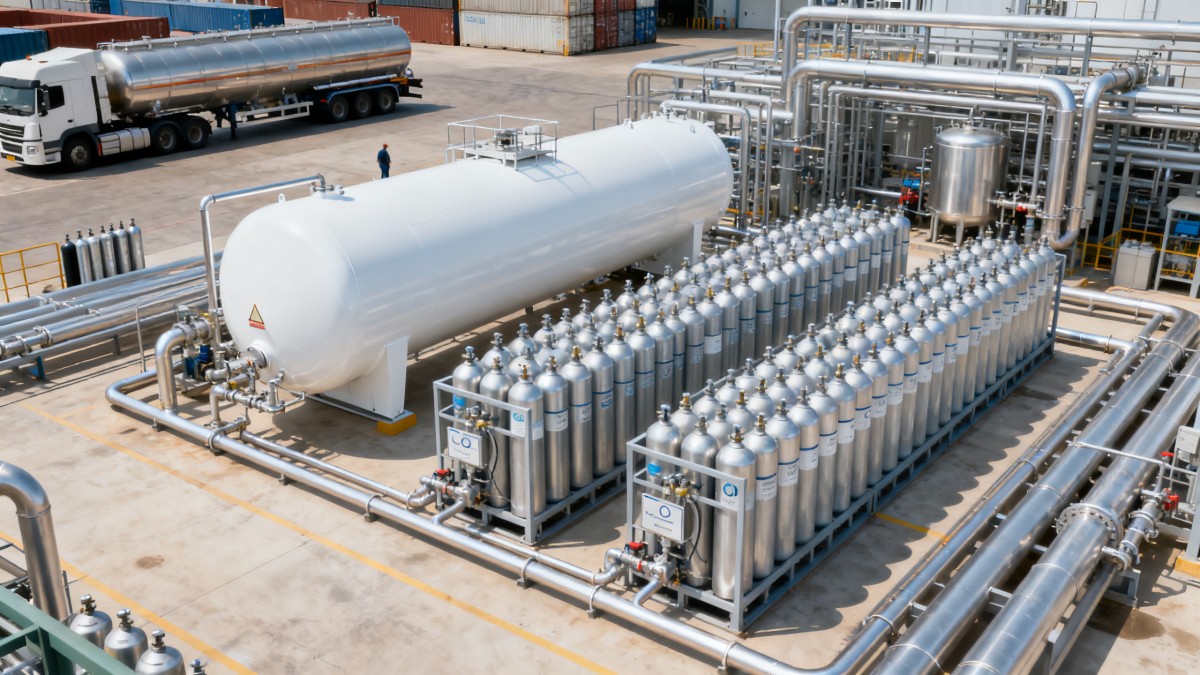
Industrial gases are expensive to move because they require cylinders, cryogenic tankers, bulk systems, or special safety controls.
Diesel prices, driver shortages, route density, and return logistics all affect delivered cost.
This is why two buyers can pay very different rates for the same industrial gases.
Location, delivery mode, and consumption profile matter just as much as published market direction.
Equipment rental, cylinder handling fees, and emergency delivery charges can also quietly inflate the total bill.
Hidden cost elements that buyers often miss
- Low fill efficiency that increases cylinder turns and freight cost.
- Purity grades that exceed process needs without adding real value.
- Take-or-pay terms that punish demand swings.
- On-site storage limits that force frequent deliveries.
- Poor telemetry that hides leaks, waste, or refill timing problems.
Where Supply Risks Are Building for 2026
The supply outlook for industrial gases is not uniformly weak, but it is uneven.
That unevenness is exactly what creates procurement risk.
Some regions are adding capacity, while others remain exposed to concentrated production and fragile logistics links.
A major issue is regional dependence.
If a site relies on one nearby plant or one dominant distributor, even a short outage becomes disruptive.
Another risk comes from cross-sector competition.
Semiconductors, healthcare, food processing, and advanced manufacturing all compete for high-purity industrial gases and priority allocation.
When margins differ, suppliers may protect strategic accounts first.
This matters for buyers with medium volumes or fragmented site demand.
Environmental regulation is also reshaping risk.
Tighter emissions standards, energy disclosure rules, and transport compliance can raise costs or reduce available routes.
More noticeably, decarbonization pressure may alter investment timing for industrial gases infrastructure.
That can create temporary supply gaps before new assets come online.
In practical terms, 2026 risk is less about one global shortage and more about local interruptions with expensive consequences.
Common industrial gases risk signals
- Supplier notices about maintenance, allocation, or force majeure.
- Longer lead times for cylinders, microbulk, or bulk tanker scheduling.
- Frequent surcharges tied to energy or transport changes.
- Rising refusal rates for spot purchases.
- Limited visibility into second-source and backup supply routes.
How Industrial Gases Affect Packaging, Retail Infrastructure, and Consumer Supply Chains
Industrial gases are often discussed in heavy industry, but their relevance is broader.
In packaging, nitrogen supports modified atmosphere applications, product protection, and line efficiency.
Carbon dioxide can influence beverage, cold chain, and food handling operations.
In commercial fit-out and fabrication, oxygen, argon, and mixed gases affect welding quality and throughput.
That means industrial gases can shape timelines for fixtures, equipment housings, signage, and display systems.
For consumer goods supply chains, gas reliability supports production continuity and packaging consistency.
If industrial gases become constrained, the damage spreads beyond plant cost.
Fill rates, launch dates, and shelf readiness can all be affected.
This is why industrial gases should be reviewed alongside packaging materials, energy exposure, and critical component supply.
A Practical Sourcing Framework for Industrial Gases in 2026
A better industrial gases strategy starts with demand clarity.
Many organizations still buy by site habit instead of category visibility.
That creates duplicate contracts, unmanaged fees, and weak leverage.
Start by separating gas spend into product cost, equipment cost, service cost, and logistics cost.
Then map which industrial gases are truly critical by process, not by invoice size alone.
Next, compare supply modes.
Cylinder, liquid bulk, microbulk, and on-site generation each have different risk and cost profiles.
In some cases, on-site nitrogen generation reduces exposure to delivered industrial gases pricing.
In others, outsourced supply remains better because uptime, purity, or scale favors the supplier network.
Contract design matters just as much.
Review indexation formulas, surcharge triggers, escalation caps, emergency service terms, and allocation language.
A cheaper headline rate can become costly if those clauses are loose.
The strongest industrial gases agreements balance price visibility with operational protection.
What to ask suppliers during sourcing reviews
- What production assets serve each site, and what is the backup plan?
- How are energy and transport surcharges calculated?
- Which service levels apply during regional shortages or planned maintenance?
- Can telemetry, tank monitoring, or leak detection reduce delivered cost?
- Are purity specifications aligned with actual process requirements?
- What lead times apply to added volume, new sites, or urgent replenishment?
Decision Priorities: Cost Control Without Losing Supply Security
The best 2026 decisions will treat industrial gases as both a cost category and a continuity category.
That balance matters because the lowest unit price is not always the lowest landed risk.
A practical approach is to rank industrial gases by business impact, substitution difficulty, and time-to-recover during disruption.
Once that is clear, sourcing choices become more disciplined.
For high-impact gases, dual sourcing, safety stock, backup storage, or revised delivery windows may be justified.
For lower-risk gases, standardization and volume bundling may unlock better terms.
It also helps to review industrial gases alongside adjacent categories.
Packaging output, fabrication schedules, refrigeration needs, and utility exposure often reveal hidden interdependencies.
From a business standpoint, that integrated view usually leads to better resilience and fewer surprises.
Quick reference table for 2026 industrial gases decisions
Final Takeaway for 2026 Sourcing Plans
Industrial gases will remain essential, but they are unlikely to remain simple.
Energy exposure, regional concentration, transport complexity, and cross-sector demand will keep pressure on both cost and supply reliability.
The strongest response is early action.
Review industrial gases contracts before renewal pressure builds.
Map critical applications, test backup assumptions, and challenge every hidden fee in the delivered cost model.
In real purchasing environments, the winners are rarely the buyers with the lowest quote alone.
They are the ones with the clearest visibility, the strongest supplier terms, and the fastest recovery options.
That is the mindset that will make industrial gases sourcing more resilient and more cost-effective in 2026.
News Recommendations
 How to choose commercial lighting for offices that reduces glare
![51a6ab95581761cc26f4318be6520c15]()
Aris Katos
Future of Carbide Coatings
 Queue Launches Fully Automated Robotic Pharmacy Kiosk for 30-Second Dispensing
![51a6ab95581761cc26f4318be6520c15]()
Aris Katos
Future of Carbide Coatings
 Can your supermarket store fixtures supplier meet your opening date?
![51a6ab95581761cc26f4318be6520c15]()
Aris Katos
Future of Carbide Coatings
 Shopify POS UI Extensions 2026-10 Adds Virtual Lists and Custom Row Templates
![51a6ab95581761cc26f4318be6520c15]()
Aris Katos
Future of Carbide Coatings
 How to assess smart office furniture suppliers’ North American support
![51a6ab95581761cc26f4318be6520c15]()
Aris Katos
Future of Carbide Coatings
 Aqara Launches Smart Lighting Range to Advance AI Spatial Intelligence
![51a6ab95581761cc26f4318be6520c15]()
Aris Katos
Future of Carbide Coatings
 How to assess demand forecasts in a lighting intelligence report
![51a6ab95581761cc26f4318be6520c15]()
Aris Katos
Future of Carbide Coatings
 Billerud推出PharmaKraft纤维基医药包装材料
![51a6ab95581761cc26f4318be6520c15]()
Aris Katos
Future of Carbide Coatings
 How to assess supplier reliability in global supply chain sourcing
![51a6ab95581761cc26f4318be6520c15]()
Aris Katos
Future of Carbide Coatings
 Omdia Forecasts 11.6% CAGR for Global LED Video Display Market in 2026–2030
![51a6ab95581761cc26f4318be6520c15]()
Aris Katos
Future of Carbide Coatings
 How to verify an LFGB testing laboratory's accreditation scope
![51a6ab95581761cc26f4318be6520c15]()
Aris Katos
Future of Carbide Coatings
 How to assess a workplace interior supplier's installation scope
![51a6ab95581761cc26f4318be6520c15]()
Aris Katos
Future of Carbide Coatings
 What records are needed for an ISO 9001 furniture factory audit?
![51a6ab95581761cc26f4318be6520c15]()
Aris Katos
Future of Carbide Coatings
 How to choose AI marketing tools that work with your existing CRM
![51a6ab95581761cc26f4318be6520c15]()
Aris Katos
Future of Carbide Coatings
 Do freight costs erase savings when buying retail fixtures wholesale?
![51a6ab95581761cc26f4318be6520c15]()
Aris Katos
Future of Carbide Coatings
 Who handles firmware updates for an OEM retail shelf screen?
![51a6ab95581761cc26f4318be6520c15]()
Aris Katos
Future of Carbide Coatings
 How to assess burn-in testing at an OEM retail shelf screen factory
![51a6ab95581761cc26f4318be6520c15]()
Aris Katos
Future of Carbide Coatings
 How custom tooling affects the cost of an OEM shelf LCD screen
![51a6ab95581761cc26f4318be6520c15]()
Aris Katos
Future of Carbide Coatings
 Can OEM retail shelf display screens work with your existing CMS?
![51a6ab95581761cc26f4318be6520c15]()
Aris Katos
Future of Carbide Coatings
 How heat buildup affects OEM retail shelf LCD screen reliability
![51a6ab95581761cc26f4318be6520c15]()
Aris Katos
Future of Carbide Coatings
 How to check whether an OEM retail shelf screen fits existing shelving
![51a6ab95581761cc26f4318be6520c15]()
Aris Katos
Future of Carbide Coatings
 What brightness should an OEM shelf LCD screen have for retail use?
![51a6ab95581761cc26f4318be6520c15]()
Aris Katos
Future of Carbide Coatings
 Can smart retail IT solutions for CPG work with legacy POS systems?
![51a6ab95581761cc26f4318be6520c15]()
Aris Katos
Future of Carbide Coatings
 What permit approvals belong in a commercial fitout planning checklist?
![51a6ab95581761cc26f4318be6520c15]()
Aris Katos
Future of Carbide Coatings
 How Can You Ensure Commercial Furniture Meets Local Safety Regulations?
![51a6ab95581761cc26f4318be6520c15]()
Aris Katos
Future of Carbide Coatings
 What Are the Most Common Mistakes When Sourcing Wholesale Office Furniture?
![51a6ab95581761cc26f4318be6520c15]()
Aris Katos
Future of Carbide Coatings
 Can You Trust G-BCE Supplier Ratings Without Independent Verification?
![51a6ab95581761cc26f4318be6520c15]()
Aris Katos
Future of Carbide Coatings
 What Selection Criteria Matter Most for Commercial Lighting?
![51a6ab95581761cc26f4318be6520c15]()
Aris Katos
Future of Carbide Coatings
 How Do You Apply Sustainability Standards to a Retail Renovation?
![51a6ab95581761cc26f4318be6520c15]()
Aris Katos
Future of Carbide Coatings
 Which Technical Factors Matter When Comparing Smart Retail Hardware?
![51a6ab95581761cc26f4318be6520c15]()
Aris Katos
Future of Carbide Coatings
 Does Data Transparency Matter When Selecting Consumer Goods Suppliers?
![51a6ab95581761cc26f4318be6520c15]()
Aris Katos
Future of Carbide Coatings
 How Does Commercial Design Differ from Interior Decoration?
![51a6ab95581761cc26f4318be6520c15]()
Aris Katos
Future of Carbide Coatings
 How Long Does It Take to Verify a Commercial Furniture Supplier?
![51a6ab95581761cc26f4318be6520c15]()
Aris Katos
Future of Carbide Coatings
 How to verify compostability claims from a bubble mailer manufacturer
![51a6ab95581761cc26f4318be6520c15]()
Aris Katos
Future of Carbide Coatings
 Will commercial smart infrastructure solutions work with legacy systems?
![51a6ab95581761cc26f4318be6520c15]()
Aris Katos
Future of Carbide Coatings
 How to verify a preschool furniture manufacturer's safety standards
![51a6ab95581761cc26f4318be6520c15]()
Aris Katos
Future of Carbide Coatings
 A technical comparison of semiconductor processes for power devices
![51a6ab95581761cc26f4318be6520c15]()
Aris Katos
Future of Carbide Coatings
 How to verify that a BIFMA ergonomic chair meets the standard
![51a6ab95581761cc26f4318be6520c15]()
Aris Katos
Future of Carbide Coatings
 How to use a CRI value chart when choosing LED lighting
![51a6ab95581761cc26f4318be6520c15]()
Aris Katos
Future of Carbide Coatings