Southeast Asia Tightens Labels for Biodegradable Packaging
Time
Click Count
On June 9, 2026, Thailand, Vietnam, and Malaysia jointly introduced a new regional framework for green packaging recognition that raises the compliance bar for imported biodegradable packaging. The change is especially relevant for packaging importers, manufacturers, retailers, e-commerce supply chain participants, and buyers handling courier bags, food trays, and protective fill, because labeling now needs to show the actual hydrolysis rate under ISO 17088 together with the CNAS/ILAC accreditation number of the testing body. For the industry, this is worth watching not only as a labeling adjustment, but as a rule that directly links technical disclosure to market access and cost exposure.
What the new framework clearly requires
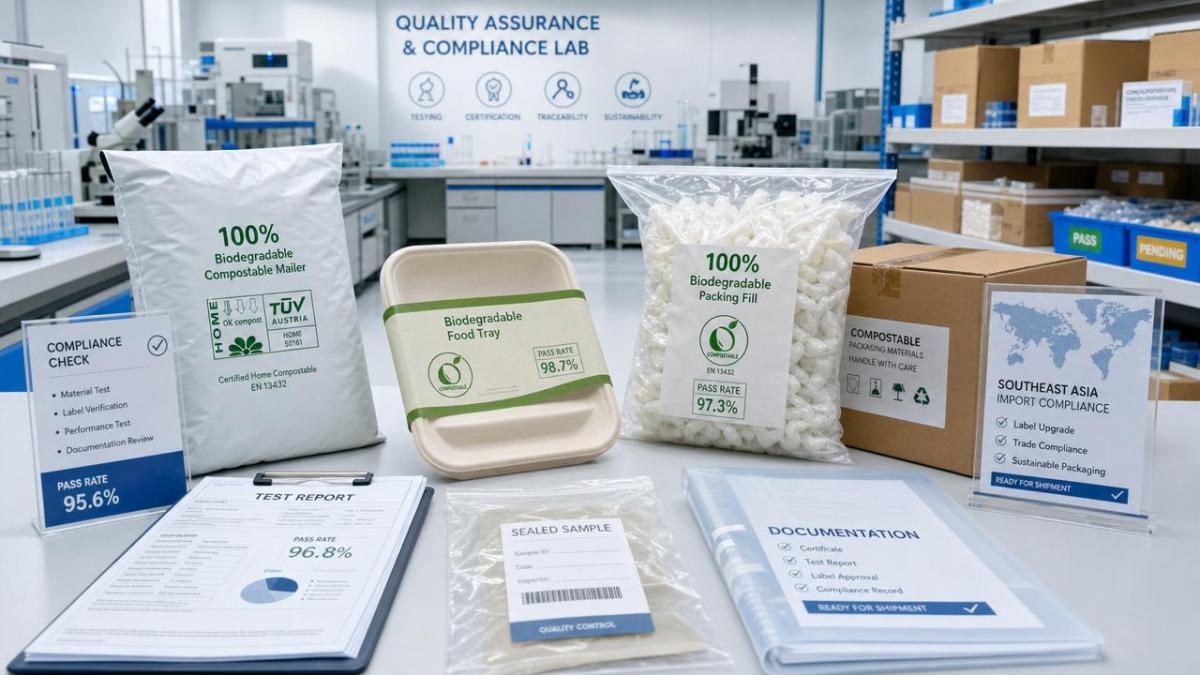
According to the information provided, Thailand, Vietnam, and Malaysia released the ASEAN Green Packaging Mutual Recognition Framework on June 9, 2026. The framework applies to imported biodegradable packaging, including courier bags, food trays, and e-commerce cushioning or filling materials.
Under the new requirement, labels must state the actual hydrolysis rate, expressed as a percentage, based on the ISO 17088 standard. Labels must also display the CNAS or ILAC accreditation number of the testing institution.
Products that do not meet the requirement will face a green adjustment fee equal to 20% of the goods' value. They will also be barred from entering mainstream supermarket channels.
Where the pressure is likely to appear first
Imported packaging programs face an immediate documentation test
From an industry perspective, companies directly importing biodegradable packaging are likely to be affected first because the rule targets imported products and ties compliance to label content. The main pressure point is not only product specification, but also whether test results and accreditation details can be accurately reflected in shipment-ready packaging and supporting documents.
Manufacturers and converters need closer alignment with test evidence
Analysis shows that packaging processors and manufacturers supplying these markets may need to pay closer attention to how product claims are translated into labels. If the hydrolysis rate under ISO 17088 and the testing body's CNAS/ILAC accreditation number are mandatory disclosures, then formulation claims, test outputs, packaging artwork, and export delivery batches need tighter coordination.
Retail and channel operators face a clearer screening threshold
For supermarket-facing distributors and channel partners, the framework matters because non-compliant products are not only exposed to an added fee but also excluded from mainstream retail access. What deserves closer attention is that channel risk may shift upstream, with procurement and category teams needing stronger checks before listing imported biodegradable packaging products.
E-commerce and logistics packaging users may need supplier reviews
Businesses using imported courier bags or e-commerce fill materials may also feel the impact through sourcing and fulfillment. Observably, even where the packaging itself is not the core product being sold, non-compliant packaging could affect procurement continuity, supplier selection, and delivery planning for operations tied to the three markets.
What companies should monitor now
Check whether current labels match test disclosures
A practical priority is to compare existing label language with the newly required disclosure items. Companies should focus on whether the actual hydrolysis rate under ISO 17088 is already presented in a usable form and whether the testing body's CNAS/ILAC accreditation number is available for label inclusion.
Review which product lines are exposed first
The provided information specifically mentions courier bags, food trays, and e-commerce filling materials. Businesses with exposure to these categories should identify which imported SKUs, customer programs, or market routes into Thailand, Vietnam, and Malaysia may require immediate review.
Separate policy wording from execution details
Analysis shows that one key issue is the difference between a published requirement and day-to-day implementation. Companies may need to keep watching for any further official clarification on how labeling will be checked in practice, how supporting materials may be reviewed, and how the framework will be applied across different packaging formats and channel types.
Prepare supplier and customer communication early
What deserves closer attention is the operational side of compliance: supplier qualification, test document readiness, packaging artwork updates, order lead times, and customer notification. For businesses shipping into these markets, delays often arise not from the rule itself, but from incomplete alignment across sourcing, quality, packaging, and sales teams.
Why this looks bigger than a routine labeling update
As an editorial observation, this development is more appropriately understood as a policy signal with immediate commercial consequences rather than a minor technical adjustment. The reason is that the requirement links a measurable standard item, the hydrolysis rate under ISO 17088, to both traceable testing credentials and direct channel access.
At the same time, it is still too early to treat this as a fully settled long-term market outcome. Observably, the announced framework establishes a clear direction, but the industry's next decisions will likely depend on how consistently the requirement is interpreted and enforced across import, retail, and supply chain processes.
How to read this development at this stage
At this stage, the news is best read as a concrete compliance change with broader signaling value for biodegradable packaging trade into Southeast Asia. It does not merely add a claim requirement; it raises the importance of verifiable test reporting and label-level transparency. A neutral reading is that the framework already matters for affected import flows, while its wider regional implications still require continued observation.
Basis of this article
This article is based on the user-provided news title, event date, and event summary. The specific official source link was not provided in the input, so further verification is still needed against materials such as official announcements, company notices, industry association updates, authoritative media coverage, and relevant standard-related documents. Continued attention should focus on whether additional official wording, implementation details, or compliance interpretations are released after the June 9, 2026 announcement.
News Recommendations
 What consumer packaging USA importers need to verify before ordering
![51a6ab95581761cc26f4318be6520c15]()
Aris Katos
Future of Carbide Coatings
 How commercial spaces interiors shape customer dwell time
![51a6ab95581761cc26f4318be6520c15]()
Aris Katos
Future of Carbide Coatings
 How LED commercial lighting design reduces glare in retail spaces
![51a6ab95581761cc26f4318be6520c15]()
Aris Katos
Future of Carbide Coatings
 How industrial technology information improves RFID inventory accuracy
![51a6ab95581761cc26f4318be6520c15]()
Aris Katos
Future of Carbide Coatings
 When drip garden watering systems make more sense than sprinklers
![51a6ab95581761cc26f4318be6520c15]()
Aris Katos
Future of Carbide Coatings
 When category comparison improves sourcing for industrial applications
![51a6ab95581761cc26f4318be6520c15]()
Aris Katos
Future of Carbide Coatings
 Industrial application guidance for selecting the right LED lighting
![51a6ab95581761cc26f4318be6520c15]()
Aris Katos
Future of Carbide Coatings
 Which commercial architecture standards apply to European retail fit-outs?
![51a6ab95581761cc26f4318be6520c15]()
Aris Katos
Future of Carbide Coatings
 How to verify FDA requirements for maternity care products
![51a6ab95581761cc26f4318be6520c15]()
Aris Katos
Future of Carbide Coatings
 How to verify BPA-free claims for food-contact products
![51a6ab95581761cc26f4318be6520c15]()
Aris Katos
Future of Carbide Coatings
 When does a European wholesale supplier suit modular office projects?
![51a6ab95581761cc26f4318be6520c15]()
Aris Katos
Future of Carbide Coatings
 When consumer ecosystem solutions improve the in-store shopping journey
![51a6ab95581761cc26f4318be6520c15]()
Aris Katos
Future of Carbide Coatings
 How a commercial developers network can reduce site selection risk
![51a6ab95581761cc26f4318be6520c15]()
Aris Katos
Future of Carbide Coatings
 How clear purchasing specifications prevent costly supplier deviations
![51a6ab95581761cc26f4318be6520c15]()
Aris Katos
Future of Carbide Coatings
 What an ISTA drop test lab checks before your packaging ships
![51a6ab95581761cc26f4318be6520c15]()
Aris Katos
Future of Carbide Coatings
 Which commercial furniture standards apply to workplace seating?
![51a6ab95581761cc26f4318be6520c15]()
Aris Katos
Future of Carbide Coatings
 How to evaluate smart lighting module OEM compatibility before sampling
![51a6ab95581761cc26f4318be6520c15]()
Aris Katos
Future of Carbide Coatings
 How to assess whether sustainable technology delivers real impact
![51a6ab95581761cc26f4318be6520c15]()
Aris Katos
Future of Carbide Coatings
 How to assess an OEM supplier’s quality control before ordering
![51a6ab95581761cc26f4318be6520c15]()
Aris Katos
Future of Carbide Coatings
 How consumer ecosystem solutions data can improve retail personalization
![51a6ab95581761cc26f4318be6520c15]()
Aris Katos
Future of Carbide Coatings
 When does consumer packaging design justify a higher product price?
![51a6ab95581761cc26f4318be6520c15]()
Aris Katos
Future of Carbide Coatings
 Supermarket Fixture Installation: Planning Layouts, Wiring, and Handover
![51a6ab95581761cc26f4318be6520c15]()
Aris Katos
Future of Carbide Coatings
 Automated Lighting and Smart Lighting Control in Bergerac: Key Project Considerations
![51a6ab95581761cc26f4318be6520c15]()
Aris Katos
Future of Carbide Coatings
 Segment Streetlight Controllers: Choosing Control Modes for Urban Roads
![51a6ab95581761cc26f4318be6520c15]()
Aris Katos
Future of Carbide Coatings
 IEC 62471-2 Explained: How to Assess Photobiological Risks in LED Lighting
![51a6ab95581761cc26f4318be6520c15]()
Aris Katos
Future of Carbide Coatings
 Food Grade Packaging Requirements by Product Type, Temperature, and Contact Risk
![51a6ab95581761cc26f4318be6520c15]()
Aris Katos
Future of Carbide Coatings
 Food Packaging Compliance Checklist: Tests, Records, and Labeling Before Shipment
![51a6ab95581761cc26f4318be6520c15]()
Aris Katos
Future of Carbide Coatings
 NSF Food Packaging Standards: When Certification Matters for Commercial Food Use
![51a6ab95581761cc26f4318be6520c15]()
Aris Katos
Future of Carbide Coatings
 FDA Food Grade Compliance: Which Materials and Documents Do Buyers Need?
![51a6ab95581761cc26f4318be6520c15]()
Aris Katos
Future of Carbide Coatings
 What Should a Food Grade Declaration Include for Packaging Compliance?
![51a6ab95581761cc26f4318be6520c15]()
Aris Katos
Future of Carbide Coatings
 Housewares Importing: How to Evaluate Suppliers, Costs, and Compliance Risks
![51a6ab95581761cc26f4318be6520c15]()
Aris Katos
Future of Carbide Coatings
 Why Freeze-Dried Fruit Ingredients Lose Crispness—and How to Prevent It
![51a6ab95581761cc26f4318be6520c15]()
Aris Katos
Future of Carbide Coatings
 What industry veterans look for before choosing a new supplier
![51a6ab95581761cc26f4318be6520c15]()
Aris Katos
Future of Carbide Coatings
 How material fatigue can shorten the service life of retail shelving
![51a6ab95581761cc26f4318be6520c15]()
Aris Katos
Future of Carbide Coatings
 What makes a global sourcing platform reliable for supplier verification?
![51a6ab95581761cc26f4318be6520c15]()
Aris Katos
Future of Carbide Coatings
 When are double platinum spark plugs a better choice than iridium?
![51a6ab95581761cc26f4318be6520c15]()
Aris Katos
Future of Carbide Coatings
 How to assess a POS terminal manufacturer in Europe for long-term support
![51a6ab95581761cc26f4318be6520c15]()
Aris Katos
Future of Carbide Coatings
 How data transparency in retail helps prevent inventory discrepancies
![51a6ab95581761cc26f4318be6520c15]()
Aris Katos
Future of Carbide Coatings
 What makes a product comparison guide actually useful for buying decisions
![51a6ab95581761cc26f4318be6520c15]()
Aris Katos
Future of Carbide Coatings