Manufacturing Precision Tools: What Affects Tool Life Most?
Time
Click Count
In manufacturing precision tools, tool life is rarely determined by a single variable. For quality control and safety managers, the biggest drivers are usually the interaction between tool material, workpiece material, cutting conditions, cooling, machine stability, and process discipline.
The practical reality is simple: tools fail early not only because they are “weak,” but because the manufacturing system around them is unstable. If you want longer service life, better quality, and lower risk, you need to control the process, not just buy harder tools.
What quality and safety teams need to know first
When users search for what affects tool life most in manufacturing precision tools, they usually want a decision-ready answer. They are not looking for textbook theory alone. They want to know which factors cause premature wear, unstable quality, tool breakage, and safety incidents.
For quality control personnel, the concern is repeatability. If one batch runs well and the next damages inserts early, the issue affects dimensional consistency, surface finish, scrap rate, and customer confidence. Tool life becomes a quality signal, not just a maintenance metric.
For safety managers, sudden tool failure matters even more. Chipped edges, fractured drills, overloaded spindles, and unstable clamping can create direct operator hazards. In high-speed machining environments, short or unpredictable tool life can quickly become a machine safety issue.
That is why the most useful way to evaluate manufacturing precision tools is through a systems lens. Tool life is shaped by the full process chain: tool design, substrate, coating, workpiece hardness, feeds and speeds, cooling, fixturing, spindle condition, vibration, operator behavior, and inspection methods.
Material compatibility often matters more than advertised hardness
One of the most common misconceptions is that harder tools always last longer. In reality, matching the tool material to the workpiece and operation is often more important than chasing maximum hardness. Hardness helps, but mismatch destroys tools quickly.
Carbide, high-speed steel, ceramics, CBN, and PCD each behave differently under heat, impact, and friction. A tool that performs well in hardened steel may perform poorly in aluminum, composites, or stainless steel if the edge geometry and coating are not selected correctly.
Stainless steel, for example, creates heat and work hardening that can accelerate wear. Aluminum may cause built-up edge if the tool coating and chip evacuation are wrong. Composite materials can be highly abrasive and may wear edges even when cutting forces appear moderate.
For manufacturing precision tools, material compatibility should be validated against actual production conditions, not only supplier data sheets. Quality teams should compare expected wear modes with real wear patterns under the microscope and adjust tool selection based on evidence.
If flank wear, crater wear, chipping, thermal cracking, or edge rounding appear earlier than expected, the problem may not be the brand or nominal grade. It may be the wrong substrate, edge prep, coating type, or geometry for the material being processed.
Cutting parameters are among the strongest predictors of tool life
In many factories, the fastest way to shorten tool life is poor parameter control. Cutting speed, feed rate, depth of cut, entry angle, and tool engagement directly influence heat generation, pressure, vibration, and chip formation. Small changes can produce major lifespan differences.
Excessive cutting speed is a frequent cause of early wear. Even premium tools degrade rapidly if heat builds faster than the coating and substrate can tolerate. Many tool failures blamed on quality are actually speed-related thermal failures.
Feed rate also requires balance. Too high, and the cutting edge overloads or chips. Too low, and the tool may rub instead of cut, generating heat and damaging the edge. This is especially critical in finishing operations where dimensional precision is tightly controlled.
Depth of cut and radial engagement affect load distribution. Inconsistent engagement creates unstable force peaks that shorten life and reduce process reliability. This matters for safety teams because sudden overload events can lead to tool breakage or fixture instability.
For quality control, the key is not simply setting conservative parameters. The goal is establishing a validated process window. That means documented feeds and speeds, confirmed wear limits, and clear evidence that the chosen parameters support both quality output and predictable tool replacement intervals.
Cooling and lubrication strategy can determine whether wear is gradual or catastrophic
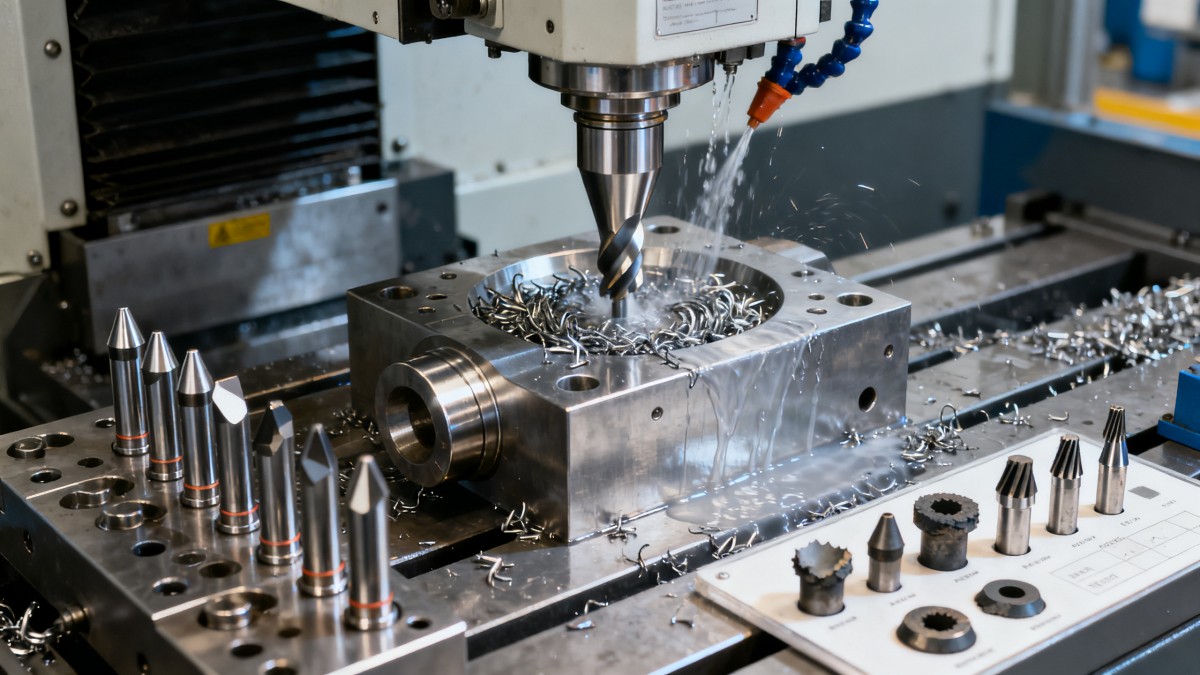
Heat is one of the most powerful enemies of tool life. In manufacturing precision tools, temperature affects coating stability, substrate toughness, edge integrity, and chip evacuation. A good tool can fail quickly if cooling strategy is weak or inconsistent.
Flood coolant, minimum quantity lubrication, through-tool coolant, dry machining, and cryogenic approaches all have different advantages. The right choice depends on material, operation, chip volume, and machine capability. There is no universal best option.
Coolant concentration and delivery are often overlooked. A correct fluid with poor nozzle positioning may do little at the cutting zone. Likewise, contaminated or poorly maintained coolant can reduce lubrication performance and increase thermal shock or corrosion risk.
Thermal cycling is another concern. Repeated heating and cooling can create cracks, especially in interrupted cutting. Safety managers should pay attention to operations where coolant application is inconsistent, because this can turn normal wear into brittle edge failure.
From a quality perspective, stable cooling improves more than tool life. It also supports surface integrity, tolerance control, and chip evacuation. Better cooling often reduces secondary defects that may otherwise be misread as machine drift or operator inconsistency.
Machine condition and setup quality frequently separate stable processes from unstable ones
Even the best cutting tools cannot compensate for poor machine health. Spindle runout, backlash, worn bearings, weak tool holders, poor balancing, and unstable fixturing all increase vibration and uneven loading. That directly reduces tool life and damages part quality.
Runout is especially damaging in drilling, reaming, and micro-machining. If one edge carries more load than the others, wear becomes uneven and failure can come much earlier than expected. Quality teams should include runout verification in process capability reviews.
Clamping matters just as much. If the workpiece shifts or resonates, edge chipping and dimension loss become more likely. For safety managers, insecure fixturing is a dual threat: it shortens tool life and raises the chance of part movement during machining.
Tool holder selection also plays a major role. Hydraulic, shrink-fit, collet, and mechanical holders differ in rigidity, balance, and damping. In high-precision work, the holder is not an accessory. It is part of the cutting system that determines real-world tool performance.
A factory trying to improve manufacturing precision tools should therefore audit machine capability before changing tool suppliers. Many recurring tool life complaints are rooted in spindle health, holder condition, setup repeatability, or preventive maintenance gaps.
Operator consistency and process discipline are major hidden variables
In plants with mixed shifts or frequent setup changes, operator behavior can strongly influence tool life. Manual offset changes, inconsistent warm-up routines, incorrect insert indexing, poor cleaning, and delayed replacement can turn a controlled process into a variable one.
Quality teams often see this as unexplained variation. One operator achieves full expected tool life while another gets premature wear using the same program and material. The difference is often not luck. It is process discipline.
Tool life management should include standard work instructions, wear criteria, replacement timing, torque standards, and verification steps after tool changes. If these controls are missing, the process depends too heavily on individual experience, which increases quality and safety risk.
Training should also cover wear recognition. Operators and inspectors need to distinguish normal wear from chipping, built-up edge, thermal cracking, and coating delamination. Correct diagnosis prevents repeated errors and helps engineering teams respond to the actual root cause.
For safety managers, disciplined replacement rules are essential. Running tools beyond wear limits may appear to save cost in the short term, but it increases the probability of sudden breakage, scrap, machine damage, and emergency intervention.
How to identify the real cause of short tool life
If tool life is inconsistent, avoid jumping to conclusions. A structured root-cause method is more effective than replacing tools at random. Start by documenting the failure mode, operation type, material lot, machine used, operator, program version, coolant condition, and actual cutting parameters.
Next, inspect the worn tool carefully. Flank wear usually indicates gradual abrasion. Crater wear may point to heat and chemical wear. Chipping often suggests impact, vibration, or unstable entry. Built-up edge may indicate poor lubrication or unsuitable geometry.
Then compare actual conditions against the approved standard. In many cases, real spindle speed, feed rate, coolant concentration, or tool stick-out differs from the documented setup. This gap between standard and execution is where many tool life problems begin.
Trend analysis is valuable for both quality and safety teams. If failures cluster by machine, shift, material source, or specific operation, the pattern can reveal the real driver. Without data trending, organizations may treat systemic issues as isolated incidents.
Where possible, use tool life testing under controlled conditions. Compare one variable at a time: coating, holder type, coolant delivery, or parameter adjustment. This disciplined approach creates reliable evidence and supports stronger purchasing and process decisions.
What matters most when balancing quality, cost, and safety
From a management perspective, the best answer to what affects tool life most is not a single factor. The biggest influence is process control around the tool. Material mismatch, excessive heat, vibration, and inconsistent execution are usually more damaging than tool price alone.
That is why low-cost tooling can become expensive if it increases variation, inspection burden, downtime, and incident risk. Conversely, a premium tool only creates value when the machine, setup, and operating discipline allow it to perform as intended.
For quality control personnel, the right benchmark is predictable life, not maximum life in isolated trials. A tool that lasts slightly less but behaves consistently may be more valuable than one with higher peak performance but greater failure variability.
For safety managers, stable wear progression is preferable to aggressive utilization. Catastrophic failure risk should be treated as a key evaluation criterion when approving tooling strategies, especially for high-speed, unattended, or difficult-to-machine applications.
Organizations that handle manufacturing precision tools well usually share the same habits: they validate tool-workpiece compatibility, lock process windows, maintain machines, train operators, inspect wear systematically, and treat tool life as part of overall process reliability.
Conclusion
Tool life in manufacturing precision tools is affected most by the combined interaction of material selection, cutting parameters, cooling, machine stability, and human execution. Hardness alone does not decide performance. Process fit and control do.
For quality control and safety teams, the most effective strategy is to reduce variability at every step. When tool life becomes predictable, part quality improves, downtime falls, safety risks decrease, and sourcing decisions become easier to justify with evidence.
If your goal is longer tool life, start by asking not only which tool is better, but which part of the process is unstable. In most cases, that question leads faster to the truth and to better operational results.
News Recommendations
 How to prevent O-rings and seals from failing in food equipment
![51a6ab95581761cc26f4318be6520c15]()
Aris Katos
Future of Carbide Coatings
 How to compare commercial linear light wholesale quotes accurately
![51a6ab95581761cc26f4318be6520c15]()
Aris Katos
Future of Carbide Coatings
 How to verify international standards compliance for Middle East exports
![51a6ab95581761cc26f4318be6520c15]()
Aris Katos
Future of Carbide Coatings
 How to select laboratory instruments for reproducible test results
![51a6ab95581761cc26f4318be6520c15]()
Aris Katos
Future of Carbide Coatings
 When does a sheet metal prototype reveal design flaws early?
![51a6ab95581761cc26f4318be6520c15]()
Aris Katos
Future of Carbide Coatings
 When PE air column bags reduce damage in e-commerce fulfillment
![51a6ab95581761cc26f4318be6520c15]()
Aris Katos
Future of Carbide Coatings
 How energy-efficient design reduces operating costs in retail lighting
![51a6ab95581761cc26f4318be6520c15]()
Aris Katos
Future of Carbide Coatings
 When commercial aluminum storefronts make sense for a retail renovation
![51a6ab95581761cc26f4318be6520c15]()
Aris Katos
Future of Carbide Coatings
 What makes LED lights durable in high-use commercial spaces?
![51a6ab95581761cc26f4318be6520c15]()
Aris Katos
Future of Carbide Coatings
 Which industry categories offer the strongest export potential in Latin America?
![51a6ab95581761cc26f4318be6520c15]()
Aris Katos
Future of Carbide Coatings
 How to choose an ultra bright waterproof window display for storefronts
![51a6ab95581761cc26f4318be6520c15]()
Aris Katos
Future of Carbide Coatings
 How to verify suppliers on a trade portal for global sourcing
![51a6ab95581761cc26f4318be6520c15]()
Aris Katos
Future of Carbide Coatings
 How RoHS requirements should be stated in product specifications
![51a6ab95581761cc26f4318be6520c15]()
Aris Katos
Future of Carbide Coatings
 What affects the lead time for custom retail counter displays?
![51a6ab95581761cc26f4318be6520c15]()
Aris Katos
Future of Carbide Coatings
 What consumer packaging USA importers need to verify before ordering
![51a6ab95581761cc26f4318be6520c15]()
Aris Katos
Future of Carbide Coatings
 How commercial spaces interiors shape customer dwell time
![51a6ab95581761cc26f4318be6520c15]()
Aris Katos
Future of Carbide Coatings
 How LED commercial lighting design reduces glare in retail spaces
![51a6ab95581761cc26f4318be6520c15]()
Aris Katos
Future of Carbide Coatings
 How industrial technology information improves RFID inventory accuracy
![51a6ab95581761cc26f4318be6520c15]()
Aris Katos
Future of Carbide Coatings
 When drip garden watering systems make more sense than sprinklers
![51a6ab95581761cc26f4318be6520c15]()
Aris Katos
Future of Carbide Coatings
 When category comparison improves sourcing for industrial applications
![51a6ab95581761cc26f4318be6520c15]()
Aris Katos
Future of Carbide Coatings
 Industrial application guidance for selecting the right LED lighting
![51a6ab95581761cc26f4318be6520c15]()
Aris Katos
Future of Carbide Coatings
 Which commercial architecture standards apply to European retail fit-outs?
![51a6ab95581761cc26f4318be6520c15]()
Aris Katos
Future of Carbide Coatings
 How to verify FDA requirements for maternity care products
![51a6ab95581761cc26f4318be6520c15]()
Aris Katos
Future of Carbide Coatings
 How to verify BPA-free claims for food-contact products
![51a6ab95581761cc26f4318be6520c15]()
Aris Katos
Future of Carbide Coatings
 When does a European wholesale supplier suit modular office projects?
![51a6ab95581761cc26f4318be6520c15]()
Aris Katos
Future of Carbide Coatings
 When consumer ecosystem solutions improve the in-store shopping journey
![51a6ab95581761cc26f4318be6520c15]()
Aris Katos
Future of Carbide Coatings
 How a commercial developers network can reduce site selection risk
![51a6ab95581761cc26f4318be6520c15]()
Aris Katos
Future of Carbide Coatings
 How clear purchasing specifications prevent costly supplier deviations
![51a6ab95581761cc26f4318be6520c15]()
Aris Katos
Future of Carbide Coatings
 What an ISTA drop test lab checks before your packaging ships
![51a6ab95581761cc26f4318be6520c15]()
Aris Katos
Future of Carbide Coatings
 Which commercial furniture standards apply to workplace seating?
![51a6ab95581761cc26f4318be6520c15]()
Aris Katos
Future of Carbide Coatings
 How to evaluate smart lighting module OEM compatibility before sampling
![51a6ab95581761cc26f4318be6520c15]()
Aris Katos
Future of Carbide Coatings
 How to assess whether sustainable technology delivers real impact
![51a6ab95581761cc26f4318be6520c15]()
Aris Katos
Future of Carbide Coatings
 How to assess an OEM supplier’s quality control before ordering
![51a6ab95581761cc26f4318be6520c15]()
Aris Katos
Future of Carbide Coatings
 How consumer ecosystem solutions data can improve retail personalization
![51a6ab95581761cc26f4318be6520c15]()
Aris Katos
Future of Carbide Coatings
 When does consumer packaging design justify a higher product price?
![51a6ab95581761cc26f4318be6520c15]()
Aris Katos
Future of Carbide Coatings
 Supermarket Fixture Installation: Planning Layouts, Wiring, and Handover
![51a6ab95581761cc26f4318be6520c15]()
Aris Katos
Future of Carbide Coatings
 Automated Lighting and Smart Lighting Control in Bergerac: Key Project Considerations
![51a6ab95581761cc26f4318be6520c15]()
Aris Katos
Future of Carbide Coatings
 Segment Streetlight Controllers: Choosing Control Modes for Urban Roads
![51a6ab95581761cc26f4318be6520c15]()
Aris Katos
Future of Carbide Coatings
 IEC 62471-2 Explained: How to Assess Photobiological Risks in LED Lighting
![51a6ab95581761cc26f4318be6520c15]()
Aris Katos
Future of Carbide Coatings