How to verify a cookware manufacturer's induction compatibility claims
Time
Click Count
A cookware supplier’s “induction compatible” label is a starting point, not proof of consistent performance. For procurement teams, the challenge is to confirm that products work reliably across target markets and cooktop types before committing to an order. When evaluating an induction stainless cookware manufacturer, buyers should examine base construction, request documented test results, and verify samples under realistic operating conditions. This guide outlines practical checks to help you assess supplier claims, reduce sourcing risk, and make more confident purchasing decisions.
Start with the base, not the product label
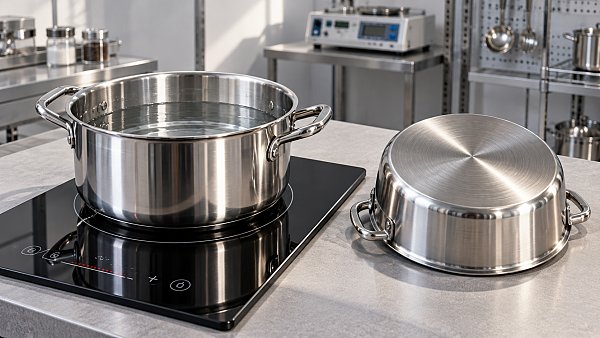
Induction cooktops transfer energy to a suitable pan through an alternating magnetic field. The cooking vessel needs a base that couples effectively with that field, but detection and cooking performance are not the same thing. A pan may trigger a cooktop and still heat slowly, develop pronounced hot spots, make objectionable noise, or lose contact as its base changes shape under heat.
Stainless steel cookware also comes in several constructions. An austenitic stainless cooking surface, such as 18/10, is often paired with a magnetic outer layer; the cooking surface designation alone does not establish induction suitability. Some products have a bonded encapsulated base, often with an aluminum core and magnetic stainless exterior. Others use multilayer construction extending up the sides. Both approaches can work, but construction quality, dimensions, and the magnetic layer matter more than the marketing name.
Ask for a cross-section drawing or specification showing each layer, the base diameter, and the thicknesses or permitted tolerances relevant to the supplied item. For a bonded disc, clarify the disc diameter and joining method. A large pan with a relatively small magnetic disc can behave differently from another pan with the same advertised rim diameter. If the supplier sells several sizes under one collection, do not assume the smallest saucepan performs like the largest stockpot.

A magnet is a useful screening tool: attraction to the underside suggests a magnetic component is present. It does not establish whether the pan will be detected by a particular cooktop, how efficiently it will heat, or whether the base will remain flat. Treat a magnet test as a way to reject an obviously unsuitable sample, not as an acceptance test.
Ask for evidence tied to the exact item
A credible test report should identify the product tested, its size and construction, the cooktop used, and the test procedure. A photograph of a pan boiling water or a generic laboratory logo does not answer those questions. Neither does a certificate for a different factory, base material, or product family.
Request the full report rather than a cropped cover page. Check the testing organization, date, sample identification, equipment, operating settings, observations, and any limitations. A report prepared by the manufacturer can still be useful if its methods and raw observations are clear; independent testing adds a separate level of assurance, particularly when the supplier’s claim is central to the purchase decision.
The report should answer practical questions: Did the pan register consistently? How was heating evaluated? Was the test repeated after thermal cycling? Were any sizes or appliances excluded? If the report covers only one diameter, ask why it is representative of the proposed range. An assurance that “all sizes use the same material” is not enough when their base geometry differs.
Also separate cookware performance from other compliance claims. Food-contact requirements, packaging claims, and electrical certification of a cooktop are different matters. A supplier’s reference to CE or UL should be checked against the actual product and applicable requirements; it is not, by itself, proof that a pan performs well on induction. Ask the supplier to identify the specific standard or test method used rather than accepting a broad claim of international compliance.
Build a sample test around the cooktops customers use
The most revealing test is often a simple one carried out with a representative cooktop, a defined quantity of water, and a repeatable procedure. If the assortment is intended for several markets or both home and commercial kitchens, include representative appliances where practical. Detection thresholds, coil layouts, controls, and power delivery vary by model; a pass on one appliance is not a universal compatibility guarantee.
Select samples across the range, especially the smallest base, the widest base, and any item with a different construction. Measure the actual contact and magnetic base diameters, not just the top diameter listed in the catalog. Compare those dimensions with the cookware guidance supplied by the cooktop manufacturer. A small saucepan can fail detection on a large zone even when a larger pan from the same collection works normally.
Before testing, agree on the conditions: starting water and ambient temperatures, water volume, lid position, cooktop zone and setting, and the point at which timing stops. Record the pan and appliance model for every result. Compare repeated runs with an agreed reference pan rather than treating one boiling time as a universal benchmark. Heating time is influenced by the appliance, the load, and the setup as well as the cookware.
Use the test to observe more than speed. Watch for intermittent detection, error messages, excessive vibration or audible buzzing, and unstable contact. Some noise can arise from the interaction between a pan and a particular cooktop, so note its setting and whether it persists on other appliances. For cooking uniformity, use a controlled, repeatable method appropriate to the product; a single visual impression from a dry pan is not a reliable measurement. Follow the cookware and cooktop instructions, and avoid overheating an empty vessel.
A practical test matrix can be concise. Record the exact pan, base dimensions, appliance and zone, load, operating setting, detection behavior, heating result, noise observations, and any visible change. Keep the raw results even when the sample passes. They become useful evidence if a later shipment performs differently.
Check what happens after repeated heating
A new sample can sit flat and still change shape after repeated use. Poor contact with a glass cooktop may produce noise or uneven heating, and a visibly rocking pan is an obvious concern. Ask how the supplier checks base flatness before and after thermal cycling, including the measurement method, test conditions, and acceptance limits. Those limits should be agreed for the product and intended use; there is no useful universal number to insert without a defined method.
For encapsulated bases, inspect the joint and edges for gaps or visible separation after the agreed test. A destructive cross-section can help assess construction, but it should be performed by a qualified party using an agreed method. It cannot prove the durability of every production unit. The point is to combine construction inspection with repeatable performance and durability checks, not to rely on one dramatic test.
Be wary of demonstrations that intentionally abuse a pan and then describe the result as normal-use durability. Thermal shock tests may be relevant for a specific risk, but their severity and pass criteria need to be defined. A buyer comparing suppliers should use the same method for both.
Turn the approved sample into a production requirement
The approval sample is only useful if the delivered cookware matches it. Record the sample identifier, manufacturing site, construction drawing, material specification, base dimensions, finish, and agreed inspection criteria. Retain an approved sample or a documented reference with both parties’ acknowledgement. If the manufacturer uses a subcontractor for bonding or buys pre-bonded material, understand which party controls that operation and how traceability is maintained.
Include a change-notification requirement in the purchase agreement. A change in magnetic layer, disc dimensions, bonding process, production site, or key material supplier can justify renewed testing even if the external appearance is unchanged. Agree who selects production samples, when checks occur, and what happens if a lot fails. A pre-shipment inspection can catch visible defects and verify dimensions, but it should not be mistaken for a full durability program unless that testing is actually included.
Sampling also needs a commercial decision. Testing every unit for thermal performance may be impractical; testing only a supplier-selected showroom sample leaves too much uncertainty. Choose the depth of inspection according to order size, product history, construction changes, and the consequences of failure. For a new collection, an initial production run may warrant more scrutiny than a repeat order made to a stable, verified specification.
Make compatibility claims as specific as the evidence
Before approving packaging or a product listing, compare the proposed wording with the test record. “Suitable for induction” is a broad statement; it does not explain minimum base-size limitations or guarantee performance on every appliance. Where meaningful restrictions are known, make them available in product information and care instructions. Avoid promising uniform heating, faster boiling, or universal cooktop compatibility unless the evidence supports the exact claim.
This is where a benchmarking approach, such as that used by Global Business & Consumer Ecosystem (G-BCE) across consumer product supply chains, is useful: compare documented construction, test methods, and production controls on a like-for-like basis rather than ranking suppliers by their labels. For the purchasing decision, the strongest offer is not necessarily the one with the most certificates. It is the one whose exact products have been tested under relevant conditions, whose limitations are clear, and whose production process can reproduce the approved result.
News Recommendations
 How do packaging customization options affect minimum order quantities in Europe?
![51a6ab95581761cc26f4318be6520c15]()
Aris Katos
Future of Carbide Coatings
 Transom to Acquire Cree LED in Commercial Lighting Ownership Change
![51a6ab95581761cc26f4318be6520c15]()
Aris Katos
Future of Carbide Coatings
 How to plan customer flow in commercial design planning
![51a6ab95581761cc26f4318be6520c15]()
Aris Katos
Future of Carbide Coatings
 USTR Urged to Permanently Suspend Fees on China-Linked Ships
![51a6ab95581761cc26f4318be6520c15]()
Aris Katos
Future of Carbide Coatings
 How to choose comparable stores for retail benchmarking
![51a6ab95581761cc26f4318be6520c15]()
Aris Katos
Future of Carbide Coatings
 How does anchoring affect modular building wind load resistance?
![51a6ab95581761cc26f4318be6520c15]()
Aris Katos
Future of Carbide Coatings
 Amazon Raises European FBA Surcharge to 2% in Ten Markets From November 2
![51a6ab95581761cc26f4318be6520c15]()
Aris Katos
Future of Carbide Coatings
 How to verify a BPA-free test report for baby products
![51a6ab95581761cc26f4318be6520c15]()
Aris Katos
Future of Carbide Coatings
 China's Mandatory Classroom Lighting Standard GB 7793-2025 Takes Effect November 1
![51a6ab95581761cc26f4318be6520c15]()
Aris Katos
Future of Carbide Coatings
 How order volume affects the price of wholesale poly mailers
![51a6ab95581761cc26f4318be6520c15]()
Aris Katos
Future of Carbide Coatings
 US Imposes 50% Tariff on Certain Canadian PET Resin Imports
![51a6ab95581761cc26f4318be6520c15]()
Aris Katos
Future of Carbide Coatings
 How to read the maximum ratings in a semiconductor datasheet
![51a6ab95581761cc26f4318be6520c15]()
Aris Katos
Future of Carbide Coatings
 University of Maryland Develops Bio-Based Packaging to Extend Avocado and Cucumber Shelf Life
![51a6ab95581761cc26f4318be6520c15]()
Aris Katos
Future of Carbide Coatings
 How to verify a cookware manufacturer's induction compatibility claims
![51a6ab95581761cc26f4318be6520c15]()
Aris Katos
Future of Carbide Coatings
 Omdia Forecasts 11.6% Annual Growth in LED Display Revenue Through 2030
![51a6ab95581761cc26f4318be6520c15]()
Aris Katos
Future of Carbide Coatings
 How to verify a pulp molding packaging factory's production capacity
![51a6ab95581761cc26f4318be6520c15]()
Aris Katos
Future of Carbide Coatings
 Curion Survey: Half of Consumers Frustrated by Sustainable Packaging
![51a6ab95581761cc26f4318be6520c15]()
Aris Katos
Future of Carbide Coatings
 How to assess the credibility of market insight content
![51a6ab95581761cc26f4318be6520c15]()
Aris Katos
Future of Carbide Coatings
 US Removes 50% Additional Tariff on Selected Canadian Packaging Products
![51a6ab95581761cc26f4318be6520c15]()
Aris Katos
Future of Carbide Coatings
 Will a waterproof dimmable LED driver work with your existing dimmer?
![51a6ab95581761cc26f4318be6520c15]()
Aris Katos
Future of Carbide Coatings
 Charter Next Generation Raises Film PCR Use 30%, Advances Food-Grade Applications
![51a6ab95581761cc26f4318be6520c15]()
Aris Katos
Future of Carbide Coatings
 How to choose a dog harness and leash for a dog that pulls hard
![51a6ab95581761cc26f4318be6520c15]()
Aris Katos
Future of Carbide Coatings
 How to respect local customs when negotiating with overseas suppliers
![51a6ab95581761cc26f4318be6520c15]()
Aris Katos
Future of Carbide Coatings
 RFID Recycling Challenges Bring Paper-Based and Chipless Tags Into Focus
![51a6ab95581761cc26f4318be6520c15]()
Aris Katos
Future of Carbide Coatings
 How to choose commercial lighting for offices that reduces glare
![51a6ab95581761cc26f4318be6520c15]()
Aris Katos
Future of Carbide Coatings
 Queue Launches Fully Automated Robotic Pharmacy Kiosk for 30-Second Dispensing
![51a6ab95581761cc26f4318be6520c15]()
Aris Katos
Future of Carbide Coatings
 Can your supermarket store fixtures supplier meet your opening date?
![51a6ab95581761cc26f4318be6520c15]()
Aris Katos
Future of Carbide Coatings
 Shopify POS UI Extensions 2026-10 Adds Virtual Lists and Custom Row Templates
![51a6ab95581761cc26f4318be6520c15]()
Aris Katos
Future of Carbide Coatings
 How to assess smart office furniture suppliers’ North American support
![51a6ab95581761cc26f4318be6520c15]()
Aris Katos
Future of Carbide Coatings
 Aqara Launches Smart Lighting Range to Advance AI Spatial Intelligence
![51a6ab95581761cc26f4318be6520c15]()
Aris Katos
Future of Carbide Coatings
 How to assess demand forecasts in a lighting intelligence report
![51a6ab95581761cc26f4318be6520c15]()
Aris Katos
Future of Carbide Coatings
 Billerud推出PharmaKraft纤维基医药包装材料
![51a6ab95581761cc26f4318be6520c15]()
Aris Katos
Future of Carbide Coatings
 How to assess supplier reliability in global supply chain sourcing
![51a6ab95581761cc26f4318be6520c15]()
Aris Katos
Future of Carbide Coatings
 Omdia Forecasts 11.6% CAGR for Global LED Video Display Market in 2026–2030
![51a6ab95581761cc26f4318be6520c15]()
Aris Katos
Future of Carbide Coatings
 How to verify an LFGB testing laboratory's accreditation scope
![51a6ab95581761cc26f4318be6520c15]()
Aris Katos
Future of Carbide Coatings
 How to assess a workplace interior supplier's installation scope
![51a6ab95581761cc26f4318be6520c15]()
Aris Katos
Future of Carbide Coatings
 What records are needed for an ISO 9001 furniture factory audit?
![51a6ab95581761cc26f4318be6520c15]()
Aris Katos
Future of Carbide Coatings
 How to choose AI marketing tools that work with your existing CRM
![51a6ab95581761cc26f4318be6520c15]()
Aris Katos
Future of Carbide Coatings
 Do freight costs erase savings when buying retail fixtures wholesale?
![51a6ab95581761cc26f4318be6520c15]()
Aris Katos
Future of Carbide Coatings