
How to assess smart office furniture suppliers’ North American support
Time
Click Count
Select a smart office furniture supplier for North American operations only when its support commitments can be traced to named service providers, identifiable spare parts, and a documented route from fault report to restored operation. A regional office or distributor address establishes a commercial presence; it does not establish repair capability at each installation site.
The strongest assessment follows a realistic failure through the supplier’s service process. A height-adjustable desk stops moving, an occupancy sensor loses connectivity, or a control dashboard becomes unavailable. Establish who diagnoses the problem, where the replacement comes from, who installs it, and which contract covers the work. Those answers reveal more than a general promise of nationwide support.
Map service coverage to actual office locations
“North American support” needs a geographic definition. Coverage in the United States does not establish equivalent service in Canada or Mexico. Even within one country, metropolitan installations and remote offices can have different technician availability, travel charges, and delivery arrangements.
Request a service map against the proposed installation addresses. Each location should have an assigned service organization, its dispatch origin, normal working hours, and any travel restrictions. For a phased rollout, include planned sites as well as the initial installation. Otherwise, a supplier may meet the first project’s requirements while leaving later locations dependent on ad hoc subcontracting.
Identify the relationship between the furniture supplier and the local technician. An installation dealer might assemble desks but lack authorization to replace electrical components or troubleshoot connected controls. A technology partner might support the dashboard while excluding physical furniture repairs. These boundaries need to be visible before contract award.
Evidence should include the relevant service agreement or written coverage confirmation, with commercially sensitive details removed where necessary. References from installations with comparable geography and product configurations are useful corroboration. Ask about completed repairs and escalation handling, rather than general satisfaction alone.
Follow one fault across the service handoffs
A stopped desk illustrates why support requires more than a replacement-parts policy. The fault could involve incoming power, a disconnected cable, a handset, a control box, or a lifting column. Diagnosis determines whether the repair needs a simple reconnection, an approved reset procedure, or component replacement.
Have the supplier demonstrate its process using a representative installed configuration. Begin with the information available on site: the asset label, displayed error, visible connections, and a description of what happened. Observe whether support can identify the correct product revision without requiring someone to dismantle the desk merely to locate basic identification.
The process should distinguish tasks suitable for facilities staff from work requiring a qualified technician. Approved troubleshooting instructions should explain when to stop, particularly where a desk moves unevenly, cables are damaged, or electrical components show signs of overheating.
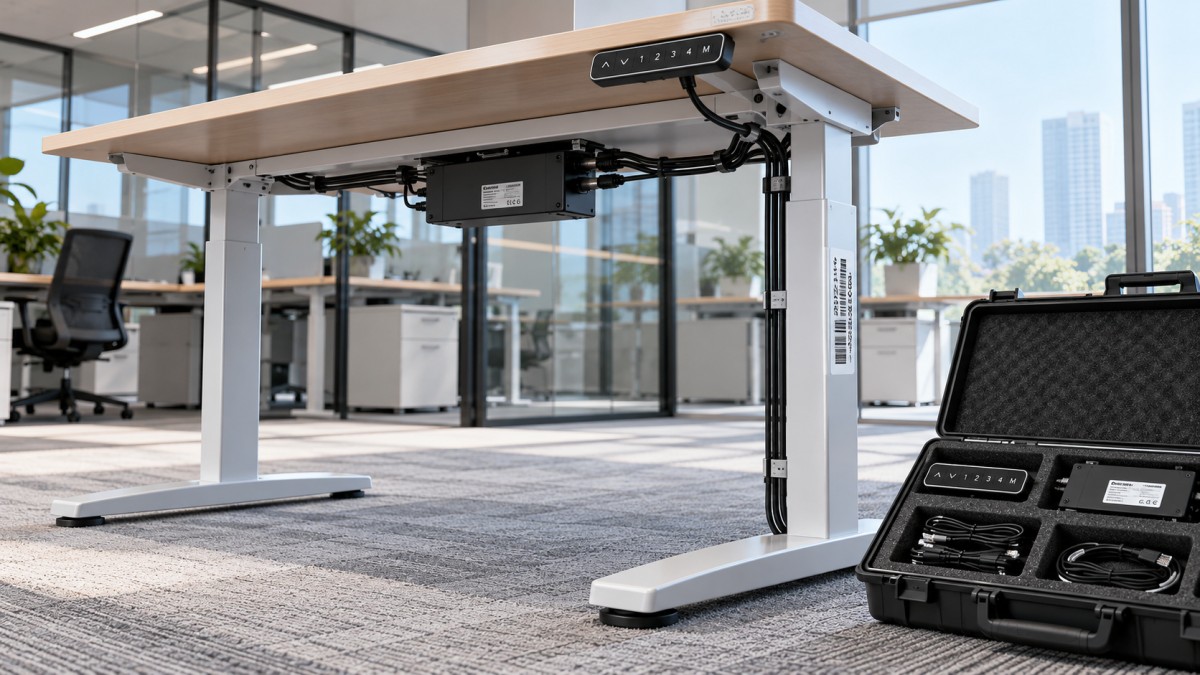
Then test the handoff between organizations. If the dealer, furniture manufacturer, and software provider each own part of the system, one party must retain responsibility for progressing the ticket. Requiring a new ticket at every handoff creates delay and makes service performance difficult to measure.
Translate response promises into restoration commitments
A fast acknowledgment says little about how long a workstation will remain unavailable. Support agreements should separate initial response, technical diagnosis, dispatch, attendance, and restoration. Each milestone needs a defined starting point and an explanation of what pauses the clock.
Use the operating hours of the offices to assess coverage. A support desk working in one time zone may leave another location without assistance during part of its working day. Clarify holiday calendars, after-hours access, language availability, and whether urgent service carries additional charges.
Severity definitions should reflect operational impact. A dashboard reporting delay and a desk with unsafe movement require different handling. For a widespread outage, establish whether the supplier opens one coordinated incident or treats every affected workstation as an unrelated ticket.
Examine spare parts at the component level
A warehouse address is insufficient evidence of parts readiness. Request an inventory view for the proposed configuration, covering serviceable items such as handsets, control boxes, power supplies, connection cables, lifting columns, sensors, and gateways. Separate stock held within the destination country from stock that requires cross-border shipment.
Compatibility deserves particular attention. Similar-looking connectors do not establish that a replacement controller will work with an installed motor or handset. Ask how the supplier links serial numbers, hardware revisions, and firmware versions to approved replacements. Where a component change requires a matched set, the quotation and support documentation should identify that dependency.
Inventory information also needs context. Stock shared across many customers can disappear during a widespread failure. Establish how critical parts are replenished, whether project stock can be reserved, and how shortages are communicated. A locally stored part has limited value if no authorized technician is available to install it.
For cross-border repairs, identify who handles freight, customs documentation, taxes, and defective-part returns. Warranty approval and shipment release are separate events. The agreement should make clear whether a replacement ships before the failed component is returned and who bears the cost of an incorrect diagnosis.
Obsolescence provisions affect long-term repairability. Request the supplier’s process for discontinuation notices, replacement compatibility, and any final ordering opportunity. A generic statement that spare parts will remain available is weak unless it defines the covered components and the applicable period.
Read the warranty as a repair-cost allocation
Warranty duration alone is a poor comparison metric. The frame, lifting mechanism, electronics, sensors, and software subscription may have different coverage. Build the comparison around the installed system and identify which costs remain payable when each component fails.
A useful warranty schedule addresses:
- Labor and access: responsibility for diagnosis, removal, replacement, reassembly, and any building access arrangements.
- Freight: outbound replacements, return shipments, and cross-border costs should be addressed explicitly.
- Service ownership after a dealer change: the route for a claim must remain clear if the original installer stops representing the supplier.
- Recurring faults: establish what triggers further investigation or assembly replacement when repeated component swaps fail to resolve the underlying problem.
Review exclusions against expected office conditions. Desk relocation, third-party cable management, cleaning practices, and connected accessories can become disputed causes of failure. Ask the supplier to explain the evidence needed to apply an exclusion. Broad wording that voids coverage after any modification creates uncertainty in offices that regularly reconfigure workstations.
Confirm who is contractually responsible for warranty performance. If the sales contract, product warranty, and service agreement name different entities, document how a claim moves between them and which entity remains accountable for completion.
Assess software support separately from furniture repair
Connected furniture introduces support dependencies beyond mechanical reliability. Establish which functions continue when internet access, a gateway, or a cloud service is unavailable. Local height adjustment, stored preferences, booking functions, and occupancy reporting should be assessed individually against the proposed architecture.
A demonstration should include loss and restoration of connectivity. Observe whether devices reconnect automatically, whether settings survive, and whether the dashboard clearly distinguishes an empty workspace from a sensor that has stopped reporting. Missing data should not silently become evidence that a desk is unoccupied.
Define responsibility for network onboarding before installation. Required network access, device credentials, firewall changes, and remote-support permissions need an agreed owner. If support depends on remote access that the office’s security policy prohibits, the supplier must provide an acceptable alternative diagnostic process.
Software maintenance terms should state how updates are announced, tested, deployed, and reversed when a release causes problems. Confirm whether firmware changes require an on-site visit or affect compatibility with stocked replacement components. Maintenance windows should account for the locations involved.
Also establish the support period for the connected service and what happens at subscription expiry or contract termination. Specify the available data export, administrator handover, account closure, and retained furniture functionality. These terms determine whether a future software change creates a physical replacement problem.
Use a pilot to test the support organization
A showroom demonstration establishes limited evidence about field service. A pilot at a representative office exposes site access restrictions, network approval delays, asset-labeling problems, and gaps between installation and ongoing support.
Agree on safe service exercises before the pilot begins. Examples include reporting an approved simulated fault, requesting a replacement for a designated serviceable component, and escalating a ticket that crosses the hardware-software boundary. Avoid deliberately creating electrical or mechanical hazards.
Record the elapsed time and the work required internally: repeated explanations, photographs, approvals, access coordination, and follow-up calls. A repair completed within the stated service window can still impose excessive administrative effort. Ticket records should show who owned each stage and why any delay occurred.
Use the pilot to validate documentation as well. The delivered asset register should connect each workstation to its location, model, serial number, relevant component revisions, and warranty record. Missing records at handover make later diagnosis and replacement ordering harder.
Make the selection conditional on verifiable commitments
Compare suppliers using the same locations, failure scenarios, and contract assumptions. Keep demonstrated performance separate from written commitments and unsupported statements. A polished support presentation should carry little weight where the underlying service organization or parts arrangement remains unverified.
Set minimum acceptance conditions before weighting convenience or price. These might include confirmed coverage at every planned site, an accountable escalation owner, a workable replacement-parts route, and acceptable operation during a software outage. Strong performance in one area should not conceal a gap that leaves an office without a repair path.
Attach the accepted coverage schedule, service definitions, parts commitments, and software responsibilities to the contract. At handover, require the asset register, approved troubleshooting instructions, support contacts, and unresolved issue log. The practical test is whether a fault can move from report to restoration using documented arrangements, without depending on a particular salesperson’s intervention.
News Recommendations
 How do packaging customization options affect minimum order quantities in Europe?
![51a6ab95581761cc26f4318be6520c15]()
Aris Katos
Future of Carbide Coatings
 Transom to Acquire Cree LED in Commercial Lighting Ownership Change
![51a6ab95581761cc26f4318be6520c15]()
Aris Katos
Future of Carbide Coatings
 How to plan customer flow in commercial design planning
![51a6ab95581761cc26f4318be6520c15]()
Aris Katos
Future of Carbide Coatings
 USTR Urged to Permanently Suspend Fees on China-Linked Ships
![51a6ab95581761cc26f4318be6520c15]()
Aris Katos
Future of Carbide Coatings
 How to choose comparable stores for retail benchmarking
![51a6ab95581761cc26f4318be6520c15]()
Aris Katos
Future of Carbide Coatings
 How does anchoring affect modular building wind load resistance?
![51a6ab95581761cc26f4318be6520c15]()
Aris Katos
Future of Carbide Coatings
 Amazon Raises European FBA Surcharge to 2% in Ten Markets From November 2
![51a6ab95581761cc26f4318be6520c15]()
Aris Katos
Future of Carbide Coatings
 How to verify a BPA-free test report for baby products
![51a6ab95581761cc26f4318be6520c15]()
Aris Katos
Future of Carbide Coatings
 China's Mandatory Classroom Lighting Standard GB 7793-2025 Takes Effect November 1
![51a6ab95581761cc26f4318be6520c15]()
Aris Katos
Future of Carbide Coatings
 How order volume affects the price of wholesale poly mailers
![51a6ab95581761cc26f4318be6520c15]()
Aris Katos
Future of Carbide Coatings
 US Imposes 50% Tariff on Certain Canadian PET Resin Imports
![51a6ab95581761cc26f4318be6520c15]()
Aris Katos
Future of Carbide Coatings
 How to read the maximum ratings in a semiconductor datasheet
![51a6ab95581761cc26f4318be6520c15]()
Aris Katos
Future of Carbide Coatings
 University of Maryland Develops Bio-Based Packaging to Extend Avocado and Cucumber Shelf Life
![51a6ab95581761cc26f4318be6520c15]()
Aris Katos
Future of Carbide Coatings
 How to verify a cookware manufacturer's induction compatibility claims
![51a6ab95581761cc26f4318be6520c15]()
Aris Katos
Future of Carbide Coatings
 Omdia Forecasts 11.6% Annual Growth in LED Display Revenue Through 2030
![51a6ab95581761cc26f4318be6520c15]()
Aris Katos
Future of Carbide Coatings
 How to verify a pulp molding packaging factory's production capacity
![51a6ab95581761cc26f4318be6520c15]()
Aris Katos
Future of Carbide Coatings
 Curion Survey: Half of Consumers Frustrated by Sustainable Packaging
![51a6ab95581761cc26f4318be6520c15]()
Aris Katos
Future of Carbide Coatings
 How to assess the credibility of market insight content
![51a6ab95581761cc26f4318be6520c15]()
Aris Katos
Future of Carbide Coatings
 US Removes 50% Additional Tariff on Selected Canadian Packaging Products
![51a6ab95581761cc26f4318be6520c15]()
Aris Katos
Future of Carbide Coatings
 Will a waterproof dimmable LED driver work with your existing dimmer?
![51a6ab95581761cc26f4318be6520c15]()
Aris Katos
Future of Carbide Coatings
 Charter Next Generation Raises Film PCR Use 30%, Advances Food-Grade Applications
![51a6ab95581761cc26f4318be6520c15]()
Aris Katos
Future of Carbide Coatings
 How to choose a dog harness and leash for a dog that pulls hard
![51a6ab95581761cc26f4318be6520c15]()
Aris Katos
Future of Carbide Coatings
 How to respect local customs when negotiating with overseas suppliers
![51a6ab95581761cc26f4318be6520c15]()
Aris Katos
Future of Carbide Coatings
 RFID Recycling Challenges Bring Paper-Based and Chipless Tags Into Focus
![51a6ab95581761cc26f4318be6520c15]()
Aris Katos
Future of Carbide Coatings
 How to choose commercial lighting for offices that reduces glare
![51a6ab95581761cc26f4318be6520c15]()
Aris Katos
Future of Carbide Coatings
 Queue Launches Fully Automated Robotic Pharmacy Kiosk for 30-Second Dispensing
![51a6ab95581761cc26f4318be6520c15]()
Aris Katos
Future of Carbide Coatings
 Can your supermarket store fixtures supplier meet your opening date?
![51a6ab95581761cc26f4318be6520c15]()
Aris Katos
Future of Carbide Coatings
 Shopify POS UI Extensions 2026-10 Adds Virtual Lists and Custom Row Templates
![51a6ab95581761cc26f4318be6520c15]()
Aris Katos
Future of Carbide Coatings
 How to assess smart office furniture suppliers’ North American support
![51a6ab95581761cc26f4318be6520c15]()
Aris Katos
Future of Carbide Coatings
 Aqara Launches Smart Lighting Range to Advance AI Spatial Intelligence
![51a6ab95581761cc26f4318be6520c15]()
Aris Katos
Future of Carbide Coatings
 How to assess demand forecasts in a lighting intelligence report
![51a6ab95581761cc26f4318be6520c15]()
Aris Katos
Future of Carbide Coatings
 Billerud推出PharmaKraft纤维基医药包装材料
![51a6ab95581761cc26f4318be6520c15]()
Aris Katos
Future of Carbide Coatings
 How to assess supplier reliability in global supply chain sourcing
![51a6ab95581761cc26f4318be6520c15]()
Aris Katos
Future of Carbide Coatings
 Omdia Forecasts 11.6% CAGR for Global LED Video Display Market in 2026–2030
![51a6ab95581761cc26f4318be6520c15]()
Aris Katos
Future of Carbide Coatings
 How to verify an LFGB testing laboratory's accreditation scope
![51a6ab95581761cc26f4318be6520c15]()
Aris Katos
Future of Carbide Coatings
 How to assess a workplace interior supplier's installation scope
![51a6ab95581761cc26f4318be6520c15]()
Aris Katos
Future of Carbide Coatings
 What records are needed for an ISO 9001 furniture factory audit?
![51a6ab95581761cc26f4318be6520c15]()
Aris Katos
Future of Carbide Coatings
 How to choose AI marketing tools that work with your existing CRM
![51a6ab95581761cc26f4318be6520c15]()
Aris Katos
Future of Carbide Coatings
 Do freight costs erase savings when buying retail fixtures wholesale?
![51a6ab95581761cc26f4318be6520c15]()
Aris Katos
Future of Carbide Coatings







































