
How to verify an LFGB testing laboratory's accreditation scope
Time
Click Count
A laboratory’s accreditation certificate does not automatically cover every test needed for German food-contact compliance. For technical evaluators, verifying an LFGB testing laboratory means checking whether its current ISO/IEC 17025 accreditation scope covers the relevant materials, test methods, and testing location—not simply accepting an accreditation logo.
This distinction matters when sourcing consumer products, food-service equipment, or packaging across borders. A quotation may bundle migration testing, sensory assessment, and chemical screening under “LFGB testing,” even though only some activities fall within the laboratory’s accredited scope. The following checks help you identify those gaps before commissioning work.
Understand what “LFGB testing” actually describes
The German Food and Feed Code, commonly abbreviated as LFGB, is legislation—not a single laboratory test method or a stand-alone laboratory accreditation scheme. For food-contact products, the assessment may also involve applicable EU legislation, material-specific measures, and relevant technical recommendations.
For example, a plastic food-contact article may require consideration of Regulation (EC) No 1935/2004 and Regulation (EU) No 10/2011, as amended. Silicone or rubber articles may require a different assessment approach, potentially drawing on relevant German Federal Institute for Risk Assessment (BfR) recommendations. Those recommendations are not themselves legislation, and their applicability must be evaluated for the product concerned.
Consequently, the question is not simply, “Is this laboratory LFGB accredited?” A more useful question is:
Does this laboratory hold valid ISO/IEC 17025 accreditation for the specific testing activities, materials, and location proposed for our product?
Accreditation supports confidence in competence for defined activities. It does not automatically establish that the proposed test program is complete or that the finished product complies with every applicable requirement.
Start with the product, not the certificate
Before reviewing laboratory credentials, prepare a short product-and-use profile. Without it, even an authentic scope document can be difficult to interpret.
- Construction: Identify each food-contact material, including coatings, seals, inks, adhesives, and multilayer structures where relevant.
- Contact conditions: Define food types, contact duration, temperature, repeated use, and foreseeable cleaning conditions.
- Market: Confirm Germany as a destination and identify any additional markets or customer specifications.
- Assessment needs: Establish the migration, substance-specific, sensory, or other testing proposed, together with any supporting documentation review.
A reusable beverage container illustrates why this matters. Its plastic lid, silicone gasket, metal body, and decorative coating may need different assessment routes. A laboratory accredited for migration testing on plastics is not necessarily accredited for every test proposed for the assembled container.
Verify an LFGB testing laboratory through the accreditation body
Match the legal entity and testing site
Request the laboratory’s full legal name, accreditation number, testing address, certificate, and complete scope annex. Compare these details with the quotation and the entity that will issue the report.
A multinational testing group may operate several laboratories under similar branding. Accreditation held by one site does not automatically extend to another. Likewise, a sales office may arrange testing without performing it.
Ask directly: “Which facility will perform each test, and under whose accreditation will the results be reported?” This often exposes ambiguity before technical review becomes time-consuming.
Check the official directory independently
Use the accreditation body’s official directory rather than relying solely on a certificate supplied by the laboratory. For German-accredited facilities, consult DAkkS records. For facilities elsewhere, check the relevant national or regional accreditation body.
Confirm the accreditation number, legal entity, applicable standard, current status, and scope documents. Check for limitations, suspension, withdrawal, or reductions affecting the required activities. Review dates carefully, but do not assume every accreditation system uses the same certificate-expiry format.
For cross-border work, also check whether the accreditation body is an ILAC Mutual Recognition Arrangement signatory for testing. This supports international recognition of accredited results; it does not guarantee acceptance by every regulator, retailer, or customer.
Retrieve the scope, not just the certificate
The certificate establishes the accreditation relationship. The scope identifies the testing activities covered. Save the current scope and record when it was checked.
If the directory and the laboratory’s supplied documents differ, request clarification before placing the order. An unexplained mismatch should remain an open issue—not something resolved by a reassuring logo.
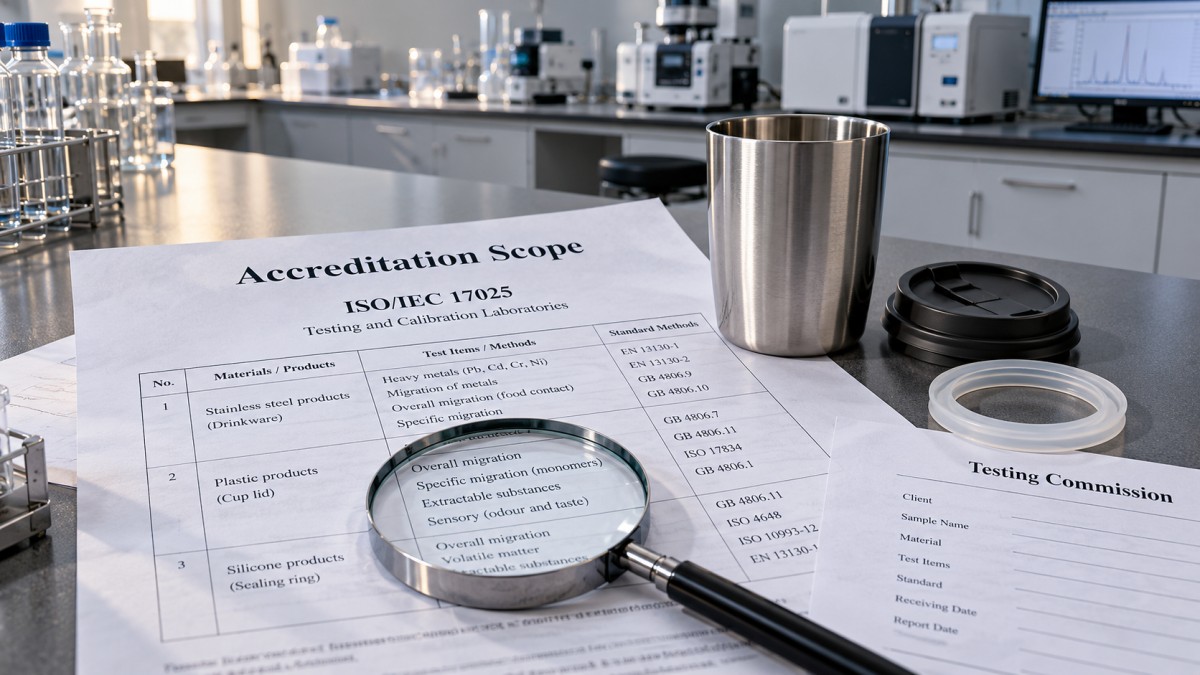
Read the scope as a technical matching exercise
Do not search only for the word “LFGB.” Relevant accredited activities may be listed under food-contact materials, chemical testing, plastics, consumer products, or specific analytical methods. Conversely, broad references to consumer-product testing do not prove coverage of your test plan.
Keep overall migration and specific migration separate. Evidence of accreditation for one does not establish coverage of the other. Similarly, accreditation for determining an element or substance in one matrix does not necessarily cover its migration from a finished article into a food simulant.
Sensory testing deserves its own line in the review. A laboratory may have extensive accredited chemical capabilities while offering a proposed odor or taste assessment outside accreditation.
When the method number does not match exactly
A different method reference is not automatically disqualifying. Laboratories may use validated in-house procedures, updated standard editions, or activities managed within an authorized flexible scope. However, a claim that two methods are “equivalent” needs a technical explanation.
Ask how the proposed method connects to the accredited scope and whether the laboratory has verified or validated it for the relevant material, analyte, and intended application. An evaluator does not necessarily need the laboratory’s complete validation dossier, but should obtain enough evidence to understand the claim.
Handle flexible scopes without accepting vague assurances
Some accreditation bodies permit flexible scopes that allow defined changes within an approved framework. Depending on the arrangement, the laboratory may introduce or update methods without each change first appearing individually in the published annex.
This is not unlimited permission to describe any test as accredited. The flexibility has boundaries, and the laboratory must follow its approved process for implementing changes.
If a proposed activity is not explicitly visible in the published scope, request:
- The scope entry and flexibility provision being relied upon.
- The laboratory’s current controlled list of activities covered under that provision.
- Written confirmation that the proposed method and material application fall within those boundaries.
- Confirmation that the activity has been authorized internally before testing begins.
If uncertainty remains, seek clarification from the accreditation body. Treat an unresolved scope interpretation as a procurement hold point rather than assuming the final report will settle it.
Make the quotation reveal the accreditation boundaries
A quotation headed “LFGB package” is too broad for technical approval. Request a test-by-test breakdown showing the method, material, performing site, accreditation status, and intended reporting basis.
For each activity, the laboratory should distinguish among testing performed within its accredited scope, testing performed outside that scope, and testing assigned to an external provider.
Non-accredited testing is not automatically invalid. A specialized or emerging assessment may have a legitimate technical basis without accredited coverage. The decision should depend on applicable obligations, customer requirements, risk, and the supporting evidence—not on an assumption that every result carries the same assurance.
Where subcontracting is proposed, verify the actual provider’s relevant scope rather than relying on the contracting laboratory’s credentials. Agree how externally provided results will be identified and whether supporting reports will be available.
A useful written request is:
For each quoted test, please identify the performing legal entity and site, method reference, applicable scope entry, and whether the result will be reported as accredited. Please identify any externally provided testing and any limitations affecting the proposed application.
Check whether accredited testing will answer your decision
Scope verification establishes an important boundary, but it does not replace review of the test design. An accredited method used under inappropriate exposure conditions may still fail to answer the product-compliance question.
Discuss food simulants, exposure time and temperature, specimen preparation, and repeated-use conditions where applicable. Confirm how different components, colors, coatings, and formulations will be represented. For multi-supplier procurement, document the rationale for any worst-case sample selection rather than assuming one sample represents an entire range.
Where a substance limit applies, ask whether the method’s reporting capability is suitable for evaluating that limit. If the laboratory will issue a pass/fail statement, agree the specification and decision rule, including how measurement uncertainty is considered where relevant.
For sourcing teams managing food-service products or sustainable packaging, this connection between scope and test design is crucial. A change in material composition or intended use can make an earlier test program unsuitable, even when the same laboratory remains accredited.
Approve the laboratory with a traceable evidence file
Before commissioning work, retain a compact review file containing the product profile, official accreditation-directory record, current scope, test-by-test mapping, approved quotation, and written clarification of gaps. This is more useful during a supplier review than a certificate saved without context.
Use three practical outcomes:
- Approve: Required activities are clearly covered, and the proposed test conditions address the intended use.
- Approve with conditions: Identified gaps are acceptable under the applicable requirements and are documented, with separate arrangements where needed.
- Hold or reject: The site, scope coverage, external provider, or reporting status cannot be verified.
Repeat the relevant checks when the testing location, method, material, product use, or accreditation status changes. On receipt of the report, reconcile it against the approved plan: confirm the performing laboratory, methods, sample descriptions, accreditation markings, and any exclusions or externally provided results.
The strongest LFGB testing laboratory choice is not necessarily the provider with the broadest package description. It is the one whose credentials, scope, test design, and reporting boundaries can be traced clearly to your product. That traceability gives technical evaluators a defensible basis for approval—and fewer unanswered questions when the results arrive.
News Recommendations
 How to verify Zigbee compatibility when sourcing lighting sensors
![51a6ab95581761cc26f4318be6520c15]()
Aris Katos
Future of Carbide Coatings
 How do packaging customization options affect minimum order quantities in Europe?
![51a6ab95581761cc26f4318be6520c15]()
Aris Katos
Future of Carbide Coatings
 Transom to Acquire Cree LED in Commercial Lighting Ownership Change
![51a6ab95581761cc26f4318be6520c15]()
Aris Katos
Future of Carbide Coatings
 How to plan customer flow in commercial design planning
![51a6ab95581761cc26f4318be6520c15]()
Aris Katos
Future of Carbide Coatings
 USTR Urged to Permanently Suspend Fees on China-Linked Ships
![51a6ab95581761cc26f4318be6520c15]()
Aris Katos
Future of Carbide Coatings
 How to choose comparable stores for retail benchmarking
![51a6ab95581761cc26f4318be6520c15]()
Aris Katos
Future of Carbide Coatings
 How does anchoring affect modular building wind load resistance?
![51a6ab95581761cc26f4318be6520c15]()
Aris Katos
Future of Carbide Coatings
 Amazon Raises European FBA Surcharge to 2% in Ten Markets From November 2
![51a6ab95581761cc26f4318be6520c15]()
Aris Katos
Future of Carbide Coatings
 How to verify a BPA-free test report for baby products
![51a6ab95581761cc26f4318be6520c15]()
Aris Katos
Future of Carbide Coatings
 China's Mandatory Classroom Lighting Standard GB 7793-2025 Takes Effect November 1
![51a6ab95581761cc26f4318be6520c15]()
Aris Katos
Future of Carbide Coatings
 How order volume affects the price of wholesale poly mailers
![51a6ab95581761cc26f4318be6520c15]()
Aris Katos
Future of Carbide Coatings
 US Imposes 50% Tariff on Certain Canadian PET Resin Imports
![51a6ab95581761cc26f4318be6520c15]()
Aris Katos
Future of Carbide Coatings
 How to read the maximum ratings in a semiconductor datasheet
![51a6ab95581761cc26f4318be6520c15]()
Aris Katos
Future of Carbide Coatings
 University of Maryland Develops Bio-Based Packaging to Extend Avocado and Cucumber Shelf Life
![51a6ab95581761cc26f4318be6520c15]()
Aris Katos
Future of Carbide Coatings
 How to verify a cookware manufacturer's induction compatibility claims
![51a6ab95581761cc26f4318be6520c15]()
Aris Katos
Future of Carbide Coatings
 Omdia Forecasts 11.6% Annual Growth in LED Display Revenue Through 2030
![51a6ab95581761cc26f4318be6520c15]()
Aris Katos
Future of Carbide Coatings
 How to verify a pulp molding packaging factory's production capacity
![51a6ab95581761cc26f4318be6520c15]()
Aris Katos
Future of Carbide Coatings
 Curion Survey: Half of Consumers Frustrated by Sustainable Packaging
![51a6ab95581761cc26f4318be6520c15]()
Aris Katos
Future of Carbide Coatings
 How to assess the credibility of market insight content
![51a6ab95581761cc26f4318be6520c15]()
Aris Katos
Future of Carbide Coatings
 US Removes 50% Additional Tariff on Selected Canadian Packaging Products
![51a6ab95581761cc26f4318be6520c15]()
Aris Katos
Future of Carbide Coatings
 Will a waterproof dimmable LED driver work with your existing dimmer?
![51a6ab95581761cc26f4318be6520c15]()
Aris Katos
Future of Carbide Coatings
 Charter Next Generation Raises Film PCR Use 30%, Advances Food-Grade Applications
![51a6ab95581761cc26f4318be6520c15]()
Aris Katos
Future of Carbide Coatings
 How to choose a dog harness and leash for a dog that pulls hard
![51a6ab95581761cc26f4318be6520c15]()
Aris Katos
Future of Carbide Coatings
 How to respect local customs when negotiating with overseas suppliers
![51a6ab95581761cc26f4318be6520c15]()
Aris Katos
Future of Carbide Coatings
 RFID Recycling Challenges Bring Paper-Based and Chipless Tags Into Focus
![51a6ab95581761cc26f4318be6520c15]()
Aris Katos
Future of Carbide Coatings
 How to choose commercial lighting for offices that reduces glare
![51a6ab95581761cc26f4318be6520c15]()
Aris Katos
Future of Carbide Coatings
 Queue Launches Fully Automated Robotic Pharmacy Kiosk for 30-Second Dispensing
![51a6ab95581761cc26f4318be6520c15]()
Aris Katos
Future of Carbide Coatings
 Can your supermarket store fixtures supplier meet your opening date?
![51a6ab95581761cc26f4318be6520c15]()
Aris Katos
Future of Carbide Coatings
 Shopify POS UI Extensions 2026-10 Adds Virtual Lists and Custom Row Templates
![51a6ab95581761cc26f4318be6520c15]()
Aris Katos
Future of Carbide Coatings
 How to assess smart office furniture suppliers’ North American support
![51a6ab95581761cc26f4318be6520c15]()
Aris Katos
Future of Carbide Coatings
 Aqara Launches Smart Lighting Range to Advance AI Spatial Intelligence
![51a6ab95581761cc26f4318be6520c15]()
Aris Katos
Future of Carbide Coatings
 How to assess demand forecasts in a lighting intelligence report
![51a6ab95581761cc26f4318be6520c15]()
Aris Katos
Future of Carbide Coatings
 Billerud推出PharmaKraft纤维基医药包装材料
![51a6ab95581761cc26f4318be6520c15]()
Aris Katos
Future of Carbide Coatings
 How to assess supplier reliability in global supply chain sourcing
![51a6ab95581761cc26f4318be6520c15]()
Aris Katos
Future of Carbide Coatings
 Omdia Forecasts 11.6% CAGR for Global LED Video Display Market in 2026–2030
![51a6ab95581761cc26f4318be6520c15]()
Aris Katos
Future of Carbide Coatings
 How to verify an LFGB testing laboratory's accreditation scope
![51a6ab95581761cc26f4318be6520c15]()
Aris Katos
Future of Carbide Coatings
 How to assess a workplace interior supplier's installation scope
![51a6ab95581761cc26f4318be6520c15]()
Aris Katos
Future of Carbide Coatings
 What records are needed for an ISO 9001 furniture factory audit?
![51a6ab95581761cc26f4318be6520c15]()
Aris Katos
Future of Carbide Coatings
 How to choose AI marketing tools that work with your existing CRM
![51a6ab95581761cc26f4318be6520c15]()
Aris Katos
Future of Carbide Coatings







































