How to Compare Retail Fixtures Manufacturers
Time
Click Count
Choosing among retail fixtures manufacturers can directly impact store efficiency, brand presentation, and long-term procurement costs. For sourcing professionals, the challenge is not only comparing price, but also evaluating engineering quality, customization capability, compliance standards, and delivery reliability. This guide explains how to assess manufacturers with a strategic lens, helping buyers make informed decisions for scalable and high-performance retail environments.
In modern retail development, fixtures are no longer simple display supports. They influence shopper flow, replenishment speed, visual consistency, maintenance frequency, and installation efficiency across 10, 50, or even 500 locations. For procurement teams working across borders, the right supplier comparison method reduces hidden costs and protects rollout schedules.
For buyers using intelligence platforms such as G-BCE, the goal is to compare retail fixtures manufacturers beyond quotations. A stronger evaluation framework connects factory capability with store design intent, compliance expectations, and long-term operating performance in global commercial environments.
Define What You Need Before Contacting Retail Fixtures Manufacturers
Many sourcing issues begin before the first RFQ is sent. If specifications are vague, even experienced retail fixtures manufacturers cannot quote accurately. That often leads to 8%–15% variation in final landed cost after engineering changes, packaging revisions, or installation adjustments.
A disciplined brief should cover store format, fixture categories, load requirements, finish standards, rollout volume, and installation method. Buyers managing chain programs usually separate needs into 3 levels: prototype, pilot rollout, and mass deployment. Each level has different tolerance for lead time, MOQ, and engineering revision.
Start with the Operating Scenario
A boutique cosmetics store, a grocery endcap, and an electronics experience zone require different fixture logic. Gondola shelving may need 80–150 kg per level, while premium brand wall bays may prioritize finish consistency within a narrow visual tolerance. Scenario clarity helps compare suppliers on relevant strengths instead of generic claims.
- Store type: flagship, mall shop, pop-up, supermarket, pharmacy, showroom
- Fixture type: shelving, cash wrap, wall display, island unit, backroom storage, branded kiosk
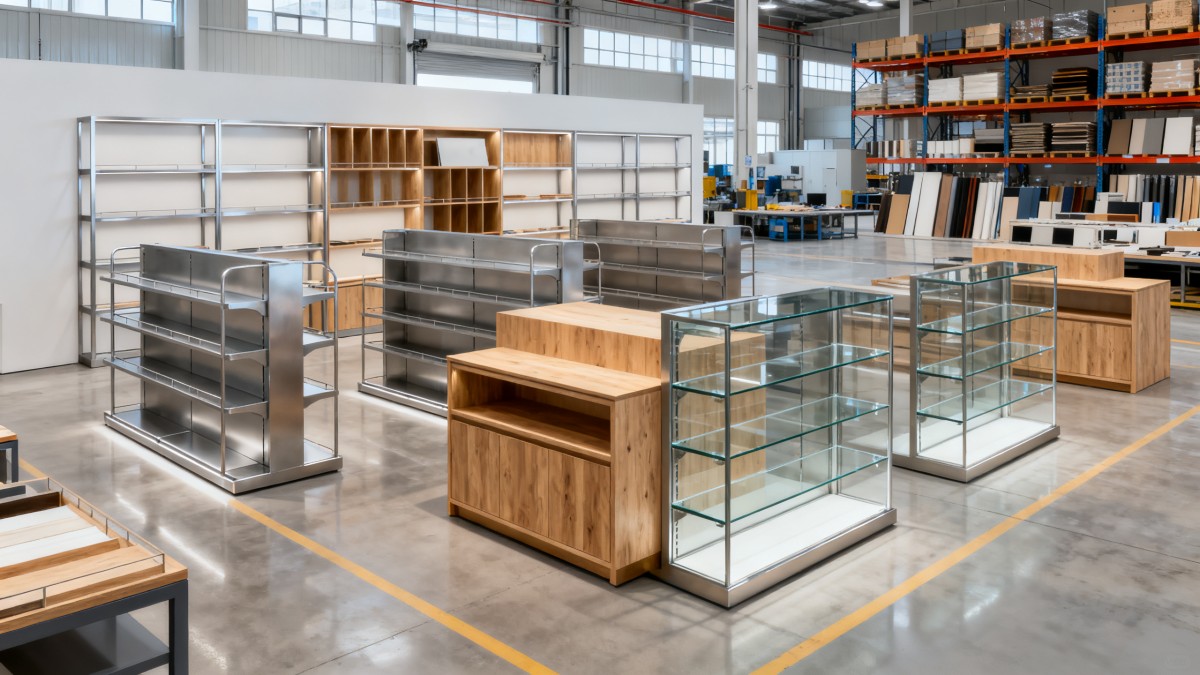
- Material mix: powder-coated steel, MDF, solid wood veneer, acrylic, glass, aluminum
- Deployment scale: 1 sample store, 20 pilot stores, or 200-store rollout
- Installation model: local contractor assembly or pre-assembled shipment
Build a Practical Comparison Matrix
Before reviewing suppliers, create a weighted scorecard. In many B2B procurement teams, a 100-point model works well because it forces trade-offs. Price may account for 20–30 points, but technical capability, lead time stability, and quality control often determine whether the project succeeds.
The following matrix can be used when comparing retail fixtures manufacturers for regional or international store programs.
This structure highlights a common procurement lesson: the cheapest quote may rank lower once revision speed, packing quality, and installation risk are measured. A supplier that saves 5% on unit price can still create a larger cost increase if replacement rates exceed 2%–3% during rollout.
Documents Buyers Should Request Early
To reduce comparison noise, request the same document set from all shortlisted retail fixtures manufacturers. This usually includes factory profile, process list, material library, QC checklist, sample photos, packing method, lead time chart, and references to standards they routinely work with.
- Product drawings or standard module catalog
- Material and finish specifications
- Prototype lead time, often 7–21 days depending on complexity
- Mass production lead time, often 4–10 weeks
- Quality checkpoints from fabrication to packing
- Export packaging details and carton labeling standards
Compare Manufacturing Capability, Materials, and Quality Control
The most reliable way to compare retail fixtures manufacturers is to look at how they build, not just what they promise. Two suppliers may show similar finished photos, yet their internal process discipline can differ sharply in welding consistency, edge treatment, hardware selection, and pre-shipment inspection.
Evaluate Multi-Material Production Strength
Retail fixtures often combine 3–5 materials in one unit. A manufacturer skilled only in metalwork may outsource wood or acrylic parts, creating coordination risk. Buyers should identify whether the supplier manages integrated production in-house or through a controlled vendor network with documented inspection standards.
This matters because mixed-material fixtures are vulnerable to alignment issues, color mismatch, and packaging damage. For example, an illuminated display with steel framing, tempered glass, and powder-coated shelves requires tighter sequencing than a simple wire rack. Even a 2 mm offset can be visible on premium branded displays.
Ask Process-Level Questions
Experienced procurement teams go deeper than factory size. They ask how many inspection gates are built into production, how non-conforming parts are isolated, and whether pilot assembly is done before bulk packing. These details reveal operational maturity far better than a broad statement about capacity.
- Are welds ground and visually checked before coating?
- Are wooden parts moisture-controlled before lamination or paint?
- Is hardware torque verified during trial assembly?
- Are carton corners reinforced for long-distance sea freight?
- Is a pre-shipment AQL or custom buyer checklist used?
The table below helps buyers compare process controls that directly affect quality, installation efficiency, and post-delivery claims.
A capable supplier should be able to explain these controls clearly within 1–2 review meetings. If responses remain vague, buyers should assume a higher risk of rework, shipment delay, or inconsistent output across batches.
Prototype Testing Should Not Be Skipped
For new store concepts or custom retail programs, a prototype phase is essential. It typically takes 1–3 weeks for fabrication and another few days for review. During this phase, buyers should validate dimensions, assembly logic, finish quality, merchandising fit, and packaging performance before approving bulk production.
Skipping this step may save time upfront, but it often increases downstream costs. A single untested fixture family repeated across 100 stores can multiply one design flaw into hundreds of field corrections.
Assess Commercial Reliability, Compliance, and Total Cost
Procurement decisions should not stop at manufacturing quality. Buyers also need to compare retail fixtures manufacturers on quote transparency, compliance readiness, shipping coordination, and after-sales response. These factors shape total cost of ownership over 12–36 months, not just the first invoice value.
Look Beyond Unit Price
A lower EXW price can be offset by higher tooling charges, more assembly labor on site, or poor packaging that increases damage claims. For chain rollouts, procurement teams should estimate total delivered cost per store, including freight, duties, installation time, spare parts, and replacement exposure.
As a working rule, compare at least 6 cost layers: product price, sample cost, tooling, packaging, logistics, and field service. This method reveals whether a supplier is truly efficient or simply shifting cost downstream.
Check Compliance and Market Fit
Not every project requires the same regulatory depth, but retail fixtures manufacturers serving global markets should understand common frameworks such as UL, CE, or BIFMA where relevant to materials, electrical integration, or furniture performance. Buyers should ask which standards are applicable and how conformity is documented.
This is especially important for illuminated displays, powered kiosks, adjustable workstation components, or fixtures installed in high-traffic commercial spaces. Documentation gaps can delay customs clearance, fit-out approval, or handover to the operating team.
Questions That Reveal Commercial Strength
- What is the standard response time for RFQ revisions: 24, 48, or 72 hours?
- Can the supplier support mixed-SKU shipments for 20–50 stores in one cycle?
- What is the spare parts policy for damaged or missing components?
- Is there a documented packaging spec for export routes over 25–35 days sea transit?
- How are engineering changes controlled after sample approval?
Review Delivery Planning and Service Support
On-time delivery is often the decisive factor in store opening programs. Buyers should compare production calendars, raw material readiness, booking coordination, and communication discipline. A supplier that updates progress weekly with photo evidence usually presents lower schedule risk than one relying on ad hoc messaging.
After-sales support also deserves a formal check. For large projects, ask whether replacement parts can ship within 7–10 days for urgent items and whether digital assembly instructions or video guidance are available for local installation teams.
A Practical Shortlisting Process for Procurement Teams
When the supplier market is crowded, a structured process helps buyers move faster without sacrificing rigor. A simple 5-step method works well for comparing retail fixtures manufacturers across both domestic and offshore sourcing channels.
Step 1: Pre-Qualify 5 to 8 Suppliers
Start with capability matching, not just online visibility. Review product categories, material range, export familiarity, and project scale. Eliminate suppliers that cannot show relevant fixture types or that rely heavily on outsourced production without clear coordination controls.
Step 2: Send a Standard RFQ Package
Use the same bill of materials, drawings, finish codes, quantity tiers, and target delivery window for every candidate. This improves quote comparability and reduces hidden assumptions. Include at least 2 quantity scenarios, such as 10-store pilot and 100-store rollout, to expose scale effects.
Step 3: Review Samples and Engineering Response
Samples are not only for visual approval. They show how quickly a supplier identifies weak points, suggests improvements, and documents revisions. A strong partner will often return a marked-up drawing package and value-engineering options within a few working days.
Step 4: Audit Commercial and Operational Fit
Compare payment terms, capacity windows, compliance habits, and communication quality. Buyers should also assess whether the supplier can align with digital procurement workflows, milestone reporting, and multi-country rollout coordination.
Step 5: Award a Pilot Order Before Full Rollout
A pilot order of limited volume gives real evidence on packing, documentation, and delivery discipline. It is often the safest way to validate one or two retail fixtures manufacturers before committing to a broader supply agreement.
Common Mistakes Buyers Should Avoid
- Approving production without a tested prototype
- Comparing quotes with inconsistent specifications
- Ignoring installation labor and replacement cost
- Assuming compliance applies only to electrical products
- Selecting a supplier without checking packing performance
Choosing among retail fixtures manufacturers is ultimately a risk-management decision as much as a sourcing decision. The best partner is not simply the one with a competitive quote, but the one that can translate design intent into repeatable quality, controlled lead times, and reliable store-level execution.
For procurement professionals, a stronger comparison framework should cover 4 core areas: technical capability, commercial transparency, compliance readiness, and service responsiveness. With the right evaluation process, buyers can reduce rework, improve rollout consistency, and protect brand presentation across every market.
If you are reviewing retail fixtures manufacturers for a new store concept, regional rollout, or global sourcing program, G-BCE can help you benchmark suppliers, clarify technical requirements, and identify solution-fit across commercial furniture, fixtures, and connected retail environments. Contact us today to discuss your project, request a tailored evaluation framework, or explore more sourcing intelligence solutions.
News Recommendations
 Commercial Environment Solutions Trends Shaping Sustainable Facilities
![51a6ab95581761cc26f4318be6520c15]()
Aris Katos
Future of Carbide Coatings
 Eco Promotional Gift Price Guide: What Affects Unit Cost in 2026
![51a6ab95581761cc26f4318be6520c15]()
Aris Katos
Future of Carbide Coatings
 Inventory Management Mistakes That Lead to Stockouts and Excess Stock
![51a6ab95581761cc26f4318be6520c15]()
Aris Katos
Future of Carbide Coatings
 How to Compare RFID Retail Inventory Systems by Accuracy and Setup Cost
![51a6ab95581761cc26f4318be6520c15]()
Aris Katos
Future of Carbide Coatings
 EMV Compliance Testing Checklist for New Payment Terminals
![51a6ab95581761cc26f4318be6520c15]()
Aris Katos
Future of Carbide Coatings
 Vietnam Rule Takes Effect on Biodegradable Pack Labels
![51a6ab95581761cc26f4318be6520c15]()
Aris Katos
Future of Carbide Coatings
 GSA Raises RFID Surcharge on Asia-Europe Shipping
![51a6ab95581761cc26f4318be6520c15]()
Aris Katos
Future of Carbide Coatings
 Saudi SASO Adds Local IoT Certification for Smart Lighting Controls
![51a6ab95581761cc26f4318be6520c15]()
Aris Katos
Future of Carbide Coatings
 France and Belgium Extend EPR to Retail Fixtures
![51a6ab95581761cc26f4318be6520c15]()
Aris Katos
Future of Carbide Coatings
 FDA Tightens Food Contact Testing for Kitchenware
![51a6ab95581761cc26f4318be6520c15]()
Aris Katos
Future of Carbide Coatings
![]() Retail Technology Standards for Signage: Common Compliance Gaps
Retail Technology Standards for Signage: Common Compliance Gaps![51a6ab95581761cc26f4318be6520c15]()
Aris Katos
Future of Carbide Coatings
![]() Mining Equipment Selection: Key Specs That Affect Uptime
Mining Equipment Selection: Key Specs That Affect Uptime![51a6ab95581761cc26f4318be6520c15]()
Aris Katos
Future of Carbide Coatings
![]() Choosing a Digital Signage Distributor for Multi-Site Rollouts
Choosing a Digital Signage Distributor for Multi-Site Rollouts![51a6ab95581761cc26f4318be6520c15]()
Aris Katos
Future of Carbide Coatings
![]() How to Compare Solar Trackers for Yield, Wind Load, and O&M
How to Compare Solar Trackers for Yield, Wind Load, and O&M![51a6ab95581761cc26f4318be6520c15]()
Aris Katos
Future of Carbide Coatings
![]() Carbon Capture Costs in 2026: What Changes Project Viability
Carbon Capture Costs in 2026: What Changes Project Viability![51a6ab95581761cc26f4318be6520c15]()
Aris Katos
Future of Carbide Coatings
![]() SABER Tightens PLA Biodegradability Path
SABER Tightens PLA Biodegradability Path![51a6ab95581761cc26f4318be6520c15]()
Aris Katos
Future of Carbide Coatings
![]() GSA Q3 Air Surcharge Lifts Digital Signage Freight 19%
GSA Q3 Air Surcharge Lifts Digital Signage Freight 19%![51a6ab95581761cc26f4318be6520c15]()
Aris Katos
Future of Carbide Coatings
![]() Vietnam Imposes AD Duties on China-Made POS and Kiosks
Vietnam Imposes AD Duties on China-Made POS and Kiosks![51a6ab95581761cc26f4318be6520c15]()
Aris Katos
Future of Carbide Coatings
![]() EN 14749:2026 Raises EU Fire Bar for Hospitality Furniture
EN 14749:2026 Raises EU Fire Bar for Hospitality Furniture![51a6ab95581761cc26f4318be6520c15]()
Aris Katos
Future of Carbide Coatings
![]() CPSC Recalls 123,840 Kitchen and Home Goods
CPSC Recalls 123,840 Kitchen and Home Goods![51a6ab95581761cc26f4318be6520c15]()
Aris Katos
Future of Carbide Coatings
 Sustainable Material Sourcing: How to Verify Supplier Claims
![51a6ab95581761cc26f4318be6520c15]()
Aris Katos
Future of Carbide Coatings
 Retail Technology Standards for Signage: What Matters in 2026
![51a6ab95581761cc26f4318be6520c15]()
Aris Katos
Future of Carbide Coatings
 Dust Collectors: Common Sizing Mistakes and How to Avoid Them
![51a6ab95581761cc26f4318be6520c15]()
Aris Katos
Future of Carbide Coatings
 Carbon Fiber vs Aluminum: What Changes Total Cost in Production
![51a6ab95581761cc26f4318be6520c15]()
Aris Katos
Future of Carbide Coatings
 Portable Oxygen Concentrators: Key Specs That Affect Daily Use
![51a6ab95581761cc26f4318be6520c15]()
Aris Katos
Future of Carbide Coatings
 Ocean Alliance Raises Air Surcharge 22% for POS Kiosks
![51a6ab95581761cc26f4318be6520c15]()
Aris Katos
Future of Carbide Coatings
 SASO AI Review Cuts Smart Lighting Certification Time
![51a6ab95581761cc26f4318be6520c15]()
Aris Katos
Future of Carbide Coatings
 RCEP Notice Adds Mandatory Stack Load Marking for E-commerce Packs
![51a6ab95581761cc26f4318be6520c15]()
Aris Katos
Future of Carbide Coatings
 EU Ecodesign Rule Takes Effect for Signage Energy APIs
![51a6ab95581761cc26f4318be6520c15]()
Aris Katos
Future of Carbide Coatings
 FDA Expands Migration Testing for Kitchenware Exports
![51a6ab95581761cc26f4318be6520c15]()
Aris Katos
Future of Carbide Coatings
 Programmable Pet Feeder Setup Tips for Reliable Daily Feeding
![51a6ab95581761cc26f4318be6520c15]()
Aris Katos
Future of Carbide Coatings
 Custom Retail Counters Factory Cost: What Drives the Quote
![51a6ab95581761cc26f4318be6520c15]()
Aris Katos
Future of Carbide Coatings
 CRM Systems: How to Compare Features Without Overbuying
![51a6ab95581761cc26f4318be6520c15]()
Aris Katos
Future of Carbide Coatings
 IC Packaging Application Explanations: Key Process Uses
![51a6ab95581761cc26f4318be6520c15]()
Aris Katos
Future of Carbide Coatings
 Welded Steel Support Frame Load Limits and Design Checks
![51a6ab95581761cc26f4318be6520c15]()
Aris Katos
Future of Carbide Coatings
 RCEP Upgrade Cuts Indonesia LED Duty to 0%
![51a6ab95581761cc26f4318be6520c15]()
Aris Katos
Future of Carbide Coatings
 Saudi SASO Tightens Biodegradable Materials Testing
![51a6ab95581761cc26f4318be6520c15]()
Aris Katos
Future of Carbide Coatings
 Vietnam Enforces QR Labels for Gifts Imports
![51a6ab95581761cc26f4318be6520c15]()
Aris Katos
Future of Carbide Coatings
 East Coast Port Strike Ends, Delays Still Widen
![51a6ab95581761cc26f4318be6520c15]()
Aris Katos
Future of Carbide Coatings