SASO AI Review Cuts Smart Lighting Certification Time
Time
Click Count
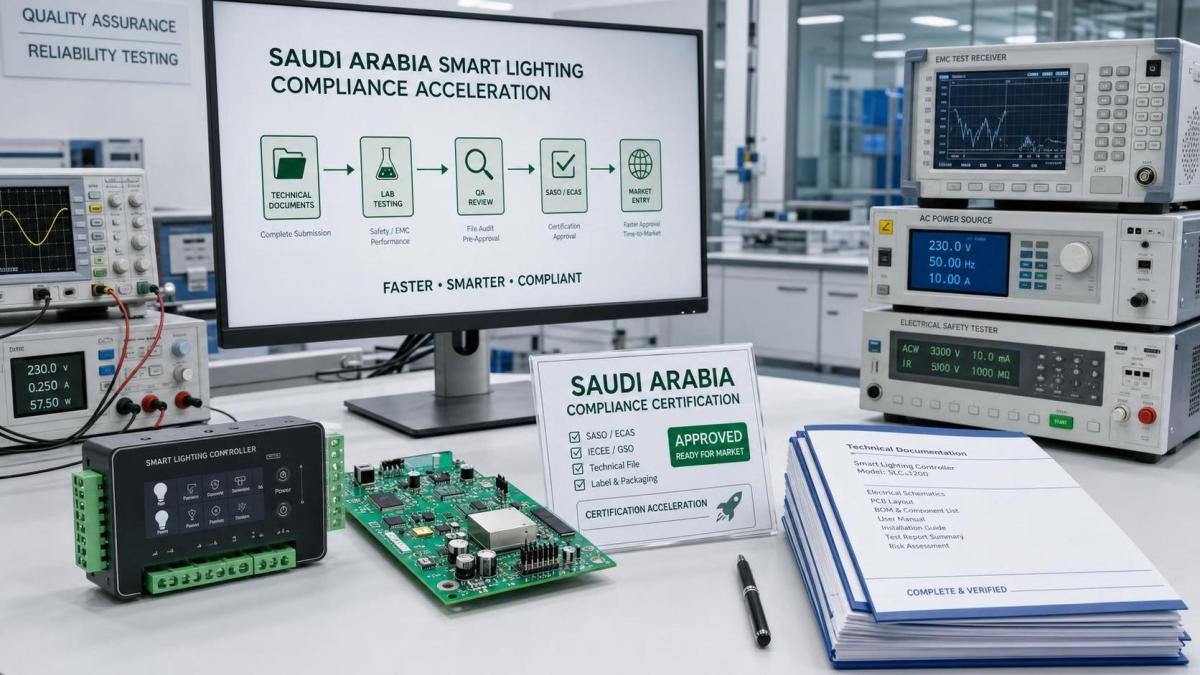
On July 5, 2026, the Saudi Standards, Metrology and Quality Organization (SASO) launched the SASO SmartCert AI platform and opened an automated compliance assessment channel for Smart Lighting Controls that meet IEC 62368-1, IEC 60598-1, and IEC 62722-2-1. For manufacturers, exporters, certification teams, sourcing units, and delivery planners involved in this product category, the development matters because it combines a much shorter certification timeline with stricter technical submission requirements and a mandatory pre-factory-audit condition.
What Has Been Confirmed So Far
According to the provided event information, SASO put the SmartCert AI platform into operation on July 5, 2026. The automated compliance review channel applies to Smart Lighting Controls products that conform to IEC 62368-1, IEC 60598-1, and IEC 62722-2-1.
After passing pre-screening, the average SASO certification cycle is shortened from 35 days to 9 working days. The submission package must include a complete BOM, PCB Gerber files, and firmware hash values. The process also requires a pre-audit factory inspection conducted by UL or TÜV Rheinland.
Where the Change May Be Felt First
Export programs and market-entry scheduling
From an industry perspective, exporters and brand owners targeting the Saudi market may feel the impact first in launch scheduling and shipment planning. A shorter certification window can improve timing for tenders, stocking decisions, and order allocation, but only where technical files are already organized to meet the new submission threshold. What deserves closer attention is that the time gain appears tied to successful pre-screening rather than to a blanket reduction for all applicants.
Engineering, documentation, and compliance preparation
Manufacturers and compliance teams may see the biggest operational change in document readiness. The requirement to provide a full BOM, PCB Gerber files, and firmware hash values shifts part of the certification burden toward deeper design-file preparation and version control. This can affect internal coordination between hardware engineering, firmware teams, regulatory staff, and external certification support providers.
Factory audit readiness in the approval chain
For suppliers and factories, the UL or TÜV Rheinland pre-factory-audit requirement may become a practical gating item. Analysis shows that even if the formal certification timeline is compressed, approval readiness may still depend on how quickly a site can meet this prerequisite and align supporting records with the product documents submitted for review.
Procurement and delivery coordination
Buyers, sourcing offices, and supply chain service providers may need to reassess lead-time assumptions. Observably, the certification cycle itself may become shorter, but procurement and delivery decisions will still depend on whether the supplier has already completed the required technical package and pre-audit steps. This means the compliance status of a supplier may matter earlier in purchasing decisions than before.
What Companies Should Watch in Practice
Check whether the product scope truly fits the AI review path
Companies should first verify that the Smart Lighting Controls products they plan to certify are actually prepared against the stated IEC 62368-1, IEC 60598-1, and IEC 62722-2-1 standards. The practical issue is not only standard reference, but whether the product file set is complete enough for the automated review route described in the event summary.
Rebuild submission files around traceability
Analysis shows that the new route places unusual weight on technical traceability. BOM completeness, PCB Gerber consistency, and firmware hash control are likely to matter not just as attachments, but as core compliance inputs. Companies involved in design outsourcing, contract manufacturing, or multi-version product management should pay close attention to document ownership and revision discipline.
Factor the pre-audit condition into delivery promises
Businesses making quotations or shipment commitments should account for the UL or TÜV Rheinland pre-factory-audit requirement as a prerequisite rather than assuming the 9-working-day timeline applies immediately in all cases. Where execution details are still limited, it is more appropriate to treat the shorter cycle as conditional on upstream readiness.
Monitor how the requirement is reflected in commercial documents
What deserves closer attention is whether customers, distributors, and project buyers begin reflecting these requirements in procurement files, technical specifications, supplier qualification checks, or delivery conditions. Even without additional official detail in the input, the combination of faster review and deeper file disclosure may influence how counterparties assess certification readiness.
Why This Looks Like an Execution Signal, Not Just a Process Update
Analysis shows that this development is not simply about speed. The combination of AI-based automated assessment, sharply reduced review time, expanded design-file disclosure, and a named pre-audit requirement suggests a change in how compliance readiness may be screened before market entry. It is more appropriate to understand this as an execution signal that rewards prepared applicants, while also raising the documentation threshold for those seeking faster approval.
At the same time, observably, the current information does not establish how broadly the route will be used across different filing scenarios, how strict the pre-screening gate will be in practice, or how consistently the documentation requirement will be interpreted in execution. Those points still require observation.
How the Market May Need to Read This Development
From an industry perspective, the most balanced reading is that SASO has introduced a faster certification path for eligible Smart Lighting Controls, but the shorter timeline should be understood together with tighter preparation demands. The practical implication is less about assuming universal acceleration and more about recognizing that certification speed may increasingly depend on technical transparency, audit readiness, and disciplined product documentation.
For now, this is better understood as a rule change with immediate operational relevance and with further execution details still worth watching. Companies involved in Saudi-bound smart lighting product flows should pay attention not only to the headline cycle reduction, but also to the upstream compliance work required to make that reduction achievable.
Basis of This Article and What Still Needs Verification
This article is based on the user-provided news title, event date, and event summary. For developments of this type, relevant source categories commonly include official notices, regulator publications, trade or customs authority information, industry association updates, standards documentation, and reporting by established professional media. A specific official source link was not provided in the input, so the underlying announcement and any supporting implementation text still need ongoing verification.
Further observation should focus on later official clarifications, certification execution criteria, document review practices, procurement-file changes, market feedback, and how companies implement the required BOM, PCB Gerber, firmware hash, and pre-audit conditions in actual certification workflows.
News Recommendations
 How to verify international standards compliance for Middle East exports
![51a6ab95581761cc26f4318be6520c15]()
Aris Katos
Future of Carbide Coatings
 How to select laboratory instruments for reproducible test results
![51a6ab95581761cc26f4318be6520c15]()
Aris Katos
Future of Carbide Coatings
 When does a sheet metal prototype reveal design flaws early?
![51a6ab95581761cc26f4318be6520c15]()
Aris Katos
Future of Carbide Coatings
 When PE air column bags reduce damage in e-commerce fulfillment
![51a6ab95581761cc26f4318be6520c15]()
Aris Katos
Future of Carbide Coatings
 How energy-efficient design reduces operating costs in retail lighting
![51a6ab95581761cc26f4318be6520c15]()
Aris Katos
Future of Carbide Coatings
 When commercial aluminum storefronts make sense for a retail renovation
![51a6ab95581761cc26f4318be6520c15]()
Aris Katos
Future of Carbide Coatings
 What makes LED lights durable in high-use commercial spaces?
![51a6ab95581761cc26f4318be6520c15]()
Aris Katos
Future of Carbide Coatings
 Which industry categories offer the strongest export potential in Latin America?
![51a6ab95581761cc26f4318be6520c15]()
Aris Katos
Future of Carbide Coatings
 How to choose an ultra bright waterproof window display for storefronts
![51a6ab95581761cc26f4318be6520c15]()
Aris Katos
Future of Carbide Coatings
 How to verify suppliers on a trade portal for global sourcing
![51a6ab95581761cc26f4318be6520c15]()
Aris Katos
Future of Carbide Coatings
 How RoHS requirements should be stated in product specifications
![51a6ab95581761cc26f4318be6520c15]()
Aris Katos
Future of Carbide Coatings
 What affects the lead time for custom retail counter displays?
![51a6ab95581761cc26f4318be6520c15]()
Aris Katos
Future of Carbide Coatings
 What consumer packaging USA importers need to verify before ordering
![51a6ab95581761cc26f4318be6520c15]()
Aris Katos
Future of Carbide Coatings
 How commercial spaces interiors shape customer dwell time
![51a6ab95581761cc26f4318be6520c15]()
Aris Katos
Future of Carbide Coatings
 How LED commercial lighting design reduces glare in retail spaces
![51a6ab95581761cc26f4318be6520c15]()
Aris Katos
Future of Carbide Coatings
 How industrial technology information improves RFID inventory accuracy
![51a6ab95581761cc26f4318be6520c15]()
Aris Katos
Future of Carbide Coatings
 When drip garden watering systems make more sense than sprinklers
![51a6ab95581761cc26f4318be6520c15]()
Aris Katos
Future of Carbide Coatings
 When category comparison improves sourcing for industrial applications
![51a6ab95581761cc26f4318be6520c15]()
Aris Katos
Future of Carbide Coatings
 Industrial application guidance for selecting the right LED lighting
![51a6ab95581761cc26f4318be6520c15]()
Aris Katos
Future of Carbide Coatings
 Which commercial architecture standards apply to European retail fit-outs?
![51a6ab95581761cc26f4318be6520c15]()
Aris Katos
Future of Carbide Coatings
 How to verify FDA requirements for maternity care products
![51a6ab95581761cc26f4318be6520c15]()
Aris Katos
Future of Carbide Coatings
 How to verify BPA-free claims for food-contact products
![51a6ab95581761cc26f4318be6520c15]()
Aris Katos
Future of Carbide Coatings
 When does a European wholesale supplier suit modular office projects?
![51a6ab95581761cc26f4318be6520c15]()
Aris Katos
Future of Carbide Coatings
 When consumer ecosystem solutions improve the in-store shopping journey
![51a6ab95581761cc26f4318be6520c15]()
Aris Katos
Future of Carbide Coatings
 How a commercial developers network can reduce site selection risk
![51a6ab95581761cc26f4318be6520c15]()
Aris Katos
Future of Carbide Coatings
 How clear purchasing specifications prevent costly supplier deviations
![51a6ab95581761cc26f4318be6520c15]()
Aris Katos
Future of Carbide Coatings
 What an ISTA drop test lab checks before your packaging ships
![51a6ab95581761cc26f4318be6520c15]()
Aris Katos
Future of Carbide Coatings
 Which commercial furniture standards apply to workplace seating?
![51a6ab95581761cc26f4318be6520c15]()
Aris Katos
Future of Carbide Coatings
 How to evaluate smart lighting module OEM compatibility before sampling
![51a6ab95581761cc26f4318be6520c15]()
Aris Katos
Future of Carbide Coatings
 How to assess whether sustainable technology delivers real impact
![51a6ab95581761cc26f4318be6520c15]()
Aris Katos
Future of Carbide Coatings
 How to assess an OEM supplier’s quality control before ordering
![51a6ab95581761cc26f4318be6520c15]()
Aris Katos
Future of Carbide Coatings
 How consumer ecosystem solutions data can improve retail personalization
![51a6ab95581761cc26f4318be6520c15]()
Aris Katos
Future of Carbide Coatings
 When does consumer packaging design justify a higher product price?
![51a6ab95581761cc26f4318be6520c15]()
Aris Katos
Future of Carbide Coatings
 Supermarket Fixture Installation: Planning Layouts, Wiring, and Handover
![51a6ab95581761cc26f4318be6520c15]()
Aris Katos
Future of Carbide Coatings
 Automated Lighting and Smart Lighting Control in Bergerac: Key Project Considerations
![51a6ab95581761cc26f4318be6520c15]()
Aris Katos
Future of Carbide Coatings
 Segment Streetlight Controllers: Choosing Control Modes for Urban Roads
![51a6ab95581761cc26f4318be6520c15]()
Aris Katos
Future of Carbide Coatings
 IEC 62471-2 Explained: How to Assess Photobiological Risks in LED Lighting
![51a6ab95581761cc26f4318be6520c15]()
Aris Katos
Future of Carbide Coatings
 Food Grade Packaging Requirements by Product Type, Temperature, and Contact Risk
![51a6ab95581761cc26f4318be6520c15]()
Aris Katos
Future of Carbide Coatings
 Food Packaging Compliance Checklist: Tests, Records, and Labeling Before Shipment
![51a6ab95581761cc26f4318be6520c15]()
Aris Katos
Future of Carbide Coatings