RCEP Biodegradable Materials Mutual Recognition Expanded
Time
Click Count
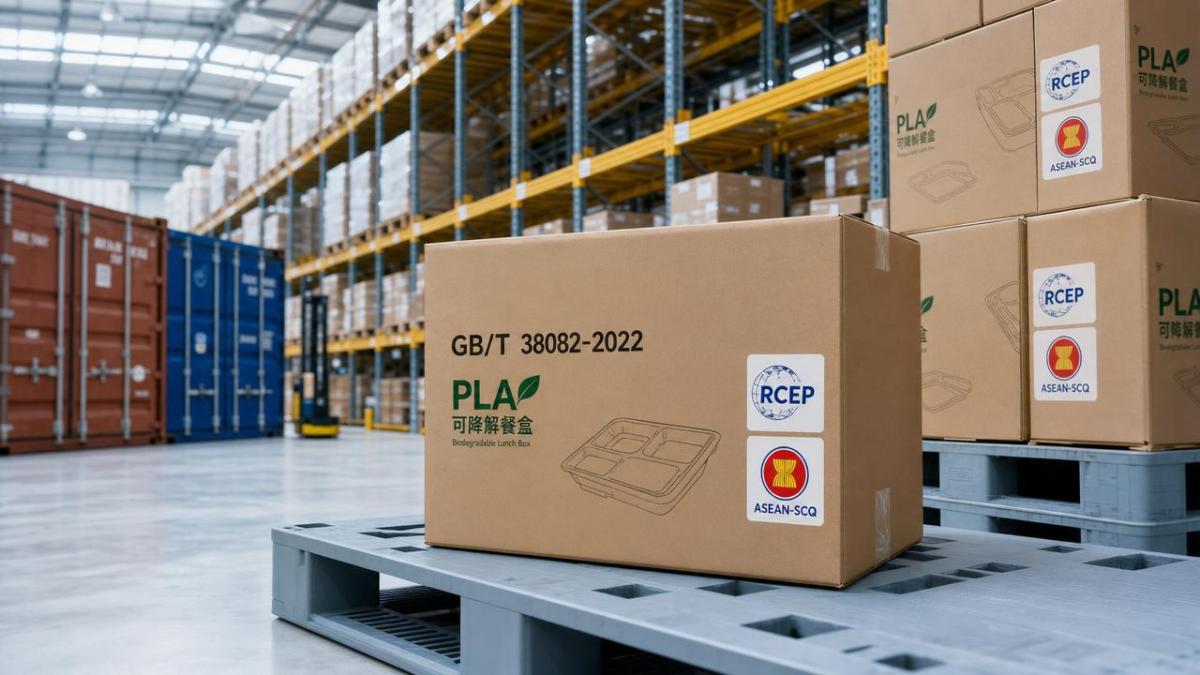
On May 3, 2026, the RCEP Secretariat and ASEAN Standards and Quality Center (ASEAN-SCQ) announced the expansion of the Biodegradable Materials Mutual Recognition Platform — with China’s GB/T 38082-2022–certified PLA disposable tableware now eligible for customs clearance without retesting in Indonesia. This development directly impacts exporters and importers in biodegradable food-contact kitchenware and home goods, offering tangible efficiency gains and cost reduction in regional trade.
Event Overview
On May 3, 2026, the RCEP Secretariat and ASEAN-SCQ jointly announced the formal expansion of the Biodegradable Materials Mutual Recognition Platform. The platform now includes PLA disposable tableware certified under China’s national standard GB/T 38082-2022. Effective immediately, Indonesian customs authorities grant ‘exemption from duplicate testing’ for such products upon presentation of a valid Chinese conformity assessment certificate. As confirmed, average clearance time has decreased from 7 days to 1.5 days, and import-related inspection costs have dropped by approximately 32%. The scope applies specifically to food-contact biodegradable products within the Kitchenware & Home Goods category.
Industries Affected
Direct Exporters (China-based)
Exporters of PLA tableware certified to GB/T 38082-2022 are now subject to simplified customs procedures in Indonesia. The impact is operational: reduced lead time per shipment and lower compliance overhead. However, eligibility is strictly contingent on holding a valid, RCEP-recognized conformity assessment certificate issued under that standard — not merely product compliance or self-declaration.
Raw Material Suppliers (PLA resin producers)
Suppliers serving certified manufacturers may see indirect demand shifts. While the policy does not alter material specifications, increased export volumes from downstream certified producers could raise order visibility and planning stability. No new certification or labeling obligations apply at the resin level — the mutual recognition applies only to finished tableware meeting GB/T 38082-2022 and accompanied by valid third-party certificates.
Contract Manufacturers & OEMs
OEMs producing PLA tableware for export brands must ensure their production facilities and quality control systems support consistent compliance with GB/T 38082-2022 — particularly regarding biodegradation performance, heavy metal limits, and food-contact safety. Certification validity rests with the certificate holder (typically the brand owner or exporter), but manufacturing traceability and documentation readiness become more critical for audit preparedness.
Distributors & Importers (Indonesia-based)
Indonesian importers handling certified PLA tableware can now bypass local laboratory testing upon entry — provided they present the original Chinese conformity certificate. This reduces landed cost and inventory holding time. However, the exemption applies only to the listed category; no extension to other biodegradable materials (e.g., PBAT blends or starch-based items) is confirmed.
Supply Chain Service Providers (Certification bodies, logistics firms)
Certification bodies accredited to issue GB/T 38082-2022 assessments may experience higher inquiry volume from exporters targeting Indonesia. Logistics providers handling RCEP-eligible shipments should verify certificate authenticity and format alignment with ASEAN-SCQ guidance — though no new documentation templates have been publicly released as of the May 3 announcement.
What Enterprises Should Monitor and Act On
Track official implementation guidance from ASEAN-SCQ and Indonesian customs
The announcement confirms eligibility and benefit scope, but detailed procedural requirements — such as certificate format, validity period, language requirements, or digital submission protocols — have not yet been published. Enterprises should monitor ASEAN-SCQ’s public notices and Indonesia’s Directorate General of Customs and Excise updates for operational clarity.
Verify certificate scope and issuing body accreditation
Not all GB/T 38082-2022 certificates qualify automatically. Only those issued by conformity assessment bodies recognized under the RCEP framework — and explicitly covering the exported PLA tableware model and batch — are accepted. Exporters must confirm their certifier’s inclusion in the RCEP-recognized list before shipment.
Distinguish between policy signal and enforceable procedure
This expansion reflects an institutional commitment to harmonize standards, but enforcement depends on frontline customs practice. Early adopters should treat initial shipments as test cases — documenting clearance timelines, feedback, and any ad hoc requests — to identify gaps between policy intent and ground-level execution.
Prepare documentation workflows for cross-border traceability
While testing is waived, Indonesian customs may still request supporting evidence (e.g., production records, raw material declarations, or test reports underlying the Chinese certificate). Exporters and importers should align internal documentation practices to ensure rapid response to such requests — without assuming full automation of the process.
Editorial Perspective / Industry Observation
Observably, this expansion functions less as a standalone regulatory milestone and more as a functional validation of RCEP’s sectoral mutual recognition mechanism — particularly for sustainability-linked product categories. It signals growing administrative convergence among RCEP members on biodegradability verification, but remains narrowly scoped: limited to one standard (GB/T 38082-2022), one material (PLA), one product type (disposable tableware), and one destination (Indonesia). Analysis shows it is not yet a template for broader ASEAN-wide or RCEP-wide adoption — no parallel expansions for Malaysia, Thailand, or Vietnam were announced. From an industry perspective, it is best understood as an early-stage, high-visibility pilot — valuable for benchmarking, but requiring careful contextualization before extrapolation to other markets or materials.
Conclusion
This development marks a concrete step toward reducing technical barriers for certified green packaging exports within the RCEP region. Its immediate value lies in predictable time and cost savings for a defined subset of PLA tableware trade between China and Indonesia. However, it remains a targeted, bilateral-enabling measure — not a systemic shift. Enterprises should leverage it where applicable, but avoid overgeneralizing its implications across other biodegradable materials, standards, or RCEP markets. Current implementation is best understood as a procedural optimization, not a strategic inflection point.
Information Sources
Main source: Official joint statement issued by the RCEP Secretariat and ASEAN Standards and Quality Center (ASEAN-SCQ), dated May 3, 2026.
Note: Further details on certificate submission formats, validity duration, and potential future expansions remain pending official publication and are subject to ongoing observation.
News Recommendations
 Which industry categories offer the strongest export potential in Latin America?
![51a6ab95581761cc26f4318be6520c15]()
Aris Katos
Future of Carbide Coatings
 How to choose an ultra bright waterproof window display for storefronts
![51a6ab95581761cc26f4318be6520c15]()
Aris Katos
Future of Carbide Coatings
 How to verify suppliers on a trade portal for global sourcing
![51a6ab95581761cc26f4318be6520c15]()
Aris Katos
Future of Carbide Coatings
 How RoHS requirements should be stated in product specifications
![51a6ab95581761cc26f4318be6520c15]()
Aris Katos
Future of Carbide Coatings
 What affects the lead time for custom retail counter displays?
![51a6ab95581761cc26f4318be6520c15]()
Aris Katos
Future of Carbide Coatings
 What consumer packaging USA importers need to verify before ordering
![51a6ab95581761cc26f4318be6520c15]()
Aris Katos
Future of Carbide Coatings
 How commercial spaces interiors shape customer dwell time
![51a6ab95581761cc26f4318be6520c15]()
Aris Katos
Future of Carbide Coatings
 How LED commercial lighting design reduces glare in retail spaces
![51a6ab95581761cc26f4318be6520c15]()
Aris Katos
Future of Carbide Coatings
 How industrial technology information improves RFID inventory accuracy
![51a6ab95581761cc26f4318be6520c15]()
Aris Katos
Future of Carbide Coatings
 When drip garden watering systems make more sense than sprinklers
![51a6ab95581761cc26f4318be6520c15]()
Aris Katos
Future of Carbide Coatings
 When category comparison improves sourcing for industrial applications
![51a6ab95581761cc26f4318be6520c15]()
Aris Katos
Future of Carbide Coatings
 Industrial application guidance for selecting the right LED lighting
![51a6ab95581761cc26f4318be6520c15]()
Aris Katos
Future of Carbide Coatings
 Which commercial architecture standards apply to European retail fit-outs?
![51a6ab95581761cc26f4318be6520c15]()
Aris Katos
Future of Carbide Coatings
 How to verify FDA requirements for maternity care products
![51a6ab95581761cc26f4318be6520c15]()
Aris Katos
Future of Carbide Coatings
 How to verify BPA-free claims for food-contact products
![51a6ab95581761cc26f4318be6520c15]()
Aris Katos
Future of Carbide Coatings
 When does a European wholesale supplier suit modular office projects?
![51a6ab95581761cc26f4318be6520c15]()
Aris Katos
Future of Carbide Coatings
 When consumer ecosystem solutions improve the in-store shopping journey
![51a6ab95581761cc26f4318be6520c15]()
Aris Katos
Future of Carbide Coatings
 How a commercial developers network can reduce site selection risk
![51a6ab95581761cc26f4318be6520c15]()
Aris Katos
Future of Carbide Coatings
 How clear purchasing specifications prevent costly supplier deviations
![51a6ab95581761cc26f4318be6520c15]()
Aris Katos
Future of Carbide Coatings
 What an ISTA drop test lab checks before your packaging ships
![51a6ab95581761cc26f4318be6520c15]()
Aris Katos
Future of Carbide Coatings
 Which commercial furniture standards apply to workplace seating?
![51a6ab95581761cc26f4318be6520c15]()
Aris Katos
Future of Carbide Coatings
 How to evaluate smart lighting module OEM compatibility before sampling
![51a6ab95581761cc26f4318be6520c15]()
Aris Katos
Future of Carbide Coatings
 How to assess whether sustainable technology delivers real impact
![51a6ab95581761cc26f4318be6520c15]()
Aris Katos
Future of Carbide Coatings
 How to assess an OEM supplier’s quality control before ordering
![51a6ab95581761cc26f4318be6520c15]()
Aris Katos
Future of Carbide Coatings
 How consumer ecosystem solutions data can improve retail personalization
![51a6ab95581761cc26f4318be6520c15]()
Aris Katos
Future of Carbide Coatings
 When does consumer packaging design justify a higher product price?
![51a6ab95581761cc26f4318be6520c15]()
Aris Katos
Future of Carbide Coatings
 Supermarket Fixture Installation: Planning Layouts, Wiring, and Handover
![51a6ab95581761cc26f4318be6520c15]()
Aris Katos
Future of Carbide Coatings
 Automated Lighting and Smart Lighting Control in Bergerac: Key Project Considerations
![51a6ab95581761cc26f4318be6520c15]()
Aris Katos
Future of Carbide Coatings
 Segment Streetlight Controllers: Choosing Control Modes for Urban Roads
![51a6ab95581761cc26f4318be6520c15]()
Aris Katos
Future of Carbide Coatings
 IEC 62471-2 Explained: How to Assess Photobiological Risks in LED Lighting
![51a6ab95581761cc26f4318be6520c15]()
Aris Katos
Future of Carbide Coatings
 Food Grade Packaging Requirements by Product Type, Temperature, and Contact Risk
![51a6ab95581761cc26f4318be6520c15]()
Aris Katos
Future of Carbide Coatings
 Food Packaging Compliance Checklist: Tests, Records, and Labeling Before Shipment
![51a6ab95581761cc26f4318be6520c15]()
Aris Katos
Future of Carbide Coatings
 NSF Food Packaging Standards: When Certification Matters for Commercial Food Use
![51a6ab95581761cc26f4318be6520c15]()
Aris Katos
Future of Carbide Coatings
 FDA Food Grade Compliance: Which Materials and Documents Do Buyers Need?
![51a6ab95581761cc26f4318be6520c15]()
Aris Katos
Future of Carbide Coatings
 What Should a Food Grade Declaration Include for Packaging Compliance?
![51a6ab95581761cc26f4318be6520c15]()
Aris Katos
Future of Carbide Coatings
 Housewares Importing: How to Evaluate Suppliers, Costs, and Compliance Risks
![51a6ab95581761cc26f4318be6520c15]()
Aris Katos
Future of Carbide Coatings
 Why Freeze-Dried Fruit Ingredients Lose Crispness—and How to Prevent It
![51a6ab95581761cc26f4318be6520c15]()
Aris Katos
Future of Carbide Coatings
 What industry veterans look for before choosing a new supplier
![51a6ab95581761cc26f4318be6520c15]()
Aris Katos
Future of Carbide Coatings
 How material fatigue can shorten the service life of retail shelving
![51a6ab95581761cc26f4318be6520c15]()
Aris Katos
Future of Carbide Coatings