Interactive Retail Kiosk OEM: Common Cost Traps in Custom Rollouts
Time
Click Count
An interactive retail kiosk OEM project can appear straightforward on paper, yet hidden costs often emerge during custom rollouts and erode ROI before deployment scales. For financial decision-makers, understanding where budget overruns typically originate—from engineering revisions to certification, logistics, and after-sales support—is essential to approving investments with confidence and protecting long-term commercial performance.
In global retail modernization programs, a kiosk is rarely just a screen in an enclosure. It is a bundled asset that combines industrial design, electronics integration, software compatibility, compliance, packaging, installation planning, and long-term field service. When sourced through an interactive retail kiosk OEM partner, the initial quotation may cover core hardware, yet still exclude 6 to 10 cost layers that emerge after design freeze.
For finance approvers, the key question is not only unit price. It is total landed cost over a 3- to 5-year operating horizon, including the risk of rework, delays, replacement parts, and support obligations across multiple store formats or regions. That is where disciplined cost mapping becomes more valuable than a low opening quote.
Where hidden costs usually start in an interactive retail kiosk OEM rollout
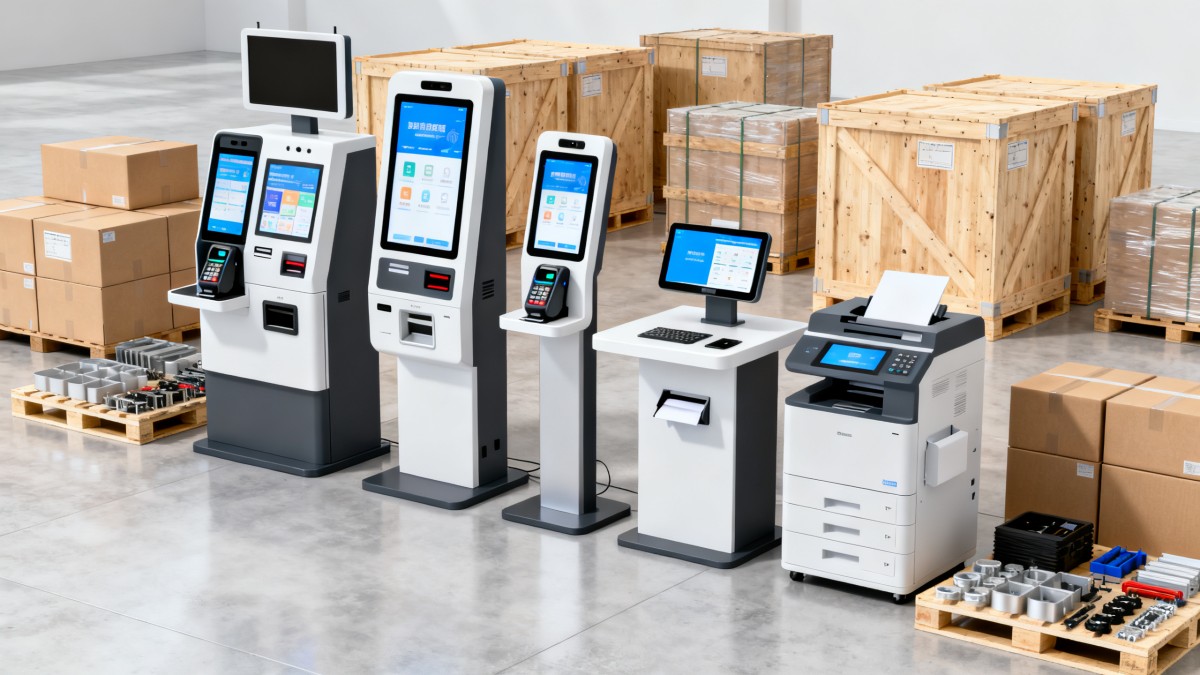
The most expensive mistakes in an interactive retail kiosk OEM project often begin before production. A concept that looks approved in a presentation deck can still lack engineering closure on thermal management, cable routing, payment device placement, ADA accessibility, vandal resistance, or maintenance access. Each unresolved point can trigger revision loops that add 7–21 days and raise non-recurring engineering expense.
This matters especially in chain retail, airports, malls, showrooms, and foodservice environments where one kiosk platform may need 3 or 4 physical variants. A wall-mounted unit, freestanding unit, countertop version, and self-service checkout tower can share a visual language but require different structures, tooling, and certification pathways.
1. Engineering revisions that look minor but compound quickly
A common budget trap is assuming that cosmetic changes are inexpensive. In practice, moving a scanner 40 mm, increasing screen size from 21.5 inches to 27 inches, or switching from powder-coated steel to aluminum can affect bracket design, center of gravity, heat dissipation, packaging dimensions, and even drop-test outcomes. One late change can affect 5 or more downstream components.
Financial teams should ask whether the quoted NRE covers only the first design round or includes 2–3 revision cycles. They should also confirm which deliverables are included: 2D drawings, 3D files, sample validation, pilot modifications, firmware adjustment, and cable map updates. Without that scope clarity, engineering fees can expand by 10%–25% during pilot preparation.
Typical change triggers
- Screen size, brightness, or touch technology changes
- Payment terminal brand or mounting standard changes
- Printer, scanner, camera, or NFC module additions
- Material changes for aesthetics, sustainability, or durability
- New regional compliance requirements after procurement approval
2. Tooling, prototyping, and pilot run costs
Custom rollouts usually require at least 3 cost stages before mass production: prototype, engineering validation, and pilot run. The prototype stage may use CNC, 3D printing, or low-volume fabrication, which creates a misleading cost baseline. Once the kiosk moves into repeatable production, tooling for sheet metal fixtures, plastics, glass, cable harnessing, or branded trims can increase front-end expense significantly.
If the rollout target is below 100 units, amortizing tooling can materially increase unit economics. If the plan is 500 to 2,000 units across multiple countries, pilot cost discipline becomes even more important because early design flaws scale rapidly into field replacement costs.
The table below shows where hidden cost exposure often appears between concept approval and commercial launch in an interactive retail kiosk OEM program.
The financial lesson is clear: a low opening quotation can still produce a high deployed cost if revision governance is weak. Approval teams should budget not only for hardware but also for controlled iteration, pilot learning, and country-specific readiness.
Compliance, logistics, and installation costs that are frequently underestimated
The second major cost cluster appears after the design seems finished. At this point, many organizations assume the hard part is over. In reality, compliance, shipping, customs preparation, site installation, and acceptance testing can add 15%–35% to total project cost depending on rollout geography, kiosk size, and store readiness.
3. Certification is not a paperwork exercise
Interactive kiosks often need electrical safety, EMC, wireless, payment-device compatibility, and local market compliance review. If a kiosk includes Wi-Fi, Bluetooth, RFID, camera modules, or integrated charging functions, testing complexity rises. Even where component-level compliance exists, the assembled system may still require verification because enclosure design, grounding, ventilation, and cable routing can affect final performance.
A finance team should verify whether the interactive retail kiosk OEM quote includes pre-compliance checks, third-party lab coordination, engineering support during test failure analysis, and documentation packages for import or local authority review. Certification delays of 2–6 weeks are not unusual when the design enters testing before full electrical maturity.
4. Packaging and freight can rewrite the business case
Kiosks are bulky, fragile, and often asymmetrical. That creates a freight profile very different from standard electronics. A slight increase in base footprint can push the unit into a higher dimensional-weight tier. A glass-fronted design may need thicker protective foam, stronger cartons, or wooden crating. Those decisions affect not only freight cost but also warehouse handling and in-store movement.
In multi-country programs, logistics costs should be modeled at three levels: ex-factory, landed at regional warehouse, and delivered to final site. For some deployments, last-mile delivery and white-glove placement can equal 20% or more of the pure ocean or air freight line item, especially when units must be unboxed, positioned, and tested on site.
Logistics questions worth asking before approval
- What is the packed size and gross weight per unit?
- How many units fit per pallet or container under safe loading conditions?
- Does packaging support single-site delivery or only warehouse receipt?
- Are spare parts packed separately for field service?
- Is installation hardware included, labeled, and country-ready?
5. Store readiness and site adaptation costs
A kiosk may be production-ready while the retail estate is not. Site power, floor flatness, anchoring method, network availability, lighting glare, queue flow, and accessibility clearances all affect deployment. If surveys are skipped, installation teams often discover field exceptions that require custom plinths, cable extensions, wall reinforcements, or relocation.
For a rollout across 50, 200, or 500 stores, even a 30-minute installation overrun per site becomes material. The better approach is to define a pre-install checklist with at least 8–12 validation points, then categorize sites into standard, constrained, and non-standard conditions before committing to a final deployment budget.
The following table helps finance approvers identify cost categories that often sit outside the base manufacturing quote but materially affect deployment economics.
A practical takeaway is that certification, freight, and installation should be budgeted as a deployment system, not as separate afterthoughts. If not modeled together, a project can appear affordable at purchase order stage but underperform once all rollout layers are activated.
After-sales support, lifecycle cost, and procurement controls
The final and often least visible cost trap in an interactive retail kiosk OEM program is lifecycle support. A kiosk may launch on time and still destroy projected ROI if it is difficult to maintain, relies on single-source parts, or lacks a realistic service model. For finance leaders, this is where capex decisions convert into opex exposure.
6. Serviceability determines real cost per year
A kiosk that requires 90 minutes to open, diagnose, and replace a printer or display module is more expensive over time than one built around quick-access service doors and modular replacement parts. Service design should be reviewed as seriously as external appearance. Ask how long common field tasks take: screen replacement, scanner swap, printer jam clearance, power supply change, and motherboard exchange.
In many chain environments, a response target of 24–72 hours is acceptable only if spare parts are locally staged. Without a regional inventory plan, a failed component can force air shipment, technician revisits, and lost transaction time. For a fleet of 300 units, even a modest 3% annual failure rate means 9 service incidents per year on one component family alone.
7. Warranty wording can hide meaningful exclusions
Not all warranties cover the same risk. One supplier may offer 12 months on manufacturing defects only, while another provides 24 months with defined response procedures, replacement-part commitments, and repair documentation. Financial approvers should verify whether the warranty includes labor, remote diagnosis, DOA handling, cosmetic defects, software image recovery, and transit damage claims.
It is also worth checking component obsolescence planning. If a display panel, CPU platform, or payment cradle is likely to change within 12–18 months, the OEM should explain the continuity plan. Otherwise, future replenishment orders may require redesign, recertification, or a mixed fleet with inconsistent maintenance needs.
A finance-focused approval checklist for custom kiosk sourcing
Before signing off on an interactive retail kiosk OEM program, finance teams can reduce exposure by requesting a structured cost map. The most useful reviews compare at least 4 dimensions: unit manufacturing cost, non-recurring engineering, deployment cost, and 3-year support cost. This prevents low-ball hardware pricing from masking lifecycle expense.
- Confirm whether quote validity covers commodity fluctuation for 30, 60, or 90 days.
- Separate one-time NRE from recurring unit cost and from pilot-only cost.
- Request an inclusion/exclusion list covering packaging, labeling, spare parts, and install kits.
- Ask for a serviceability review with field-replaceable component logic.
- Model cost under three volumes, such as 50 units, 200 units, and 1,000 units.
- Check regional compliance assumptions before final design approval.
How G-BCE-style benchmarking improves approval confidence
For global commercial developers, chain operators, and sourcing directors, benchmark-driven review helps translate technical complexity into financial clarity. By comparing kiosk architecture, material choices, compliance pathways, and support assumptions against international commercial standards and practical supply chain realities, decision-makers can distinguish a competitive quote from an incomplete one.
That is especially important when bridging Asian manufacturing capability with the aesthetic, operational, and regulatory demands of international retail environments. Precision manufacturing can create strong value, but only when the total project structure is disciplined from design freeze to end-of-life support.
An interactive retail kiosk OEM project becomes financially stronger when approval teams treat it as a full commercial infrastructure investment rather than a standalone hardware purchase. Engineering scope, compliance timing, freight profile, site readiness, and serviceability all influence payback and operational resilience. If you are evaluating a custom kiosk rollout for chain retail, hospitality, transport, or branded commercial spaces, now is the right time to map hidden costs before they become deployed losses.
To review cost drivers, benchmark supply options, or build a more reliable sourcing framework for your next deployment, contact us to get a tailored solution, discuss product details, and explore more commercial modernization strategies.
News Recommendations
 What consumer packaging USA importers need to verify before ordering
![51a6ab95581761cc26f4318be6520c15]()
Aris Katos
Future of Carbide Coatings
 How commercial spaces interiors shape customer dwell time
![51a6ab95581761cc26f4318be6520c15]()
Aris Katos
Future of Carbide Coatings
 How LED commercial lighting design reduces glare in retail spaces
![51a6ab95581761cc26f4318be6520c15]()
Aris Katos
Future of Carbide Coatings
 How industrial technology information improves RFID inventory accuracy
![51a6ab95581761cc26f4318be6520c15]()
Aris Katos
Future of Carbide Coatings
 When drip garden watering systems make more sense than sprinklers
![51a6ab95581761cc26f4318be6520c15]()
Aris Katos
Future of Carbide Coatings
 When category comparison improves sourcing for industrial applications
![51a6ab95581761cc26f4318be6520c15]()
Aris Katos
Future of Carbide Coatings
 Industrial application guidance for selecting the right LED lighting
![51a6ab95581761cc26f4318be6520c15]()
Aris Katos
Future of Carbide Coatings
 Which commercial architecture standards apply to European retail fit-outs?
![51a6ab95581761cc26f4318be6520c15]()
Aris Katos
Future of Carbide Coatings
 How to verify FDA requirements for maternity care products
![51a6ab95581761cc26f4318be6520c15]()
Aris Katos
Future of Carbide Coatings
 How to verify BPA-free claims for food-contact products
![51a6ab95581761cc26f4318be6520c15]()
Aris Katos
Future of Carbide Coatings
 When does a European wholesale supplier suit modular office projects?
![51a6ab95581761cc26f4318be6520c15]()
Aris Katos
Future of Carbide Coatings
 When consumer ecosystem solutions improve the in-store shopping journey
![51a6ab95581761cc26f4318be6520c15]()
Aris Katos
Future of Carbide Coatings
 How a commercial developers network can reduce site selection risk
![51a6ab95581761cc26f4318be6520c15]()
Aris Katos
Future of Carbide Coatings
 How clear purchasing specifications prevent costly supplier deviations
![51a6ab95581761cc26f4318be6520c15]()
Aris Katos
Future of Carbide Coatings
 What an ISTA drop test lab checks before your packaging ships
![51a6ab95581761cc26f4318be6520c15]()
Aris Katos
Future of Carbide Coatings
 Which commercial furniture standards apply to workplace seating?
![51a6ab95581761cc26f4318be6520c15]()
Aris Katos
Future of Carbide Coatings
 How to evaluate smart lighting module OEM compatibility before sampling
![51a6ab95581761cc26f4318be6520c15]()
Aris Katos
Future of Carbide Coatings
 How to assess whether sustainable technology delivers real impact
![51a6ab95581761cc26f4318be6520c15]()
Aris Katos
Future of Carbide Coatings
 How to assess an OEM supplier’s quality control before ordering
![51a6ab95581761cc26f4318be6520c15]()
Aris Katos
Future of Carbide Coatings
 How consumer ecosystem solutions data can improve retail personalization
![51a6ab95581761cc26f4318be6520c15]()
Aris Katos
Future of Carbide Coatings
 When does consumer packaging design justify a higher product price?
![51a6ab95581761cc26f4318be6520c15]()
Aris Katos
Future of Carbide Coatings
 Supermarket Fixture Installation: Planning Layouts, Wiring, and Handover
![51a6ab95581761cc26f4318be6520c15]()
Aris Katos
Future of Carbide Coatings
 Automated Lighting and Smart Lighting Control in Bergerac: Key Project Considerations
![51a6ab95581761cc26f4318be6520c15]()
Aris Katos
Future of Carbide Coatings
 Segment Streetlight Controllers: Choosing Control Modes for Urban Roads
![51a6ab95581761cc26f4318be6520c15]()
Aris Katos
Future of Carbide Coatings
 IEC 62471-2 Explained: How to Assess Photobiological Risks in LED Lighting
![51a6ab95581761cc26f4318be6520c15]()
Aris Katos
Future of Carbide Coatings
 Food Grade Packaging Requirements by Product Type, Temperature, and Contact Risk
![51a6ab95581761cc26f4318be6520c15]()
Aris Katos
Future of Carbide Coatings
 Food Packaging Compliance Checklist: Tests, Records, and Labeling Before Shipment
![51a6ab95581761cc26f4318be6520c15]()
Aris Katos
Future of Carbide Coatings
 NSF Food Packaging Standards: When Certification Matters for Commercial Food Use
![51a6ab95581761cc26f4318be6520c15]()
Aris Katos
Future of Carbide Coatings
 FDA Food Grade Compliance: Which Materials and Documents Do Buyers Need?
![51a6ab95581761cc26f4318be6520c15]()
Aris Katos
Future of Carbide Coatings
 What Should a Food Grade Declaration Include for Packaging Compliance?
![51a6ab95581761cc26f4318be6520c15]()
Aris Katos
Future of Carbide Coatings
 Housewares Importing: How to Evaluate Suppliers, Costs, and Compliance Risks
![51a6ab95581761cc26f4318be6520c15]()
Aris Katos
Future of Carbide Coatings
 Why Freeze-Dried Fruit Ingredients Lose Crispness—and How to Prevent It
![51a6ab95581761cc26f4318be6520c15]()
Aris Katos
Future of Carbide Coatings
 What industry veterans look for before choosing a new supplier
![51a6ab95581761cc26f4318be6520c15]()
Aris Katos
Future of Carbide Coatings
 How material fatigue can shorten the service life of retail shelving
![51a6ab95581761cc26f4318be6520c15]()
Aris Katos
Future of Carbide Coatings
 What makes a global sourcing platform reliable for supplier verification?
![51a6ab95581761cc26f4318be6520c15]()
Aris Katos
Future of Carbide Coatings
 When are double platinum spark plugs a better choice than iridium?
![51a6ab95581761cc26f4318be6520c15]()
Aris Katos
Future of Carbide Coatings
 How to assess a POS terminal manufacturer in Europe for long-term support
![51a6ab95581761cc26f4318be6520c15]()
Aris Katos
Future of Carbide Coatings
 How data transparency in retail helps prevent inventory discrepancies
![51a6ab95581761cc26f4318be6520c15]()
Aris Katos
Future of Carbide Coatings
 What makes a product comparison guide actually useful for buying decisions
![51a6ab95581761cc26f4318be6520c15]()
Aris Katos
Future of Carbide Coatings