Thailand and Vietnam Tighten LED Entry Rules
Time
Click Count
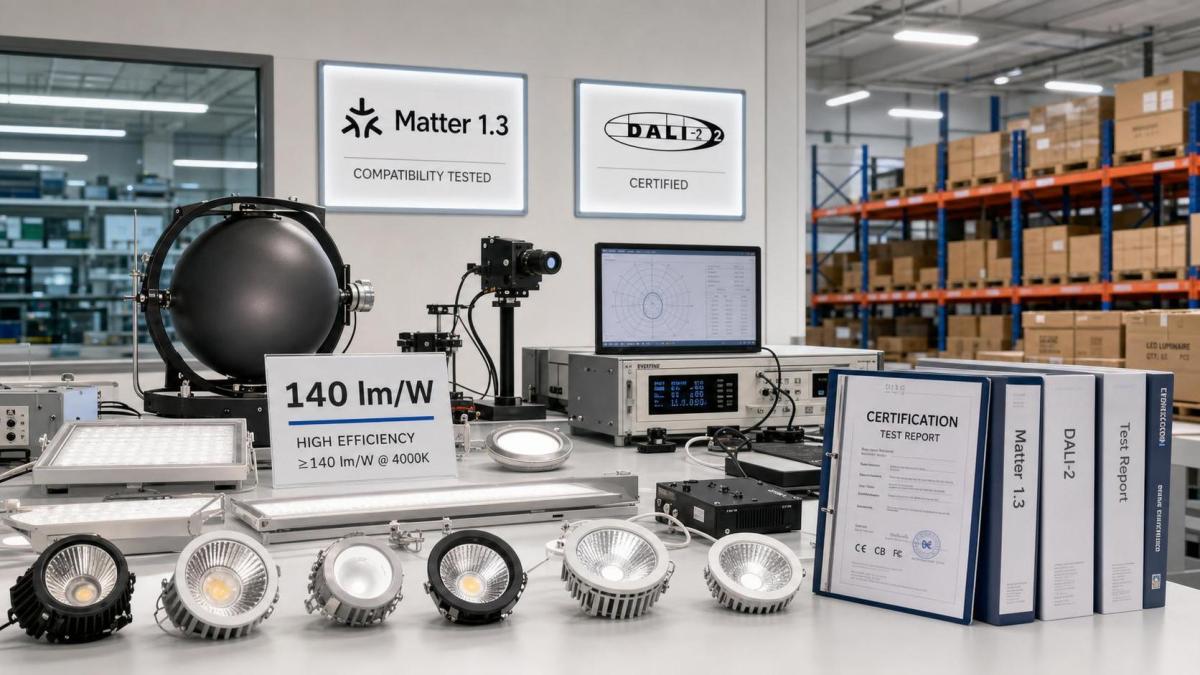
On June 20, 2026, updated mandatory certification annexes for LED lighting products in Thailand’s TISI and Vietnam’s CRS introduced a stricter compliance baseline for market access. The change centers on a minimum luminous efficacy threshold of at least 140 lm/W and a protocol requirement for Architectural LED Lighting and Smart Lighting Controls to support Matter 1.3 or DALI-2. For exporters, certification-related firms, buyers, and supply chain teams, this matters because products that do not meet these conditions cannot complete local market access registration, which directly affects delivery timing into these markets.
What the revised access conditions now require
The confirmed change is limited but commercially significant. From June 20, 2026, Thailand’s TISI and Vietnam’s CRS each updated the technical annexes used in mandatory certification for LED lighting products.
The updated annexes add two explicit requirements. First, LED products covered by the rule must meet a minimum luminous efficacy of no less than 140 lm/W. Second, all products falling under Architectural LED Lighting and Smart Lighting Controls must support either Matter 1.3 or DALI-2.
The direct compliance consequence is also clear in the provided information: products that do not meet these updated conditions cannot complete local market access registration. The stated commercial effect is a likely disruption to the delivery rhythm of Chinese LED lighting exports into the affected markets.
Where the pressure is likely to appear first
Export shipments face a registration-linked bottleneck
From an industry perspective, exporters are likely to feel the impact first because the rule change is tied to market access registration rather than only to product positioning or project preference. If a shipment includes models that fail the new efficacy threshold or lack the required protocol support in the covered categories, the issue is not merely a specification mismatch; it can stop local registration from being completed. What deserves closer attention is the interaction between technical readiness, certification timing, and shipment scheduling.
Manufacturers may need to recheck product readiness by category
For manufacturers, the practical issue is whether existing LED lighting products already align with the new threshold and whether covered smart or architectural products can demonstrate support for Matter 1.3 or DALI-2. The impact is likely to fall on model screening, technical file review, and the matching of product claims with certification submissions. Observably, the risk is not limited to new product launches; current export models may also need to be re-examined before further registration activity.
Testing and certification workflows become more sensitive
Certification-related firms and testing service providers may see closer scrutiny around efficacy evidence, protocol support documentation, and the consistency of submitted technical materials. Analysis shows that once access conditions are embedded in mandatory certification annexes, any gap between product design, test evidence, and registration documents can become a delivery issue rather than a paperwork issue alone. Companies involved in dossier preparation should therefore pay attention to how technical claims are presented and substantiated.
Buyers and channel partners may need to revisit procurement timing
For buyers, distributors, and channel operators, the key issue is continuity of supply. If a product cannot complete local registration, procurement plans, project delivery sequences, and replacement arrangements may all need adjustment. It is more appropriate to understand this as a compliance-linked procurement risk signal rather than a pure pricing or sourcing issue. In practice, counterparties may need to verify earlier whether shortlisted products meet the new access conditions before finalizing orders.
What companies should review now
Reconfirm whether target models clear the new baseline
Companies shipping into the affected markets should review whether relevant LED products can meet the minimum 140 lm/W requirement and whether products within Architectural LED Lighting and Smart Lighting Controls can demonstrate support for Matter 1.3 or DALI-2. Because the provided information does not include more detailed enforcement mechanics, this should be treated as a compliance review priority rather than as proof of how every case will be handled in practice.
Check certification files and technical documentation for alignment
What deserves closer attention is whether test reports, technical descriptions, product specifications, and registration materials all describe the same compliance position. Where protocol support is relevant, companies may need to confirm that submitted materials clearly reflect the applicable requirement. Where efficacy claims are used for certification, consistency between product performance evidence and filing documents becomes especially important.
Watch the effect on delivery planning and order execution
Analysis shows that the most immediate business exposure may sit in the gap between order commitment and registration completion. Exporters, supply chain coordinators, and procurement teams should therefore pay attention to shipment timing, product substitutions, and model approval status in parallel. If compliance confirmation comes late, the issue may surface as a delivery delay rather than as a factory-side production problem.
Follow subsequent wording and market implementation closely
The current information confirms the rule change itself, but it does not provide the full downstream execution detail. For that reason, companies should keep watching for later official wording, certification interpretation, tender document updates, and practical feedback from the market. This is particularly relevant for firms managing multi-model product portfolios or projects that rely on smart control interoperability claims.
How this change is best understood at this stage
Observably, this development is more than a routine technical update because it links measurable product performance and protocol compatibility directly to mandatory market access registration. At the same time, it should not be overstated beyond the confirmed facts. Analysis shows that the strongest current signal is an execution and compliance signal: affected businesses should treat the revised annexes as an active entry requirement that can influence export delivery cadence.
It is also more appropriate to understand this as a rule change with immediate screening value, while some implementation details still require observation. The market will likely pay close attention to how certification reviews interpret documentation, how buyers revise qualification language, and whether supply chains adjust model selection earlier in the transaction process.
Why the market should keep this on its active watchlist
The significance of this update lies in its practical effect on access, not only in its technical wording. The confirmed facts indicate that non-compliant products cannot complete registration in the affected markets, which makes the issue relevant to product planning, export scheduling, procurement coordination, and compliance review at the same time.
From an industry perspective, the most balanced reading is that this is an already landed rule change with direct operational relevance, while the precise execution rhythm still deserves continued observation. Companies do not need to assume outcomes beyond the supplied facts, but they do need to treat efficacy thresholds, protocol compatibility, and certification readiness as connected issues rather than separate tasks.
Basis of this article and what still needs verification
This article is generated from the user-provided news title, event date, and event summary. No specific official source link was provided in the input, so the exact official publication link still needs to be verified on an ongoing basis.
For developments of this type, commonly relevant source categories may include official notices, releases from regulatory authorities, customs or trade administration information, industry association updates, standardization documents, and reporting by established professional media. Further follow-up should focus on detailed policy wording, certification implementation practices, tender document adjustments, market feedback, and how affected companies carry out compliance and delivery planning in response.
News Recommendations
 What consumer packaging USA importers need to verify before ordering
![51a6ab95581761cc26f4318be6520c15]()
Aris Katos
Future of Carbide Coatings
 How commercial spaces interiors shape customer dwell time
![51a6ab95581761cc26f4318be6520c15]()
Aris Katos
Future of Carbide Coatings
 How LED commercial lighting design reduces glare in retail spaces
![51a6ab95581761cc26f4318be6520c15]()
Aris Katos
Future of Carbide Coatings
 How industrial technology information improves RFID inventory accuracy
![51a6ab95581761cc26f4318be6520c15]()
Aris Katos
Future of Carbide Coatings
 When drip garden watering systems make more sense than sprinklers
![51a6ab95581761cc26f4318be6520c15]()
Aris Katos
Future of Carbide Coatings
 When category comparison improves sourcing for industrial applications
![51a6ab95581761cc26f4318be6520c15]()
Aris Katos
Future of Carbide Coatings
 Industrial application guidance for selecting the right LED lighting
![51a6ab95581761cc26f4318be6520c15]()
Aris Katos
Future of Carbide Coatings
 Which commercial architecture standards apply to European retail fit-outs?
![51a6ab95581761cc26f4318be6520c15]()
Aris Katos
Future of Carbide Coatings
 How to verify FDA requirements for maternity care products
![51a6ab95581761cc26f4318be6520c15]()
Aris Katos
Future of Carbide Coatings
 How to verify BPA-free claims for food-contact products
![51a6ab95581761cc26f4318be6520c15]()
Aris Katos
Future of Carbide Coatings
 When does a European wholesale supplier suit modular office projects?
![51a6ab95581761cc26f4318be6520c15]()
Aris Katos
Future of Carbide Coatings
 When consumer ecosystem solutions improve the in-store shopping journey
![51a6ab95581761cc26f4318be6520c15]()
Aris Katos
Future of Carbide Coatings
 How a commercial developers network can reduce site selection risk
![51a6ab95581761cc26f4318be6520c15]()
Aris Katos
Future of Carbide Coatings
 How clear purchasing specifications prevent costly supplier deviations
![51a6ab95581761cc26f4318be6520c15]()
Aris Katos
Future of Carbide Coatings
 What an ISTA drop test lab checks before your packaging ships
![51a6ab95581761cc26f4318be6520c15]()
Aris Katos
Future of Carbide Coatings
 Which commercial furniture standards apply to workplace seating?
![51a6ab95581761cc26f4318be6520c15]()
Aris Katos
Future of Carbide Coatings
 How to evaluate smart lighting module OEM compatibility before sampling
![51a6ab95581761cc26f4318be6520c15]()
Aris Katos
Future of Carbide Coatings
 How to assess whether sustainable technology delivers real impact
![51a6ab95581761cc26f4318be6520c15]()
Aris Katos
Future of Carbide Coatings
 How to assess an OEM supplier’s quality control before ordering
![51a6ab95581761cc26f4318be6520c15]()
Aris Katos
Future of Carbide Coatings
 How consumer ecosystem solutions data can improve retail personalization
![51a6ab95581761cc26f4318be6520c15]()
Aris Katos
Future of Carbide Coatings
 When does consumer packaging design justify a higher product price?
![51a6ab95581761cc26f4318be6520c15]()
Aris Katos
Future of Carbide Coatings
 Supermarket Fixture Installation: Planning Layouts, Wiring, and Handover
![51a6ab95581761cc26f4318be6520c15]()
Aris Katos
Future of Carbide Coatings
 Automated Lighting and Smart Lighting Control in Bergerac: Key Project Considerations
![51a6ab95581761cc26f4318be6520c15]()
Aris Katos
Future of Carbide Coatings
 Segment Streetlight Controllers: Choosing Control Modes for Urban Roads
![51a6ab95581761cc26f4318be6520c15]()
Aris Katos
Future of Carbide Coatings
 IEC 62471-2 Explained: How to Assess Photobiological Risks in LED Lighting
![51a6ab95581761cc26f4318be6520c15]()
Aris Katos
Future of Carbide Coatings
 Food Grade Packaging Requirements by Product Type, Temperature, and Contact Risk
![51a6ab95581761cc26f4318be6520c15]()
Aris Katos
Future of Carbide Coatings
 Food Packaging Compliance Checklist: Tests, Records, and Labeling Before Shipment
![51a6ab95581761cc26f4318be6520c15]()
Aris Katos
Future of Carbide Coatings
 NSF Food Packaging Standards: When Certification Matters for Commercial Food Use
![51a6ab95581761cc26f4318be6520c15]()
Aris Katos
Future of Carbide Coatings
 FDA Food Grade Compliance: Which Materials and Documents Do Buyers Need?
![51a6ab95581761cc26f4318be6520c15]()
Aris Katos
Future of Carbide Coatings
 What Should a Food Grade Declaration Include for Packaging Compliance?
![51a6ab95581761cc26f4318be6520c15]()
Aris Katos
Future of Carbide Coatings
 Housewares Importing: How to Evaluate Suppliers, Costs, and Compliance Risks
![51a6ab95581761cc26f4318be6520c15]()
Aris Katos
Future of Carbide Coatings
 Why Freeze-Dried Fruit Ingredients Lose Crispness—and How to Prevent It
![51a6ab95581761cc26f4318be6520c15]()
Aris Katos
Future of Carbide Coatings
 What industry veterans look for before choosing a new supplier
![51a6ab95581761cc26f4318be6520c15]()
Aris Katos
Future of Carbide Coatings
 How material fatigue can shorten the service life of retail shelving
![51a6ab95581761cc26f4318be6520c15]()
Aris Katos
Future of Carbide Coatings
 What makes a global sourcing platform reliable for supplier verification?
![51a6ab95581761cc26f4318be6520c15]()
Aris Katos
Future of Carbide Coatings
 When are double platinum spark plugs a better choice than iridium?
![51a6ab95581761cc26f4318be6520c15]()
Aris Katos
Future of Carbide Coatings
 How to assess a POS terminal manufacturer in Europe for long-term support
![51a6ab95581761cc26f4318be6520c15]()
Aris Katos
Future of Carbide Coatings
 How data transparency in retail helps prevent inventory discrepancies
![51a6ab95581761cc26f4318be6520c15]()
Aris Katos
Future of Carbide Coatings
 What makes a product comparison guide actually useful for buying decisions
![51a6ab95581761cc26f4318be6520c15]()
Aris Katos
Future of Carbide Coatings