Digital Signage ROI: When Smarter Screens Pay Off
Time
Click Count
For financial decision-makers, digital signage is no longer a visual upgrade alone—it is a measurable asset that can improve revenue, reduce operational friction, and strengthen customer engagement.
Understanding signage ROI means looking beyond hardware costs to lifecycle value, content efficiency, and data-backed performance, especially as smarter screens become a strategic part of modern commercial environments.
What Financial Decision-Makers Are Really Asking About Signage ROI
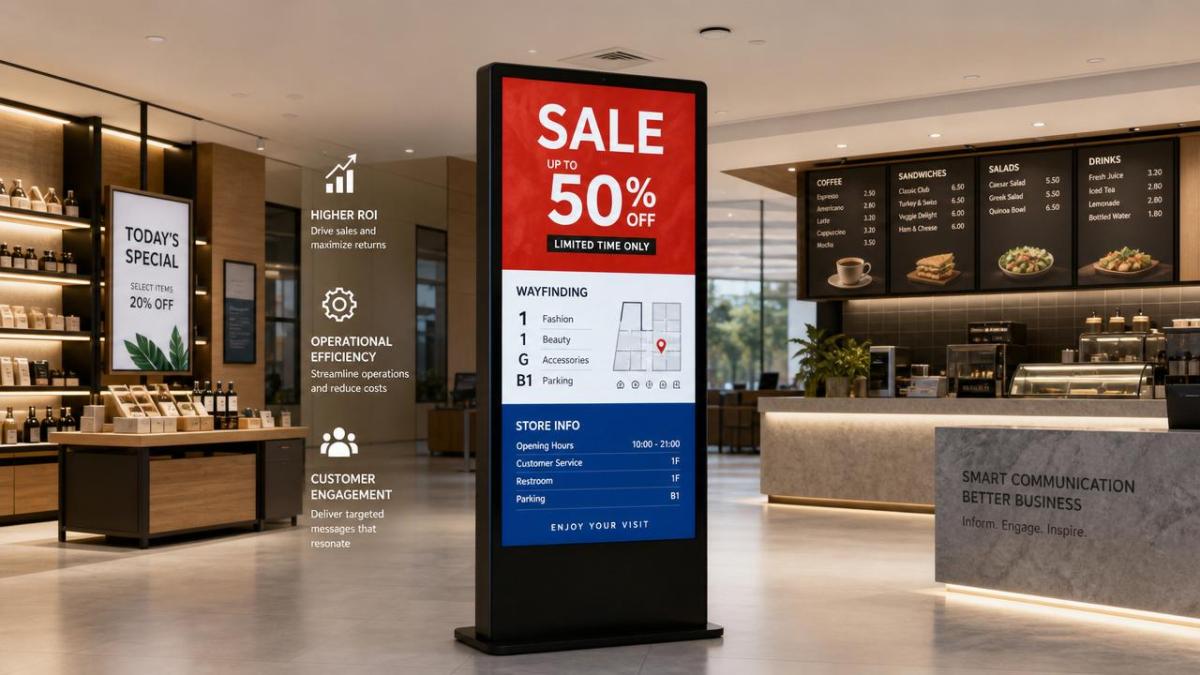
The core search intent behind “Digital Signage ROI” is practical, not theoretical: when does signage justify the spend, and under what conditions do smarter screens pay off?
For finance teams, the question is rarely whether digital signage looks modern. The real issue is whether it produces measurable gains that outweigh capital cost, deployment complexity, and ongoing management expenses.
That means the most useful evaluation framework is not based on display specifications alone. It should focus on cash flow impact, operational savings, controllability, and the expected time to value.
In most commercial environments, the answer is clear: digital signage pays off when it replaces repeated manual work, improves conversion at decision points, reduces campaign lag, or supports higher-margin selling.
It is less compelling when installed only for visual prestige, without content discipline, location strategy, or ownership of performance metrics. Screens do not generate returns by themselves; systems and execution do.
The Main Concerns Finance Approvers Need Answered Before Investing
Financial approvers tend to care about a predictable set of issues. First is total cost of ownership, including hardware, mounting, software, integration, energy use, maintenance, and replacement cycles.
Second is payback period. A project that improves brand presence may still struggle for approval if the economic return is vague, delayed, or dependent on assumptions that operating teams cannot verify.
Third is scalability. A pilot may perform well in one flagship location, but finance leaders need confidence that results can be replicated across stores, branches, showrooms, or mixed-format commercial sites.
Fourth is operational ownership. If no team is accountable for content updates, scheduling, analytics, and uptime, then even a technically strong signage program can become an underused capital asset.
Fifth is risk. Decision-makers want to know whether signage will become obsolete too quickly, whether software subscriptions will expand unexpectedly, and whether adoption depends on fragile internal processes.
These concerns are valid. In fact, they define the difference between a decorative deployment and a financially responsible signage strategy built for measurable business outcomes.
Where Digital Signage Creates Real Economic Value
To evaluate ROI correctly, it helps to separate value creation into revenue lift, cost reduction, risk control, and experience enhancement that supports long-term commercial performance.
Revenue lift is often the most visible benefit. Digital signage can increase basket size, promote premium products, support cross-sell messaging, and improve campaign responsiveness during time-sensitive offers.
In retail, food service, hospitality, transportation, and commercial real estate, screens placed near decision points can influence customer behavior more effectively than static signage because messaging stays timely and relevant.
Cost reduction is equally important, especially for finance teams. Digital signage lowers recurring print production, shipping, installation labor, and the waste associated with expired or inconsistent static materials.
It also reduces the hidden cost of slow execution. When pricing, promotions, or operational instructions change across many locations, centralized digital control can replace fragmented manual updates.
Risk control matters more than many buyers initially expect. Centralized signage systems reduce off-brand messaging, outdated regulatory notices, and inconsistent product information across distributed commercial environments.
Experience enhancement may appear harder to quantify, yet it has clear financial relevance. Better navigation, shorter perceived wait times, clearer product education, and more polished environments can support conversion and retention.
How to Calculate Signage ROI Without Oversimplifying the Business Case
A useful signage ROI model should include both direct and indirect returns. Direct returns are easier to measure, such as labor saved, print cost avoided, or incremental sales tied to promoted products.
Indirect returns include faster campaign execution, stronger consistency across locations, fewer customer service interruptions, and the strategic flexibility created by a centrally managed communications platform.
Start with the full investment base: displays, media players, mounting systems, software licenses, network configuration, installation, content creation, staff training, and maintenance commitments over the expected asset life.
Then estimate annual financial benefits in categories. For example, print replacement savings, labor reduction from fewer manual swaps, lower error rates, and uplift from targeted merchandising or menu optimization.
A simple formula is: ROI equals total net benefit over a defined period divided by total investment. But finance leaders should also calculate payback period and compare best-case and conservative scenarios.
In many cases, payback arrives faster than expected when organizations properly count the cost of manual content distribution and the opportunity loss from slow promotional execution.
However, not every project deserves approval. If projected gains rely mostly on unverified brand value, with weak operational control and no baseline metrics, the business case remains fragile.
What Makes Smarter Screens More Profitable Than Basic Displays
Not all digital signage delivers the same economic value. Smarter screens become more profitable when they are connected to data, integrated into workflows, and managed as part of a broader commercial system.
For example, signage linked to POS data, inventory systems, or traffic patterns can adapt messaging to actual business conditions rather than display generic loops that rarely change.
That matters because relevance drives performance. A screen showing products with strong stock availability, localized promotions, or time-of-day offers is more likely to influence purchase decisions.
Smart scheduling also improves asset productivity. Instead of one static playlist all day, content can shift by audience segment, operating hour, weather pattern, or promotional urgency.
Analytics make the investment more defensible. Even if attribution is not perfect, finance teams gain stronger oversight when signage platforms report uptime, playback compliance, campaign timing, and audience interaction signals.
Remote management further strengthens ROI by lowering service costs. Central teams can update content, troubleshoot issues, and maintain consistency without dispatching local staff for routine signage changes.
The result is not just a better screen. It is a more accountable communications asset with higher utilization, better governance, and stronger alignment with business performance goals.
Where Signage ROI Is Usually Strongest Across Commercial Environments
ROI tends to be strongest in environments where customer decisions happen quickly, promotions change often, and manual updates are expensive or error-prone.
Retail chains are a leading example. Category promotions, new launches, loyalty prompts, and seasonal campaigns benefit from rapid deployment and local adaptation across multiple sites.
Quick-service restaurants and food halls also see strong returns. Menu boards can shift by daypart, product availability, and margin strategy while reducing print changes and improving order flow.
Corporate offices and mixed-use commercial buildings benefit in different ways. There, signage may improve wayfinding, visitor communications, room utilization visibility, and internal messaging efficiency.
Healthcare, transportation, and education environments often justify signage through operational clarity, reduced confusion, and better service communication, even when direct revenue attribution is more limited.
Luxury and premium commercial spaces may generate returns through experience quality, product storytelling, and more consistent brand presentation, especially where aesthetics influence customer trust and purchase confidence.
In short, the best use cases are those where signage has a job to do—not simply a wall to fill.
The Most Common Reasons Digital Signage Fails to Deliver ROI
One common failure is treating signage as a one-time hardware purchase rather than an operational platform. Without process ownership, the screens quickly become stale or underused.
Another is weak content strategy. Even excellent displays cannot generate returns if messaging is generic, cluttered, outdated, or disconnected from the specific customer decision point.
Poor placement also damages results. Screens installed where they are not visible, relevant, or timed to influence behavior often produce little more than ambient visual noise.
Overbuying technology is another risk. Some organizations purchase advanced systems with features they never use, inflating cost without improving performance or control.
Underestimating integration requirements can also reduce value. If pricing, campaigns, or operational data cannot flow efficiently into signage workflows, update speed and consistency suffer.
Finally, many projects fail because they launch without success metrics. If no baseline exists for labor, print spend, conversion, or customer engagement, the business case becomes difficult to prove later.
A CFO-Friendly Framework for Approving or Rejecting a Signage Investment
For financial decision-makers, the strongest approval process begins with a narrow question: what business problem is this signage system expected to solve better than current methods?
If the answer includes measurable categories such as promotional agility, labor efficiency, customer flow, conversion improvement, or compliance consistency, the evaluation can move forward with discipline.
Next, ask whether the deployment model matches the use case. A flagship showroom may justify premium displays and richer experiences, while distributed networks may need standardization and lower service complexity.
Then review content governance. Who owns messaging? How often will it change? What systems feed it? How will approvals work? These questions matter as much as the hardware specification.
Require a lifecycle cost view, not only a procurement price. Decision-makers should see expected costs over three to five years, including subscriptions, replacements, support, and content operations.
Finally, define a measurement plan before rollout. Even a simple dashboard with campaign compliance, manual hours saved, print cost avoided, and selected sales indicators can materially improve accountability.
If those conditions are in place, signage becomes easier to approve because it is being treated as a managed business asset rather than a design-driven expense.
Conclusion: When Smarter Screens Truly Pay Off
Digital signage ROI becomes compelling when screens are deployed with operational purpose, measurable outcomes, and strong ownership—not merely as a visual modernization exercise.
For finance approvers, the right question is not whether signage is innovative, but whether it can improve commercial performance more efficiently than current communication methods.
In many sectors, the answer is yes. Smarter signage can reduce recurring costs, accelerate campaign execution, improve selling conditions, and create a more responsive commercial environment.
But the payoff depends on fit. The best investments align screen placement, content strategy, data integration, and management accountability with a clear financial objective.
When those elements come together, signage is no longer a discretionary display line item. It becomes a scalable, trackable asset that supports both operating efficiency and revenue quality over time.
News Recommendations
 How to assess supplier reliability in global supply chain sourcing
![51a6ab95581761cc26f4318be6520c15]()
Aris Katos
Future of Carbide Coatings
 Omdia Forecasts 11.6% CAGR for Global LED Video Display Market in 2026–2030
![51a6ab95581761cc26f4318be6520c15]()
Aris Katos
Future of Carbide Coatings
 How to verify an LFGB testing laboratory's accreditation scope
![51a6ab95581761cc26f4318be6520c15]()
Aris Katos
Future of Carbide Coatings
 How to assess a workplace interior supplier's installation scope
![51a6ab95581761cc26f4318be6520c15]()
Aris Katos
Future of Carbide Coatings
 What records are needed for an ISO 9001 furniture factory audit?
![51a6ab95581761cc26f4318be6520c15]()
Aris Katos
Future of Carbide Coatings
 How to choose AI marketing tools that work with your existing CRM
![51a6ab95581761cc26f4318be6520c15]()
Aris Katos
Future of Carbide Coatings
 Do freight costs erase savings when buying retail fixtures wholesale?
![51a6ab95581761cc26f4318be6520c15]()
Aris Katos
Future of Carbide Coatings
 How heat buildup affects OEM retail shelf LCD screen reliability
![51a6ab95581761cc26f4318be6520c15]()
Aris Katos
Future of Carbide Coatings
 How to check whether an OEM retail shelf screen fits existing shelving
![51a6ab95581761cc26f4318be6520c15]()
Aris Katos
Future of Carbide Coatings
 What brightness should an OEM shelf LCD screen have for retail use?
![51a6ab95581761cc26f4318be6520c15]()
Aris Katos
Future of Carbide Coatings
 Can smart retail IT solutions for CPG work with legacy POS systems?
![51a6ab95581761cc26f4318be6520c15]()
Aris Katos
Future of Carbide Coatings
 What permit approvals belong in a commercial fitout planning checklist?
![51a6ab95581761cc26f4318be6520c15]()
Aris Katos
Future of Carbide Coatings
 How Do You Apply Sustainability Standards to a Retail Renovation?
![51a6ab95581761cc26f4318be6520c15]()
Aris Katos
Future of Carbide Coatings
 Which Technical Factors Matter When Comparing Smart Retail Hardware?
![51a6ab95581761cc26f4318be6520c15]()
Aris Katos
Future of Carbide Coatings
 Does Data Transparency Matter When Selecting Consumer Goods Suppliers?
![51a6ab95581761cc26f4318be6520c15]()
Aris Katos
Future of Carbide Coatings
 How Does Commercial Design Differ from Interior Decoration?
![51a6ab95581761cc26f4318be6520c15]()
Aris Katos
Future of Carbide Coatings
 How Long Does It Take to Verify a Commercial Furniture Supplier?
![51a6ab95581761cc26f4318be6520c15]()
Aris Katos
Future of Carbide Coatings
 How to verify compostability claims from a bubble mailer manufacturer
![51a6ab95581761cc26f4318be6520c15]()
Aris Katos
Future of Carbide Coatings
 Will commercial smart infrastructure solutions work with legacy systems?
![51a6ab95581761cc26f4318be6520c15]()
Aris Katos
Future of Carbide Coatings
 How to verify a preschool furniture manufacturer's safety standards
![51a6ab95581761cc26f4318be6520c15]()
Aris Katos
Future of Carbide Coatings
 A technical comparison of semiconductor processes for power devices
![51a6ab95581761cc26f4318be6520c15]()
Aris Katos
Future of Carbide Coatings
 How to verify that a BIFMA ergonomic chair meets the standard
![51a6ab95581761cc26f4318be6520c15]()
Aris Katos
Future of Carbide Coatings
 How to use a CRI value chart when choosing LED lighting
![51a6ab95581761cc26f4318be6520c15]()
Aris Katos
Future of Carbide Coatings
 How to compare hotel aroma diffuser wholesale options by coverage area
![51a6ab95581761cc26f4318be6520c15]()
Aris Katos
Future of Carbide Coatings
 How to prevent O-rings and seals from failing in food equipment
![51a6ab95581761cc26f4318be6520c15]()
Aris Katos
Future of Carbide Coatings
 How to compare commercial linear light wholesale quotes accurately
![51a6ab95581761cc26f4318be6520c15]()
Aris Katos
Future of Carbide Coatings
 How to verify international standards compliance for Middle East exports
![51a6ab95581761cc26f4318be6520c15]()
Aris Katos
Future of Carbide Coatings
 How to select laboratory instruments for reproducible test results
![51a6ab95581761cc26f4318be6520c15]()
Aris Katos
Future of Carbide Coatings
 When does a sheet metal prototype reveal design flaws early?
![51a6ab95581761cc26f4318be6520c15]()
Aris Katos
Future of Carbide Coatings
 When PE air column bags reduce damage in e-commerce fulfillment
![51a6ab95581761cc26f4318be6520c15]()
Aris Katos
Future of Carbide Coatings
 How energy-efficient design reduces operating costs in retail lighting
![51a6ab95581761cc26f4318be6520c15]()
Aris Katos
Future of Carbide Coatings
 When commercial aluminum storefronts make sense for a retail renovation
![51a6ab95581761cc26f4318be6520c15]()
Aris Katos
Future of Carbide Coatings
 What makes LED lights durable in high-use commercial spaces?
![51a6ab95581761cc26f4318be6520c15]()
Aris Katos
Future of Carbide Coatings
 Which industry categories offer the strongest export potential in Latin America?
![51a6ab95581761cc26f4318be6520c15]()
Aris Katos
Future of Carbide Coatings
 How to choose an ultra bright waterproof window display for storefronts
![51a6ab95581761cc26f4318be6520c15]()
Aris Katos
Future of Carbide Coatings
 How to verify suppliers on a trade portal for global sourcing
![51a6ab95581761cc26f4318be6520c15]()
Aris Katos
Future of Carbide Coatings
 How RoHS requirements should be stated in product specifications
![51a6ab95581761cc26f4318be6520c15]()
Aris Katos
Future of Carbide Coatings
 What affects the lead time for custom retail counter displays?
![51a6ab95581761cc26f4318be6520c15]()
Aris Katos
Future of Carbide Coatings
 What consumer packaging USA importers need to verify before ordering
![51a6ab95581761cc26f4318be6520c15]()
Aris Katos
Future of Carbide Coatings