How to Choose Supply Chain Partners for Consumer Goods
Time
Click Count
Choosing the right supply chain partners for consumer goods is no longer just about getting the lowest quote. For most brands, retailers, and sourcing teams, the real question is this: can a partner consistently deliver quality, compliance, speed, and flexibility without creating hidden risk? The best partners help you protect margins, shorten lead times, support sustainability goals, and maintain a reliable customer experience across stores, channels, and regions.
For information researchers and operational users, the evaluation process should go beyond price comparisons. A strong supply chain partner should match your product category, meet international standards, communicate clearly, and prove they can perform under pressure. Whether you source retail technology, fixtures, packaging, signage, or other consumer-facing components, the right decision comes from structured assessment rather than assumptions.
What decision-makers really need to evaluate in a consumer goods supply chain partner

When people search for how to choose supply chain partners for consumer goods, they are usually trying to reduce uncertainty before making a sourcing or procurement decision. They want to know which criteria truly matter, how to compare suppliers fairly, and how to avoid costly mistakes such as delays, inconsistent quality, poor compliance, or weak after-sales support.
In practice, the most useful evaluation framework includes six areas:
- Product and manufacturing fit: Does the partner have proven experience in your category and order profile?
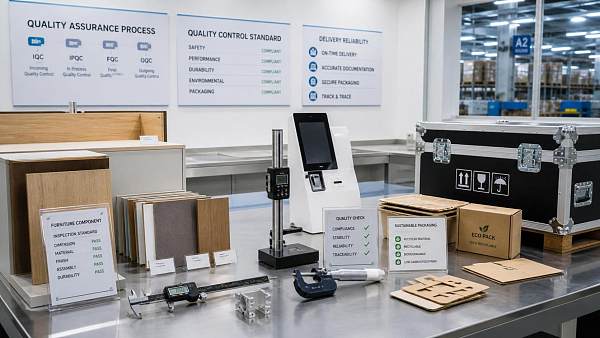
- Quality assurance: Can they maintain stable output across batches, regions, and production cycles?
- Compliance and certification: Are they familiar with standards such as UL, CE, BIFMA, material safety requirements, and packaging regulations where relevant?
- Operational reliability: Can they meet deadlines, manage inventory visibility, and recover from disruptions?
- Communication and transparency: Do they provide accurate data, timely updates, and realistic commitments?
- Strategic alignment: Can they support your growth, sustainability priorities, and channel expansion over time?
If a supplier looks strong in one area but weak in several others, the total cost of partnership often becomes much higher than expected. A low-cost supplier that causes stockouts, rework, compliance issues, or poor in-store performance can damage both revenue and brand trust.
How to assess whether a partner is the right fit for your product category
Not every capable manufacturer or distributor is the right supply chain partner for your business. Consumer goods supply chains are highly category-specific. A supplier that performs well in general merchandise may not be prepared for technical retail hardware, sustainable packaging, commercial furniture components, or smart POS systems.
Start by checking whether the partner has real operating experience in products similar to yours. Look for evidence such as:
- Existing customers in comparable industries or channels
- Case studies involving similar technical or aesthetic requirements
- Experience with multi-market compliance and shipping complexity
- Ability to handle your expected order volume and replenishment rhythm
- Knowledge of packaging durability, display conditions, and commercial use cases
This is especially important in commercial environments where products must perform not only functionally, but also visually and operationally. For example, fixtures, signage, lighting, and retail technology often need to meet brand guidelines, installation requirements, and regulatory expectations at the same time. A category-aligned partner is more likely to understand these constraints before problems emerge.
Why quality systems and compliance matter more than a low quote
For most consumer goods organizations, supplier risk does not begin at the invoice. It begins when product quality varies across orders, when documentation is incomplete, or when a component fails in the field. That is why quality systems and compliance capabilities should be examined early, not after commercial negotiation.
Ask practical questions such as:
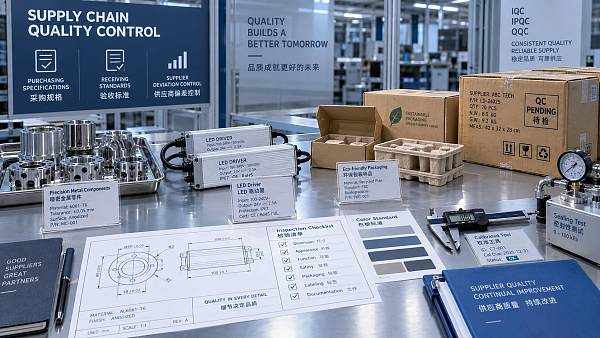
- What inspections are performed before shipment?
- How are defects tracked and corrected?
- Can the supplier provide batch traceability?
- What certifications or test reports are available?
- How do they manage material substitutions?
- What happens when a nonconforming shipment is discovered?
In global sourcing, compliance is not just a technical issue. It affects customs clearance, liability exposure, project acceptance, and customer confidence. This is especially relevant for products used in public-facing or high-traffic commercial settings, where durability, safety, and specification consistency directly influence operational performance.
Strong partners should be able to discuss standards confidently and provide evidence, not vague assurances. If they cannot explain how they control quality and compliance, they may not be ready for complex consumer goods programs.
How to evaluate supply chain resilience, lead times, and delivery performance
One of the biggest concerns for sourcing teams and operational users is whether a partner can actually deliver on time and adapt when conditions change. Modern consumer goods supply chains face disruption from freight volatility, material shortages, demand swings, geopolitical factors, and regional regulation changes. A good partner is not one that promises perfection, but one that manages disruption with discipline and visibility.
To evaluate operational resilience, review these factors:
- Lead time stability: Are quoted lead times realistic and consistent?
- Capacity planning: Can the supplier scale up during peak periods?
- Raw material sourcing: Do they rely on single-source inputs?
- Inventory strategy: Can they support safety stock, buffer planning, or regional warehousing?
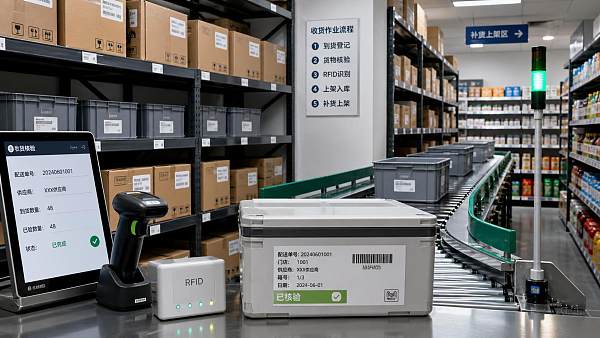
- Logistics coordination: Do they understand export documentation, routing, and destination requirements?
- Exception handling: How do they respond when a shipment is delayed or specifications change?
Ask for historical performance data where possible, including on-time delivery rates, corrective action records, and examples of disruption recovery. Operational maturity often becomes visible in how a supplier handles bad scenarios, not ideal ones.
What transparency and communication reveal about a future partnership
Many supplier relationships fail not because of technical inability, but because information does not move clearly between teams. This is particularly important when multiple stakeholders are involved, such as procurement, design, quality control, store development, and logistics.
A reliable consumer goods supply chain partner should communicate with enough structure to support decision-making. Useful indicators include:
- Fast and accurate quotation turnaround
- Clear answers on specifications, tolerances, and materials
- Documented timelines rather than verbal estimates only
- Willingness to share production status and risk alerts early
- Defined escalation contacts for operational issues
- After-sales and warranty processes that are easy to understand
For information researchers, this matters because communication quality often predicts execution quality. If a partner is vague during the evaluation stage, transparency is unlikely to improve once orders become more complex.
How to compare suppliers with a practical scoring framework
To avoid subjective decisions, create a weighted scorecard that reflects your actual business priorities. This helps teams compare supply chain partners fairly across technical, operational, and commercial dimensions.
A practical scorecard may include:
- Category expertise: 20%
- Quality and compliance capability: 20%
- Lead time and delivery reliability: 20%
- Cost competitiveness and total landed cost: 15%
- Communication and service responsiveness: 10%
- Sustainability and material transparency: 10%
- Innovation or long-term scalability: 5%
The weighting should change based on your use case. For example, high-end consumer brands may prioritize finish quality, brand consistency, and sustainable materials more heavily. Retail operators deploying smart hardware may put greater weight on compliance, field performance, and technical support. The key is to assess total value, not only unit price.
Common mistakes to avoid when choosing supply chain partners for consumer goods
Even experienced teams can make avoidable mistakes during supplier selection. The most common ones include:
- Choosing based on price before validating capability
- Assuming certifications apply to all product variations
- Ignoring communication issues during the trial phase
- Failing to check actual production capacity
- Overlooking packaging, labeling, or destination-market requirements
- Not clarifying ownership of tooling, specifications, or change control
- Relying on a single supplier without backup planning
These errors often lead to delays, rework, service failures, and unexpected cost increases. A more disciplined qualification process may take longer upfront, but it usually reduces operational friction and protects long-term performance.
Final checklist for selecting the right partner
Before making a final decision, confirm that your shortlisted supply chain partner can answer yes to most of the following:
- Do they understand your product, market, and usage environment?
- Can they prove quality consistency with data and process controls?
- Do they meet relevant compliance and documentation requirements?
- Are their lead times believable and operationally supported?
- Do they communicate clearly and escalate issues quickly?
- Can they support future growth, sustainability targets, or market expansion?
- Do they reduce total supply chain risk rather than simply offering a low price?
Choosing supply chain partners for consumer goods should be treated as a strategic decision, not a transactional purchase. The right partner strengthens resilience, protects product quality, supports compliance, and improves the end-user experience across the entire commercial ecosystem. For brands, operators, and sourcing professionals working in modern retail and consumer environments, the best choice is usually the partner that combines transparency, operational discipline, and long-term alignment—not just the cheapest offer on paper.
News Recommendations
 What consumer packaging USA importers need to verify before ordering
![51a6ab95581761cc26f4318be6520c15]()
Aris Katos
Future of Carbide Coatings
 How commercial spaces interiors shape customer dwell time
![51a6ab95581761cc26f4318be6520c15]()
Aris Katos
Future of Carbide Coatings
 How LED commercial lighting design reduces glare in retail spaces
![51a6ab95581761cc26f4318be6520c15]()
Aris Katos
Future of Carbide Coatings
 How industrial technology information improves RFID inventory accuracy
![51a6ab95581761cc26f4318be6520c15]()
Aris Katos
Future of Carbide Coatings
 When drip garden watering systems make more sense than sprinklers
![51a6ab95581761cc26f4318be6520c15]()
Aris Katos
Future of Carbide Coatings
 When category comparison improves sourcing for industrial applications
![51a6ab95581761cc26f4318be6520c15]()
Aris Katos
Future of Carbide Coatings
 Industrial application guidance for selecting the right LED lighting
![51a6ab95581761cc26f4318be6520c15]()
Aris Katos
Future of Carbide Coatings
 Which commercial architecture standards apply to European retail fit-outs?
![51a6ab95581761cc26f4318be6520c15]()
Aris Katos
Future of Carbide Coatings
 How to verify FDA requirements for maternity care products
![51a6ab95581761cc26f4318be6520c15]()
Aris Katos
Future of Carbide Coatings
 How to verify BPA-free claims for food-contact products
![51a6ab95581761cc26f4318be6520c15]()
Aris Katos
Future of Carbide Coatings
 When does a European wholesale supplier suit modular office projects?
![51a6ab95581761cc26f4318be6520c15]()
Aris Katos
Future of Carbide Coatings
 When consumer ecosystem solutions improve the in-store shopping journey
![51a6ab95581761cc26f4318be6520c15]()
Aris Katos
Future of Carbide Coatings
 How a commercial developers network can reduce site selection risk
![51a6ab95581761cc26f4318be6520c15]()
Aris Katos
Future of Carbide Coatings
 How clear purchasing specifications prevent costly supplier deviations
![51a6ab95581761cc26f4318be6520c15]()
Aris Katos
Future of Carbide Coatings
 What an ISTA drop test lab checks before your packaging ships
![51a6ab95581761cc26f4318be6520c15]()
Aris Katos
Future of Carbide Coatings
 Which commercial furniture standards apply to workplace seating?
![51a6ab95581761cc26f4318be6520c15]()
Aris Katos
Future of Carbide Coatings
 How to evaluate smart lighting module OEM compatibility before sampling
![51a6ab95581761cc26f4318be6520c15]()
Aris Katos
Future of Carbide Coatings
 How to assess whether sustainable technology delivers real impact
![51a6ab95581761cc26f4318be6520c15]()
Aris Katos
Future of Carbide Coatings
 How to assess an OEM supplier’s quality control before ordering
![51a6ab95581761cc26f4318be6520c15]()
Aris Katos
Future of Carbide Coatings
 How consumer ecosystem solutions data can improve retail personalization
![51a6ab95581761cc26f4318be6520c15]()
Aris Katos
Future of Carbide Coatings
 When does consumer packaging design justify a higher product price?
![51a6ab95581761cc26f4318be6520c15]()
Aris Katos
Future of Carbide Coatings
 Supermarket Fixture Installation: Planning Layouts, Wiring, and Handover
![51a6ab95581761cc26f4318be6520c15]()
Aris Katos
Future of Carbide Coatings
 Automated Lighting and Smart Lighting Control in Bergerac: Key Project Considerations
![51a6ab95581761cc26f4318be6520c15]()
Aris Katos
Future of Carbide Coatings
 Segment Streetlight Controllers: Choosing Control Modes for Urban Roads
![51a6ab95581761cc26f4318be6520c15]()
Aris Katos
Future of Carbide Coatings
 IEC 62471-2 Explained: How to Assess Photobiological Risks in LED Lighting
![51a6ab95581761cc26f4318be6520c15]()
Aris Katos
Future of Carbide Coatings
 Food Grade Packaging Requirements by Product Type, Temperature, and Contact Risk
![51a6ab95581761cc26f4318be6520c15]()
Aris Katos
Future of Carbide Coatings
 Food Packaging Compliance Checklist: Tests, Records, and Labeling Before Shipment
![51a6ab95581761cc26f4318be6520c15]()
Aris Katos
Future of Carbide Coatings
 NSF Food Packaging Standards: When Certification Matters for Commercial Food Use
![51a6ab95581761cc26f4318be6520c15]()
Aris Katos
Future of Carbide Coatings
 FDA Food Grade Compliance: Which Materials and Documents Do Buyers Need?
![51a6ab95581761cc26f4318be6520c15]()
Aris Katos
Future of Carbide Coatings
 What Should a Food Grade Declaration Include for Packaging Compliance?
![51a6ab95581761cc26f4318be6520c15]()
Aris Katos
Future of Carbide Coatings
 Housewares Importing: How to Evaluate Suppliers, Costs, and Compliance Risks
![51a6ab95581761cc26f4318be6520c15]()
Aris Katos
Future of Carbide Coatings
 Why Freeze-Dried Fruit Ingredients Lose Crispness—and How to Prevent It
![51a6ab95581761cc26f4318be6520c15]()
Aris Katos
Future of Carbide Coatings
 What industry veterans look for before choosing a new supplier
![51a6ab95581761cc26f4318be6520c15]()
Aris Katos
Future of Carbide Coatings
 How material fatigue can shorten the service life of retail shelving
![51a6ab95581761cc26f4318be6520c15]()
Aris Katos
Future of Carbide Coatings
 What makes a global sourcing platform reliable for supplier verification?
![51a6ab95581761cc26f4318be6520c15]()
Aris Katos
Future of Carbide Coatings
 When are double platinum spark plugs a better choice than iridium?
![51a6ab95581761cc26f4318be6520c15]()
Aris Katos
Future of Carbide Coatings
 How to assess a POS terminal manufacturer in Europe for long-term support
![51a6ab95581761cc26f4318be6520c15]()
Aris Katos
Future of Carbide Coatings
 How data transparency in retail helps prevent inventory discrepancies
![51a6ab95581761cc26f4318be6520c15]()
Aris Katos
Future of Carbide Coatings
 What makes a product comparison guide actually useful for buying decisions
![51a6ab95581761cc26f4318be6520c15]()
Aris Katos
Future of Carbide Coatings