Biodegradation time benchmarks vary more than most labels suggest
Time
Click Count
Biodegradation time benchmarks often vary far more than product labels imply, making packaging decisions harder for researchers, buyers, and evaluators. This article explores how metrics such as packaging carbon footprint calculator results, OK compost industrial certification, FSC certified paper sourcing, and extended producer responsibility (EPR) shape credible comparisons and smarter compliance-driven sourcing.
For cross-border sourcing teams, retail developers, and product assessment professionals, the challenge is not simply finding a “green” material. The real task is comparing packaging claims across different test conditions, waste systems, fiber origins, and regulatory obligations. A tray that breaks down in 90 days under industrial composting may remain intact for 12 months or longer in landfill-like conditions, while a paper-based format with strong recycling credentials may outperform a compostable alternative in total supply-chain efficiency.
Within the broader commercial ecosystem, this issue affects specification work, procurement screening, compliance planning, and long-term brand risk. G-BCE’s benchmarking perspective is especially relevant here because sustainable packaging cannot be evaluated in isolation. It must be assessed alongside logistics, product protection, labeling integrity, end-of-life pathways, and compatibility with international commercial standards and sourcing expectations.
Why biodegradation labels often fail as procurement benchmarks
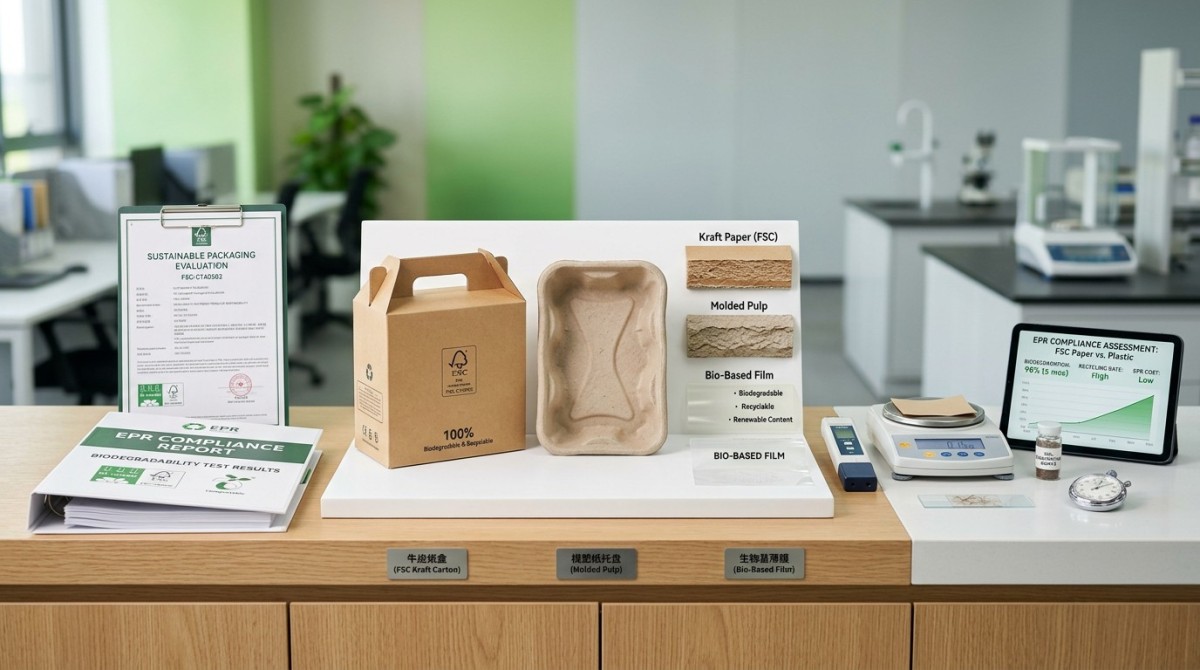
Many labels compress a complex performance profile into a simple phrase such as “biodegradable,” “compostable,” or “eco-friendly.” For procurement teams, that wording is too broad to support a sourcing decision. Biodegradation time can vary by 3 major factors at minimum: material chemistry, exposure environment, and test protocol. A coated paper cup, molded fiber insert, and PLA film can all carry sustainability messaging, yet their breakdown timelines may differ from 60 days to more than 2 years depending on oxygen level, moisture, heat, and microbial activity.
This gap matters in commercial supply chains because labels are often read as end-state promises rather than condition-based outcomes. In practice, one buyer may assume household disposal compatibility, while another interprets the same claim as industrial compost readiness. If the destination market lacks compost infrastructure within a 50–100 km recovery radius, the environmental advantage may be significantly reduced, even if the packaging performs well in a lab-certified environment.
Researchers and evaluators should also distinguish between biodegradation, disintegration, and recyclability. A material may fragment in 12 weeks without fully biodegrading into biomass, water, and CO2 under the relevant standard. Likewise, a package may be technically recyclable yet contaminated by barriers, inks, or adhesives that lower recovery yield. These are not semantic differences; they shape collection cost, downstream sorting loss, and compliance exposure.
In B2B purchasing, the safest approach is to replace claim-based comparison with benchmark-based comparison. That means reviewing the actual disposal scenario, the expected recovery channel, the shelf-life requirement, and the product’s physical performance under transport stress. For many commercial users, a 6-point benchmark framework is more useful than a front-of-pack claim.
Key variables behind biodegradation time variation
- Temperature range: industrial composting commonly operates around 50–60°C, far above ambient disposal conditions.
- Moisture and oxygen exposure: sealed landfill-like environments can slow degradation dramatically.
- Material composition: blends, coatings, wet-strength additives, and barrier layers alter breakdown speed.
- Item geometry: thickness, density, and surface area influence microbial access and disintegration rate.
- Contamination risk: food residue, inks, tapes, and labels can change recovery outcomes.
- Collection infrastructure: a material with good lab performance may fail in markets without the right waste stream.
Why this affects commercial decision-making
For sourcing directors and business evaluators, misreading these variables can lead to 4 costly outcomes: non-compliant claims, unsuitable material selection, higher disposal fees, and reputational criticism. The issue becomes more serious in multi-market product launches, where one packaging SKU may enter regions with very different EPR rules, compost access, and recycling capabilities.
How to compare claims using measurable packaging sustainability indicators
A stronger method is to compare packaging through multiple indicators rather than a single biodegradation statement. For example, a packaging carbon footprint calculator can estimate cradle-to-gate or broader life-cycle impact per unit, often expressed per 1,000 pieces or per kilogram of material. While these tools vary in sophistication, they help procurement teams identify trade-offs between fiber-based, bio-based, and multilayer formats before contracts are finalized.
OK compost industrial certification is another useful filter because it signals performance under a recognized industrial composting environment rather than vague marketing language. However, buyers should still confirm whether the certification scope matches the complete packaging format. A certified film alone is not equivalent to a fully certified finished pack if inks, closures, or adhesives differ from the tested configuration.
FSC certified paper sourcing adds a different dimension. It does not prove biodegradation speed, but it supports fiber traceability, responsible forestry, and chain-of-custody discipline. In many retail and premium consumer environments, FSC-certified paperboard combined with high recyclability may be a stronger commercial choice than a compostable structure that lacks stable end-of-life infrastructure.
Extended producer responsibility further changes how these indicators should be weighted. Under EPR schemes, producers or importers may bear financial or reporting responsibility for packaging placed on the market. That means recovery compatibility, material complexity, label accuracy, and data transparency can directly affect cost and administrative burden over a 12-month reporting cycle.
A practical comparison framework
The table below shows how commonly used indicators support different procurement questions. It is not a universal scoring model, but it helps teams align technical review with commercial use cases.
The main lesson is that no single metric answers every sourcing question. A procurement team comparing 3 packaging options for food service, premium retail, or e-commerce should evaluate at least 4 dimensions together: carbon, disposal pathway, fiber sourcing, and producer responsibility impact. This creates a more stable benchmark than relying on biodegradation time alone.
What buyers, researchers, and evaluators should test before approval
In commercial packaging selection, approval should involve both environmental review and functional review. A pack that performs well in a sustainability data sheet but fails in humidity resistance, print durability, or transit protection can increase waste rather than reduce it. For most B2B packaging programs, a 5-step qualification path is more reliable than reviewing claims at sample stage only.
First, define the actual use scenario. Is the pack intended for shelf display, direct food contact, last-mile shipping, premium gift presentation, or refill logistics? Each scenario changes the acceptable performance range. A luxury retail box may require stronger edge crush resistance and surface finish consistency, while a quick-service takeaway format may prioritize grease barrier and short-use disposal compatibility.
Second, request data on composition and structure. Buyers should ask about fiber percentage, bio-based content, coating type, adhesive system, total basis weight, and whether the tested sample matches the final production version. A difference of even 10%–15% in barrier coating weight can affect recyclability and breakdown behavior.
Third, validate destination-market fit. A packaging solution intended for 6 countries may face 6 different interpretations of labeling, recovery access, and EPR reporting. This is especially important for global brands that centralize packaging design but distribute regionally. Technical procurement must therefore sit alongside regulatory review, not after it.
Recommended approval checklist
- Confirm the end-of-life claim and the exact condition it depends on, such as industrial composting versus general biodegradation.
- Compare at least 2 alternative materials with a packaging carbon footprint calculator using the same assumptions.
- Review chain-of-custody documentation when FSC certified paper is part of the sourcing requirement.
- Check whether all pack components, not just the main substrate, align with the intended certification pathway.
- Map EPR implications, including reporting format, fee category, and packaging material declaration requirements.
Common specification mistakes
A frequent mistake is approving a material based on a supplier presentation without reviewing full-component compatibility. Another is treating “paper-based” as automatically low impact, even when multilayer barriers complicate recovery. A third is ignoring storage and transit conditions; for example, humidity above 70% for several days can alter the structural behavior of some fiber formats and change real-world waste rates.
The table below outlines practical checks that help align technical claims with sourcing reality.
For evaluators, the most valuable finding often comes from inconsistency. If the technical sheet, certification scope, and market disposal reality do not align, the package may still be usable, but it should not be benchmarked against less complex alternatives as if the claims were equivalent.
How EPR, fiber sourcing, and carbon accounting change packaging strategy
A modern packaging strategy must account for more than substrate choice. Extended producer responsibility is turning packaging from a procurement line item into an operational data issue. In some markets, companies need annual or periodic declarations by material category, weight band, or packaging function. That means inconsistent packaging specifications across SKUs can increase reporting effort by 20%–40% compared with a more standardized design system.
This is where FSC certified paper sourcing becomes strategically relevant. For many commercial brands, it supports both environmental narrative and supply-chain discipline. Traceable fiber programs can simplify supplier review, especially when procurement teams are managing multiple converters across Asia, Europe, and North America. However, FSC content should be assessed together with basis weight, printing process, lamination needs, and actual recovery pathway. Responsible sourcing alone does not guarantee lower total impact.
Packaging carbon footprint calculator outputs can also change packaging conversations inside procurement committees. A lightweight flexible solution may show lower transport-related emissions, but if it is difficult to recover under local systems, a heavier paper-based option could be preferred in a region that rewards high recyclability and clear EPR classification. Strategic packaging therefore depends on system fit, not symbolism.
For G-BCE-aligned commercial ecosystems, the priority is benchmarking materials within real operating environments: retail distribution, branded presentation, storage humidity, regional compliance, and recovery economics. This cross-sector view matters because packaging is rarely a standalone sustainability decision. It affects store operations, transport efficiency, customer perception, and regulatory administration over multi-year sourcing cycles.
Three strategic sourcing models
- Recyclability-led model: suitable where paper and board recovery systems are mature and EPR classification favors simpler material structures.
- Compostability-led model: suitable for controlled-service environments where certified collection and industrial composting access are realistic.
- Hybrid benchmarking model: suitable for multinational brands comparing carbon, sourcing, recovery, and compliance across 3 or more destination markets.
What commercial teams should standardize
At minimum, teams should standardize 4 data fields in supplier onboarding: material composition, unit weight, certification status, and intended end-of-life route. Without those basics, it becomes difficult to compare bids consistently or to defend packaging choices during internal audits and customer-facing sustainability reviews.
FAQ for packaging benchmarking and compliance-driven sourcing
How should buyers interpret a biodegradation time claim?
Treat it as a condition-based result, not a universal disposal promise. Ask where the test was conducted, what temperature range applied, how long the cycle lasted, and whether the full packaging structure was included. A 90-day industrial compost result should not be treated as evidence of rapid breakdown in home compost, open environment, or landfill conditions.
When is FSC certified paper a better choice than a compostable material?
It is often a better fit when the destination market has strong paper recovery infrastructure, when premium print quality is needed, or when EPR systems reward simpler material categories. In many retail and e-commerce applications, a recyclable FSC-certified paper format may offer clearer compliance and better supply-chain consistency than a compostable option with limited collection support.
What should evaluators verify in a packaging carbon footprint calculator output?
Check the boundaries, assumptions, and comparison basis. The result should use the same unit across alternatives, such as per 1,000 units or per kilogram delivered. Also verify whether transport distance, recycled content, conversion energy, and end-of-life assumptions are included. Without aligned assumptions, side-by-side supplier comparison can be misleading.
How long does packaging qualification usually take in B2B sourcing?
For standard commercial packaging, an initial screening and sample review may take 2–4 weeks. If performance testing, regulatory review, graphic validation, and multi-market compliance checks are included, the process can extend to 6–10 weeks. Complex launches with several SKUs or region-specific labeling often take longer.
Biodegradation time benchmarks are useful only when they are interpreted within a broader material, compliance, and infrastructure context. For information researchers, sourcing teams, and business evaluators, the smarter path is to compare packaging through multiple lenses: verified compostability where relevant, FSC fiber traceability, carbon footprint estimation, EPR impact, and real-world packaging performance under commercial conditions.
G-BCE supports this decision model by connecting sustainable packaging analysis with the wider commercial ecosystem, where material choices influence logistics, retail execution, product presentation, and long-term sourcing resilience. If you need a more structured benchmarking approach for packaging selection, supplier comparison, or compliance-driven procurement, contact us to discuss your project, request a tailored evaluation framework, or learn more about practical solutions for modern commercial supply chains.
News Recommendations
 How to choose an ultra bright waterproof window display for storefronts
![51a6ab95581761cc26f4318be6520c15]()
Aris Katos
Future of Carbide Coatings
 How to verify suppliers on a trade portal for global sourcing
![51a6ab95581761cc26f4318be6520c15]()
Aris Katos
Future of Carbide Coatings
 How RoHS requirements should be stated in product specifications
![51a6ab95581761cc26f4318be6520c15]()
Aris Katos
Future of Carbide Coatings
 What affects the lead time for custom retail counter displays?
![51a6ab95581761cc26f4318be6520c15]()
Aris Katos
Future of Carbide Coatings
 What consumer packaging USA importers need to verify before ordering
![51a6ab95581761cc26f4318be6520c15]()
Aris Katos
Future of Carbide Coatings
 How commercial spaces interiors shape customer dwell time
![51a6ab95581761cc26f4318be6520c15]()
Aris Katos
Future of Carbide Coatings
 How LED commercial lighting design reduces glare in retail spaces
![51a6ab95581761cc26f4318be6520c15]()
Aris Katos
Future of Carbide Coatings
 How industrial technology information improves RFID inventory accuracy
![51a6ab95581761cc26f4318be6520c15]()
Aris Katos
Future of Carbide Coatings
 When drip garden watering systems make more sense than sprinklers
![51a6ab95581761cc26f4318be6520c15]()
Aris Katos
Future of Carbide Coatings
 When category comparison improves sourcing for industrial applications
![51a6ab95581761cc26f4318be6520c15]()
Aris Katos
Future of Carbide Coatings
 Industrial application guidance for selecting the right LED lighting
![51a6ab95581761cc26f4318be6520c15]()
Aris Katos
Future of Carbide Coatings
 Which commercial architecture standards apply to European retail fit-outs?
![51a6ab95581761cc26f4318be6520c15]()
Aris Katos
Future of Carbide Coatings
 How to verify FDA requirements for maternity care products
![51a6ab95581761cc26f4318be6520c15]()
Aris Katos
Future of Carbide Coatings
 How to verify BPA-free claims for food-contact products
![51a6ab95581761cc26f4318be6520c15]()
Aris Katos
Future of Carbide Coatings
 When does a European wholesale supplier suit modular office projects?
![51a6ab95581761cc26f4318be6520c15]()
Aris Katos
Future of Carbide Coatings
 When consumer ecosystem solutions improve the in-store shopping journey
![51a6ab95581761cc26f4318be6520c15]()
Aris Katos
Future of Carbide Coatings
 How a commercial developers network can reduce site selection risk
![51a6ab95581761cc26f4318be6520c15]()
Aris Katos
Future of Carbide Coatings
 How clear purchasing specifications prevent costly supplier deviations
![51a6ab95581761cc26f4318be6520c15]()
Aris Katos
Future of Carbide Coatings
 What an ISTA drop test lab checks before your packaging ships
![51a6ab95581761cc26f4318be6520c15]()
Aris Katos
Future of Carbide Coatings
 Which commercial furniture standards apply to workplace seating?
![51a6ab95581761cc26f4318be6520c15]()
Aris Katos
Future of Carbide Coatings
 How to evaluate smart lighting module OEM compatibility before sampling
![51a6ab95581761cc26f4318be6520c15]()
Aris Katos
Future of Carbide Coatings
 How to assess whether sustainable technology delivers real impact
![51a6ab95581761cc26f4318be6520c15]()
Aris Katos
Future of Carbide Coatings
 How to assess an OEM supplier’s quality control before ordering
![51a6ab95581761cc26f4318be6520c15]()
Aris Katos
Future of Carbide Coatings
 How consumer ecosystem solutions data can improve retail personalization
![51a6ab95581761cc26f4318be6520c15]()
Aris Katos
Future of Carbide Coatings
 When does consumer packaging design justify a higher product price?
![51a6ab95581761cc26f4318be6520c15]()
Aris Katos
Future of Carbide Coatings
 Supermarket Fixture Installation: Planning Layouts, Wiring, and Handover
![51a6ab95581761cc26f4318be6520c15]()
Aris Katos
Future of Carbide Coatings
 Automated Lighting and Smart Lighting Control in Bergerac: Key Project Considerations
![51a6ab95581761cc26f4318be6520c15]()
Aris Katos
Future of Carbide Coatings
 Segment Streetlight Controllers: Choosing Control Modes for Urban Roads
![51a6ab95581761cc26f4318be6520c15]()
Aris Katos
Future of Carbide Coatings
 IEC 62471-2 Explained: How to Assess Photobiological Risks in LED Lighting
![51a6ab95581761cc26f4318be6520c15]()
Aris Katos
Future of Carbide Coatings
 Food Grade Packaging Requirements by Product Type, Temperature, and Contact Risk
![51a6ab95581761cc26f4318be6520c15]()
Aris Katos
Future of Carbide Coatings
 Food Packaging Compliance Checklist: Tests, Records, and Labeling Before Shipment
![51a6ab95581761cc26f4318be6520c15]()
Aris Katos
Future of Carbide Coatings
 NSF Food Packaging Standards: When Certification Matters for Commercial Food Use
![51a6ab95581761cc26f4318be6520c15]()
Aris Katos
Future of Carbide Coatings
 FDA Food Grade Compliance: Which Materials and Documents Do Buyers Need?
![51a6ab95581761cc26f4318be6520c15]()
Aris Katos
Future of Carbide Coatings
 What Should a Food Grade Declaration Include for Packaging Compliance?
![51a6ab95581761cc26f4318be6520c15]()
Aris Katos
Future of Carbide Coatings
 Housewares Importing: How to Evaluate Suppliers, Costs, and Compliance Risks
![51a6ab95581761cc26f4318be6520c15]()
Aris Katos
Future of Carbide Coatings
 Why Freeze-Dried Fruit Ingredients Lose Crispness—and How to Prevent It
![51a6ab95581761cc26f4318be6520c15]()
Aris Katos
Future of Carbide Coatings
 What industry veterans look for before choosing a new supplier
![51a6ab95581761cc26f4318be6520c15]()
Aris Katos
Future of Carbide Coatings
 How material fatigue can shorten the service life of retail shelving
![51a6ab95581761cc26f4318be6520c15]()
Aris Katos
Future of Carbide Coatings
 What makes a global sourcing platform reliable for supplier verification?
![51a6ab95581761cc26f4318be6520c15]()
Aris Katos
Future of Carbide Coatings