OK compost industrial certification: what actually fails in testing
Time
Click Count
OK compost industrial certification is often treated as a simple sustainability claim, but in practice many packaging products fail for reasons that are not obvious in early sourcing reviews. The main problems are rarely limited to “is it compostable or not.” Failures usually appear in the interaction between material chemistry, biodegradation timing, disintegration behavior, and packaging performance data such as moisture vapor transmission rate (MVTR) and burst strength. For procurement teams, that matters because a failed certification path can affect market access, sustainability claims, EU plastic tax positioning, and extended producer responsibility (EPR) reporting. The practical takeaway is straightforward: if you only review the certificate target, and not the test-risk profile behind it, you are more likely to select a format that underperforms in both compliance and commercial use.
What buyers are really asking: why do products fail OK compost industrial testing after looking compliant on paper?
The core search intent behind this topic is practical, not academic. Information researchers, procurement teams, and business evaluators usually want to know three things: what actually causes failure, how to spot risk before lab testing, and how those results affect sourcing and compliance decisions.
For this audience, the most important issue is not a generic explanation of compostability standards. It is understanding why a package that appears sustainable in a supplier presentation may still fail in formal testing. In most cases, failure comes from one of four areas:
- Biodegradation does not meet the required timeframe, even if the base resin is marketed as compostable.
- Disintegration is incomplete, leaving visible fragments after the industrial composting test cycle.
- Chemical composition creates compliance risk, such as problematic additives, inks, adhesives, or coatings.
- Functional packaging performance pushes the design away from compostability, especially when stronger barrier or strength requirements require non-compostable layers or treatment systems.
That is why the most useful evaluation framework combines certification likelihood, packaging performance, regulatory exposure, and total sourcing practicality. Buyers do not need more sustainability slogans. They need a failure map.
The most common technical reasons OK compost industrial applications fail
Although every material system is different, failed applications usually cluster around a short list of technical causes.
1. The full structure is not compostable, even if one layer is.
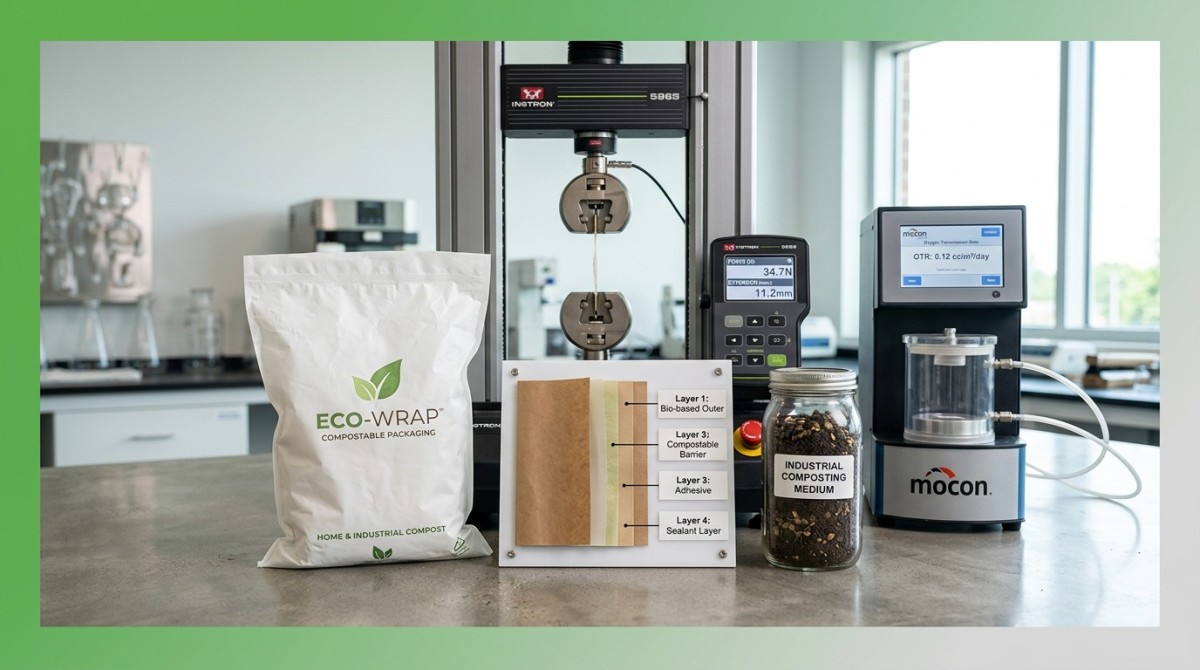
Many packaging formats are assessed too loosely during sourcing. A supplier may highlight a compostable film or resin, while the complete structure includes barrier coatings, lamination tie layers, pressure-sensitive adhesives, zipper components, labels, or printing systems that compromise certification. OK compost industrial certification applies to the tested article, not just its headline material.
2. Biodegradation timing misses the benchmark.
Industrial compostability is not only about eventual breakdown. The material must biodegrade within defined test parameters and timelines. Thicker gauges, crystallinity, fillers, coatings, and poor formulation control can slow microbial conversion enough to fail the benchmark, even when the material family is generally considered compostable.
3. Disintegration performance is weaker than expected.
A package may chemically biodegrade over time but still fail disintegration criteria if visible fragments remain after composting simulation. This is a common issue in rigid or semi-rigid formats, multilayer constructions, labels, and closure areas where thickness is uneven.
4. Additives, inks, and adhesives are overlooked.
This is one of the most frequent commercial mistakes. Procurement teams often review the substrate but not the conversion package. Colorants, slip agents, metallized effects, heat-seal systems, and adhesive chemistry can all affect test outcomes. In practice, secondary inputs can be the difference between a passing sample and a failed one.
5. Packaging performance requirements force trade-offs.
A structure designed to protect moisture-sensitive, oxygen-sensitive, greasy, or heavy products often requires enhanced barrier and mechanical integrity. That is where metrics like MVTR and Mullen burst strength become commercially important. If a design is optimized too aggressively for shelf life or transport robustness, it may move outside what can reliably pass industrial compostability testing.
Why MVTR and burst strength matter more than many sustainability teams expect
For buyers evaluating packaging formats, compostability is rarely the only requirement. A pack still has to survive filling, logistics, display, and end use. This is why hidden technical metrics matter.
Moisture vapor transmission rate (MVTR) influences how well a package protects moisture-sensitive goods. If MVTR is too high, product quality can decline before sale. To lower MVTR, converters may add coatings or structural layers that improve barrier but reduce compostability performance or complicate certification.
Burst strength, often discussed through Mullen data in paper-based packaging, affects resistance to rupture during handling and distribution. If the board or paper structure lacks sufficient strength, the package may fail in transport or palletization. To solve that, suppliers may introduce reinforcements, treatments, or hybrid constructions that create compostability issues.
The sourcing problem is not that MVTR or burst strength are bad metrics. The problem is that they are often evaluated too late. A sustainable packaging concept may look ideal at the claim level, but once real barrier and strength targets are added, the construction changes significantly. Certification risk rises at exactly that point.
For procurement and evaluation teams, the practical lesson is clear: assess compostability together with functional packaging data from the start. If you separate sustainability review from packaging engineering review, you increase the odds of failure, redesign, and delayed commercialization.
How failed testing affects EU plastic tax, EPR, and commercial risk
Certification failure is not just a technical inconvenience. It can reshape the business case for a packaging format.
EU plastic tax implications
Teams often explore compostable materials as part of a wider strategy around plastics reduction, recycled content planning, and tax exposure management. But if a material fails industrial compostability validation, the business may lose a planned sustainability positioning advantage. It may also need to revisit material classification assumptions used during cost modeling and regulatory planning.
Extended Producer Responsibility (EPR) implications
EPR frameworks increasingly reward clear, evidence-based packaging design and penalize formats that are difficult to classify, sort, or justify environmentally. A failed compostability route can weaken a packaging narrative if the product was intended to be presented as a lower-impact or end-of-life-optimized solution. That can affect fee structures, reporting confidence, and retailer acceptance depending on the market.
Commercial and reputational implications
A sourcing team that commits to a compostable format too early may face reformulation costs, delayed qualification, revised artwork claims, or retailer scrutiny if testing does not support the intended certification. The risk is highest when procurement decisions are made from marketing claims, generic declarations, or partial lab data instead of certification-oriented evidence.
What procurement teams should ask suppliers before shortlisting a compostable packaging option
To reduce failure risk, buyers should push beyond “Is this material certified?” and ask structure-level questions.
- Is the exact finished packaging structure already certified, or only the base material?
- What are the thickness ranges and tolerances used in the tested sample?
- Do inks, adhesives, coatings, labels, and closures match the tested configuration?
- What are the verified MVTR, oxygen barrier, and mechanical strength values for the final converted pack?
- Has the supplier tested performance after printing, sealing, storage, and transport simulation?
- What failure modes appeared in prior certification attempts or pilot runs?
- How does the supplier position the packaging in relation to EPR and local end-of-life infrastructure?
These questions are valuable because they reveal whether the supplier understands certification as a complete system requirement or only as a material claim. That distinction matters greatly in commercial packaging programs.
Where a packaging carbon footprint calculator helps, and where it does not
A packaging carbon footprint calculator can support better sourcing decisions, but it should not be used as a substitute for compostability evidence. Its best use is comparative planning.
For example, a calculator can help teams compare:
- compostable versus recyclable material pathways,
- monomaterial versus multilayer structures,
- lightweighting trade-offs,
- regional sourcing and transport scenarios,
- different end-of-life assumptions in lifecycle planning.
That kind of modeling is useful because a packaging option with a strong sustainability story may not always have the best overall environmental profile once logistics, conversion intensity, product loss risk, and disposal realities are included.
However, the calculator cannot tell you whether a structure will pass OK compost industrial testing. It also cannot resolve incompatibilities between compostability goals and packaging performance targets. In other words, carbon tools are decision enhancers, not certification predictors.
A practical decision framework for evaluating OK compost industrial packaging options
For sourcing teams, the best approach is to evaluate each candidate packaging format across five gates:
- Certification feasibility: Can the exact structure realistically pass OK compost industrial requirements?
- Functional performance: Does it meet barrier, seal, strength, and shelf-life needs without hidden compromises?
- Regulatory fit: Does it support the intended approach to EPR, claims substantiation, and market-specific packaging rules?
- Commercial scalability: Can the supplier hold quality, thickness, conversion consistency, and lead times at production scale?
- Total sustainability value: Does the format still perform well when carbon, waste, recovery context, and product protection are considered together?
If a packaging option looks good in only one gate, it is not ready for strategic procurement. The strongest candidates are the ones that remain credible across all five.
OK compost industrial certification failures usually happen because teams focus on the sustainability claim before validating the tested structure, the additives package, and the real-world performance requirements. For procurement professionals and business evaluators, the key insight is that compostability cannot be assessed in isolation. The real decision sits at the intersection of biodegradation benchmarks, disintegration behavior, MVTR, burst strength, regulatory consequences, and total lifecycle trade-offs. If you want fewer redesign cycles and better sourcing outcomes, review the full packaging system early, ask for structure-level evidence, and use carbon and compliance tools to support judgment rather than replace it.
News Recommendations
 How to choose an ultra bright waterproof window display for storefronts
![51a6ab95581761cc26f4318be6520c15]()
Aris Katos
Future of Carbide Coatings
 How to verify suppliers on a trade portal for global sourcing
![51a6ab95581761cc26f4318be6520c15]()
Aris Katos
Future of Carbide Coatings
 How RoHS requirements should be stated in product specifications
![51a6ab95581761cc26f4318be6520c15]()
Aris Katos
Future of Carbide Coatings
 What affects the lead time for custom retail counter displays?
![51a6ab95581761cc26f4318be6520c15]()
Aris Katos
Future of Carbide Coatings
 What consumer packaging USA importers need to verify before ordering
![51a6ab95581761cc26f4318be6520c15]()
Aris Katos
Future of Carbide Coatings
 How commercial spaces interiors shape customer dwell time
![51a6ab95581761cc26f4318be6520c15]()
Aris Katos
Future of Carbide Coatings
 How LED commercial lighting design reduces glare in retail spaces
![51a6ab95581761cc26f4318be6520c15]()
Aris Katos
Future of Carbide Coatings
 How industrial technology information improves RFID inventory accuracy
![51a6ab95581761cc26f4318be6520c15]()
Aris Katos
Future of Carbide Coatings
 When drip garden watering systems make more sense than sprinklers
![51a6ab95581761cc26f4318be6520c15]()
Aris Katos
Future of Carbide Coatings
 When category comparison improves sourcing for industrial applications
![51a6ab95581761cc26f4318be6520c15]()
Aris Katos
Future of Carbide Coatings
 Industrial application guidance for selecting the right LED lighting
![51a6ab95581761cc26f4318be6520c15]()
Aris Katos
Future of Carbide Coatings
 Which commercial architecture standards apply to European retail fit-outs?
![51a6ab95581761cc26f4318be6520c15]()
Aris Katos
Future of Carbide Coatings
 How to verify FDA requirements for maternity care products
![51a6ab95581761cc26f4318be6520c15]()
Aris Katos
Future of Carbide Coatings
 How to verify BPA-free claims for food-contact products
![51a6ab95581761cc26f4318be6520c15]()
Aris Katos
Future of Carbide Coatings
 When does a European wholesale supplier suit modular office projects?
![51a6ab95581761cc26f4318be6520c15]()
Aris Katos
Future of Carbide Coatings
 When consumer ecosystem solutions improve the in-store shopping journey
![51a6ab95581761cc26f4318be6520c15]()
Aris Katos
Future of Carbide Coatings
 How a commercial developers network can reduce site selection risk
![51a6ab95581761cc26f4318be6520c15]()
Aris Katos
Future of Carbide Coatings
 How clear purchasing specifications prevent costly supplier deviations
![51a6ab95581761cc26f4318be6520c15]()
Aris Katos
Future of Carbide Coatings
 What an ISTA drop test lab checks before your packaging ships
![51a6ab95581761cc26f4318be6520c15]()
Aris Katos
Future of Carbide Coatings
 Which commercial furniture standards apply to workplace seating?
![51a6ab95581761cc26f4318be6520c15]()
Aris Katos
Future of Carbide Coatings
 How to evaluate smart lighting module OEM compatibility before sampling
![51a6ab95581761cc26f4318be6520c15]()
Aris Katos
Future of Carbide Coatings
 How to assess whether sustainable technology delivers real impact
![51a6ab95581761cc26f4318be6520c15]()
Aris Katos
Future of Carbide Coatings
 How to assess an OEM supplier’s quality control before ordering
![51a6ab95581761cc26f4318be6520c15]()
Aris Katos
Future of Carbide Coatings
 How consumer ecosystem solutions data can improve retail personalization
![51a6ab95581761cc26f4318be6520c15]()
Aris Katos
Future of Carbide Coatings
 When does consumer packaging design justify a higher product price?
![51a6ab95581761cc26f4318be6520c15]()
Aris Katos
Future of Carbide Coatings
 Supermarket Fixture Installation: Planning Layouts, Wiring, and Handover
![51a6ab95581761cc26f4318be6520c15]()
Aris Katos
Future of Carbide Coatings
 Automated Lighting and Smart Lighting Control in Bergerac: Key Project Considerations
![51a6ab95581761cc26f4318be6520c15]()
Aris Katos
Future of Carbide Coatings
 Segment Streetlight Controllers: Choosing Control Modes for Urban Roads
![51a6ab95581761cc26f4318be6520c15]()
Aris Katos
Future of Carbide Coatings
 IEC 62471-2 Explained: How to Assess Photobiological Risks in LED Lighting
![51a6ab95581761cc26f4318be6520c15]()
Aris Katos
Future of Carbide Coatings
 Food Grade Packaging Requirements by Product Type, Temperature, and Contact Risk
![51a6ab95581761cc26f4318be6520c15]()
Aris Katos
Future of Carbide Coatings
 Food Packaging Compliance Checklist: Tests, Records, and Labeling Before Shipment
![51a6ab95581761cc26f4318be6520c15]()
Aris Katos
Future of Carbide Coatings
 NSF Food Packaging Standards: When Certification Matters for Commercial Food Use
![51a6ab95581761cc26f4318be6520c15]()
Aris Katos
Future of Carbide Coatings
 FDA Food Grade Compliance: Which Materials and Documents Do Buyers Need?
![51a6ab95581761cc26f4318be6520c15]()
Aris Katos
Future of Carbide Coatings
 What Should a Food Grade Declaration Include for Packaging Compliance?
![51a6ab95581761cc26f4318be6520c15]()
Aris Katos
Future of Carbide Coatings
 Housewares Importing: How to Evaluate Suppliers, Costs, and Compliance Risks
![51a6ab95581761cc26f4318be6520c15]()
Aris Katos
Future of Carbide Coatings
 Why Freeze-Dried Fruit Ingredients Lose Crispness—and How to Prevent It
![51a6ab95581761cc26f4318be6520c15]()
Aris Katos
Future of Carbide Coatings
 What industry veterans look for before choosing a new supplier
![51a6ab95581761cc26f4318be6520c15]()
Aris Katos
Future of Carbide Coatings
 How material fatigue can shorten the service life of retail shelving
![51a6ab95581761cc26f4318be6520c15]()
Aris Katos
Future of Carbide Coatings
 What makes a global sourcing platform reliable for supplier verification?
![51a6ab95581761cc26f4318be6520c15]()
Aris Katos
Future of Carbide Coatings