IP65 Waterproof Kiosk Rating: When Is It Really Necessary?
Time
Click Count
For project managers and engineering leads, specifying an ip65 waterproof kiosk rating should be a deliberate risk-based decision, not a box-checking exercise. In many commercial deployments, IP65 is essential. In many others, it is excessive.
The practical question is not whether IP65 sounds safer. It is whether the kiosk will actually face hose-down cleaning, direct rain exposure, windblown dust, or contamination severe enough to justify higher enclosure cost and tighter design constraints.
For decision-makers managing budgets, timelines, and field reliability, the real value lies in matching protection level to operating conditions. When the rating is too low, failures rise. When it is too high, procurement, service, thermals, and total cost often become harder.
This article explains the core search question behind an ip65 waterproof kiosk rating: when is it truly necessary, when is it over-specified, and how should project teams evaluate real deployment risks before locking in requirements.
What project managers really need to know before specifying IP65
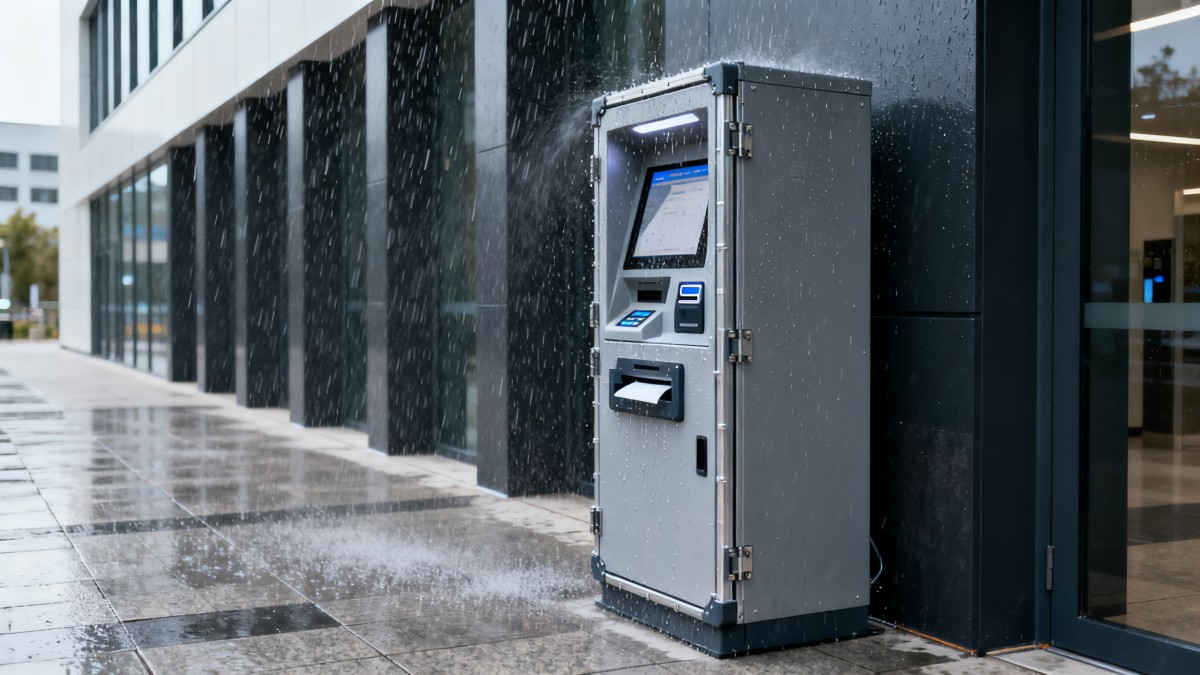
The main search intent behind this topic is straightforward. Buyers and technical leads want to know whether IP65 is required for their kiosk project, or whether a lower rating will deliver better value with fewer tradeoffs.
That means the most useful discussion is not a generic explanation of IP codes. It is a deployment-based decision framework covering environment, cleaning routines, exposure duration, maintenance access, thermal performance, warranty risk, and capital cost.
Project managers usually care about five things most: failure risk, compliance with actual site conditions, procurement cost, serviceability in the field, and whether the specification will delay approvals or customization.
So the right way to evaluate an ip65 waterproof kiosk rating is to ask where the kiosk will be installed, what it will be exposed to, how often it will be cleaned, and what operational consequences follow if moisture or dust ingress occurs.
What IP65 actually means in kiosk applications
IP ratings are enclosure protection standards that indicate resistance to solids and liquids. For kiosks, the “6” means dust-tight protection, while the “5” means protection against water jets from any direction under defined test conditions.
That is important because IP65 does not mean the kiosk is indestructible, submersible, or maintenance-free. It does not automatically guarantee long-term outdoor performance if the overall system design is poor.
In practice, an ip65 waterproof kiosk rating normally requires sealed joints, cable management, gasketed access panels, protected ventilation strategies, and careful integration of displays, printers, payment hardware, and touch interfaces.
It also means every opening becomes a design challenge. Card readers, receipt slots, barcode scanners, speakers, cooling paths, and service doors all affect whether the final kiosk can genuinely perform at the claimed protection level.
When an IP65 waterproof kiosk rating is genuinely necessary
IP65 is usually justified when the kiosk is installed in locations with direct weather exposure. Examples include transport platforms, curbside pickup points, parking facilities, outdoor ticketing stations, and self-service terminals placed without protective overhangs.
It is also often necessary in dust-heavy or contamination-prone sites. Construction-adjacent deployments, industrial campuses, garden centers, agricultural retail, ports, and some logistics environments can expose hardware to airborne particulates that quickly degrade electronics.
Another clear use case is washdown cleaning. If staff routinely clean the kiosk using pressurized spray, aggressive surface washing, or frequent sanitation procedures, lower-rated enclosures may not survive the actual maintenance routine.
Food-related commercial environments can fall into this category as well. Quick-service exteriors, drive-through support terminals, or public kiosks in settings requiring frequent disinfecting often benefit from the extra margin offered by IP65-level sealing.
Finally, IP65 becomes more defensible when downtime is unusually expensive. If a kiosk outage disrupts transportation flow, payment collection, visitor management, or high-volume customer service, resilience can outweigh the premium of a tighter enclosure.
When IP65 is often unnecessary or over-specified
Many kiosk projects use IP65 because it sounds like the safest choice, not because the environment truly requires it. Indoor commercial deployments are the most common example of unnecessary over-specification.
In shopping malls, office lobbies, hotel interiors, clinics, banks, museums, and most retail environments, the kiosk may only need protection against casual touch, light dust, and occasional spill resistance rather than direct water jets.
If the unit is placed under a canopy, recessed into an architectural enclosure, or installed in a semi-protected vestibule, the case for a full ip65 waterproof kiosk rating may weaken significantly.
Over-specifying can create hidden penalties. Sealed enclosures may require more complex thermal engineering, which can increase fan costs, internal heat stress, or the need for specialized cooling systems.
Service access can also become slower. The tighter the enclosure, the more effort is needed to preserve seals during repair, printer replacement, cable routing, or module upgrades. That can affect field labor and maintenance schedules.
In some cases, a targeted approach is better than demanding IP65 for the entire kiosk. A project may only need weather protection for the screen, payment area, or external connectors while allowing the cabinet body to follow a lower rating.
Why the environment matters more than the specification sheet
Two kiosks with the same formal rating can perform very differently in the field because site conditions vary far beyond the laboratory test. This is where project managers need to move from abstract standards to operational reality.
Ask whether the kiosk faces direct rain, wind-driven rain, standing splash from vehicles, sprinkler systems, chemical cleaners, airborne grease, coastal humidity, or large day-night temperature swings that cause internal condensation.
Dust conditions also deserve closer evaluation. Fine dust in transport hubs or industrial zones behaves differently from normal indoor retail dust. If contaminants are persistent and abrasive, seal integrity becomes much more important.
Cleaning practices are especially underrated during specification. A kiosk may never face a storm, yet still fail because janitorial teams use pressure spray, saturated cloth cleaning, or harsh disinfectants that attack seams and vulnerable interfaces.
That is why a site exposure assessment often adds more value than simply requesting the highest rating available. The better the exposure definition, the more accurate the specification and the lower the risk of buying the wrong enclosure.
Cost, maintenance, and thermal tradeoffs project teams should expect
An ip65 waterproof kiosk rating generally increases cost not only through enclosure materials, but also through engineering time, tooling precision, validation testing, sealing components, and more demanding assembly control.
That premium may be justified in the right environment. But procurement teams should understand that higher ingress protection can also affect lead times, especially when integrating peripherals that are not naturally easy to seal.
Thermal performance is another major tradeoff. Sealed or near-sealed kiosk structures limit airflow, which raises internal temperature risk for processors, power supplies, display components, printers, and payment devices.
To compensate, manufacturers may add heat sinks, controlled airflow systems, compartmentalization, or industrial-grade electronics. These solutions improve durability, but they also increase system complexity and replacement cost.
Maintenance teams often encounter another issue: every service event becomes more sensitive. If seals are damaged, reinstalled incorrectly, or contaminated during field repair, the original rating may no longer be preserved in practice.
For long-life commercial programs, that means the decision is not just about day-one protection. It is about whether the service model can reliably sustain that protection level across years of operation.
How to decide if your kiosk project really needs IP65
A practical evaluation starts with four questions. Will the kiosk face direct weather or water spray? Will it operate in heavy dust or contamination? Will staff clean it with water jets or aggressive washdown methods? Is downtime costly enough to justify extra protection?
If the answer is yes to one or more of these questions, IP65 may be appropriate. If the answer is no across the board, a lower rating may be more cost-effective without meaningfully increasing operational risk.
Next, map the deployment by zone rather than treating every location the same. Entry vestibules, covered sidewalks, exposed exteriors, food-service edges, and indoor concourses each create very different protection requirements.
Then review subsystem vulnerability. A kiosk is only as robust as its weakest interface. Printers, card dispensers, speakers, camera windows, ventilation paths, and payment openings often determine whether full-system IP65 is realistic or merely advertised.
Finally, request evidence beyond a marketing claim. Ask suppliers how the rating was tested, which configuration was tested, whether peripherals were included, what maintenance conditions preserve the rating, and how thermal stability was validated.
Questions to ask kiosk suppliers before approving the specification
Project leaders can avoid expensive mistakes by pushing suppliers beyond the headline number. Start with a simple question: what specific deployment conditions was this kiosk designed to survive on a daily basis?
Then ask whether the ip65 waterproof kiosk rating applies to the full assembled kiosk or only to the enclosure shell. Some products are rated in principle, but lose practical protection once peripherals are integrated.
It is also important to ask how service operations affect sealing. Can field technicians replace printers, cables, or internal modules without compromising the gasket system? How many service cycles can the access points realistically withstand?
Request details on drainage, condensation control, and temperature management. Water ingress is not the only moisture issue. A poorly managed sealed cabinet can still fail from heat buildup or internal condensation over time.
Lastly, ask for deployment references that resemble your own environment. A kiosk proven in an airport interior is not equivalent to one performing outdoors in a coastal, dusty, or frequently washed commercial setting.
Conclusion: specify IP65 only when risk justifies it
The best takeaway for project managers is simple: an ip65 waterproof kiosk rating is valuable when exposure conditions truly demand dust-tight sealing and resistance to water jets. It should not be treated as an automatic premium feature.
For harsh outdoor, washdown, or contamination-heavy deployments, IP65 can reduce failures and protect service continuity. For many indoor or partially sheltered commercial environments, it may add cost and complexity without delivering proportional benefit.
The strongest specification decisions come from matching protection level to actual environmental risk, maintenance behavior, and business impact of downtime. That approach protects both the kiosk and the project budget.
In short, do not ask whether IP65 is the highest rating you can buy. Ask whether it is the right rating for the environment you are actually building for. That is the decision that leads to better lifecycle performance.
News Recommendations
 How to choose an ultra bright waterproof window display for storefronts
![51a6ab95581761cc26f4318be6520c15]()
Aris Katos
Future of Carbide Coatings
 How to verify suppliers on a trade portal for global sourcing
![51a6ab95581761cc26f4318be6520c15]()
Aris Katos
Future of Carbide Coatings
 How RoHS requirements should be stated in product specifications
![51a6ab95581761cc26f4318be6520c15]()
Aris Katos
Future of Carbide Coatings
 What affects the lead time for custom retail counter displays?
![51a6ab95581761cc26f4318be6520c15]()
Aris Katos
Future of Carbide Coatings
 What consumer packaging USA importers need to verify before ordering
![51a6ab95581761cc26f4318be6520c15]()
Aris Katos
Future of Carbide Coatings
 How commercial spaces interiors shape customer dwell time
![51a6ab95581761cc26f4318be6520c15]()
Aris Katos
Future of Carbide Coatings
 How LED commercial lighting design reduces glare in retail spaces
![51a6ab95581761cc26f4318be6520c15]()
Aris Katos
Future of Carbide Coatings
 How industrial technology information improves RFID inventory accuracy
![51a6ab95581761cc26f4318be6520c15]()
Aris Katos
Future of Carbide Coatings
 When drip garden watering systems make more sense than sprinklers
![51a6ab95581761cc26f4318be6520c15]()
Aris Katos
Future of Carbide Coatings
 When category comparison improves sourcing for industrial applications
![51a6ab95581761cc26f4318be6520c15]()
Aris Katos
Future of Carbide Coatings
 Industrial application guidance for selecting the right LED lighting
![51a6ab95581761cc26f4318be6520c15]()
Aris Katos
Future of Carbide Coatings
 Which commercial architecture standards apply to European retail fit-outs?
![51a6ab95581761cc26f4318be6520c15]()
Aris Katos
Future of Carbide Coatings
 How to verify FDA requirements for maternity care products
![51a6ab95581761cc26f4318be6520c15]()
Aris Katos
Future of Carbide Coatings
 How to verify BPA-free claims for food-contact products
![51a6ab95581761cc26f4318be6520c15]()
Aris Katos
Future of Carbide Coatings
 When does a European wholesale supplier suit modular office projects?
![51a6ab95581761cc26f4318be6520c15]()
Aris Katos
Future of Carbide Coatings
 When consumer ecosystem solutions improve the in-store shopping journey
![51a6ab95581761cc26f4318be6520c15]()
Aris Katos
Future of Carbide Coatings
 How a commercial developers network can reduce site selection risk
![51a6ab95581761cc26f4318be6520c15]()
Aris Katos
Future of Carbide Coatings
 How clear purchasing specifications prevent costly supplier deviations
![51a6ab95581761cc26f4318be6520c15]()
Aris Katos
Future of Carbide Coatings
 What an ISTA drop test lab checks before your packaging ships
![51a6ab95581761cc26f4318be6520c15]()
Aris Katos
Future of Carbide Coatings
 Which commercial furniture standards apply to workplace seating?
![51a6ab95581761cc26f4318be6520c15]()
Aris Katos
Future of Carbide Coatings
 How to evaluate smart lighting module OEM compatibility before sampling
![51a6ab95581761cc26f4318be6520c15]()
Aris Katos
Future of Carbide Coatings
 How to assess whether sustainable technology delivers real impact
![51a6ab95581761cc26f4318be6520c15]()
Aris Katos
Future of Carbide Coatings
 How to assess an OEM supplier’s quality control before ordering
![51a6ab95581761cc26f4318be6520c15]()
Aris Katos
Future of Carbide Coatings
 How consumer ecosystem solutions data can improve retail personalization
![51a6ab95581761cc26f4318be6520c15]()
Aris Katos
Future of Carbide Coatings
 When does consumer packaging design justify a higher product price?
![51a6ab95581761cc26f4318be6520c15]()
Aris Katos
Future of Carbide Coatings
 Supermarket Fixture Installation: Planning Layouts, Wiring, and Handover
![51a6ab95581761cc26f4318be6520c15]()
Aris Katos
Future of Carbide Coatings
 Automated Lighting and Smart Lighting Control in Bergerac: Key Project Considerations
![51a6ab95581761cc26f4318be6520c15]()
Aris Katos
Future of Carbide Coatings
 Segment Streetlight Controllers: Choosing Control Modes for Urban Roads
![51a6ab95581761cc26f4318be6520c15]()
Aris Katos
Future of Carbide Coatings
 IEC 62471-2 Explained: How to Assess Photobiological Risks in LED Lighting
![51a6ab95581761cc26f4318be6520c15]()
Aris Katos
Future of Carbide Coatings
 Food Grade Packaging Requirements by Product Type, Temperature, and Contact Risk
![51a6ab95581761cc26f4318be6520c15]()
Aris Katos
Future of Carbide Coatings
 Food Packaging Compliance Checklist: Tests, Records, and Labeling Before Shipment
![51a6ab95581761cc26f4318be6520c15]()
Aris Katos
Future of Carbide Coatings
 NSF Food Packaging Standards: When Certification Matters for Commercial Food Use
![51a6ab95581761cc26f4318be6520c15]()
Aris Katos
Future of Carbide Coatings
 FDA Food Grade Compliance: Which Materials and Documents Do Buyers Need?
![51a6ab95581761cc26f4318be6520c15]()
Aris Katos
Future of Carbide Coatings
 What Should a Food Grade Declaration Include for Packaging Compliance?
![51a6ab95581761cc26f4318be6520c15]()
Aris Katos
Future of Carbide Coatings
 Housewares Importing: How to Evaluate Suppliers, Costs, and Compliance Risks
![51a6ab95581761cc26f4318be6520c15]()
Aris Katos
Future of Carbide Coatings
 Why Freeze-Dried Fruit Ingredients Lose Crispness—and How to Prevent It
![51a6ab95581761cc26f4318be6520c15]()
Aris Katos
Future of Carbide Coatings
 What industry veterans look for before choosing a new supplier
![51a6ab95581761cc26f4318be6520c15]()
Aris Katos
Future of Carbide Coatings
 How material fatigue can shorten the service life of retail shelving
![51a6ab95581761cc26f4318be6520c15]()
Aris Katos
Future of Carbide Coatings
 What makes a global sourcing platform reliable for supplier verification?
![51a6ab95581761cc26f4318be6520c15]()
Aris Katos
Future of Carbide Coatings