Arm vs x86 Kiosk Performance: What Matters in Daily Use
Time
Click Count
When evaluating arm vs x86 kiosk performance, daily use matters more than benchmark charts. In commercial spaces, consistency, heat behavior, I/O stability, and service life decide real value.
This matters across smart retail, hospitality, transport, healthcare check-in, and self-service business environments. A kiosk must feel fast every day, not only during controlled testing.
For the broader commercial ecosystem, platform choice affects enclosure design, power planning, software maintenance, and peripheral integration. That is why arm vs x86 kiosk performance deserves a practical, trend-based review.
Daily-use signals are replacing raw benchmark scores
The market has shifted from peak speed comparisons to sustained user experience. Many kiosk deployments now run longer hours, connect more peripherals, and operate in tighter thermal conditions.
As a result, arm vs x86 kiosk performance is now judged by transaction smoothness, boot reliability, touchscreen response, and recovery after repeated workloads.
This shift is especially visible in modern commercial projects. Digital signage, POS, self-ordering, visitor registration, and queue systems now share infrastructure expectations once limited to office computing.
At the same time, sustainable design goals are influencing hardware selection. Lower power draw and quieter cooling increasingly support both operating efficiency and improved space experience.
Why arm vs x86 kiosk performance is being reassessed now
Several industry signals are driving fresh comparison between the two architectures. The question is no longer which is universally stronger, but which is better matched to daily commercial usage.
In this context, arm vs x86 kiosk performance becomes a systems decision. Processing power, operating cost, deployment simplicity, and support continuity must all be considered together.
The biggest differences appear in five practical areas
1. Responsiveness under real workloads
x86 platforms often perform strongly in heavier multitasking. They can handle complex Windows applications, richer browser sessions, and legacy business software with fewer compromises.
ARM platforms often feel very responsive in streamlined kiosk environments. Single-purpose applications, Android-based interfaces, and lightweight Linux stacks can run smoothly with lower energy use.
So in arm vs x86 kiosk performance, perceived speed depends on software design. A well-optimized ARM kiosk may feel faster than an overloaded x86 unit in daily operation.
2. Thermal stability and enclosure constraints
Heat remains one of the clearest separators. ARM systems usually run cooler, which supports fanless design, lower noise, and easier integration into compact kiosk housings.
x86 systems can deliver more headroom, but they may require better ventilation or active cooling. In dusty, enclosed, or sun-exposed settings, this can affect reliability.
3. Peripheral and driver compatibility
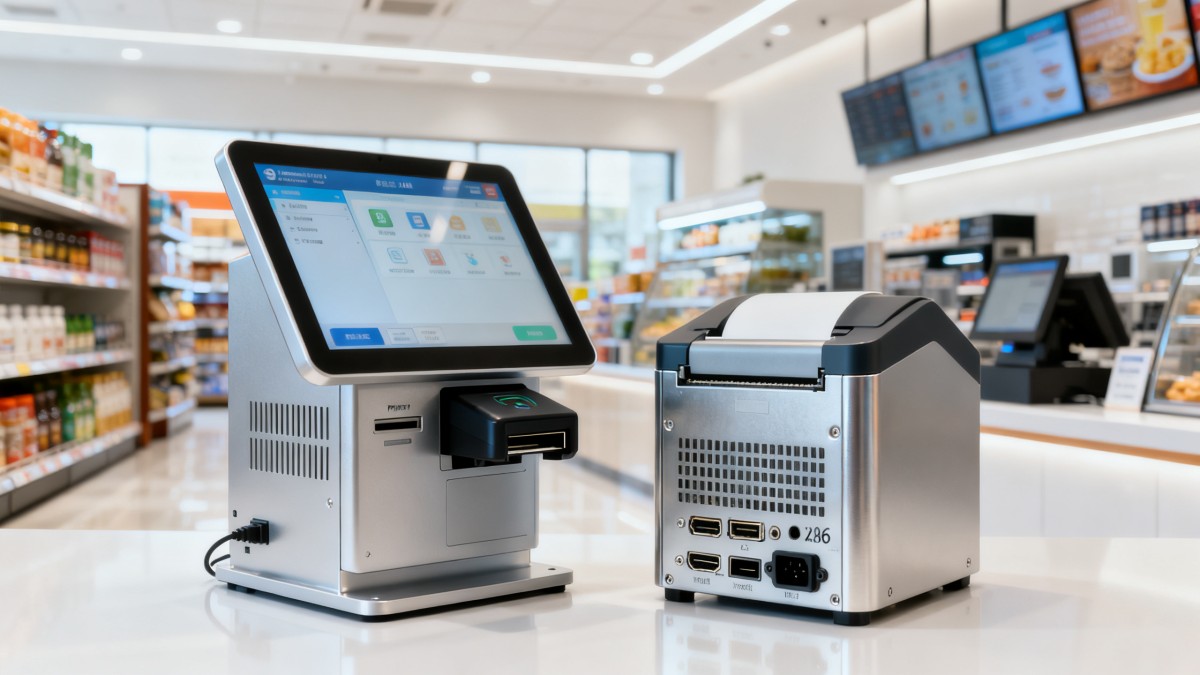
This is often the decision point. x86 usually offers broader compatibility with payment terminals, receipt printers, industrial scanners, and older USB serial devices.
ARM compatibility has improved significantly, especially with modern Android and Linux ecosystems. Still, specialized peripherals may require deeper validation and middleware adjustments.
4. Power efficiency and operating economics
ARM tends to lead in low-power operation. Across large fleets, this can reduce energy use, thermal stress, and power supply requirements.
For always-on deployments, arm vs x86 kiosk performance must include electricity consumption and cooling burden. Small savings per unit become meaningful over years of operation.
5. Lifecycle reliability and update management
x86 often benefits from mature enterprise management tools and familiar update workflows. This supports easier integration into established IT governance models.
ARM can simplify appliance-style deployments, especially when software stacks are tightly controlled. The advantage is strongest when hardware, OS, and application are designed together.
Different commercial scenarios reveal different winners
There is no single answer to arm vs x86 kiosk performance. Usage context changes the result, sometimes dramatically.
- Self-ordering and wayfinding often favor ARM when apps are lightweight and displays run for extended hours.
- Full POS terminals often favor x86 when many peripherals and Windows-based applications must work together.
- Healthcare or transport kiosks may favor x86 when compliance software and legacy integrations are critical.
- Visitor management and ticketing may favor ARM when quiet operation and low maintenance matter most.
In mixed environments, architecture may be segmented by function. A network can use ARM for simple public interfaces and x86 for transaction-heavy or integration-heavy stations.
This blended approach aligns with broader commercial modernization. It also reflects how smart retail technology increasingly balances user experience, sustainability, and operational control.
What the comparison means for supply chain and commercial design
The arm vs x86 kiosk performance question reaches beyond processing architecture. It affects mechanical design, certification planning, sourcing risk, and service strategy.
Lower-heat ARM systems can support thinner housings, simpler airflow planning, and quieter customer-facing spaces. That influences fixture integration and overall commercial aesthetics.
x86 systems can protect software continuity where existing business applications are non-negotiable. That can reduce migration risk, even if power or thermal requirements increase.
From a benchmarking perspective, neither platform should be judged only by CPU numbers. International deployment quality depends on standards compliance, interface stability, and field replacement predictability.
The most useful evaluation points before platform selection
A practical review framework helps avoid costly mismatches. The following checkpoints are more reliable than isolated benchmark claims.
- Test cold boot, wake recovery, and application launch time under actual kiosk software.
- Measure sustained temperature inside the real enclosure, not on an open bench.
- Validate every peripheral, including payment, barcode, camera, printer, and remote management tools.
- Compare energy draw across idle, normal, and peak duty conditions.
- Review operating system support, security patch cadence, and image deployment methods.
- Confirm replacement availability and long-term board continuity.
The next step is evidence-based validation, not architecture loyalty
The strongest conclusion from arm vs x86 kiosk performance is simple. Daily use should guide the decision more than brand familiarity or theoretical maximum speed.
ARM is increasingly compelling for efficient, quiet, tightly scoped kiosk tasks. x86 remains highly relevant where broad software support and peripheral flexibility are essential.
A short pilot under real commercial conditions is the smartest next move. Validate response time, heat, device compatibility, update behavior, and energy draw before scaling.
For organizations shaping modern commercial ecosystems, that approach delivers better technology fit, lower lifecycle risk, and more dependable customer-facing performance.
News Recommendations
 How to choose an ultra bright waterproof window display for storefronts
![51a6ab95581761cc26f4318be6520c15]()
Aris Katos
Future of Carbide Coatings
 How to verify suppliers on a trade portal for global sourcing
![51a6ab95581761cc26f4318be6520c15]()
Aris Katos
Future of Carbide Coatings
 How RoHS requirements should be stated in product specifications
![51a6ab95581761cc26f4318be6520c15]()
Aris Katos
Future of Carbide Coatings
 What affects the lead time for custom retail counter displays?
![51a6ab95581761cc26f4318be6520c15]()
Aris Katos
Future of Carbide Coatings
 What consumer packaging USA importers need to verify before ordering
![51a6ab95581761cc26f4318be6520c15]()
Aris Katos
Future of Carbide Coatings
 How commercial spaces interiors shape customer dwell time
![51a6ab95581761cc26f4318be6520c15]()
Aris Katos
Future of Carbide Coatings
 How LED commercial lighting design reduces glare in retail spaces
![51a6ab95581761cc26f4318be6520c15]()
Aris Katos
Future of Carbide Coatings
 How industrial technology information improves RFID inventory accuracy
![51a6ab95581761cc26f4318be6520c15]()
Aris Katos
Future of Carbide Coatings
 When drip garden watering systems make more sense than sprinklers
![51a6ab95581761cc26f4318be6520c15]()
Aris Katos
Future of Carbide Coatings
 When category comparison improves sourcing for industrial applications
![51a6ab95581761cc26f4318be6520c15]()
Aris Katos
Future of Carbide Coatings
 Industrial application guidance for selecting the right LED lighting
![51a6ab95581761cc26f4318be6520c15]()
Aris Katos
Future of Carbide Coatings
 Which commercial architecture standards apply to European retail fit-outs?
![51a6ab95581761cc26f4318be6520c15]()
Aris Katos
Future of Carbide Coatings
 How to verify FDA requirements for maternity care products
![51a6ab95581761cc26f4318be6520c15]()
Aris Katos
Future of Carbide Coatings
 How to verify BPA-free claims for food-contact products
![51a6ab95581761cc26f4318be6520c15]()
Aris Katos
Future of Carbide Coatings
 When does a European wholesale supplier suit modular office projects?
![51a6ab95581761cc26f4318be6520c15]()
Aris Katos
Future of Carbide Coatings
 When consumer ecosystem solutions improve the in-store shopping journey
![51a6ab95581761cc26f4318be6520c15]()
Aris Katos
Future of Carbide Coatings
 How a commercial developers network can reduce site selection risk
![51a6ab95581761cc26f4318be6520c15]()
Aris Katos
Future of Carbide Coatings
 How clear purchasing specifications prevent costly supplier deviations
![51a6ab95581761cc26f4318be6520c15]()
Aris Katos
Future of Carbide Coatings
 What an ISTA drop test lab checks before your packaging ships
![51a6ab95581761cc26f4318be6520c15]()
Aris Katos
Future of Carbide Coatings
 Which commercial furniture standards apply to workplace seating?
![51a6ab95581761cc26f4318be6520c15]()
Aris Katos
Future of Carbide Coatings
 How to evaluate smart lighting module OEM compatibility before sampling
![51a6ab95581761cc26f4318be6520c15]()
Aris Katos
Future of Carbide Coatings
 How to assess whether sustainable technology delivers real impact
![51a6ab95581761cc26f4318be6520c15]()
Aris Katos
Future of Carbide Coatings
 How to assess an OEM supplier’s quality control before ordering
![51a6ab95581761cc26f4318be6520c15]()
Aris Katos
Future of Carbide Coatings
 How consumer ecosystem solutions data can improve retail personalization
![51a6ab95581761cc26f4318be6520c15]()
Aris Katos
Future of Carbide Coatings
 When does consumer packaging design justify a higher product price?
![51a6ab95581761cc26f4318be6520c15]()
Aris Katos
Future of Carbide Coatings
 Supermarket Fixture Installation: Planning Layouts, Wiring, and Handover
![51a6ab95581761cc26f4318be6520c15]()
Aris Katos
Future of Carbide Coatings
 Automated Lighting and Smart Lighting Control in Bergerac: Key Project Considerations
![51a6ab95581761cc26f4318be6520c15]()
Aris Katos
Future of Carbide Coatings
 Segment Streetlight Controllers: Choosing Control Modes for Urban Roads
![51a6ab95581761cc26f4318be6520c15]()
Aris Katos
Future of Carbide Coatings
 IEC 62471-2 Explained: How to Assess Photobiological Risks in LED Lighting
![51a6ab95581761cc26f4318be6520c15]()
Aris Katos
Future of Carbide Coatings
 Food Grade Packaging Requirements by Product Type, Temperature, and Contact Risk
![51a6ab95581761cc26f4318be6520c15]()
Aris Katos
Future of Carbide Coatings
 Food Packaging Compliance Checklist: Tests, Records, and Labeling Before Shipment
![51a6ab95581761cc26f4318be6520c15]()
Aris Katos
Future of Carbide Coatings
 NSF Food Packaging Standards: When Certification Matters for Commercial Food Use
![51a6ab95581761cc26f4318be6520c15]()
Aris Katos
Future of Carbide Coatings
 FDA Food Grade Compliance: Which Materials and Documents Do Buyers Need?
![51a6ab95581761cc26f4318be6520c15]()
Aris Katos
Future of Carbide Coatings
 What Should a Food Grade Declaration Include for Packaging Compliance?
![51a6ab95581761cc26f4318be6520c15]()
Aris Katos
Future of Carbide Coatings
 Housewares Importing: How to Evaluate Suppliers, Costs, and Compliance Risks
![51a6ab95581761cc26f4318be6520c15]()
Aris Katos
Future of Carbide Coatings
 Why Freeze-Dried Fruit Ingredients Lose Crispness—and How to Prevent It
![51a6ab95581761cc26f4318be6520c15]()
Aris Katos
Future of Carbide Coatings
 What industry veterans look for before choosing a new supplier
![51a6ab95581761cc26f4318be6520c15]()
Aris Katos
Future of Carbide Coatings
 How material fatigue can shorten the service life of retail shelving
![51a6ab95581761cc26f4318be6520c15]()
Aris Katos
Future of Carbide Coatings
 What makes a global sourcing platform reliable for supplier verification?
![51a6ab95581761cc26f4318be6520c15]()
Aris Katos
Future of Carbide Coatings