US West Capacity Tightens, Raising POS Export Costs
Time
Click Count
The timing of this development is not clearly specified in the source input, but the latest shipping data points to a rules-and-execution shift in how space is allocated on the US West Coast route. For exporters of POS and self-service kiosks, the issue is no longer only freight volatility; it now also involves carrier acceptance conditions, port-side allocation priorities, and longer booking-to-loading cycles. That makes this update relevant not only to exporters, but also to procurement teams, delivery planners, supply chain service providers, and after-sales operations that depend on predictable shipment timing.
What the latest shipping data confirms
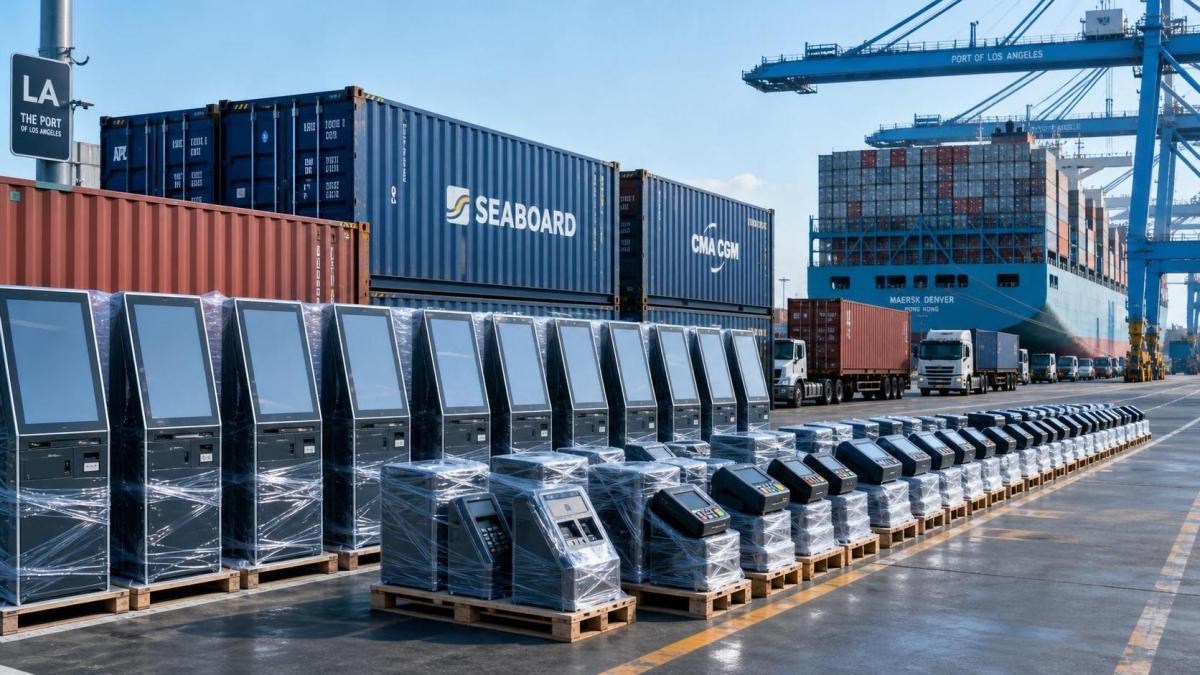
According to the latest data cited from Alphaliner and the Shanghai Shipping Exchange, effective capacity on the US West Coast route fell by 23% year on year in the first week of July 2026. The change is linked to an automation system upgrade at the Port of Los Angeles and renewed negotiations over labor agreements at US West Coast terminals.
The same information indicates that POS and self-service kiosks, which are often shipped as high-value full-container cargo and require stricter stowage arrangements, have become one of the first categories subject to carriage restrictions. Spot freight rates for this category rose 18% from the previous period, while the average cycle from booking to loading extended to 6 to 8 weeks. Major export ports in South China and East China have already activated priority-based space allocation mechanisms.
Where the immediate pressure is likely to appear
Export order execution is becoming more timing-sensitive
From an industry perspective, exporters of POS and self-service kiosks may be affected first because their products are large, high in value, and less flexible in vessel loading arrangements. The impact is likely to show up in booking confirmation, shipment scheduling, and contract delivery coordination. What deserves closer attention is whether existing delivery commitments, shipping terms, and customer communication records remain aligned with the longer 6 to 8 week booking-to-loading window.
Procurement and production planning may need tighter coordination
For manufacturers and procurement teams, the pressure is likely to move upstream once outbound shipping becomes harder to secure. Analysis shows that production release timing, packing readiness, and handover to logistics providers may require closer synchronization with vessel availability and port-side allocation priorities. The practical issue is not a change in product certification rules themselves, but the need to ensure that technical documents, packing data, and shipment files are complete early enough to avoid missing limited cargo acceptance windows.
Logistics service providers face a more rule-driven allocation environment
Supply chain service providers, including booking agents and freight coordinators, are likely to be affected by the activation of priority-based space allocation at major export ports in South and East China. Observably, once priority rules are introduced, shipment handling becomes more dependent on cargo classification, loading constraints, and booking sequence. That raises the importance of documentation accuracy, cargo specification consistency, and early communication around container requirements.
Buyers and after-sales teams may see downstream delivery effects
For overseas buyers, channel operators, and after-sales service teams, the main exposure is likely to be delivery uncertainty rather than a direct regulatory obligation. If shipping lead times stretch, installation schedules, replenishment planning, and service deployment may all need adjustment. It is more appropriate to understand this as a logistics execution issue with commercial and service implications, especially for projects that depend on fixed rollout dates.
What companies should watch in the coming weeks
Review booking assumptions against current allocation conditions
Analysis shows that companies shipping POS and self-service kiosks should reassess whether their current booking lead times still match actual loading conditions on the US West Coast route. Where internal planning still assumes shorter vessel access cycles, the gap could affect shipment promises and procurement timing.
Check whether shipment files are ready for tighter carrier screening
Because this product category is described as one of the first subject to carriage restrictions, exporters should pay closer attention to the completeness and consistency of cargo-related documentation. That includes technical descriptions, packing details, and shipment documents used in booking and handover. The source input does not provide detailed execution criteria, so this should be treated as a monitoring point rather than a confirmed new documentation rule.
Track how priority allocation is applied at export ports
What deserves closer attention is how the priority-based space allocation mechanism is applied in practice at major South China and East China export ports. The input confirms that the mechanism has been activated, but it does not specify the detailed operating standard, ranking logic, or cargo treatment thresholds. Companies should therefore watch for further clarification in actual port and booking execution.
Revisit delivery, service, and customer communication plans
Observably, a 6 to 8 week booking-to-loading cycle can affect not just freight budgets but also downstream delivery commitments and service readiness. Exporters, project teams, and after-sales coordinators may need to review customer-facing timelines, installation planning, and contingency arrangements. This is especially relevant where contracts or tenders are sensitive to shipment timing, even if no formal rule text has been updated in the input.
Why this looks more like an execution signal than a standalone freight story
Analysis shows that this development should not be read only as a short-term freight increase. The combination of reduced effective capacity, port automation-related adjustment, labor agreement negotiations, and priority-based allocation suggests a change in the operating environment for cargo access. For the POS and self-service kiosk segment, the key point is that transport constraints are already interacting with cargo handling rules and loading priorities.
At the same time, it would be premature to treat this as a fully stabilized long-term rule framework. The source input confirms the immediate capacity reduction and allocation response, but it does not provide a complete enforcement timeline or detailed carrier-by-carrier standards. That means the market still needs to observe how execution develops.
How this update is best understood now
From an industry perspective, the current signal is clear: for POS and self-service kiosk exports on the US West Coast route, shipping access has tightened in a way that affects cost, timing, and operational planning at the same time. The most reasonable interpretation at this stage is that the market is already dealing with a real execution change, while the detailed operating boundaries still require continued observation.
Rather than treating the issue as a general market headline, companies should read it as a practical warning on booking discipline, delivery scheduling, and coordination across export, logistics, procurement, and service functions. The input supports that conclusion, but it does not support stronger claims beyond that.
Basis of this article and points still requiring verification
This article is generated on the basis of the user-provided news title, event timing, and event summary. The specific official source link was not provided in the input, so further verification is still required.
For developments of this kind, commonly relevant source types may include official announcements, regulatory releases, customs or trade authority information, industry association updates, standard-setting documents, and reporting from authoritative trade media. Further observation is still needed on detailed execution standards, cargo acceptance practice, allocation criteria, tender document changes, market feedback, and how affected companies are adjusting in actual operations.
News Recommendations
 When does a sheet metal prototype reveal design flaws early?
![51a6ab95581761cc26f4318be6520c15]()
Aris Katos
Future of Carbide Coatings
 When PE air column bags reduce damage in e-commerce fulfillment
![51a6ab95581761cc26f4318be6520c15]()
Aris Katos
Future of Carbide Coatings
 How energy-efficient design reduces operating costs in retail lighting
![51a6ab95581761cc26f4318be6520c15]()
Aris Katos
Future of Carbide Coatings
 When commercial aluminum storefronts make sense for a retail renovation
![51a6ab95581761cc26f4318be6520c15]()
Aris Katos
Future of Carbide Coatings
 What makes LED lights durable in high-use commercial spaces?
![51a6ab95581761cc26f4318be6520c15]()
Aris Katos
Future of Carbide Coatings
 Which industry categories offer the strongest export potential in Latin America?
![51a6ab95581761cc26f4318be6520c15]()
Aris Katos
Future of Carbide Coatings
 How to choose an ultra bright waterproof window display for storefronts
![51a6ab95581761cc26f4318be6520c15]()
Aris Katos
Future of Carbide Coatings
 How to verify suppliers on a trade portal for global sourcing
![51a6ab95581761cc26f4318be6520c15]()
Aris Katos
Future of Carbide Coatings
 How RoHS requirements should be stated in product specifications
![51a6ab95581761cc26f4318be6520c15]()
Aris Katos
Future of Carbide Coatings
 What affects the lead time for custom retail counter displays?
![51a6ab95581761cc26f4318be6520c15]()
Aris Katos
Future of Carbide Coatings
 What consumer packaging USA importers need to verify before ordering
![51a6ab95581761cc26f4318be6520c15]()
Aris Katos
Future of Carbide Coatings
 How commercial spaces interiors shape customer dwell time
![51a6ab95581761cc26f4318be6520c15]()
Aris Katos
Future of Carbide Coatings
 How LED commercial lighting design reduces glare in retail spaces
![51a6ab95581761cc26f4318be6520c15]()
Aris Katos
Future of Carbide Coatings
 How industrial technology information improves RFID inventory accuracy
![51a6ab95581761cc26f4318be6520c15]()
Aris Katos
Future of Carbide Coatings
 When drip garden watering systems make more sense than sprinklers
![51a6ab95581761cc26f4318be6520c15]()
Aris Katos
Future of Carbide Coatings
 When category comparison improves sourcing for industrial applications
![51a6ab95581761cc26f4318be6520c15]()
Aris Katos
Future of Carbide Coatings
 Industrial application guidance for selecting the right LED lighting
![51a6ab95581761cc26f4318be6520c15]()
Aris Katos
Future of Carbide Coatings
 Which commercial architecture standards apply to European retail fit-outs?
![51a6ab95581761cc26f4318be6520c15]()
Aris Katos
Future of Carbide Coatings
 How to verify FDA requirements for maternity care products
![51a6ab95581761cc26f4318be6520c15]()
Aris Katos
Future of Carbide Coatings
 How to verify BPA-free claims for food-contact products
![51a6ab95581761cc26f4318be6520c15]()
Aris Katos
Future of Carbide Coatings
 When does a European wholesale supplier suit modular office projects?
![51a6ab95581761cc26f4318be6520c15]()
Aris Katos
Future of Carbide Coatings
 When consumer ecosystem solutions improve the in-store shopping journey
![51a6ab95581761cc26f4318be6520c15]()
Aris Katos
Future of Carbide Coatings
 How a commercial developers network can reduce site selection risk
![51a6ab95581761cc26f4318be6520c15]()
Aris Katos
Future of Carbide Coatings
 How clear purchasing specifications prevent costly supplier deviations
![51a6ab95581761cc26f4318be6520c15]()
Aris Katos
Future of Carbide Coatings
 What an ISTA drop test lab checks before your packaging ships
![51a6ab95581761cc26f4318be6520c15]()
Aris Katos
Future of Carbide Coatings
 Which commercial furniture standards apply to workplace seating?
![51a6ab95581761cc26f4318be6520c15]()
Aris Katos
Future of Carbide Coatings
 How to evaluate smart lighting module OEM compatibility before sampling
![51a6ab95581761cc26f4318be6520c15]()
Aris Katos
Future of Carbide Coatings
 How to assess whether sustainable technology delivers real impact
![51a6ab95581761cc26f4318be6520c15]()
Aris Katos
Future of Carbide Coatings
 How to assess an OEM supplier’s quality control before ordering
![51a6ab95581761cc26f4318be6520c15]()
Aris Katos
Future of Carbide Coatings
 How consumer ecosystem solutions data can improve retail personalization
![51a6ab95581761cc26f4318be6520c15]()
Aris Katos
Future of Carbide Coatings
 When does consumer packaging design justify a higher product price?
![51a6ab95581761cc26f4318be6520c15]()
Aris Katos
Future of Carbide Coatings
 Supermarket Fixture Installation: Planning Layouts, Wiring, and Handover
![51a6ab95581761cc26f4318be6520c15]()
Aris Katos
Future of Carbide Coatings
 Automated Lighting and Smart Lighting Control in Bergerac: Key Project Considerations
![51a6ab95581761cc26f4318be6520c15]()
Aris Katos
Future of Carbide Coatings
 Segment Streetlight Controllers: Choosing Control Modes for Urban Roads
![51a6ab95581761cc26f4318be6520c15]()
Aris Katos
Future of Carbide Coatings
 IEC 62471-2 Explained: How to Assess Photobiological Risks in LED Lighting
![51a6ab95581761cc26f4318be6520c15]()
Aris Katos
Future of Carbide Coatings
 Food Grade Packaging Requirements by Product Type, Temperature, and Contact Risk
![51a6ab95581761cc26f4318be6520c15]()
Aris Katos
Future of Carbide Coatings
 Food Packaging Compliance Checklist: Tests, Records, and Labeling Before Shipment
![51a6ab95581761cc26f4318be6520c15]()
Aris Katos
Future of Carbide Coatings
 NSF Food Packaging Standards: When Certification Matters for Commercial Food Use
![51a6ab95581761cc26f4318be6520c15]()
Aris Katos
Future of Carbide Coatings
 FDA Food Grade Compliance: Which Materials and Documents Do Buyers Need?
![51a6ab95581761cc26f4318be6520c15]()
Aris Katos
Future of Carbide Coatings