Commercial Spaces Design Mistakes That Hurt Customer Flow
Time
Click Count
Even the most visually impressive commercial spaces design can fail when customer flow is overlooked. For project managers and engineering leads, poor circulation planning often leads to congestion, lost sales, and inefficient operations. Understanding the design mistakes that disrupt movement is essential to creating commercial environments that perform better, feel intuitive, and support both brand goals and long-term operational success.
Why customer flow has become a strategic issue in commercial environments
Customer flow is no longer just a layout concern. In today’s market, commercial spaces design is being reshaped by omnichannel retail, shorter customer attention spans, higher labor costs, and growing pressure to convert every square meter into measurable value. A store, showroom, service center, lobby, or mixed-use venue may look refined on opening day, but if people hesitate, loop back, queue in the wrong place, or miss high-value zones, the space underperforms.
For project managers and engineering leads, this shift matters because circulation problems are often locked in early. Once fixtures, lighting, power routing, digital screens, and access control are installed, correcting a flawed path becomes expensive. The result is a rising industry focus on operationally intelligent commercial spaces design: environments that support movement, visibility, dwell time, staffing efficiency, accessibility, and maintenance at the same time.
This is especially relevant across global commercial development, where supply chain standardization, safety compliance, sustainable materials, and smart retail systems now intersect. Platforms such as G-BCE highlight that modern commercial performance depends not only on aesthetics, but also on how furniture systems, signage, POS technology, lighting, and wayfinding work together as one ecosystem.
The biggest commercial spaces design mistakes that hurt flow
Many customer flow failures come from decisions that seem minor during design review but create major friction after launch. The most common mistakes are becoming more visible as brands demand spaces that are both visually premium and operationally precise.
1. Over-prioritizing visual symmetry over real movement patterns
A symmetrical plan may look clean on paper, yet customers rarely move symmetrically. Entrances, natural turn tendencies, product interest zones, daylight direction, and digital display placement all influence traffic behavior. When commercial spaces design is driven mainly by visual balance, circulation can feel forced and browsing becomes less intuitive.
2. Narrow transitions between key zones
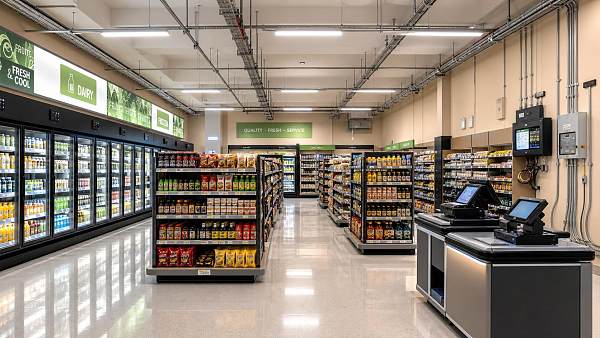
Bottlenecks typically appear where entry zones, promotional displays, checkout points, service desks, and waiting areas overlap. Aisles that technically meet minimum clearance may still fail under peak traffic, stroller use, delivery movement, or cleaning operations. In practice, this affects customer comfort and staff productivity at the same time.
3. Misplaced focal points and feature displays
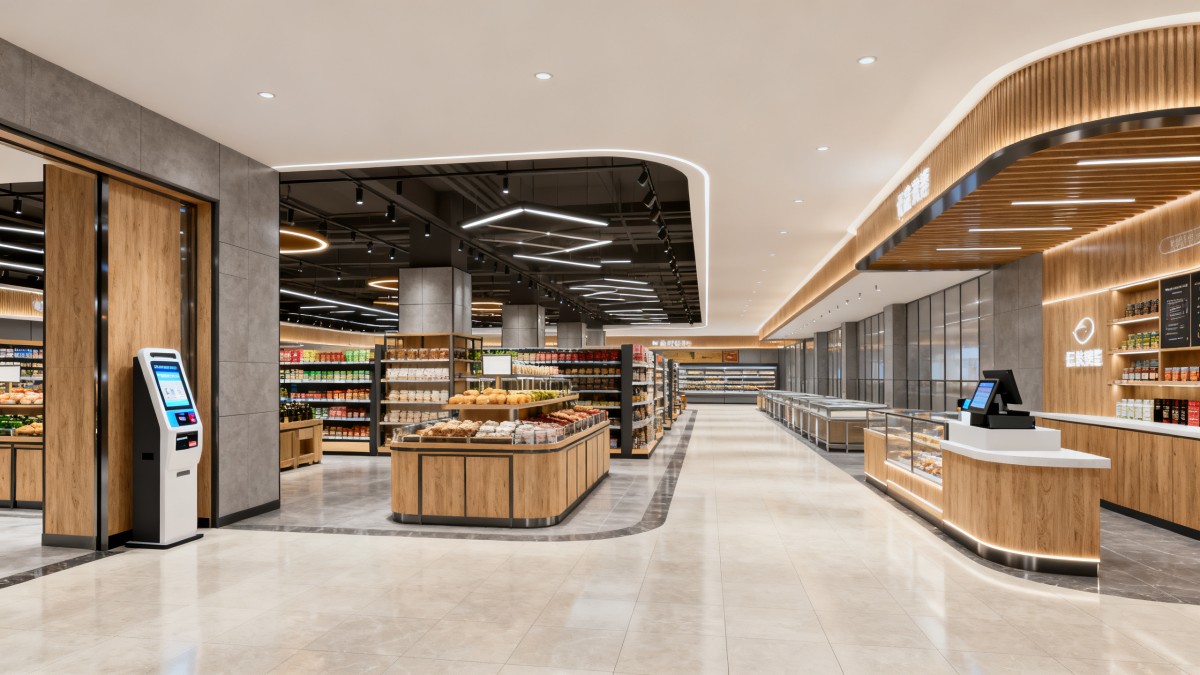
Feature installations are meant to attract attention, but poorly positioned islands, digital kiosks, or branded fixtures often interrupt natural pathways. Instead of pulling visitors deeper into the environment, they create hesitation at thresholds and reduce visibility toward profitable zones.
4. Treating signage as decoration rather than navigation infrastructure
One major trend in commercial spaces design is the move from brand-led signage to decision-support signage. Customers now expect quick orientation. If directional signs are too subtle, too high, too late in the journey, or disconnected from lighting and sightlines, movement slows. This problem is amplified in large-format retail, multi-tenant developments, and hybrid service spaces.
5. Ignoring the interaction between digital systems and physical circulation
Self-checkout terminals, click-and-collect points, AI-powered kiosks, digital queue systems, and interactive displays are now common. But when these are added late, without spatial coordination, they can block traffic, generate crowd clustering, and create confusion over where customers should stand, wait, or exit.
6. Underestimating service and replenishment routes
Customer flow does not exist separately from back-of-house movement. If restocking, cleaning, maintenance, waste handling, and staff access intersect with customer circulation, friction becomes constant. Strong commercial spaces design aligns front-end experience with support operations instead of treating them as separate systems.
What is changing in the market and why these mistakes matter more now
Several industry changes are making flow-related mistakes more costly than before. First, physical spaces are expected to do more than display products. They must support discovery, fulfillment, service, social engagement, and digital integration. Second, customers have less patience for unclear environments. Third, operators want layouts that can adapt to seasonal merchandising, technology updates, and sustainability targets without major rebuilds.
At the same time, investment scrutiny is increasing. Developers and brand operators want proof that design decisions improve conversion, queue efficiency, accessibility, and operational resilience. This means customer flow is becoming a board-level performance question, not just a designer’s preference.
Trend signals reshaping commercial spaces design
Who feels the impact first: from project delivery to daily operations
Flow mistakes in commercial spaces design do not affect only customers. They create cascading consequences across delivery teams, operators, and sourcing decisions. Project managers often face rework pressure when field conditions reveal that fixture footprints, electrical drops, or queue barriers do not match real traffic. Engineering leads may need to solve visibility issues, power relocation, or service access conflicts after installation. Store operations teams then inherit the long-term inefficiency.
The deeper drivers behind poor flow decisions
Most bad outcomes are not caused by a single design error. They come from fragmented decision-making. Commercial spaces design often passes through branding teams, architects, engineers, fixture vendors, lighting consultants, and digital technology suppliers. When each discipline optimizes its own scope, overall movement quality suffers.
Another driver is the overreliance on compliance minimums. Meeting code or standard clearance does not always mean the space will function well under real traffic conditions. This is where technical benchmarking becomes valuable. Reviewing commercial furniture dimensions, POS footprints, signage legibility, lighting contrast, and maintenance access against both standards and operating scenarios helps teams avoid costly blind spots.
There is also a growing mismatch between old planning assumptions and new customer behavior. Today’s visitors may browse with mobile devices, stop for digital interaction, collect online orders, or compare products while standing still. These patterns demand more nuanced commercial spaces design than traditional aisle planning alone.
What high-performing projects are doing differently
The strongest projects are shifting from static layout planning to flow-aware systems planning. Instead of asking only where fixtures fit, they ask how customers enter, pause, turn, queue, interact, and leave. They also test how staff, replenishment carts, cleaning teams, and service equipment move through the same environment.
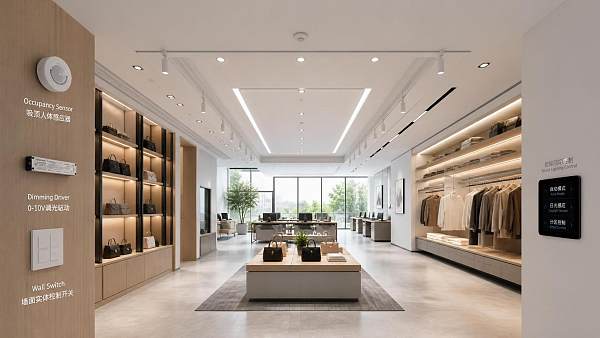
In practice, better commercial spaces design now includes clearer zoning logic, earlier integration of smart retail equipment, modular fixture strategies, stronger sightline control, and material choices that support both durability and spatial clarity. Lighting is used not just for mood, but to guide movement. Signage is coordinated with architecture rather than applied at the end. Hardware selections are evaluated for both ergonomic performance and spatial impact.
How project managers and engineering leads should judge risk earlier
The most useful response is to move customer flow review earlier in project decision cycles. Before procurement is locked, teams should evaluate five practical questions:
- Where are the likely congestion points during peak traffic, promotion periods, and maintenance operations?
- Do feature displays improve navigation, or do they interrupt path continuity and sightlines?
- How will digital systems such as kiosks, POS terminals, pickup counters, and queue screens alter standing behavior?
- Can the selected furniture, fixtures, and signage adapt without degrading flow after seasonal resets?
- Are front-of-house and back-of-house routes coordinated well enough to avoid repeated interference?
These questions are increasingly important in global projects where component sourcing, compliance standards such as UL, CE, and BIFMA, and regional construction realities must align. A technically benchmarked approach reduces the chance that a visually impressive concept will fail in operation.
Commercial spaces design is moving toward measurable circulation performance
The broader direction is clear: commercial spaces design is evolving from style-led execution to performance-led integration. Customer flow sits at the center of that change because it influences sales, safety, labor, accessibility, service quality, and brand perception all at once. As commercial environments become more digital, more flexible, and more sustainability-focused, circulation mistakes will become less tolerable and more visible.
For organizations planning new builds, retrofits, or international rollouts, the best next step is not simply to ask whether the layout looks modern. The better question is whether the entire spatial ecosystem supports intuitive movement under real operating conditions. If businesses want to judge how these trends affect their own projects, they should closely review traffic bottlenecks, fixture adaptability, signage clarity, smart technology placement, and service-route coordination before final approvals are issued.
That is where better decisions begin, and where commercial spaces design starts to deliver not only visual impact, but also long-term commercial performance.
News Recommendations
 How to choose an ultra bright waterproof window display for storefronts
![51a6ab95581761cc26f4318be6520c15]()
Aris Katos
Future of Carbide Coatings
 How to verify suppliers on a trade portal for global sourcing
![51a6ab95581761cc26f4318be6520c15]()
Aris Katos
Future of Carbide Coatings
 How RoHS requirements should be stated in product specifications
![51a6ab95581761cc26f4318be6520c15]()
Aris Katos
Future of Carbide Coatings
 What affects the lead time for custom retail counter displays?
![51a6ab95581761cc26f4318be6520c15]()
Aris Katos
Future of Carbide Coatings
 What consumer packaging USA importers need to verify before ordering
![51a6ab95581761cc26f4318be6520c15]()
Aris Katos
Future of Carbide Coatings
 How commercial spaces interiors shape customer dwell time
![51a6ab95581761cc26f4318be6520c15]()
Aris Katos
Future of Carbide Coatings
 How LED commercial lighting design reduces glare in retail spaces
![51a6ab95581761cc26f4318be6520c15]()
Aris Katos
Future of Carbide Coatings
 How industrial technology information improves RFID inventory accuracy
![51a6ab95581761cc26f4318be6520c15]()
Aris Katos
Future of Carbide Coatings
 When drip garden watering systems make more sense than sprinklers
![51a6ab95581761cc26f4318be6520c15]()
Aris Katos
Future of Carbide Coatings
 When category comparison improves sourcing for industrial applications
![51a6ab95581761cc26f4318be6520c15]()
Aris Katos
Future of Carbide Coatings
 Industrial application guidance for selecting the right LED lighting
![51a6ab95581761cc26f4318be6520c15]()
Aris Katos
Future of Carbide Coatings
 Which commercial architecture standards apply to European retail fit-outs?
![51a6ab95581761cc26f4318be6520c15]()
Aris Katos
Future of Carbide Coatings
 How to verify FDA requirements for maternity care products
![51a6ab95581761cc26f4318be6520c15]()
Aris Katos
Future of Carbide Coatings
 How to verify BPA-free claims for food-contact products
![51a6ab95581761cc26f4318be6520c15]()
Aris Katos
Future of Carbide Coatings
 When does a European wholesale supplier suit modular office projects?
![51a6ab95581761cc26f4318be6520c15]()
Aris Katos
Future of Carbide Coatings
 When consumer ecosystem solutions improve the in-store shopping journey
![51a6ab95581761cc26f4318be6520c15]()
Aris Katos
Future of Carbide Coatings
 How a commercial developers network can reduce site selection risk
![51a6ab95581761cc26f4318be6520c15]()
Aris Katos
Future of Carbide Coatings
 How clear purchasing specifications prevent costly supplier deviations
![51a6ab95581761cc26f4318be6520c15]()
Aris Katos
Future of Carbide Coatings
 What an ISTA drop test lab checks before your packaging ships
![51a6ab95581761cc26f4318be6520c15]()
Aris Katos
Future of Carbide Coatings
 Which commercial furniture standards apply to workplace seating?
![51a6ab95581761cc26f4318be6520c15]()
Aris Katos
Future of Carbide Coatings
 How to evaluate smart lighting module OEM compatibility before sampling
![51a6ab95581761cc26f4318be6520c15]()
Aris Katos
Future of Carbide Coatings
 How to assess whether sustainable technology delivers real impact
![51a6ab95581761cc26f4318be6520c15]()
Aris Katos
Future of Carbide Coatings
 How to assess an OEM supplier’s quality control before ordering
![51a6ab95581761cc26f4318be6520c15]()
Aris Katos
Future of Carbide Coatings
 How consumer ecosystem solutions data can improve retail personalization
![51a6ab95581761cc26f4318be6520c15]()
Aris Katos
Future of Carbide Coatings
 When does consumer packaging design justify a higher product price?
![51a6ab95581761cc26f4318be6520c15]()
Aris Katos
Future of Carbide Coatings
 Supermarket Fixture Installation: Planning Layouts, Wiring, and Handover
![51a6ab95581761cc26f4318be6520c15]()
Aris Katos
Future of Carbide Coatings
 Automated Lighting and Smart Lighting Control in Bergerac: Key Project Considerations
![51a6ab95581761cc26f4318be6520c15]()
Aris Katos
Future of Carbide Coatings
 Segment Streetlight Controllers: Choosing Control Modes for Urban Roads
![51a6ab95581761cc26f4318be6520c15]()
Aris Katos
Future of Carbide Coatings
 IEC 62471-2 Explained: How to Assess Photobiological Risks in LED Lighting
![51a6ab95581761cc26f4318be6520c15]()
Aris Katos
Future of Carbide Coatings
 Food Grade Packaging Requirements by Product Type, Temperature, and Contact Risk
![51a6ab95581761cc26f4318be6520c15]()
Aris Katos
Future of Carbide Coatings
 Food Packaging Compliance Checklist: Tests, Records, and Labeling Before Shipment
![51a6ab95581761cc26f4318be6520c15]()
Aris Katos
Future of Carbide Coatings
 NSF Food Packaging Standards: When Certification Matters for Commercial Food Use
![51a6ab95581761cc26f4318be6520c15]()
Aris Katos
Future of Carbide Coatings
 FDA Food Grade Compliance: Which Materials and Documents Do Buyers Need?
![51a6ab95581761cc26f4318be6520c15]()
Aris Katos
Future of Carbide Coatings
 What Should a Food Grade Declaration Include for Packaging Compliance?
![51a6ab95581761cc26f4318be6520c15]()
Aris Katos
Future of Carbide Coatings
 Housewares Importing: How to Evaluate Suppliers, Costs, and Compliance Risks
![51a6ab95581761cc26f4318be6520c15]()
Aris Katos
Future of Carbide Coatings
 Why Freeze-Dried Fruit Ingredients Lose Crispness—and How to Prevent It
![51a6ab95581761cc26f4318be6520c15]()
Aris Katos
Future of Carbide Coatings
 What industry veterans look for before choosing a new supplier
![51a6ab95581761cc26f4318be6520c15]()
Aris Katos
Future of Carbide Coatings
 How material fatigue can shorten the service life of retail shelving
![51a6ab95581761cc26f4318be6520c15]()
Aris Katos
Future of Carbide Coatings
 What makes a global sourcing platform reliable for supplier verification?
![51a6ab95581761cc26f4318be6520c15]()
Aris Katos
Future of Carbide Coatings