Custom Cutlery Set OEM: Key Cost and MOQ Factors
Time
Click Count
For procurement teams evaluating a custom cutlery set OEM partner, cost structure and MOQ are two factors that directly shape sourcing efficiency, margin control, and delivery risk.
Understanding material grades, finishing routes, packaging complexity, tooling charges, and volume breaks makes supplier comparisons more accurate and negotiations more disciplined.
In the wider consumer goods supply chain, a custom cutlery set OEM program also affects brand consistency, sustainability targets, compliance readiness, and replenishment planning across regions.
Cost Structure Fundamentals in a Custom Cutlery Set OEM Project
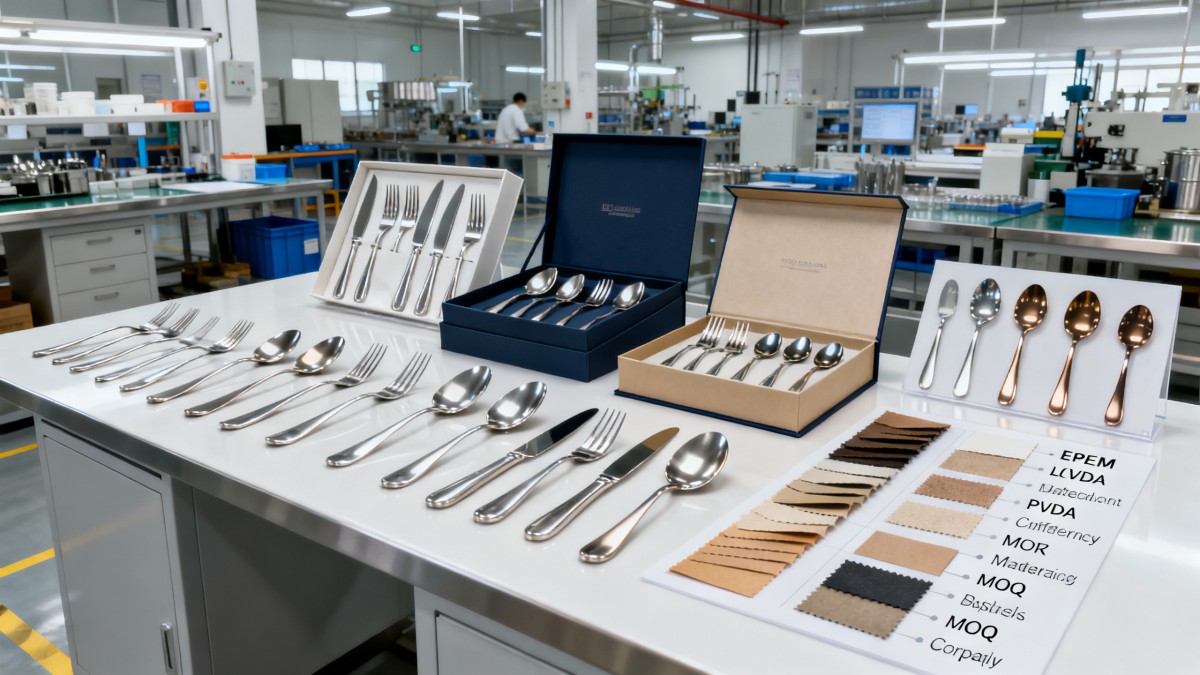
A custom cutlery set OEM quotation is rarely driven by one factor alone. It is usually a layered combination of product design, raw material inputs, process steps, and commercial terms.
Stainless steel remains the most common base material. Popular grades include 18/0, 18/8, and 18/10, each with different corrosion resistance, appearance, and market positioning.
Handle construction changes cost significantly. One-piece forged structures, hollow handles, plastic inserts, wood accents, or mixed-material decorative elements all alter labor content and scrap rate.
Surface treatment is another major cost driver. Mirror polish, satin finish, stonewash texture, PVD coating, electroplating, laser engraving, and embossed branding add different process times and quality controls.
Packaging also matters more than many buyers expect. Basic polybag packing costs far less than gift boxes, molded trays, recycled paper sleeves, barcode labeling, and multilingual retail inserts.
For a custom cutlery set OEM order, the supplier may also include tooling amortization, sampling charges, test fees, and carton optimization based on destination channel requirements.
Main quotation components
- Raw material grade and thickness
- Forging, stamping, grinding, and polishing labor
- Logo application and decorative finishing
- Set configuration and piece count
- Retail, hospitality, or e-commerce packaging
- Inspection standards and compliance testing
- Freight terms, carton loading, and delivery schedule
MOQ Dynamics and Why They Vary Across Suppliers
MOQ in a custom cutlery set OEM arrangement is not only a production preference. It is a mechanism for recovering setup costs, controlling operational complexity, and protecting factory efficiency.
Factories with highly automated lines may accept lower MOQ for standard shapes. However, deeply customized handles, colors, or gift packaging often require higher minimums.
MOQ can be defined in several ways. Some suppliers quote by total units, some by SKU, and others by finish, color, or packaging configuration.
This difference affects apparent price competitiveness. A low MOQ headline may still hide higher setup fees or stricter carton quantity requirements.
Typical MOQ variables
Current Industry Signals Influencing Price and Volume Decisions
The custom cutlery set OEM market is influenced by broader changes in retail, hospitality, and sustainable packaging. These shifts directly affect target cost and acceptable MOQ levels.
Material volatility remains a core concern. Stainless steel pricing can fluctuate with nickel costs, energy inputs, and regional supply chain disruptions.
Sustainability requirements are also becoming more visible. Buyers increasingly request recycled packaging, reduced plastic content, and longer product lifespan to support environmental claims.
Omnichannel retail adds another layer. Products may need to perform in store, online, and in gift presentation formats, which increases packaging and barcode complexity.
Compliance expectations are growing as well. Food-contact safety, coating durability, dishwasher performance, and labeling accuracy can all affect final program cost.
Key market signals
- Premium appearance is increasingly expected in mid-market product lines.
- Small-batch launches are more common, but factory economics still favor scale.
- Private label differentiation often depends on finish, packaging, and branding details.
- Cross-border shipping pressure makes carton efficiency and weight optimization more important.
- Data transparency on lead time and reject rate is now part of supplier evaluation.
Business Value of Understanding Custom Cutlery Set OEM Cost and MOQ
A clear view of custom cutlery set OEM economics improves more than unit price comparison. It supports stronger forecasting, healthier inventory turnover, and more resilient supplier selection.
When cost is broken into meaningful components, unexpected overruns become easier to prevent. This is especially important when several finishes or packaging options are under review.
MOQ visibility helps align ordering strategy with launch timing. It can reduce overbuying for seasonal promotions or underbuying for hospitality replacement cycles.
Better cost insight also supports benchmarking across regions. It becomes easier to compare an Asian source with nearshore alternatives on a like-for-like basis.
For organizations focused on supply chain modernization, this transparency improves collaboration between design, quality, logistics, and commercial planning functions.
Typical Project Scenarios and Cost Profiles
Different use cases produce very different custom cutlery set OEM requirements. Cost and MOQ should always be reviewed in relation to the final channel and usage pattern.
Practical Evaluation Points Before Confirming a Supplier
A strong custom cutlery set OEM review process should test both commercial terms and operational reliability. Price alone does not reveal execution quality.
- Request a cost breakdown by material, finish, packaging, tooling, and testing.
- Confirm whether MOQ applies per item, per set, per finish, or per packaging version.
- Check tolerance standards, polishing consistency, and logo placement quality.
- Verify lead time for samples, mass production, and repeat orders.
- Review carton dimensions, loading efficiency, and shipping impact on landed cost.
- Ask whether tooling fees can be amortized across future purchase volumes.
- Clarify defect handling, replacement policy, and final inspection methodology.
It is also useful to compare standard-platform options against fully bespoke development. In many cases, selective customization delivers better economics without sacrificing brand distinction.
For example, a standard spoon and fork silhouette with custom finishing and packaging may lower MOQ while preserving visual differentiation in the market.
Action Path for a More Reliable Custom Cutlery Set OEM Sourcing Process
A structured sourcing path begins with a precise specification sheet. Define material grade, thickness, finish, logo method, set composition, packaging type, and compliance expectations early.
Then request comparable quotations from multiple suppliers using the same format. This reduces ambiguity and highlights real differences in custom cutlery set OEM cost logic.
Next, test MOQ flexibility through scenario planning. Compare standard packaging against premium packaging, and compare common finishes against special finishes.
Finally, evaluate total landed value rather than ex-works price alone. Reliable output, lower defect risk, stable replenishment, and efficient packaging often justify a higher initial quote.
A disciplined custom cutlery set OEM assessment creates stronger cost control, better supplier alignment, and a more resilient consumer product supply chain over time.
News Recommendations
 Which industry categories offer the strongest export potential in Latin America?
![51a6ab95581761cc26f4318be6520c15]()
Aris Katos
Future of Carbide Coatings
 How to choose an ultra bright waterproof window display for storefronts
![51a6ab95581761cc26f4318be6520c15]()
Aris Katos
Future of Carbide Coatings
 How to verify suppliers on a trade portal for global sourcing
![51a6ab95581761cc26f4318be6520c15]()
Aris Katos
Future of Carbide Coatings
 How RoHS requirements should be stated in product specifications
![51a6ab95581761cc26f4318be6520c15]()
Aris Katos
Future of Carbide Coatings
 What affects the lead time for custom retail counter displays?
![51a6ab95581761cc26f4318be6520c15]()
Aris Katos
Future of Carbide Coatings
 What consumer packaging USA importers need to verify before ordering
![51a6ab95581761cc26f4318be6520c15]()
Aris Katos
Future of Carbide Coatings
 How commercial spaces interiors shape customer dwell time
![51a6ab95581761cc26f4318be6520c15]()
Aris Katos
Future of Carbide Coatings
 How LED commercial lighting design reduces glare in retail spaces
![51a6ab95581761cc26f4318be6520c15]()
Aris Katos
Future of Carbide Coatings
 How industrial technology information improves RFID inventory accuracy
![51a6ab95581761cc26f4318be6520c15]()
Aris Katos
Future of Carbide Coatings
 When drip garden watering systems make more sense than sprinklers
![51a6ab95581761cc26f4318be6520c15]()
Aris Katos
Future of Carbide Coatings
 When category comparison improves sourcing for industrial applications
![51a6ab95581761cc26f4318be6520c15]()
Aris Katos
Future of Carbide Coatings
 Industrial application guidance for selecting the right LED lighting
![51a6ab95581761cc26f4318be6520c15]()
Aris Katos
Future of Carbide Coatings
 Which commercial architecture standards apply to European retail fit-outs?
![51a6ab95581761cc26f4318be6520c15]()
Aris Katos
Future of Carbide Coatings
 How to verify FDA requirements for maternity care products
![51a6ab95581761cc26f4318be6520c15]()
Aris Katos
Future of Carbide Coatings
 How to verify BPA-free claims for food-contact products
![51a6ab95581761cc26f4318be6520c15]()
Aris Katos
Future of Carbide Coatings
 When does a European wholesale supplier suit modular office projects?
![51a6ab95581761cc26f4318be6520c15]()
Aris Katos
Future of Carbide Coatings
 When consumer ecosystem solutions improve the in-store shopping journey
![51a6ab95581761cc26f4318be6520c15]()
Aris Katos
Future of Carbide Coatings
 How a commercial developers network can reduce site selection risk
![51a6ab95581761cc26f4318be6520c15]()
Aris Katos
Future of Carbide Coatings
 How clear purchasing specifications prevent costly supplier deviations
![51a6ab95581761cc26f4318be6520c15]()
Aris Katos
Future of Carbide Coatings
 What an ISTA drop test lab checks before your packaging ships
![51a6ab95581761cc26f4318be6520c15]()
Aris Katos
Future of Carbide Coatings
 Which commercial furniture standards apply to workplace seating?
![51a6ab95581761cc26f4318be6520c15]()
Aris Katos
Future of Carbide Coatings
 How to evaluate smart lighting module OEM compatibility before sampling
![51a6ab95581761cc26f4318be6520c15]()
Aris Katos
Future of Carbide Coatings
 How to assess whether sustainable technology delivers real impact
![51a6ab95581761cc26f4318be6520c15]()
Aris Katos
Future of Carbide Coatings
 How to assess an OEM supplier’s quality control before ordering
![51a6ab95581761cc26f4318be6520c15]()
Aris Katos
Future of Carbide Coatings
 How consumer ecosystem solutions data can improve retail personalization
![51a6ab95581761cc26f4318be6520c15]()
Aris Katos
Future of Carbide Coatings
 When does consumer packaging design justify a higher product price?
![51a6ab95581761cc26f4318be6520c15]()
Aris Katos
Future of Carbide Coatings
 Supermarket Fixture Installation: Planning Layouts, Wiring, and Handover
![51a6ab95581761cc26f4318be6520c15]()
Aris Katos
Future of Carbide Coatings
 Automated Lighting and Smart Lighting Control in Bergerac: Key Project Considerations
![51a6ab95581761cc26f4318be6520c15]()
Aris Katos
Future of Carbide Coatings
 Segment Streetlight Controllers: Choosing Control Modes for Urban Roads
![51a6ab95581761cc26f4318be6520c15]()
Aris Katos
Future of Carbide Coatings
 IEC 62471-2 Explained: How to Assess Photobiological Risks in LED Lighting
![51a6ab95581761cc26f4318be6520c15]()
Aris Katos
Future of Carbide Coatings
 Food Grade Packaging Requirements by Product Type, Temperature, and Contact Risk
![51a6ab95581761cc26f4318be6520c15]()
Aris Katos
Future of Carbide Coatings
 Food Packaging Compliance Checklist: Tests, Records, and Labeling Before Shipment
![51a6ab95581761cc26f4318be6520c15]()
Aris Katos
Future of Carbide Coatings
 NSF Food Packaging Standards: When Certification Matters for Commercial Food Use
![51a6ab95581761cc26f4318be6520c15]()
Aris Katos
Future of Carbide Coatings
 FDA Food Grade Compliance: Which Materials and Documents Do Buyers Need?
![51a6ab95581761cc26f4318be6520c15]()
Aris Katos
Future of Carbide Coatings
 What Should a Food Grade Declaration Include for Packaging Compliance?
![51a6ab95581761cc26f4318be6520c15]()
Aris Katos
Future of Carbide Coatings
 Housewares Importing: How to Evaluate Suppliers, Costs, and Compliance Risks
![51a6ab95581761cc26f4318be6520c15]()
Aris Katos
Future of Carbide Coatings
 Why Freeze-Dried Fruit Ingredients Lose Crispness—and How to Prevent It
![51a6ab95581761cc26f4318be6520c15]()
Aris Katos
Future of Carbide Coatings
 What industry veterans look for before choosing a new supplier
![51a6ab95581761cc26f4318be6520c15]()
Aris Katos
Future of Carbide Coatings
 How material fatigue can shorten the service life of retail shelving
![51a6ab95581761cc26f4318be6520c15]()
Aris Katos
Future of Carbide Coatings