How to Compare Commercial Furniture Manufacturers Without Costly Mistakes
Time
Click Count
Choosing among commercial furniture manufacturers can shape project cost, brand image, and long-term operational efficiency. For procurement professionals, a smart comparison goes beyond unit price to include compliance, material quality, customization capacity, lead times, and after-sales support. This guide outlines how to evaluate suppliers systematically, helping you avoid costly mistakes and make confident sourcing decisions.
Why a Checklist Approach Works Better Than Price-Only Comparison
Procurement teams often face pressure to move fast, standardize vendors, and defend every sourcing decision. In that environment, comparing commercial furniture manufacturers with a checklist is more reliable than relying on catalogs, sales promises, or headline pricing. A structured review reduces hidden risk, makes supplier discussions more objective, and creates a documented basis for internal approval.
This matters because commercial furniture is not a one-dimensional purchase. A reception desk, office workstation, hospitality seating system, retail display fixture, or educational casework installation affects durability, space planning, maintenance cost, and user experience over many years. A supplier that looks inexpensive at quotation stage can become expensive later through delays, quality failures, warranty disputes, or poor installation support.
For buyers working across regions, the challenge becomes even greater. Global projects may involve different fire codes, sustainability requirements, shipping methods, and branding expectations. That is why leading procurement professionals compare commercial furniture manufacturers across a defined set of decision points before negotiating final price.
Start With These Priority Questions Before You Shortlist Suppliers
Before requesting samples or quotations, confirm the core sourcing requirements internally. This step prevents wasted time and weak comparisons.
- What is the primary application: office, hospitality, healthcare, education, retail, or mixed-use commercial space?
- Are you buying standard products, semi-custom programs, or fully bespoke furniture and fixtures?
- Which certifications or standards are mandatory, such as BIFMA, UL-related electrical safety for integrated components, CE relevance for certain markets, or local fire and emissions compliance?
- What is the realistic installation deadline, including production, shipping, customs, and on-site coordination?
- What level of finish consistency is required across multiple locations or future rollout phases?
- Will the supplier need to support drawings, mockups, packaging standards, or replacement part programs?
With these answers in place, procurement teams can compare commercial furniture manufacturers using the same decision logic instead of reacting to whichever supplier responds first.
The Core Evaluation Checklist for Commercial Furniture Manufacturers
1. Compliance and Testing Should Be Verified First
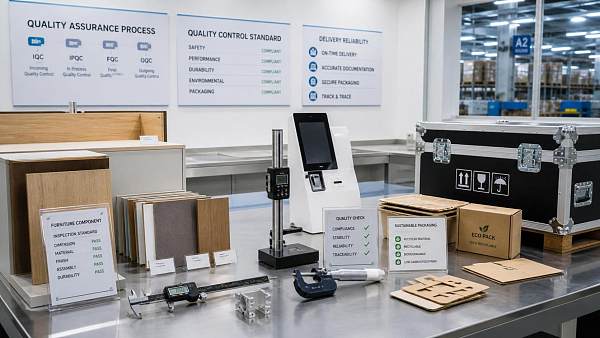
A credible manufacturer should be able to provide test reports, material data, and evidence of compliance relevant to your target market. Do not assume that a statement like “meets international standards” is enough. Ask which specific product lines were tested, when the testing occurred, and whether the report applies to the exact configuration you are sourcing.
Key checks include structural performance, flammability, surface abrasion resistance, emissions, and hardware durability. If power integration, lighting, or charging modules are built into furniture, electrical compliance becomes essential. Buyers comparing commercial furniture manufacturers should also verify whether the supplier understands destination-country rules rather than only domestic production requirements.
2. Material Quality Must Be Evaluated Beyond Appearance
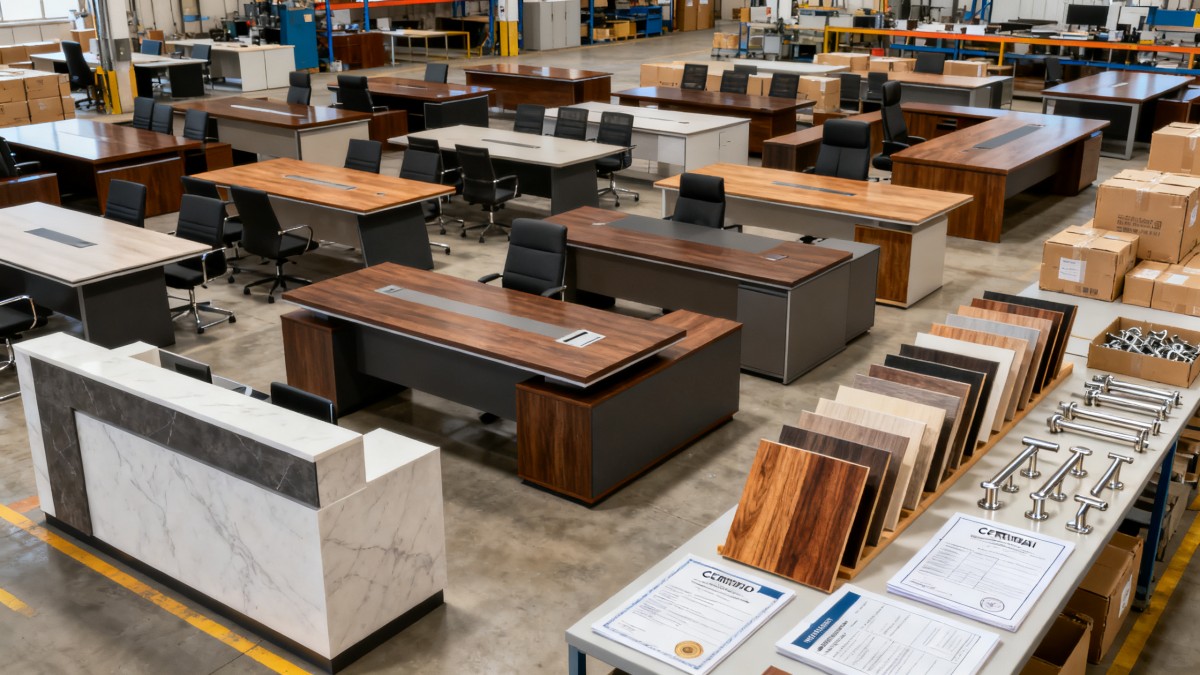
Good-looking samples can still hide weak substrate quality or inconsistent finishing. Ask for full material specifications: board density, veneer thickness, metal gauge, foam density, laminate brand, edge treatment, powder coating standard, and fabric rub count where applicable. These details influence durability far more than photography or showroom styling.
It is useful to compare how commercial furniture manufacturers source core materials. Do they use stable long-term suppliers? Can they maintain color consistency across repeat orders? Are sustainable materials available with traceable documentation? Strong manufacturers provide this information clearly because they know procurement decisions require accountability, not just visual appeal.
3. Manufacturing Capability Should Match Project Complexity
Not all commercial furniture manufacturers are equally capable. Some are excellent at high-volume standard office products but struggle with custom retail fixtures or hospitality millwork. Others can engineer complex assemblies but are less efficient for repeat commodity orders. Review the factory’s real strengths, not just its product brochure.
Ask to see examples of comparable projects, especially those involving similar finishes, tolerances, branding requirements, or installation environments. If your program includes custom dimensions, integrated technology, unusual materials, or phased rollouts, confirm the engineering and project management process in detail. A supplier that cannot manage change control will create downstream cost even if the initial quote is attractive.
4. Customization Capacity Needs Practical Proof
Many suppliers say they offer customization, but the important question is how well they control it. Procurement teams should assess whether the manufacturer can translate design intent into shop drawings, prototypes, approved samples, and scalable production without quality drift.
A reliable process usually includes design review, technical clarification, finish sample approval, mockup production, revision tracking, and final sign-off. When comparing commercial furniture manufacturers, buyers should favor those that treat customization as an engineered workflow rather than an informal promise from a sales representative.
5. Lead Time Analysis Should Include More Than Factory Days
One of the most expensive procurement mistakes is accepting an optimistic lead time without understanding the full timeline. Commercial furniture manufacturers may quote production days only, while procurement must manage sample approval, material reservation, packaging, export documents, vessel booking, customs clearance, inland delivery, and site readiness.
Ask suppliers to break the timeline into stages. This reveals where risk is concentrated. A mature supplier can explain standard lead times, rush-order limitations, and contingency planning. For multi-site rollouts, also confirm whether partial shipment, buffer stock, or staged production is possible.
6. After-Sales Support Is a Financial Factor, Not a Courtesy
After-sales capability is often overlooked during tender review, yet it has direct budget impact. Clarify warranty scope, spare parts availability, claim response process, field repair support, and ownership of freight cost for replacements. For office systems, seating, and frequently used public furniture, access to replacement parts can extend asset life significantly.
The best commercial furniture manufacturers offer documented service terms, not vague assurances. If your organization manages multiple locations, ask whether the supplier can support future matching orders and maintain archival records of specifications and finishes.
Use This Comparison Table to Score Suppliers Objectively
A simple scoring method helps procurement teams compare commercial furniture manufacturers consistently across bids and internal stakeholders.
What Changes by Project Type
Procurement criteria should be adjusted to the environment where the furniture will be used. The same commercial furniture manufacturers may perform differently depending on the application.
- Office projects: Prioritize ergonomics, reconfiguration flexibility, cable management, acoustic performance, and long-term replacement support.
- Retail environments: Focus on brand consistency, fixture durability, visual merchandising adaptability, and rollout speed across stores.
- Hospitality spaces: Examine finish quality, comfort, stain resistance, fire performance, and custom detailing accuracy.
- Healthcare or education: Pay close attention to cleanability, safety edges, intensive-use durability, and material compliance documentation.
This project-based lens helps buyers avoid selecting commercial furniture manufacturers that are reputable in one category but poorly matched to another.
Commonly Ignored Warning Signs That Lead to Costly Mistakes
Procurement errors often come from what was not asked early enough. Watch for these warning signs during supplier evaluation:
- Quotes that are substantially lower without a clear specification match.
- No version control on drawings, finish approvals, or revised dimensions.
- Testing reports that do not match the actual product configuration.
- Unclear packaging standards for export or site delivery.
- Vague warranty language and no spare parts plan.
- Poor responsiveness from engineering or project management teams before order placement.
When commercial furniture manufacturers show weakness in communication during the bidding stage, the execution stage is rarely better. Responsiveness is often an early indicator of operational discipline.
Practical Steps for a Better Procurement Process
To make comparisons meaningful, standardize the information you request from every supplier. Provide the same drawings, finish expectations, compliance requirements, delivery terms, and service questions to each bidder. This improves quote quality and reduces the risk of choosing based on incomplete assumptions.
It is also wise to request one or more of the following before final award: a material board, a control sample, a mockup, a reference list for similar projects, and a production schedule with milestone dates. These items reveal far more about commercial furniture manufacturers than polished presentations do.
For strategic sourcing, procurement teams should document supplier performance after installation as well. Track damage rates, finish consistency, punch-list issues, warranty claims, and reorder accuracy. Over time, this converts one-time purchasing into a stronger supplier benchmarking system.
FAQ for Procurement Teams Comparing Commercial Furniture Manufacturers
Is the lowest quote ever the best choice?
Usually not. The best value comes from the supplier that can meet specifications, timeline, compliance, and service expectations with the lowest total risk-adjusted cost.
How many suppliers should be compared?
For most projects, three qualified commercial furniture manufacturers provide enough range for meaningful comparison without overloading the review process.
When should a factory audit or virtual review be considered?
Consider it for high-value custom projects, multi-site rollouts, or when the supplier relationship may become long term. Audits help validate capability, process control, and quality discipline.
Final Decision Guidance and Next Questions to Raise
The smartest way to compare commercial furniture manufacturers is to treat sourcing as a risk-managed business decision, not a simple unit-price exercise. Procurement professionals should prioritize compliance, material integrity, manufacturing fit, customization control, realistic lead times, and after-sales reliability. Those factors protect budget, timeline, and brand standards far better than a cheap initial offer.
If you are ready to move forward, the next conversation with shortlisted suppliers should focus on six practical points: exact specifications, certification evidence, approved material options, production milestones, packaging and logistics method, and warranty or spare parts commitments. With those answers documented, your team can compare commercial furniture manufacturers with greater confidence and avoid the costly mistakes that undermine otherwise well-planned projects.
News Recommendations
 How to choose an ultra bright waterproof window display for storefronts
![51a6ab95581761cc26f4318be6520c15]()
Aris Katos
Future of Carbide Coatings
 How to verify suppliers on a trade portal for global sourcing
![51a6ab95581761cc26f4318be6520c15]()
Aris Katos
Future of Carbide Coatings
 How RoHS requirements should be stated in product specifications
![51a6ab95581761cc26f4318be6520c15]()
Aris Katos
Future of Carbide Coatings
 What affects the lead time for custom retail counter displays?
![51a6ab95581761cc26f4318be6520c15]()
Aris Katos
Future of Carbide Coatings
 What consumer packaging USA importers need to verify before ordering
![51a6ab95581761cc26f4318be6520c15]()
Aris Katos
Future of Carbide Coatings
 How commercial spaces interiors shape customer dwell time
![51a6ab95581761cc26f4318be6520c15]()
Aris Katos
Future of Carbide Coatings
 How LED commercial lighting design reduces glare in retail spaces
![51a6ab95581761cc26f4318be6520c15]()
Aris Katos
Future of Carbide Coatings
 How industrial technology information improves RFID inventory accuracy
![51a6ab95581761cc26f4318be6520c15]()
Aris Katos
Future of Carbide Coatings
 When drip garden watering systems make more sense than sprinklers
![51a6ab95581761cc26f4318be6520c15]()
Aris Katos
Future of Carbide Coatings
 When category comparison improves sourcing for industrial applications
![51a6ab95581761cc26f4318be6520c15]()
Aris Katos
Future of Carbide Coatings
 Industrial application guidance for selecting the right LED lighting
![51a6ab95581761cc26f4318be6520c15]()
Aris Katos
Future of Carbide Coatings
 Which commercial architecture standards apply to European retail fit-outs?
![51a6ab95581761cc26f4318be6520c15]()
Aris Katos
Future of Carbide Coatings
 How to verify FDA requirements for maternity care products
![51a6ab95581761cc26f4318be6520c15]()
Aris Katos
Future of Carbide Coatings
 How to verify BPA-free claims for food-contact products
![51a6ab95581761cc26f4318be6520c15]()
Aris Katos
Future of Carbide Coatings
 When does a European wholesale supplier suit modular office projects?
![51a6ab95581761cc26f4318be6520c15]()
Aris Katos
Future of Carbide Coatings
 When consumer ecosystem solutions improve the in-store shopping journey
![51a6ab95581761cc26f4318be6520c15]()
Aris Katos
Future of Carbide Coatings
 How a commercial developers network can reduce site selection risk
![51a6ab95581761cc26f4318be6520c15]()
Aris Katos
Future of Carbide Coatings
 How clear purchasing specifications prevent costly supplier deviations
![51a6ab95581761cc26f4318be6520c15]()
Aris Katos
Future of Carbide Coatings
 What an ISTA drop test lab checks before your packaging ships
![51a6ab95581761cc26f4318be6520c15]()
Aris Katos
Future of Carbide Coatings
 Which commercial furniture standards apply to workplace seating?
![51a6ab95581761cc26f4318be6520c15]()
Aris Katos
Future of Carbide Coatings
 How to evaluate smart lighting module OEM compatibility before sampling
![51a6ab95581761cc26f4318be6520c15]()
Aris Katos
Future of Carbide Coatings
 How to assess whether sustainable technology delivers real impact
![51a6ab95581761cc26f4318be6520c15]()
Aris Katos
Future of Carbide Coatings
 How to assess an OEM supplier’s quality control before ordering
![51a6ab95581761cc26f4318be6520c15]()
Aris Katos
Future of Carbide Coatings
 How consumer ecosystem solutions data can improve retail personalization
![51a6ab95581761cc26f4318be6520c15]()
Aris Katos
Future of Carbide Coatings
 When does consumer packaging design justify a higher product price?
![51a6ab95581761cc26f4318be6520c15]()
Aris Katos
Future of Carbide Coatings
 Supermarket Fixture Installation: Planning Layouts, Wiring, and Handover
![51a6ab95581761cc26f4318be6520c15]()
Aris Katos
Future of Carbide Coatings
 Automated Lighting and Smart Lighting Control in Bergerac: Key Project Considerations
![51a6ab95581761cc26f4318be6520c15]()
Aris Katos
Future of Carbide Coatings
 Segment Streetlight Controllers: Choosing Control Modes for Urban Roads
![51a6ab95581761cc26f4318be6520c15]()
Aris Katos
Future of Carbide Coatings
 IEC 62471-2 Explained: How to Assess Photobiological Risks in LED Lighting
![51a6ab95581761cc26f4318be6520c15]()
Aris Katos
Future of Carbide Coatings
 Food Grade Packaging Requirements by Product Type, Temperature, and Contact Risk
![51a6ab95581761cc26f4318be6520c15]()
Aris Katos
Future of Carbide Coatings
 Food Packaging Compliance Checklist: Tests, Records, and Labeling Before Shipment
![51a6ab95581761cc26f4318be6520c15]()
Aris Katos
Future of Carbide Coatings
 NSF Food Packaging Standards: When Certification Matters for Commercial Food Use
![51a6ab95581761cc26f4318be6520c15]()
Aris Katos
Future of Carbide Coatings
 FDA Food Grade Compliance: Which Materials and Documents Do Buyers Need?
![51a6ab95581761cc26f4318be6520c15]()
Aris Katos
Future of Carbide Coatings
 What Should a Food Grade Declaration Include for Packaging Compliance?
![51a6ab95581761cc26f4318be6520c15]()
Aris Katos
Future of Carbide Coatings
 Housewares Importing: How to Evaluate Suppliers, Costs, and Compliance Risks
![51a6ab95581761cc26f4318be6520c15]()
Aris Katos
Future of Carbide Coatings
 Why Freeze-Dried Fruit Ingredients Lose Crispness—and How to Prevent It
![51a6ab95581761cc26f4318be6520c15]()
Aris Katos
Future of Carbide Coatings
 What industry veterans look for before choosing a new supplier
![51a6ab95581761cc26f4318be6520c15]()
Aris Katos
Future of Carbide Coatings
 How material fatigue can shorten the service life of retail shelving
![51a6ab95581761cc26f4318be6520c15]()
Aris Katos
Future of Carbide Coatings
 What makes a global sourcing platform reliable for supplier verification?
![51a6ab95581761cc26f4318be6520c15]()
Aris Katos
Future of Carbide Coatings