
Indonesia BPOM Requires Digital Shelf Life on E-Commerce Fulfillment Packs
Time
Click Count
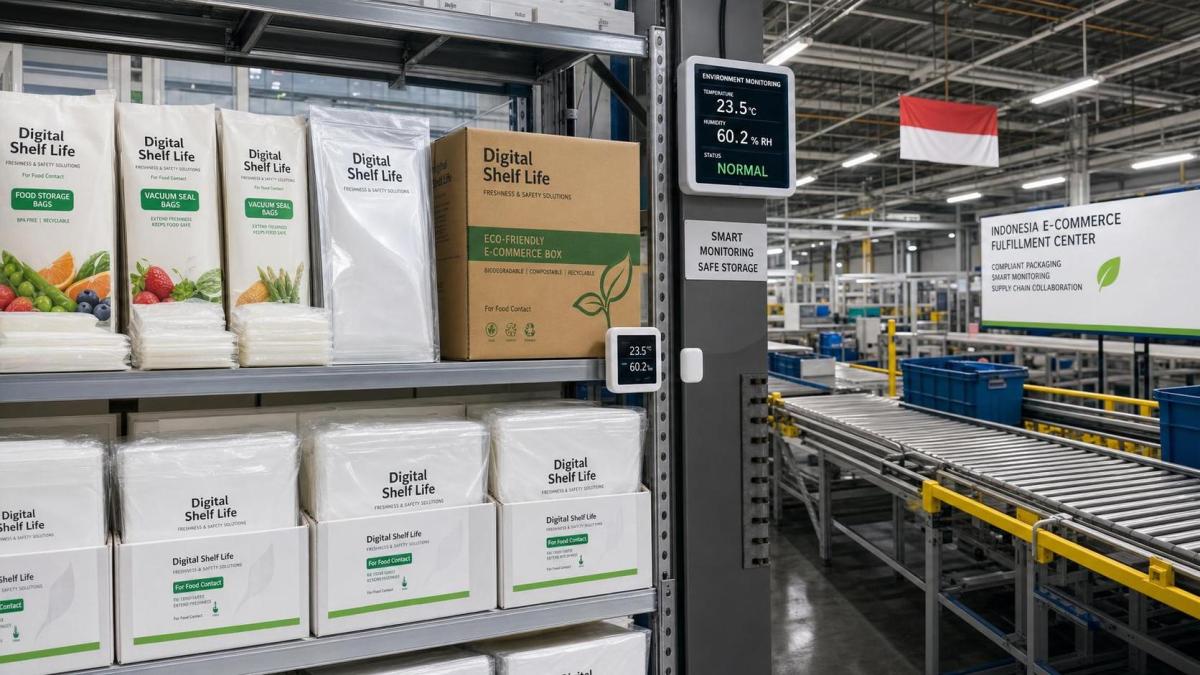
Effective June 27, 2026, Indonesia’s National Agency of Drug and Food Control (BPOM) has introduced a new requirement for food-contact packaging shipped through local e-commerce fulfillment centers. The rule draws attention from packaging suppliers, fulfillment operators, importers, local assemblers, and brands using marketplace logistics, because it connects packaging compliance with a bilingual “Digital Shelf Life” label calculated from temperature and humidity IoT data rather than a static packaging statement.
What the New Requirement Covers
According to the provided information, the BPOM rule took effect on June 27, 2026. It requires all food-contact packaging dispatched from local e-commerce fulfillment centers, including examples such as Lazada Fulfillment and Tokopedia Logistics, to carry a bilingual Indonesian-and-English “Digital Shelf Life” marking on the packaging material.
The requirement applies to food-contact packaging used in fulfillment, including fresh-keeping bags, vacuum bags, and biodegradable courier boxes. The “Digital Shelf Life” referred to in the summary is a remaining shelf-life period dynamically calculated on the basis of temperature and humidity IoT data. The scope of the rule covers both imported packaging suppliers and locally assembled packaging suppliers.
Where the Pressure Points May Appear First
Packaging suppliers face a direct labeling adjustment
From an industry perspective, imported and local packaging suppliers are the most directly affected because the rule is tied to what must be printed on the packaging itself. The immediate impact is likely to fall on packaging design, bilingual label preparation, production coordination, and shipment readiness for materials destined for Indonesian e-commerce fulfillment channels.
Fulfillment centers may need tighter outbound controls
Analysis shows that fulfillment operators are relevant because the requirement is defined around packaging shipped from local e-commerce fulfillment centers. That means the outbound stage, packaging material selection, and compliance checks before dispatch become practical points of attention, especially where multiple packaging formats are used across different product flows.
Brands and sellers using marketplace logistics may need to verify packaging compliance earlier
Observably, merchants and brand owners relying on marketplace fulfillment are not the primary rule makers here, but they may still be affected through packaging sourcing and order execution. Their exposure is likely to sit in procurement decisions, supplier communication, and the risk of operational disruption if packaging prepared for fulfillment does not align with the new labeling requirement.
Cross-border and assembly-linked supply chains may see added coordination needs
Because the requirement applies to both imported and locally assembled packaging suppliers, the issue is not limited to one origin model. What deserves closer attention is how cross-border supply, local assembly, and final fulfillment packaging specifications are aligned, particularly when one packaging standard has been used across several channels or markets.
What Companies Should Watch Now
Follow the exact language and execution details
Analysis shows that the core requirement is clear in principle, but practical execution often depends on official wording, formatting expectations, and interpretation at the operating level. Companies involved in packaging production or fulfillment should pay close attention to any subsequent BPOM expression that clarifies how the bilingual “Digital Shelf Life” must appear on pack materials.
Review which SKUs and packaging formats are in scope
The provided summary names food-contact packaging and gives examples such as fresh-keeping bags, vacuum bags, and biodegradable courier boxes. For businesses, the operational issue is to identify which packaging formats entering Indonesian fulfillment flows fall within that scope, rather than assuming all packaging or only a narrow subset is affected.
Separate policy intent from operational readiness
Observably, the policy signal is about dynamic shelf-life labeling tied to IoT temperature and humidity data, but actual implementation in business workflows may involve several handoff points. Companies should distinguish between understanding the rule conceptually and being ready to execute it consistently across sourcing, printing, warehousing, and outbound fulfillment.
Prepare supplier documentation and communication paths
What deserves closer attention is the documentary and communication side of compliance. Packaging buyers, fulfillment partners, and suppliers may need aligned product specifications, bilingual label confirmation, and a clear process for handling packaging batches intended for Indonesian e-commerce fulfillment operations.
Why This Looks Like More Than a Simple Packaging Update
Analysis shows that this development is not only about adding another printed statement to a package. It points to a closer link between packaging compliance and digitally derived product-condition information in e-commerce logistics. Based on the provided information alone, it is more appropriate to understand this as a regulatory signal with operational implications, rather than as a fully observable market shift whose long-term effects are already settled.
Observably, the requirement also matters because it is framed around fulfillment-center outbound activity. That places compliance attention inside the e-commerce warehouse and distribution process, not only at the product manufacturing stage. For the industry, the key question is less whether the rule exists and more how consistently it will be translated into packaging supply and fulfillment execution.
How the Industry May Best Read This at Present
At this stage, the most balanced reading is that Indonesia’s new BPOM requirement creates an immediate compliance issue for food-contact packaging used in e-commerce fulfillment, while also signaling a wider regulatory interest in data-linked packaging information. It should not yet be overstated as a final indicator of broader regional convergence, but it is clearly more than a short-lived procedural adjustment for packaging suppliers serving Indonesian e-commerce channels.
Basis of This Article and Ongoing Verification
This article is based on the user-provided news title, event date, and event summary. For developments of this kind, commonly relevant source types may include official regulatory notices, company announcements, industry association updates, authoritative media reporting, and standards-related documents. A specific official source link was not provided in the input, so the exact source text still requires continued verification. Follow-up attention should focus on any further BPOM clarification, implementation wording, and how the requirement is applied in actual fulfillment and packaging operations.
News Recommendations
 Which consumer goods need CE marking in Europe?
![51a6ab95581761cc26f4318be6520c15]()
Aris Katos
Future of Carbide Coatings
 Uniguest and Extreme Networks Partner to Simplify Digital Signage Deployment
![51a6ab95581761cc26f4318be6520c15]()
Aris Katos
Future of Carbide Coatings
 How to assess electronics compliance whitepapers for regulatory accuracy
![51a6ab95581761cc26f4318be6520c15]()
Aris Katos
Future of Carbide Coatings
 Packaging Data Hub Launches With Plastic Recycling Findings for 50 Countries
![51a6ab95581761cc26f4318be6520c15]()
Aris Katos
Future of Carbide Coatings
 How to verify an ergonomic office chair supplier's warranty terms
![51a6ab95581761cc26f4318be6520c15]()
Aris Katos
Future of Carbide Coatings
 Curion Survey: 64% Value Sustainable Beauty Packaging, but Quality Comes First
![51a6ab95581761cc26f4318be6520c15]()
Aris Katos
Future of Carbide Coatings
 Can minimalist fit out solutions make a small office feel larger?
![51a6ab95581761cc26f4318be6520c15]()
Aris Katos
Future of Carbide Coatings
 Kiosk Industry Releases IAAPA 2026 Self-Service Guide
![51a6ab95581761cc26f4318be6520c15]()
Aris Katos
Future of Carbide Coatings
 How to improve global supply chain visibility beyond tier-one suppliers
![51a6ab95581761cc26f4318be6520c15]()
Aris Katos
Future of Carbide Coatings
 Austria’s MM Group to Sell 70% of Packaging Business to KPS for $2.7 Billion
![51a6ab95581761cc26f4318be6520c15]()
Aris Katos
Future of Carbide Coatings
 How to assess delivery reliability of airport terminal seating suppliers in Europe
![51a6ab95581761cc26f4318be6520c15]()
Aris Katos
Future of Carbide Coatings
 USTR Extends China-Linked Vessel Fee Pause and 178 Product Exemptions to January 2027
![51a6ab95581761cc26f4318be6520c15]()
Aris Katos
Future of Carbide Coatings
 How to choose smart sensors for automated lighting
![51a6ab95581761cc26f4318be6520c15]()
Aris Katos
Future of Carbide Coatings
 Shanghai Retail Buyers Sign Deals at Ninth China International Import Expo
![51a6ab95581761cc26f4318be6520c15]()
Aris Katos
Future of Carbide Coatings
 Which toys are subject to EN 71 toy safety requirements?
![51a6ab95581761cc26f4318be6520c15]()
Aris Katos
Future of Carbide Coatings
 Report: Global Kraft Paper Market Forecast to Reach $20.5 Billion by 2033
![51a6ab95581761cc26f4318be6520c15]()
Aris Katos
Future of Carbide Coatings
 How to verify Zigbee compatibility when sourcing lighting sensors
![51a6ab95581761cc26f4318be6520c15]()
Aris Katos
Future of Carbide Coatings
 How do packaging customization options affect minimum order quantities in Europe?
![51a6ab95581761cc26f4318be6520c15]()
Aris Katos
Future of Carbide Coatings
 Transom to Acquire Cree LED in Commercial Lighting Ownership Change
![51a6ab95581761cc26f4318be6520c15]()
Aris Katos
Future of Carbide Coatings
 How to plan customer flow in commercial design planning
![51a6ab95581761cc26f4318be6520c15]()
Aris Katos
Future of Carbide Coatings
 USTR Urged to Permanently Suspend Fees on China-Linked Ships
![51a6ab95581761cc26f4318be6520c15]()
Aris Katos
Future of Carbide Coatings
 How to choose comparable stores for retail benchmarking
![51a6ab95581761cc26f4318be6520c15]()
Aris Katos
Future of Carbide Coatings
 How does anchoring affect modular building wind load resistance?
![51a6ab95581761cc26f4318be6520c15]()
Aris Katos
Future of Carbide Coatings
 Amazon Raises European FBA Surcharge to 2% in Ten Markets From November 2
![51a6ab95581761cc26f4318be6520c15]()
Aris Katos
Future of Carbide Coatings
 How to verify a BPA-free test report for baby products
![51a6ab95581761cc26f4318be6520c15]()
Aris Katos
Future of Carbide Coatings
 China's Mandatory Classroom Lighting Standard GB 7793-2025 Takes Effect November 1
![51a6ab95581761cc26f4318be6520c15]()
Aris Katos
Future of Carbide Coatings
 How order volume affects the price of wholesale poly mailers
![51a6ab95581761cc26f4318be6520c15]()
Aris Katos
Future of Carbide Coatings
 US Imposes 50% Tariff on Certain Canadian PET Resin Imports
![51a6ab95581761cc26f4318be6520c15]()
Aris Katos
Future of Carbide Coatings
 How to read the maximum ratings in a semiconductor datasheet
![51a6ab95581761cc26f4318be6520c15]()
Aris Katos
Future of Carbide Coatings
 University of Maryland Develops Bio-Based Packaging to Extend Avocado and Cucumber Shelf Life
![51a6ab95581761cc26f4318be6520c15]()
Aris Katos
Future of Carbide Coatings
 How to verify a cookware manufacturer's induction compatibility claims
![51a6ab95581761cc26f4318be6520c15]()
Aris Katos
Future of Carbide Coatings
 Omdia Forecasts 11.6% Annual Growth in LED Display Revenue Through 2030
![51a6ab95581761cc26f4318be6520c15]()
Aris Katos
Future of Carbide Coatings
 How to verify a pulp molding packaging factory's production capacity
![51a6ab95581761cc26f4318be6520c15]()
Aris Katos
Future of Carbide Coatings
 Curion Survey: Half of Consumers Frustrated by Sustainable Packaging
![51a6ab95581761cc26f4318be6520c15]()
Aris Katos
Future of Carbide Coatings
 How to assess the credibility of market insight content
![51a6ab95581761cc26f4318be6520c15]()
Aris Katos
Future of Carbide Coatings
 US Removes 50% Additional Tariff on Selected Canadian Packaging Products
![51a6ab95581761cc26f4318be6520c15]()
Aris Katos
Future of Carbide Coatings
 Will a waterproof dimmable LED driver work with your existing dimmer?
![51a6ab95581761cc26f4318be6520c15]()
Aris Katos
Future of Carbide Coatings
 Charter Next Generation Raises Film PCR Use 30%, Advances Food-Grade Applications
![51a6ab95581761cc26f4318be6520c15]()
Aris Katos
Future of Carbide Coatings
 How to choose a dog harness and leash for a dog that pulls hard
![51a6ab95581761cc26f4318be6520c15]()
Aris Katos
Future of Carbide Coatings