How to verify EMC reports from an OEM retail shelf LCD screen factory
Time
Click Count
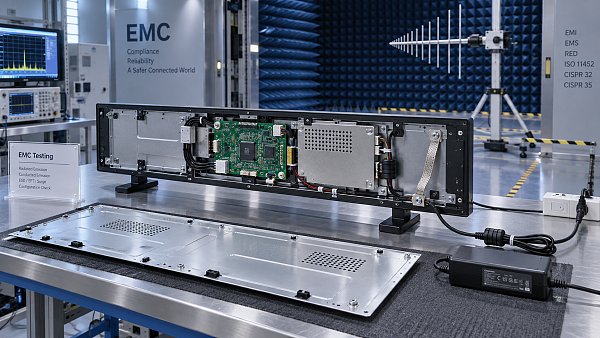
An EMC report supports acceptance only when the tested equipment represents the retail shelf LCD screen being delivered. A passing result has limited value if the report identifies a different controller board, omits the supplied power adapter, or covers an operating mode that leaves major interfaces inactive. Verification therefore starts with a traceable link between the report, the test sample, and the production configuration.
For a screen sourced from an oem retail shelf lcd screen factory, the strongest evidence combines an authenticated laboratory report with identifiable hardware, documented test conditions, and controlled production revisions. The following examination focuses on the gaps that change whether a reported pass applies to the finished product.
Establish that the report is authentic and complete
Obtain the complete report, including photographs, results tables, equipment descriptions, and any amendments. A certificate page or a cropped “PASS” table does not show which tests were performed or what equipment was connected. Confirm that the report number, issue date, page numbering, laboratory identity, and approval details are consistent throughout the document.
Authenticate questionable documents through contact information obtained independently from the laboratory’s official website. Contact details printed inside an altered report could lead back to the source of the alteration. Request confirmation that the report number exists, that its revision is current, and that the supplied document matches the laboratory’s issued version. Where confidentiality prevents direct confirmation, authorization from the report owner provides a route to verification.
The applicant, manufacturing site, and product brand can legitimately differ in an OEM arrangement. Those differences need an explainable documentary chain. A report issued to an unrelated trading entity is not automatically invalid, but the relationship to the supplied model must be established. A shared enclosure shape or similar product photograph is insufficient.
Also distinguish a final compliance report from a development scan. Preliminary measurements are useful engineering evidence, but they may lack the full test sequence, formal approval, or controlled configuration needed to support acceptance.
Read laboratory accreditation at the scope level
Accreditation to ISO/IEC 17025 provides evidence of laboratory competence for activities within its accredited scope. It does not establish that every service offered by that laboratory is accredited. Retrieve the scope from the accreditation body’s directory and compare it with the methods, site, and activities shown in the report.
The relevant questions are whether the accreditation covered the work when it was performed and whether the particular tests fall within the scope. A laboratory accredited for emissions testing does not automatically have accredited capability for immunity testing. Testing performed at a different location or subcontracted to another laboratory also needs identifiable supporting information.
Report markings sometimes distinguish accredited results from tests outside the scope. Read those notes rather than treating an accreditation logo as blanket coverage. If the applicable conformity route requires a recognized or designated laboratory, verify that status separately; accreditation and regulatory recognition serve different purposes.
An expired accreditation certificate displayed today does not, by itself, invalidate a report issued during a valid period. Conversely, current accreditation does not prove that earlier work was covered. Dates and scope history resolve that distinction.
Confirm that the standards fit the product and intended market
A shelf LCD screen can combine a display, media processor, wired interfaces, and wireless modules. The applicable EMC assessment follows the finished equipment’s functions, ports, power arrangement, intended environment, and destination market. A generic statement such as “EMC compliant” leaves too much unresolved.
Compare the report’s cited standards and editions with the intended conformity route. Confirm the product category and any environmental classification used to select limits. Commercial installation alone does not justify every less restrictive emissions classification; the chosen classification must fit the applicable rules and any associated installation restrictions.
Emissions and immunity answer different questions. Emissions testing measures disturbance generated by the equipment. Immunity testing evaluates its behavior under specified disturbances. Some market routes focus on emissions, while others also require immunity evidence. A radiated-emissions pass cannot establish resistance to electrostatic discharge or supply disturbances.
Wireless functions introduce a separate coverage question. Evidence for a radio module does not automatically establish EMC performance of the assembled display. The host board, antenna arrangement, enclosure, and power supply affect the finished system. Determine which requirements the module evidence supports and which remain dependent on the host integration.
Do not reject a report solely because its standard edition is older. Establish whether that edition remains acceptable for the intended route and relevant placing-on-market date. Where an update changes applicable tests or limits, obtain a documented gap assessment or additional testing.
Match the tested sample to the production screen
Start with the equipment identification pages and photographs. The model designation should connect to the purchase specification, product label, and production records. Record the controller board revision, panel identification, firmware version, enclosure construction, and power-input arrangement wherever those details affect EMC behavior.
Model suffixes deserve particular attention. A suffix that merely indicates a cosmetic finish has a different significance from one identifying a new processor, wireless option, or power circuit. A family report needs a technical explanation of how its tested models represent the listed variants. Different display lengths alone do not establish that one sample is the worst case.
Internal photographs are especially valuable when external labels remain unchanged across revisions. Compare connector locations, shielding parts, ferrites, grounding straps, and cable routing with a production sample. A missing ferrite or revised shield attachment can undermine the relevance of a report without changing the product’s advertised specifications.

Where internal details are commercially sensitive, controlled access to photographs or revision records still needs to establish the match. Confidentiality does not resolve an unidentified hardware configuration.
Inspect the power, cables, and operating modes used during testing
The equipment-under-test description should identify everything needed to reproduce the setup: the screen, adapter, connected peripherals, cable types and lengths, port use, and relevant grounding or mounting conditions. Follow the configuration through the photographs and individual test sections, since emissions and immunity setups can differ.
An adapter’s own compliance evidence is useful but does not prove compliance of the adapter-and-display combination. Noise can couple through the DC lead, screen chassis, and signal cables. If the screen report used a laboratory supply while production units ship with an AC adapter, establish which system-level evidence covers the shipped arrangement.
Cable details affect the conclusion. Shielded cables, connector shield termination, and ferrites influence common-mode emissions. If the passing configuration relies on a supplied shielded cable, replacing it with an unshielded accessory changes the assessed setup. A report should make such configuration dependencies visible.
For networked shelf displays, look for representative activity rather than a static image with disconnected ports. Video playback, content transfer, wireless traffic, and brightness control exercise different circuits. Maximum brightness is a useful condition to investigate, but it is not automatically the worst case: dimming control can introduce a different switching pattern.
The report should explain how operating modes were selected. Evidence from exploratory scans or a documented technical rationale supports selection of the final test mode. Testing every imaginable screen image is unnecessary, but leaving active product functions unrepresented creates a coverage gap.
Mounting also matters when it affects electrical behavior. A metal shelf bracket, bonded rail, or accessible bezel can change coupling and discharge paths. A desktop arrangement needs review when the product relies on its installed mounting arrangement for grounding or shielding.
Interpret the measurements and immunity observations
Read results tables alongside plots. For emissions, identify the applicable limit, measured level, frequency, detector, and test configuration. A preliminary peak scan above a limit is not automatically a failure if the required final detector measurement establishes compliance. Conversely, a plot alone does not demonstrate that every relevant frequency received the required final assessment.
Compare like measurements. Different measurement distances, bandwidths, detectors, and correction methods prevent direct comparison of headline values. For conducted emissions, confirm that the assessed port and power arrangement correspond to the actual product configuration.
Passing margin indicates how close the tested sample was to a limit under the stated conditions. It does not guarantee that production variation will remain within limits. Small margins deserve closer attention to component substitutions, assembly consistency, and configuration control. Measurement uncertainty should be interpreted through the laboratory’s stated decision rule; do not independently add or subtract it to redefine the result.
Immunity results require a functional reading. Determine what the screen was required to maintain, what temporary degradation was permitted, and how recovery was assessed. A temporary image disturbance, automatic restart, or loss of stored content has a different significance under different performance criteria. “Recovered after power cycling” needs explicit evaluation against the criterion assigned to that test.
Look for observations during exposure and after the test. A screen that returns to normal afterward could still have frozen throughout the disturbance. Useful monitoring covers visible display behavior, communication status, and stored settings where those functions form part of the acceptance criteria.
For electrostatic discharge, photographs and notes should explain the accessible points exercised. For disturbances applied through cables or power ports, confirm that applicable ports were included. “Not applicable” needs a product-specific reason, such as the absence of the relevant port, rather than an unexplained omission.
Resolve gaps before treating the report as production evidence
Separate document gaps from configuration gaps. Missing pages, an ambiguous model suffix, or an unreadable adapter label can often be resolved with authenticated records. A changed controller, altered shielding arrangement, or untested power combination requires technical assessment and potentially additional testing. Editing the model list cannot establish equivalence by itself.
A useful closure record identifies the discrepancy, the evidence reviewed, the technical basis for acceptance, and any remaining configuration restrictions. Where additional measurements are needed, define the affected tests and operating conditions explicitly. A focused reassessment is defensible when the change analysis supports its scope; broad hardware changes need a broader evaluation.
Finally, retain the accepted report revision alongside the corresponding hardware and firmware baseline. Subsequent substitutions should trigger review against that baseline, including adapters and accessories supplied separately. This preserves the link between the tested sample and later shipments, which is the practical basis for relying on an OEM shelf display’s EMC report.
News Recommendations
 How to plan customer flow in commercial design planning
![51a6ab95581761cc26f4318be6520c15]()
Aris Katos
Future of Carbide Coatings
 USTR Urged to Permanently Suspend Fees on China-Linked Ships
![51a6ab95581761cc26f4318be6520c15]()
Aris Katos
Future of Carbide Coatings
 How to choose comparable stores for retail benchmarking
![51a6ab95581761cc26f4318be6520c15]()
Aris Katos
Future of Carbide Coatings
 How does anchoring affect modular building wind load resistance?
![51a6ab95581761cc26f4318be6520c15]()
Aris Katos
Future of Carbide Coatings
 Amazon Raises European FBA Surcharge to 2% in Ten Markets From November 2
![51a6ab95581761cc26f4318be6520c15]()
Aris Katos
Future of Carbide Coatings
 How to verify a BPA-free test report for baby products
![51a6ab95581761cc26f4318be6520c15]()
Aris Katos
Future of Carbide Coatings
 China's Mandatory Classroom Lighting Standard GB 7793-2025 Takes Effect November 1
![51a6ab95581761cc26f4318be6520c15]()
Aris Katos
Future of Carbide Coatings
 How order volume affects the price of wholesale poly mailers
![51a6ab95581761cc26f4318be6520c15]()
Aris Katos
Future of Carbide Coatings
 US Imposes 50% Tariff on Certain Canadian PET Resin Imports
![51a6ab95581761cc26f4318be6520c15]()
Aris Katos
Future of Carbide Coatings
 How to read the maximum ratings in a semiconductor datasheet
![51a6ab95581761cc26f4318be6520c15]()
Aris Katos
Future of Carbide Coatings
 University of Maryland Develops Bio-Based Packaging to Extend Avocado and Cucumber Shelf Life
![51a6ab95581761cc26f4318be6520c15]()
Aris Katos
Future of Carbide Coatings
 How to verify a cookware manufacturer's induction compatibility claims
![51a6ab95581761cc26f4318be6520c15]()
Aris Katos
Future of Carbide Coatings
 Omdia Forecasts 11.6% Annual Growth in LED Display Revenue Through 2030
![51a6ab95581761cc26f4318be6520c15]()
Aris Katos
Future of Carbide Coatings
 How to verify a pulp molding packaging factory's production capacity
![51a6ab95581761cc26f4318be6520c15]()
Aris Katos
Future of Carbide Coatings
 Curion Survey: Half of Consumers Frustrated by Sustainable Packaging
![51a6ab95581761cc26f4318be6520c15]()
Aris Katos
Future of Carbide Coatings
 How to assess the credibility of market insight content
![51a6ab95581761cc26f4318be6520c15]()
Aris Katos
Future of Carbide Coatings
 US Removes 50% Additional Tariff on Selected Canadian Packaging Products
![51a6ab95581761cc26f4318be6520c15]()
Aris Katos
Future of Carbide Coatings
 Will a waterproof dimmable LED driver work with your existing dimmer?
![51a6ab95581761cc26f4318be6520c15]()
Aris Katos
Future of Carbide Coatings
 Charter Next Generation Raises Film PCR Use 30%, Advances Food-Grade Applications
![51a6ab95581761cc26f4318be6520c15]()
Aris Katos
Future of Carbide Coatings
 How to choose a dog harness and leash for a dog that pulls hard
![51a6ab95581761cc26f4318be6520c15]()
Aris Katos
Future of Carbide Coatings
 How to respect local customs when negotiating with overseas suppliers
![51a6ab95581761cc26f4318be6520c15]()
Aris Katos
Future of Carbide Coatings
 RFID Recycling Challenges Bring Paper-Based and Chipless Tags Into Focus
![51a6ab95581761cc26f4318be6520c15]()
Aris Katos
Future of Carbide Coatings
 How to choose commercial lighting for offices that reduces glare
![51a6ab95581761cc26f4318be6520c15]()
Aris Katos
Future of Carbide Coatings
 Queue Launches Fully Automated Robotic Pharmacy Kiosk for 30-Second Dispensing
![51a6ab95581761cc26f4318be6520c15]()
Aris Katos
Future of Carbide Coatings
 Can your supermarket store fixtures supplier meet your opening date?
![51a6ab95581761cc26f4318be6520c15]()
Aris Katos
Future of Carbide Coatings
 Shopify POS UI Extensions 2026-10 Adds Virtual Lists and Custom Row Templates
![51a6ab95581761cc26f4318be6520c15]()
Aris Katos
Future of Carbide Coatings
 How to assess smart office furniture suppliers’ North American support
![51a6ab95581761cc26f4318be6520c15]()
Aris Katos
Future of Carbide Coatings
 Aqara Launches Smart Lighting Range to Advance AI Spatial Intelligence
![51a6ab95581761cc26f4318be6520c15]()
Aris Katos
Future of Carbide Coatings
 How to assess demand forecasts in a lighting intelligence report
![51a6ab95581761cc26f4318be6520c15]()
Aris Katos
Future of Carbide Coatings
 Billerud推出PharmaKraft纤维基医药包装材料
![51a6ab95581761cc26f4318be6520c15]()
Aris Katos
Future of Carbide Coatings
 How to assess supplier reliability in global supply chain sourcing
![51a6ab95581761cc26f4318be6520c15]()
Aris Katos
Future of Carbide Coatings
 Omdia Forecasts 11.6% CAGR for Global LED Video Display Market in 2026–2030
![51a6ab95581761cc26f4318be6520c15]()
Aris Katos
Future of Carbide Coatings
 How to verify an LFGB testing laboratory's accreditation scope
![51a6ab95581761cc26f4318be6520c15]()
Aris Katos
Future of Carbide Coatings
 How to assess a workplace interior supplier's installation scope
![51a6ab95581761cc26f4318be6520c15]()
Aris Katos
Future of Carbide Coatings
 What records are needed for an ISO 9001 furniture factory audit?
![51a6ab95581761cc26f4318be6520c15]()
Aris Katos
Future of Carbide Coatings
 How to choose AI marketing tools that work with your existing CRM
![51a6ab95581761cc26f4318be6520c15]()
Aris Katos
Future of Carbide Coatings
 Do freight costs erase savings when buying retail fixtures wholesale?
![51a6ab95581761cc26f4318be6520c15]()
Aris Katos
Future of Carbide Coatings
 How to verify EMC reports from an OEM retail shelf LCD screen factory
![51a6ab95581761cc26f4318be6520c15]()
Aris Katos
Future of Carbide Coatings
 Who handles firmware updates for an OEM retail shelf screen?
![51a6ab95581761cc26f4318be6520c15]()
Aris Katos
Future of Carbide Coatings