
EU Adopts EN IEC 63000:2026 for Smart Lighting Controls
Time
Click Count
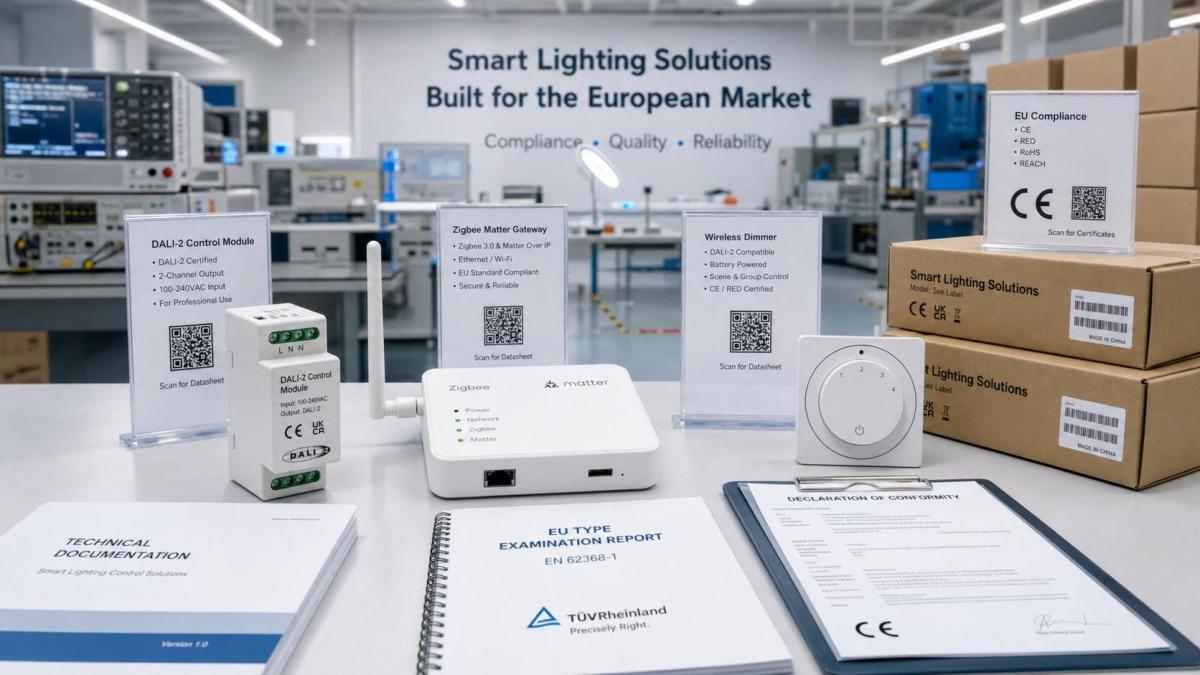
On 2026-07-02, the Official Journal of the European Union (OJEU) published EN IEC 63000:2026 as a harmonized standard for smart lighting control systems entering the EU market. The change covers products including DALI-2, Zigbee Matter gateways, and wireless dimming modules, and it introduces new documentation and labeling expectations tied to hazardous substance disclosure across the product lifecycle. For OEMs, exporters, distributors, and compliance-related service providers, this matters because the update is directly connected to customs clearance and market access for a G-BCE closely monitored Smart Lighting Controls category.
What the new standard now requires
According to the provided information, EN IEC 63000:2026 was formally published by OJEU on 2026-07-02 and applies from that date to all smart lighting control systems placed on the EU market.
The scope specifically includes smart lighting control products such as DALI-2 systems, Zigbee Matter gateways, and wireless dimming modules.
The new requirement asks manufacturers to submit a complete material declaration (CSD), provide verifiable technical documentation demonstrating RoHS and REACH conformity, and add a “Substance Declaration ID” QR code to the product label.
The standard is also directly linked to the export compliance pathway for the Smart Lighting Controls category under G-BCE key monitoring, with implications for customs handling and market entry.
Where the pressure will likely appear across the supply chain
Manufacturers face a heavier documentation threshold
From an industry perspective, manufacturers are the first group likely to feel the direct operational impact because the requirement is framed around material declarations, technical files, and label content. The immediate pressure point is not only product design, but also the completeness and traceability of compliance records used to support RoHS and REACH claims.
What deserves closer attention is whether existing product files for smart lighting controls can already support a full CSD and a verifiable substance-related document trail. Where records are fragmented across component suppliers, internal engineering teams, and contract manufacturing partners, the compliance burden may shift into document consolidation and review before shipment.
Exporters and distributors may see tighter market-entry checks
Analysis shows that exporters and distributors may be affected through customs clearance and EU market access rather than through technical design itself. Because the update is linked to the monitored export compliance path for Smart Lighting Controls, the practical issue for these companies is whether product files, declarations, and labeling can travel with the goods in a form that is easy to verify.
For channel participants, the change is less about interpreting the standard in theory and more about preparing transaction-ready compliance documents that align with shipment, labeling, and product identity.
Procurement and supplier management will need closer material visibility
Observably, procurement teams and sourcing functions may also be affected because a complete material declaration depends on upstream information quality. If suppliers cannot provide sufficiently clear material content data or supporting conformity records, downstream manufacturers and brand owners may struggle to complete the required technical package.
The business impact is likely to show up in supplier qualification, document requests, and purchase planning for covered smart lighting control products and modules.
Testing, certification, and compliance support functions may be pulled in earlier
From an industry perspective, companies involved in testing, certification support, and regulatory file preparation may see demand shift toward earlier-stage document review. The key issue is not that a new certification result has been confirmed in the provided facts, but that verifiable RoHS/REACH technical documentation is now explicitly part of the compliance expectation described in the event summary.
That means supporting functions may need to focus more on consistency between declarations, technical files, and product labeling before goods move into the EU channel.
What companies should review now
Check whether current technical files are evidence-ready
Analysis shows that companies handling covered smart lighting controls should first review whether existing compliance files can be presented as verifiable RoHS/REACH documentation rather than as scattered internal records. This is especially relevant where product variants, communication modules, or gateway configurations are sold under the same commercial family but rely on different component structures.
Revisit labeling workflows for the new QR code element
What deserves closer attention is the new requirement to add a “Substance Declaration ID” QR code to the product label. Companies should examine whether their current label approval, artwork control, and shipment release processes can accommodate this additional element without creating mismatch risks between the label and the supporting declaration set.
Review supplier document flow, not only finished-goods claims
Observably, the new rule puts pressure on the reliability of upstream material information. Companies should pay attention to whether supplier files can support a complete material declaration and whether those files can be matched to the exact product placed on the EU market. This is particularly relevant for OEM arrangements and multi-tier sourcing structures.
Watch for changes in tenders, customer requests, and clearance practice
Because the provided information links the standard to customs clearance and market access, it is more appropriate to understand the current development as a compliance execution signal rather than a purely technical update. Companies should therefore monitor whether buyers, importers, or channel partners begin requesting revised declaration packages, updated labels, or additional product-level traceability materials.
Why this looks like an execution signal, not just a paper update
Analysis shows that this development is best read as a rule change with immediate practical consequences for market access documentation. The fact pattern provided does not confirm how every authority, customer, or service provider will implement the requirement in practice, so execution details still need observation. Even so, the combination of mandatory CSD submission, verifiable RoHS/REACH technical documentation, and a new QR code identifier on the label points to a more operational form of substance compliance management for smart lighting controls.
From an industry perspective, the significance lies less in the existence of a new standard title and more in the way documentation, labeling, and shipment readiness are now tied together around a monitored export category.
How this update is best understood at this stage
At this stage, the event is more appropriately understood as an already landed compliance change with clear market-entry relevance for smart lighting controls entering the EU. At the same time, it should not be overstated as a fully settled enforcement picture, because the provided information does not include detailed implementation practice, authority interpretation, or market feedback.
A balanced reading is that companies in the affected product category should treat the update as a real operational requirement while continuing to watch how documentation expectations, trade handling, and customer-side compliance requests evolve.
Basis of this article and what still needs verification
This article is based on the user-provided news title, event date, and event summary. It has been written from the facts provided about the OJEU publication of EN IEC 63000:2026, the covered Smart Lighting Controls product scope, the CSD, RoHS/REACH technical documentation, the “Substance Declaration ID” QR code requirement, and the stated link to G-BCE monitored export compliance and market access.
For this type of event, commonly relevant source categories may include official notices, regulatory authority publications, customs or trade administration information, industry association updates, standard organization documents, and reporting by established trade media. No specific official source link was provided in the input, so the exact official reference path still requires further verification.
Further observation is still needed on detailed implementation language, certification and compliance interpretation, tender document changes, customs handling practice, market feedback, and how affected companies execute the new requirements in live export and distribution workflows.
News Recommendations
 Which consumer goods need CE marking in Europe?
![51a6ab95581761cc26f4318be6520c15]()
Aris Katos
Future of Carbide Coatings
 Uniguest and Extreme Networks Partner to Simplify Digital Signage Deployment
![51a6ab95581761cc26f4318be6520c15]()
Aris Katos
Future of Carbide Coatings
 How to assess electronics compliance whitepapers for regulatory accuracy
![51a6ab95581761cc26f4318be6520c15]()
Aris Katos
Future of Carbide Coatings
 Packaging Data Hub Launches With Plastic Recycling Findings for 50 Countries
![51a6ab95581761cc26f4318be6520c15]()
Aris Katos
Future of Carbide Coatings
 How to verify an ergonomic office chair supplier's warranty terms
![51a6ab95581761cc26f4318be6520c15]()
Aris Katos
Future of Carbide Coatings
 Curion Survey: 64% Value Sustainable Beauty Packaging, but Quality Comes First
![51a6ab95581761cc26f4318be6520c15]()
Aris Katos
Future of Carbide Coatings
 Can minimalist fit out solutions make a small office feel larger?
![51a6ab95581761cc26f4318be6520c15]()
Aris Katos
Future of Carbide Coatings
 Kiosk Industry Releases IAAPA 2026 Self-Service Guide
![51a6ab95581761cc26f4318be6520c15]()
Aris Katos
Future of Carbide Coatings
 How to improve global supply chain visibility beyond tier-one suppliers
![51a6ab95581761cc26f4318be6520c15]()
Aris Katos
Future of Carbide Coatings
 Austria’s MM Group to Sell 70% of Packaging Business to KPS for $2.7 Billion
![51a6ab95581761cc26f4318be6520c15]()
Aris Katos
Future of Carbide Coatings
 How to assess delivery reliability of airport terminal seating suppliers in Europe
![51a6ab95581761cc26f4318be6520c15]()
Aris Katos
Future of Carbide Coatings
 USTR Extends China-Linked Vessel Fee Pause and 178 Product Exemptions to January 2027
![51a6ab95581761cc26f4318be6520c15]()
Aris Katos
Future of Carbide Coatings
 How to choose smart sensors for automated lighting
![51a6ab95581761cc26f4318be6520c15]()
Aris Katos
Future of Carbide Coatings
 Shanghai Retail Buyers Sign Deals at Ninth China International Import Expo
![51a6ab95581761cc26f4318be6520c15]()
Aris Katos
Future of Carbide Coatings
 Which toys are subject to EN 71 toy safety requirements?
![51a6ab95581761cc26f4318be6520c15]()
Aris Katos
Future of Carbide Coatings
 Report: Global Kraft Paper Market Forecast to Reach $20.5 Billion by 2033
![51a6ab95581761cc26f4318be6520c15]()
Aris Katos
Future of Carbide Coatings
 How to verify Zigbee compatibility when sourcing lighting sensors
![51a6ab95581761cc26f4318be6520c15]()
Aris Katos
Future of Carbide Coatings
 How do packaging customization options affect minimum order quantities in Europe?
![51a6ab95581761cc26f4318be6520c15]()
Aris Katos
Future of Carbide Coatings
 Transom to Acquire Cree LED in Commercial Lighting Ownership Change
![51a6ab95581761cc26f4318be6520c15]()
Aris Katos
Future of Carbide Coatings
 How to plan customer flow in commercial design planning
![51a6ab95581761cc26f4318be6520c15]()
Aris Katos
Future of Carbide Coatings
 USTR Urged to Permanently Suspend Fees on China-Linked Ships
![51a6ab95581761cc26f4318be6520c15]()
Aris Katos
Future of Carbide Coatings
 How to choose comparable stores for retail benchmarking
![51a6ab95581761cc26f4318be6520c15]()
Aris Katos
Future of Carbide Coatings
 How does anchoring affect modular building wind load resistance?
![51a6ab95581761cc26f4318be6520c15]()
Aris Katos
Future of Carbide Coatings
 Amazon Raises European FBA Surcharge to 2% in Ten Markets From November 2
![51a6ab95581761cc26f4318be6520c15]()
Aris Katos
Future of Carbide Coatings
 How to verify a BPA-free test report for baby products
![51a6ab95581761cc26f4318be6520c15]()
Aris Katos
Future of Carbide Coatings
 China's Mandatory Classroom Lighting Standard GB 7793-2025 Takes Effect November 1
![51a6ab95581761cc26f4318be6520c15]()
Aris Katos
Future of Carbide Coatings
 How order volume affects the price of wholesale poly mailers
![51a6ab95581761cc26f4318be6520c15]()
Aris Katos
Future of Carbide Coatings
 US Imposes 50% Tariff on Certain Canadian PET Resin Imports
![51a6ab95581761cc26f4318be6520c15]()
Aris Katos
Future of Carbide Coatings
 How to read the maximum ratings in a semiconductor datasheet
![51a6ab95581761cc26f4318be6520c15]()
Aris Katos
Future of Carbide Coatings
 University of Maryland Develops Bio-Based Packaging to Extend Avocado and Cucumber Shelf Life
![51a6ab95581761cc26f4318be6520c15]()
Aris Katos
Future of Carbide Coatings
 How to verify a cookware manufacturer's induction compatibility claims
![51a6ab95581761cc26f4318be6520c15]()
Aris Katos
Future of Carbide Coatings
 Omdia Forecasts 11.6% Annual Growth in LED Display Revenue Through 2030
![51a6ab95581761cc26f4318be6520c15]()
Aris Katos
Future of Carbide Coatings
 How to verify a pulp molding packaging factory's production capacity
![51a6ab95581761cc26f4318be6520c15]()
Aris Katos
Future of Carbide Coatings
 Curion Survey: Half of Consumers Frustrated by Sustainable Packaging
![51a6ab95581761cc26f4318be6520c15]()
Aris Katos
Future of Carbide Coatings
 How to assess the credibility of market insight content
![51a6ab95581761cc26f4318be6520c15]()
Aris Katos
Future of Carbide Coatings
 US Removes 50% Additional Tariff on Selected Canadian Packaging Products
![51a6ab95581761cc26f4318be6520c15]()
Aris Katos
Future of Carbide Coatings
 Will a waterproof dimmable LED driver work with your existing dimmer?
![51a6ab95581761cc26f4318be6520c15]()
Aris Katos
Future of Carbide Coatings
 Charter Next Generation Raises Film PCR Use 30%, Advances Food-Grade Applications
![51a6ab95581761cc26f4318be6520c15]()
Aris Katos
Future of Carbide Coatings
 How to choose a dog harness and leash for a dog that pulls hard
![51a6ab95581761cc26f4318be6520c15]()
Aris Katos
Future of Carbide Coatings