
Cat Trees and Towers: What to Compare Before You Buy
Time
Click Count
Cat Trees and Towers: What to Compare Before You Buy
Choosing the right cattreesandtowers can make a big difference in your cat’s comfort, activity, and sense of security.
Before you buy, compare size, stability, materials, scratching surfaces, and how well the design fits your home.
This guide breaks down what matters most, so your purchase feels practical, safe, and worth the money.
Start with Your Cat’s Daily Habits
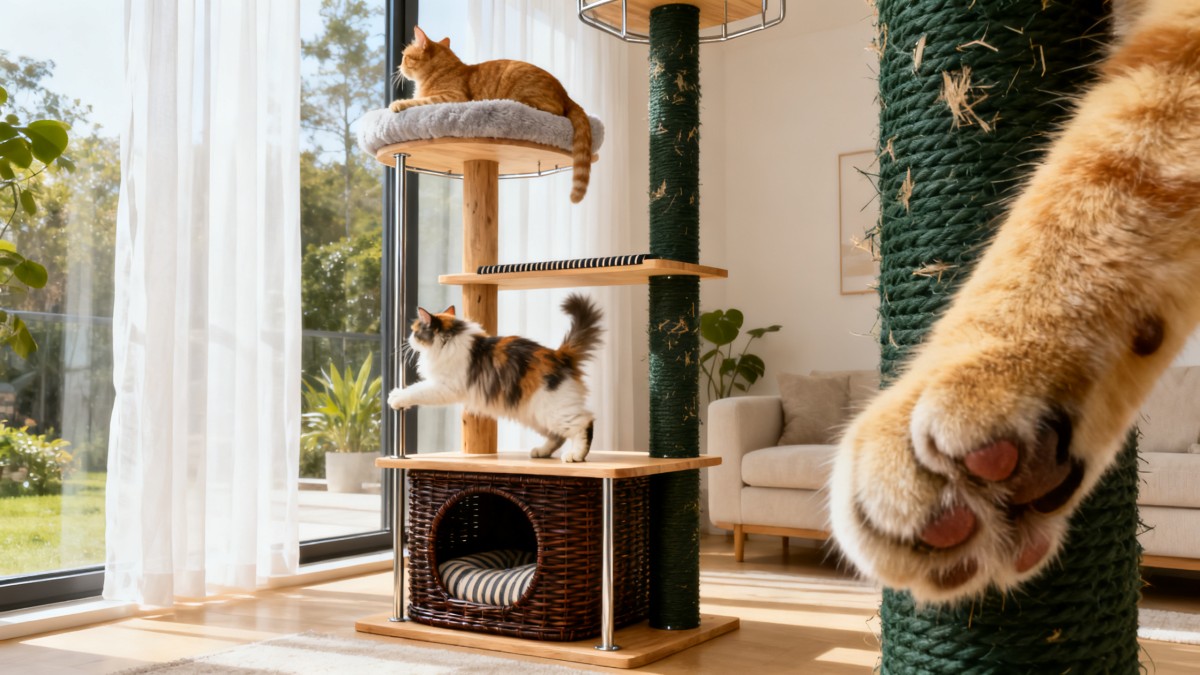
The best cattreesandtowers are not always the tallest or the most expensive.
They are the ones that match how your cat actually climbs, sleeps, scratches, and watches the room.
Some cats love height and want a top perch near a window.
Others prefer enclosed condos, lower platforms, or wider steps that feel easier to trust.
Age also changes what to compare before you buy.
Kittens usually enjoy vertical play and hanging toys.
Senior cats often need shorter jumps, softer surfaces, and stable access points.
If you share your home with more than one cat, compare platform spacing and traffic flow.
Good cattreesandtowers give each cat a place to perch without crowding the others.
Quick behavior checklist
- Climber or ground-level lounger
- Heavy scratcher or occasional scratcher
- Needs hiding space or open view
- Young, active, senior, or larger breed
- Single-cat use or shared-cat use
Compare Size, Height, and Footprint
One common mistake is focusing only on appearance.
In real use, dimensions decide whether cattreesandtowers feel inviting or awkward.
Height matters if your cat likes to survey the room.
But footprint matters just as much, especially in apartments, bedrooms, or tighter corners.
Check the base width carefully.
A narrow base under a tall tower can look sleek online but wobble during active play.
Also compare perch size.
Many stylish cattreesandtowers have platforms that are too small for large cats to rest comfortably.
If your cat hangs off the edge, that top level may become decoration instead of a favorite spot.
What to measure first
- Ceiling clearance for taller models
- Open floor area around the base
- Platform width for your cat’s body size
- Jump distance between levels
- Access to windows, walls, or furniture nearby
Stability Is More Important Than Extra Features
If cattreesandtowers feel unstable, cats notice immediately.
Even a small shake can make a perch less attractive.
That is why stability should come before toys, color, or fancy shapes.
Look for a heavy base, thick support posts, and strong connections between levels.
Engineered wood can work well when hardware is solid and assembly is tight.
Solid wood often feels sturdier, but it usually costs more and weighs more too.
For larger cats, this trade-off is often worth it.
Wall-anchoring options are another smart detail.
They matter even more in homes with children, energetic pets, or slippery floors.
Warning signs to avoid
- Very tall frame with a small base
- Thin posts on upper levels
- Loose bolts after light use
- Weak particle board smell or crumbling edges
- Reviews mentioning tipping or shaking
Materials, Scratching Surfaces, and Cleaning Needs
Materials shape both durability and day-to-day maintenance.
When comparing cattreesandtowers, pay close attention to fabric, post wrap, and board quality.
Plush fabric feels cozy, but it can trap fur and show wear faster.
Tighter woven covers are usually easier to vacuum and keep looking fresh.
Sisal remains one of the most practical scratching materials.
It gives cats a satisfying grip and tends to last longer than thin carpet wrap.
Try to compare how much scratching area is actually usable.
Some cattreesandtowers advertise several posts, but only one is tall enough for a full-body stretch.
That matters more than the post count alone.
Easy-care material priorities
- Dense sisal for regular scratching
- Low-shed surface covering
- Wipeable boards or removable pads
- Low-odor materials after unpacking
- Spare parts or replaceable posts when available
Check the Layout, Not Just the Feature List
A long feature list does not automatically mean better cattreesandtowers.
The smarter question is how the layout works in motion.
Cats move through furniture in quick, instinctive ways.
If the route upward is awkward, certain levels may never get used.
Look for step-like progression between platforms.
That makes climbing easier and reduces risky jumps.
Enclosed condos should be big enough to turn around in comfortably.
Hammocks should support your cat’s weight without sagging too close to the frame.
Top perches should feel protected, not exposed and slippery.
Well-designed cattreesandtowers create a natural path from scratch zone to perch to rest zone.
Think About Your Home as Much as the Product
A good buying decision connects the product to the room.
That is especially true for cattreesandtowers, because placement affects daily use.
A tower near a window often gets more attention.
A unit near the social center of the home can also work well for cats that like company.
On the other hand, nervous cats may prefer a quieter corner with less foot traffic.
Color and finish matter too, but mostly after function is covered.
Many people now want cattreesandtowers that blend into living rooms instead of looking overly bulky or playful.
That is a reasonable goal, as long as design does not weaken structure.
Best placement questions
- Will the tower block walkways or doors?
- Does your cat prefer sun, privacy, or activity?
- Is there enough room for safe jumping?
- Will fur cleanup be manageable in that spot?
- Does the finish match your furniture well enough?
Use Price as a Value Filter, Not the Main Decision Tool
Price matters, but cheap cattreesandtowers can become expensive if they wear out fast.
A lower upfront cost may mean weaker hardware, thinner sisal, or smaller resting areas.
A mid-range model often gives the best balance of stability, comfort, and usable features.
When comparing options, think in terms of cost per year, not just purchase price.
Also check assembly time, spare hardware, warranty support, and return terms.
These details often reveal whether a brand expects long-term satisfaction or quick replacement.
Simple comparison table
Final Buying Priorities That Make the Decision Easier
If you feel stuck between several cattreesandtowers, simplify the choice.
Start with safety, then comfort, then usability, and only then style.
That order helps cut through marketing noise quickly.
The strongest options usually share a few things.
They feel solid, offer real scratching value, fit your space, and support natural cat behavior.
In other words, the right cattreesandtowers do more than fill a corner.
They create a trusted place for climbing, observing, stretching, and resting every day.
Before buying, narrow your shortlist to two or three models.
Then compare base size, post thickness, perch dimensions, and cleaning effort side by side.
That quick review usually makes the best choice much clearer.
When cattreesandtowers match your cat’s habits and your home’s layout, the result feels right almost immediately.
News Recommendations
 Which consumer goods need CE marking in Europe?
![51a6ab95581761cc26f4318be6520c15]()
Aris Katos
Future of Carbide Coatings
 Uniguest and Extreme Networks Partner to Simplify Digital Signage Deployment
![51a6ab95581761cc26f4318be6520c15]()
Aris Katos
Future of Carbide Coatings
 How to assess electronics compliance whitepapers for regulatory accuracy
![51a6ab95581761cc26f4318be6520c15]()
Aris Katos
Future of Carbide Coatings
 Packaging Data Hub Launches With Plastic Recycling Findings for 50 Countries
![51a6ab95581761cc26f4318be6520c15]()
Aris Katos
Future of Carbide Coatings
 How to verify an ergonomic office chair supplier's warranty terms
![51a6ab95581761cc26f4318be6520c15]()
Aris Katos
Future of Carbide Coatings
 Curion Survey: 64% Value Sustainable Beauty Packaging, but Quality Comes First
![51a6ab95581761cc26f4318be6520c15]()
Aris Katos
Future of Carbide Coatings
 Can minimalist fit out solutions make a small office feel larger?
![51a6ab95581761cc26f4318be6520c15]()
Aris Katos
Future of Carbide Coatings
 Kiosk Industry Releases IAAPA 2026 Self-Service Guide
![51a6ab95581761cc26f4318be6520c15]()
Aris Katos
Future of Carbide Coatings
 How to improve global supply chain visibility beyond tier-one suppliers
![51a6ab95581761cc26f4318be6520c15]()
Aris Katos
Future of Carbide Coatings
 Austria’s MM Group to Sell 70% of Packaging Business to KPS for $2.7 Billion
![51a6ab95581761cc26f4318be6520c15]()
Aris Katos
Future of Carbide Coatings
 How to assess delivery reliability of airport terminal seating suppliers in Europe
![51a6ab95581761cc26f4318be6520c15]()
Aris Katos
Future of Carbide Coatings
 USTR Extends China-Linked Vessel Fee Pause and 178 Product Exemptions to January 2027
![51a6ab95581761cc26f4318be6520c15]()
Aris Katos
Future of Carbide Coatings
 How to choose smart sensors for automated lighting
![51a6ab95581761cc26f4318be6520c15]()
Aris Katos
Future of Carbide Coatings
 Shanghai Retail Buyers Sign Deals at Ninth China International Import Expo
![51a6ab95581761cc26f4318be6520c15]()
Aris Katos
Future of Carbide Coatings
 Which toys are subject to EN 71 toy safety requirements?
![51a6ab95581761cc26f4318be6520c15]()
Aris Katos
Future of Carbide Coatings
 Report: Global Kraft Paper Market Forecast to Reach $20.5 Billion by 2033
![51a6ab95581761cc26f4318be6520c15]()
Aris Katos
Future of Carbide Coatings
 How to verify Zigbee compatibility when sourcing lighting sensors
![51a6ab95581761cc26f4318be6520c15]()
Aris Katos
Future of Carbide Coatings
 How do packaging customization options affect minimum order quantities in Europe?
![51a6ab95581761cc26f4318be6520c15]()
Aris Katos
Future of Carbide Coatings
 Transom to Acquire Cree LED in Commercial Lighting Ownership Change
![51a6ab95581761cc26f4318be6520c15]()
Aris Katos
Future of Carbide Coatings
 How to plan customer flow in commercial design planning
![51a6ab95581761cc26f4318be6520c15]()
Aris Katos
Future of Carbide Coatings
 USTR Urged to Permanently Suspend Fees on China-Linked Ships
![51a6ab95581761cc26f4318be6520c15]()
Aris Katos
Future of Carbide Coatings
 How to choose comparable stores for retail benchmarking
![51a6ab95581761cc26f4318be6520c15]()
Aris Katos
Future of Carbide Coatings
 How does anchoring affect modular building wind load resistance?
![51a6ab95581761cc26f4318be6520c15]()
Aris Katos
Future of Carbide Coatings
 Amazon Raises European FBA Surcharge to 2% in Ten Markets From November 2
![51a6ab95581761cc26f4318be6520c15]()
Aris Katos
Future of Carbide Coatings
 How to verify a BPA-free test report for baby products
![51a6ab95581761cc26f4318be6520c15]()
Aris Katos
Future of Carbide Coatings
 China's Mandatory Classroom Lighting Standard GB 7793-2025 Takes Effect November 1
![51a6ab95581761cc26f4318be6520c15]()
Aris Katos
Future of Carbide Coatings
 How order volume affects the price of wholesale poly mailers
![51a6ab95581761cc26f4318be6520c15]()
Aris Katos
Future of Carbide Coatings
 US Imposes 50% Tariff on Certain Canadian PET Resin Imports
![51a6ab95581761cc26f4318be6520c15]()
Aris Katos
Future of Carbide Coatings
 How to read the maximum ratings in a semiconductor datasheet
![51a6ab95581761cc26f4318be6520c15]()
Aris Katos
Future of Carbide Coatings
 University of Maryland Develops Bio-Based Packaging to Extend Avocado and Cucumber Shelf Life
![51a6ab95581761cc26f4318be6520c15]()
Aris Katos
Future of Carbide Coatings
 How to verify a cookware manufacturer's induction compatibility claims
![51a6ab95581761cc26f4318be6520c15]()
Aris Katos
Future of Carbide Coatings
 Omdia Forecasts 11.6% Annual Growth in LED Display Revenue Through 2030
![51a6ab95581761cc26f4318be6520c15]()
Aris Katos
Future of Carbide Coatings
 How to verify a pulp molding packaging factory's production capacity
![51a6ab95581761cc26f4318be6520c15]()
Aris Katos
Future of Carbide Coatings
 Curion Survey: Half of Consumers Frustrated by Sustainable Packaging
![51a6ab95581761cc26f4318be6520c15]()
Aris Katos
Future of Carbide Coatings
 How to assess the credibility of market insight content
![51a6ab95581761cc26f4318be6520c15]()
Aris Katos
Future of Carbide Coatings
 US Removes 50% Additional Tariff on Selected Canadian Packaging Products
![51a6ab95581761cc26f4318be6520c15]()
Aris Katos
Future of Carbide Coatings
 Will a waterproof dimmable LED driver work with your existing dimmer?
![51a6ab95581761cc26f4318be6520c15]()
Aris Katos
Future of Carbide Coatings
 Charter Next Generation Raises Film PCR Use 30%, Advances Food-Grade Applications
![51a6ab95581761cc26f4318be6520c15]()
Aris Katos
Future of Carbide Coatings
 How to choose a dog harness and leash for a dog that pulls hard
![51a6ab95581761cc26f4318be6520c15]()
Aris Katos
Future of Carbide Coatings