How to Compare Ergonomic Desk Supplier Options for Long-Term Workplace Comfort
Time
Click Count
Choosing the right ergonomic desk supplier is not just about price or product range—it is a long-term investment in workplace comfort, employee well-being, and operational consistency. For procurement professionals, comparing suppliers requires a close look at quality standards, customization capability, compliance, supply chain reliability, and after-sales support to ensure every purchasing decision delivers lasting value.
Why supplier comparison is changing in today’s workplace market
The way buyers evaluate an ergonomic desk supplier has shifted significantly over the past few years. Procurement teams are no longer comparing desks as isolated furniture items. They are assessing how a supplier supports broader workplace goals: hybrid work adaptation, employee retention, sustainability commitments, digital facility planning, and consistent global rollout standards. In other words, the desk is now part of a larger performance system.
This change matters because workplace comfort has moved from a soft benefit to an operational concern. Long hours of seated work, growing awareness of musculoskeletal health, and the expectation of adjustable workstations have made ergonomic solutions more strategic. As a result, the best ergonomic desk supplier is often not the one with the cheapest unit cost, but the one that can deliver verified quality, stable lead times, support at scale, and lifecycle value.
For sourcing teams in commercial, institutional, and multi-site office environments, supplier evaluation now sits at the intersection of furniture performance, compliance, and risk management. This is especially relevant for organizations with expansion plans, renovation cycles, or international procurement requirements.
Key market signals influencing every ergonomic desk supplier review
Several visible signals are reshaping how buyers compare supplier options. First, adjustable desk demand has become more mainstream, which means more vendors can offer similar-looking products. That increases the importance of technical benchmarking rather than visual comparison alone. Second, buyers are paying closer attention to testing standards such as BIFMA, electrical safety compliance, and long-term durability under commercial use conditions.
Third, workplace projects are increasingly linked to ESG and material transparency goals. Procurement professionals often need to ask not only how a desk performs, but what it is made from, how packaging is handled, and whether documentation supports sustainable purchasing policies. Fourth, global supply chain volatility has changed expectations around inventory strategy, component sourcing, and replacement-part continuity. A capable ergonomic desk supplier must now prove resilience, not just catalog depth.
Finally, buyers are becoming more sensitive to user experience after installation. Noise levels, lifting speed, collision detection, cable management, and compatibility with monitor arms or office power systems all affect adoption and satisfaction. Procurement teams that once focused mostly on quotation comparison are now reviewing real usage outcomes more carefully.
The table above shows why a modern ergonomic desk supplier comparison cannot rely on a simple price sheet. Procurement decisions increasingly depend on whether a supplier can align with changing workplace and business requirements.
The drivers behind this shift are operational, not just aesthetic
It is easy to assume that ergonomic desk demand is rising because offices want a more modern image. In reality, the stronger driver is operational efficiency. Organizations are under pressure to create work environments that support productivity while reducing avoidable friction. If desks wobble, fail electronically, arrive late, or cannot integrate with IT and cable systems, the cost appears later through complaints, rework, and fragmented maintenance.
Another important driver is standardization across multiple sites. Buyers managing regional offices, coworking spaces, educational environments, or enterprise fit-outs often need a repeatable product platform. They are looking for an ergonomic desk supplier that can maintain finish consistency, dimensional accuracy, and accessory compatibility over time. This is particularly relevant when procurement cycles stretch across phases rather than a single purchase event.
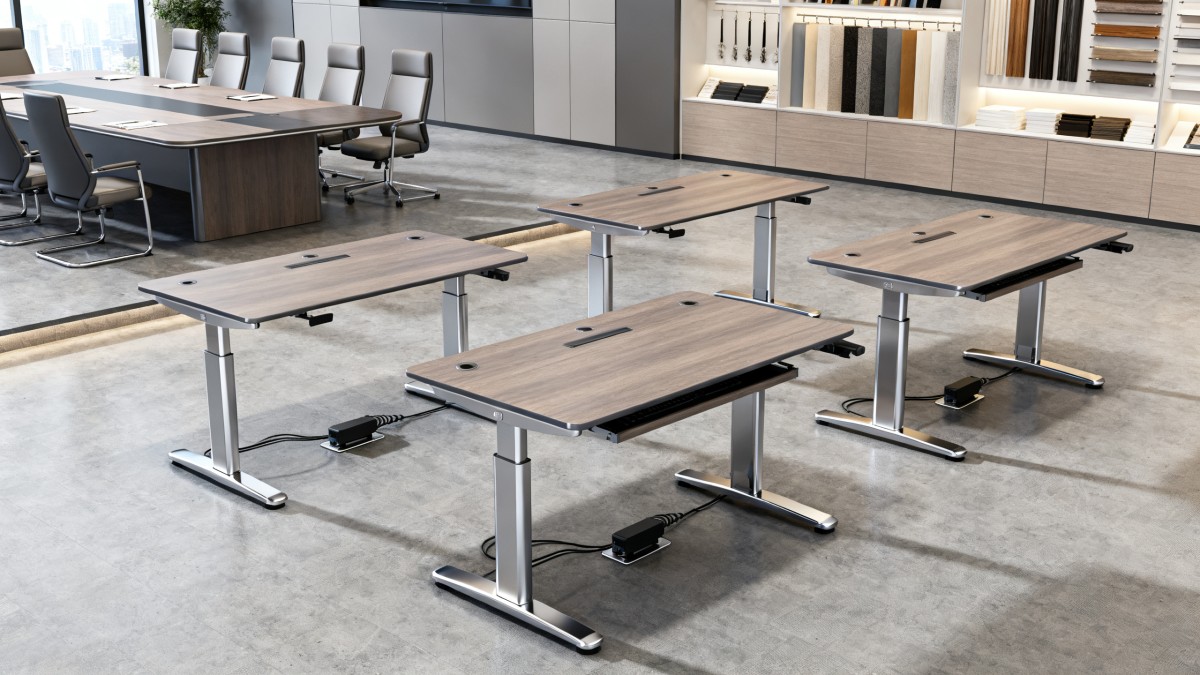
Technology is also influencing expectations. Electrically adjustable desks now involve motors, control boxes, anti-collision systems, and memory presets. That means supplier assessment overlaps with light industrial product evaluation. Technical reliability, warranty handling, and replacement logistics become central factors rather than secondary concerns.
What procurement teams should compare beyond basic product specifications
When many suppliers offer similar lifting ranges, frame colors, and desktop finishes, procurement teams need better comparison criteria. A high-quality ergonomic desk supplier should be evaluated across six dimensions.
1. Commercial-grade stability and durability
Commercial buyers should verify frame stability at standing height, motor lifecycle expectations, weight capacity under realistic load, and wear performance for high-frequency use. A desk that looks acceptable in a showroom may perform poorly in dense office deployment. Product testing records and third-party certifications are useful signals here.
2. Compliance depth
Not all certifications carry the same value. Buyers should confirm whether the ergonomic desk supplier can provide documentation relevant to destination markets, including furniture standards, electrical safety, emissions requirements, and material declarations where needed. The ability to respond quickly to compliance checks is often a practical advantage.
3. Customization and project fit
Workplace projects rarely fit a standard catalog perfectly. Teams may need custom sizes, branding colors, specific cable trays, modesty panels, or integration with acoustic and storage systems. A capable ergonomic desk supplier should show design flexibility without losing production discipline.
4. Supply chain visibility
Procurement professionals increasingly ask where components come from, what lead-time assumptions are realistic, and how spare parts are stocked. This is especially important for sit-stand desks with electrical parts. A supplier that lacks transparency may create hidden risk later.
5. Installation and after-sales support
A strong ergonomic desk supplier does more than ship cartons. Buyers should review assembly clarity, installation coordination, replacement-part response, technical troubleshooting, and warranty workflow. These details influence project speed and user satisfaction after handover.
6. Total cost over the product lifecycle
The cheapest quote can become expensive if the product fails early, requires frequent service, or causes workspace inconsistency. Procurement teams should compare not just unit cost, but lifecycle cost, support burden, and upgrade compatibility.
How these changes affect different stakeholders in the buying chain
The impact of supplier quality is not limited to purchasing departments. The choice of ergonomic desk supplier affects multiple roles across a project and across the workplace lifecycle.
This broader impact is why procurement should treat ergonomic desk supplier selection as a cross-functional decision. If one stakeholder is ignored, hidden costs usually appear later.
Signals that an ergonomic desk supplier is aligned with long-term market direction
In a crowded market, buyers need practical signs of future readiness. One useful signal is whether the supplier can explain product evolution clearly: frame improvements, control upgrades, packaging changes, or sustainability initiatives. Another is whether they support data-backed comparison instead of relying only on visual brochures.
Suppliers aligned with long-term market direction also tend to show stronger documentation discipline. They can provide specification sheets, testing records, material information, maintenance guidance, and coordinated support during bidding or rollout. This level of readiness suggests internal process maturity, which often translates into more dependable execution.
A further signal is the ability to support different application scenarios without losing consistency. For example, a supplier that can serve executive offices, open-plan workstations, project rooms, and reception-adjacent touchdown spaces with a coherent product family may be more valuable than one offering only isolated desk models.
Common evaluation mistakes in a fast-growing supplier landscape
As more manufacturers and trading companies enter the adjustable desk category, comparison mistakes become more common. One frequent error is assuming that similar appearance means similar engineering quality. Another is overvaluing short-term discounts without checking electrical component origin, testing validity, or service readiness.
Procurement teams may also underestimate the importance of post-installation support. A supplier with weak replacement procedures can create significant disruption, especially across multiple office locations. In addition, some buyers fail to ask whether the ergonomic desk supplier can maintain the same product specification six to twelve months later for phased orders. This becomes a serious issue in staged fit-out programs.
Another mistake is separating ergonomic furniture evaluation from the wider commercial environment. Desks interact with chairs, lighting, monitor arms, cable systems, power access, and user behavior. A supplier that understands this ecosystem often brings more value than one focused only on a standalone desk sale.
A practical decision framework for upcoming supplier reviews
For the next sourcing cycle, procurement teams can use a staged comparison method. Start by screening for baseline compliance, commercial durability, and delivery capacity. Then move to project-fit questions such as customization, accessory integration, and documentation quality. Finally, assess long-term partnership indicators including service process, spare-part continuity, and roadmap stability.
This approach reduces the chance of selecting an ergonomic desk supplier based on surface-level criteria. It also supports better internal alignment because each evaluation stage links to a specific risk area: technical, operational, financial, and user-experience related.
If possible, request pilot installations or sample evaluations under real office conditions. Observing noise, stability, control responsiveness, and finish quality in daily use often reveals more than a static product review. In a market shaped by both design expectations and operational pressure, evidence-based comparison is becoming the standard.
What to confirm before making a final sourcing decision
Before signing with any ergonomic desk supplier, procurement professionals should confirm several points: Are certifications relevant to your target market? Are motor systems and frames supported by a realistic warranty process? Can the supplier handle repeat orders without changing key specifications? Is there a clear plan for packaging, installation, and replacement parts? Can the supplier support sustainability reporting or internal procurement compliance requirements?
These questions reflect the current direction of the market. Buyers are no longer simply purchasing office desks; they are selecting partners that influence workplace performance over years, not months. In that context, a strong ergonomic desk supplier is one that combines manufacturing precision, technical transparency, and dependable support across the full commercial lifecycle.
If your organization wants to better judge how these trends affect its own sourcing strategy, focus first on three areas: what level of ergonomic performance your users truly need, how much supply continuity matters across project phases, and which compliance or sustainability requirements are becoming non-negotiable. Those answers will make the supplier comparison process more accurate, more strategic, and more resilient.
News Recommendations
 How to assess electronics compliance whitepapers for regulatory accuracy
![51a6ab95581761cc26f4318be6520c15]()
Aris Katos
Future of Carbide Coatings
 Packaging Data Hub Launches With Plastic Recycling Findings for 50 Countries
![51a6ab95581761cc26f4318be6520c15]()
Aris Katos
Future of Carbide Coatings
 How to verify an ergonomic office chair supplier's warranty terms
![51a6ab95581761cc26f4318be6520c15]()
Aris Katos
Future of Carbide Coatings
 Curion Survey: 64% Value Sustainable Beauty Packaging, but Quality Comes First
![51a6ab95581761cc26f4318be6520c15]()
Aris Katos
Future of Carbide Coatings
 Can minimalist fit out solutions make a small office feel larger?
![51a6ab95581761cc26f4318be6520c15]()
Aris Katos
Future of Carbide Coatings
 Kiosk Industry Releases IAAPA 2026 Self-Service Guide
![51a6ab95581761cc26f4318be6520c15]()
Aris Katos
Future of Carbide Coatings
 How to improve global supply chain visibility beyond tier-one suppliers
![51a6ab95581761cc26f4318be6520c15]()
Aris Katos
Future of Carbide Coatings
 Austria’s MM Group to Sell 70% of Packaging Business to KPS for $2.7 Billion
![51a6ab95581761cc26f4318be6520c15]()
Aris Katos
Future of Carbide Coatings
 How to assess delivery reliability of airport terminal seating suppliers in Europe
![51a6ab95581761cc26f4318be6520c15]()
Aris Katos
Future of Carbide Coatings
 USTR Extends China-Linked Vessel Fee Pause and 178 Product Exemptions to January 2027
![51a6ab95581761cc26f4318be6520c15]()
Aris Katos
Future of Carbide Coatings
 How to choose smart sensors for automated lighting
![51a6ab95581761cc26f4318be6520c15]()
Aris Katos
Future of Carbide Coatings
 Shanghai Retail Buyers Sign Deals at Ninth China International Import Expo
![51a6ab95581761cc26f4318be6520c15]()
Aris Katos
Future of Carbide Coatings
 Which toys are subject to EN 71 toy safety requirements?
![51a6ab95581761cc26f4318be6520c15]()
Aris Katos
Future of Carbide Coatings
 Report: Global Kraft Paper Market Forecast to Reach $20.5 Billion by 2033
![51a6ab95581761cc26f4318be6520c15]()
Aris Katos
Future of Carbide Coatings
 How to verify Zigbee compatibility when sourcing lighting sensors
![51a6ab95581761cc26f4318be6520c15]()
Aris Katos
Future of Carbide Coatings
 How do packaging customization options affect minimum order quantities in Europe?
![51a6ab95581761cc26f4318be6520c15]()
Aris Katos
Future of Carbide Coatings
 Transom to Acquire Cree LED in Commercial Lighting Ownership Change
![51a6ab95581761cc26f4318be6520c15]()
Aris Katos
Future of Carbide Coatings
 How to plan customer flow in commercial design planning
![51a6ab95581761cc26f4318be6520c15]()
Aris Katos
Future of Carbide Coatings
 USTR Urged to Permanently Suspend Fees on China-Linked Ships
![51a6ab95581761cc26f4318be6520c15]()
Aris Katos
Future of Carbide Coatings
 How to choose comparable stores for retail benchmarking
![51a6ab95581761cc26f4318be6520c15]()
Aris Katos
Future of Carbide Coatings
 How does anchoring affect modular building wind load resistance?
![51a6ab95581761cc26f4318be6520c15]()
Aris Katos
Future of Carbide Coatings
 Amazon Raises European FBA Surcharge to 2% in Ten Markets From November 2
![51a6ab95581761cc26f4318be6520c15]()
Aris Katos
Future of Carbide Coatings
 How to verify a BPA-free test report for baby products
![51a6ab95581761cc26f4318be6520c15]()
Aris Katos
Future of Carbide Coatings
 China's Mandatory Classroom Lighting Standard GB 7793-2025 Takes Effect November 1
![51a6ab95581761cc26f4318be6520c15]()
Aris Katos
Future of Carbide Coatings
 How order volume affects the price of wholesale poly mailers
![51a6ab95581761cc26f4318be6520c15]()
Aris Katos
Future of Carbide Coatings
 US Imposes 50% Tariff on Certain Canadian PET Resin Imports
![51a6ab95581761cc26f4318be6520c15]()
Aris Katos
Future of Carbide Coatings
 How to read the maximum ratings in a semiconductor datasheet
![51a6ab95581761cc26f4318be6520c15]()
Aris Katos
Future of Carbide Coatings
 University of Maryland Develops Bio-Based Packaging to Extend Avocado and Cucumber Shelf Life
![51a6ab95581761cc26f4318be6520c15]()
Aris Katos
Future of Carbide Coatings
 How to verify a cookware manufacturer's induction compatibility claims
![51a6ab95581761cc26f4318be6520c15]()
Aris Katos
Future of Carbide Coatings
 Omdia Forecasts 11.6% Annual Growth in LED Display Revenue Through 2030
![51a6ab95581761cc26f4318be6520c15]()
Aris Katos
Future of Carbide Coatings
 How to verify a pulp molding packaging factory's production capacity
![51a6ab95581761cc26f4318be6520c15]()
Aris Katos
Future of Carbide Coatings
 Curion Survey: Half of Consumers Frustrated by Sustainable Packaging
![51a6ab95581761cc26f4318be6520c15]()
Aris Katos
Future of Carbide Coatings
 How to assess the credibility of market insight content
![51a6ab95581761cc26f4318be6520c15]()
Aris Katos
Future of Carbide Coatings
 US Removes 50% Additional Tariff on Selected Canadian Packaging Products
![51a6ab95581761cc26f4318be6520c15]()
Aris Katos
Future of Carbide Coatings
 Will a waterproof dimmable LED driver work with your existing dimmer?
![51a6ab95581761cc26f4318be6520c15]()
Aris Katos
Future of Carbide Coatings
 Charter Next Generation Raises Film PCR Use 30%, Advances Food-Grade Applications
![51a6ab95581761cc26f4318be6520c15]()
Aris Katos
Future of Carbide Coatings
 How to choose a dog harness and leash for a dog that pulls hard
![51a6ab95581761cc26f4318be6520c15]()
Aris Katos
Future of Carbide Coatings
 How to respect local customs when negotiating with overseas suppliers
![51a6ab95581761cc26f4318be6520c15]()
Aris Katos
Future of Carbide Coatings
 RFID Recycling Challenges Bring Paper-Based and Chipless Tags Into Focus
![51a6ab95581761cc26f4318be6520c15]()
Aris Katos
Future of Carbide Coatings